Coronary Revascularization: PCI vs. Bypass Surgery, Risks and Recovery

Updated: 6 days ago
Written and medically reviewed by Dr. Baraa Alnahhal, MD · Last reviewed: October 2026 · How we review
Quick Answer: What is coronary revascularization?
Coronary revascularization is a group of treatments that restore blood flow to heart muscle that lacks enough blood. The two main options are percutaneous coronary intervention, which opens a narrowed artery from inside with a balloon or stent, and bypass surgery, which reroutes blood around a blockage. Fast treatment during a heart attack can limit permanent damage. [1]
What the research says
Opening arteries early did not beat medicines alone for stable heart disease. In a trial of 5,179 people with stable coronary disease and moderate or severe ischemia, the 5-year rate of heart events was 16.4% with an early procedure strategy and 18.2% with medicines first, which was not a meaningful difference; deaths were 145 vs. 144. (Maron et al., N Engl J Med, 2020) [2]
Bypass surgery lowered the risk of death compared with stents when several arteries were blocked. Pooled data from 11 trials (11,518 patients) showed 5-year death rates of 11.5% after PCI vs. 8.9% after CABG in multivessel disease, and 15.5% vs. 10.0% in people who also had diabetes; for left main artery disease, results were similar (10.7% vs. 10.5%). (Head et al., Lancet, 2018) [3]
Exercise-based cardiac rehab cut repeat heart attacks and hospital stays. A review of 85 trials (23,430 people, mostly after a heart attack or revascularization) found rehab lowered heart attack risk by 28% and all-cause hospital admissions by 42% over 6 to 12 months. (Dibben et al., Cochrane Database Syst Rev, 2021) [4]
Key takeaways
Revascularization treats ischemia, the damage that happens when heart muscle does not get enough blood.
PCI works from inside the artery through a thin tube; CABG is surgery that builds a new path around a blockage.
PCI recovery usually takes days. CABG recovery can take weeks or even months.
After any procedure, chest pain, shortness of breath, dizziness or fainting need prompt medical attention.
Why is coronary revascularization needed?
Coronary revascularization is needed when a heart artery is narrowed or blocked and part of the heart muscle stops getting enough blood. This lack of blood flow causes cell damage called ischemia. [1]
Ischemia usually comes from atherosclerosis. Plaque, a fat-like, waxy residue, builds up inside the heart's arteries and narrows them, much like grease clogging a drainpipe. [1]
If a patch of plaque breaks open, a blood clot can form on it. That clot can partly or fully block the artery. [1]
Heart muscle cells do not die right away, but severe or long-lasting ischemia kills them, and that damage is permanent. Restoring blood flow quickly can limit the damage or prevent it entirely. [1]
Learn how plaque develops in our coronary artery disease guide, and see how these vessels feed the heart in coronary arteries: the lifelines of the heart.
Who needs coronary revascularization?
Coronary revascularization can help anyone who has limited blood flow to part of the heart. Coronary artery disease is the most common cause of these blockages. [1]
Because this disease becomes more common with age and is tied to certain risk factors, these procedures are done most often in people over 65. [1]
Revascularization treats ischemia linked to these conditions: [1]
Condition | Learn more |
Heart attack | |
Stable angina | |
Unstable angina |
The goal can be treatment after a heart attack, or prevention when your risk of having one is high. [1]
What are the types of coronary revascularization?
The two main types of coronary revascularization are percutaneous coronary intervention (PCI) and coronary artery bypass grafting (CABG). Both aim to restore blood flow, but they take very different approaches. [1]
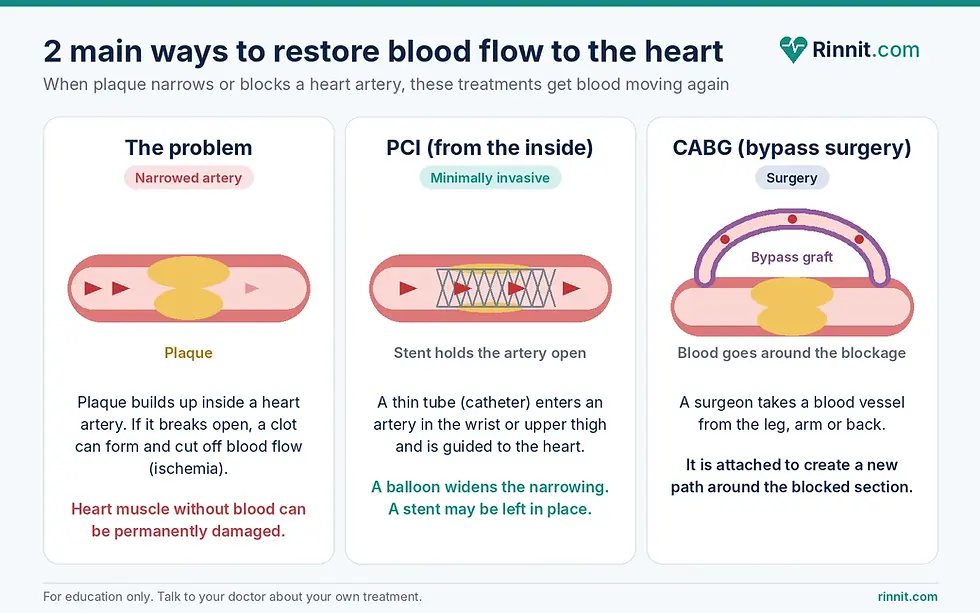
PCI vs. CABG at a glance
PCI | CABG | |
What it is | Minimally invasive procedure | Surgery |
How it works | Opens the narrowed artery from the inside | Creates a bypass around the blocked section |
Way in | Thin tube through a blood vessel in the wrist or upper thigh | Chest incision, or small cuts between the ribs (minimally invasive or robot-assisted) |
Sleep or sedation | Sedative to help you relax | General anesthesia (deep sleep) |
Hospital stay | Sometimes outpatient | Several days |
Recovery | Usually days | Weeks or even months |
How is percutaneous coronary intervention (PCI) done?
Percutaneous coronary intervention is done by passing a catheter, a hollow tube-like device, into a major blood vessel and steering it to the heart. The tube usually goes in at the wrist or upper thigh. [1]
The doctor may inject a special liquid that shows up on X-ray. This helps them see the blockage and plan how to open it. [1]

Depending on your needs, one or more of these techniques are used: [1]
Balloon angioplasty. A balloon on the tip of the catheter inflates inside the narrowed area to widen it.
Stenting. A stent is a support framework that keeps the narrowed area open. It can be bare metal or coated with a medicine that slowly releases to stop the artery from narrowing again.
Brachytherapy. Radiation is applied from inside the blood vessel to stop narrowing from coming back after procedures like stenting. It is mainly a cancer treatment but also useful here.
When the artery is open, the catheter is removed and the entry site is stitched closed. [1]
How is coronary artery bypass grafting (CABG) done?
Coronary artery bypass grafting is done by taking a healthy blood vessel from another part of the body and using it to build a detour around a blocked artery. This "harvested" vessel can come from the leg, arm or back. [1]
The surgeon reaches the heart in one of two ways: [1]
Open surgery. An incision several inches long runs down the center of the chest. The breastbone is opened and the rib cage is separated to reach the heart.
Minimally invasive or robot-assisted surgery. One or more small cuts let special tools pass between the ribs. In robotic surgery, the surgeon drives robotic arms and watches through a small camera.
Sometimes the heart is stopped for a while and a heart-lung bypass machine takes over. It adds oxygen to the blood, removes carbon dioxide and keeps blood moving. Some people have off-pump surgery, where the heart keeps beating. [1]
After the bypass is attached, the chest is closed. With open surgery, the breastbone is wired together so it can heal. [1]
What other coronary revascularization techniques exist?
Two specialized coronary revascularization techniques can be used alongside PCI or CABG, or on their own, to improve the chance of success. [1]
Technique | What it involves | When it helps |
Total arterial revascularization | The bypass is built from an artery instead of a vein | Arteries tend to hold up better and have fewer of the common problems seen with vein grafts |
Transmyocardial laser revascularization (TMR) | A laser is fired into the heart muscle to improve blood flow and encourage new blood vessels | When other procedures are not an option or have not worked; sometimes added to CABG |
TMR has limits on when it is useful, so your care team decides whether it fits your case. [1]
How do you prepare for coronary revascularization?
You prepare for coronary revascularization with medical tests that help your care team plan the safest way to treat you. These can include one or more of the following: [1]
Test group | Tests |
Heart tests | Electrocardiogram (ECG or EKG), echocardiogram |
Artery imaging | Cardiac catheterization, X-ray angiography or CT angiography, coronary calcium scan |
Blood tests | Complete blood count, cardiac enzyme tests |
If the procedure is planned (not an emergency), you will need to fast. That usually means only clear liquids for at least eight hours before, and no liquids at all for at least two hours before. [1]
Right before the procedure, a nurse places an IV line, usually in your arm, to give fluids and medicines quickly. [1]
What are the benefits of coronary revascularization?
The main benefits of coronary revascularization are preventing heart attacks, saving lives during a heart attack and protecting heart function. [1]
Prevention. These procedures can often stop a heart attack from happening, especially when coronary artery disease is found before one occurs.
Life-saving potential. Revascularization is one of the treatments for a heart attack, which is a life-threatening emergency.
Protects the heart muscle. Heart cells do not die immediately during ischemia. Quick treatment can prevent permanent damage or make it less severe, so never delay care for a heart attack.
What are the risks of coronary revascularization?
The risks of coronary revascularization depend mostly on which procedure you have. [1]
Procedure | Main risks |
PCI | Damage to the heart or nearby blood vessels from the inside, which can cause irregular heart rhythms (arrhythmias), blood clots, stroke or bleeding |
CABG | Surgical risks, especially pain, bleeding and infection |
Your own risk also depends on your age, other health conditions, medical history and personal situation. Your doctor is the best person to explain what to expect in your case. [1]
How long is recovery after coronary revascularization?
Recovery after coronary revascularization usually takes days for PCI and weeks or even months for CABG. PCI is not major surgery and is sometimes done as an outpatient procedure, especially when it is planned. A CABG hospital stay may last several days. [1]

In general, the better your overall health, the shorter your hospital stay and the easier your recovery. [1]
Your doctor may recommend a cardiac rehabilitation program. The team often includes doctors, nurses, exercise physiologists, nutritionists and dietitians who teach you how to exercise and care for your heart as you return to daily life. [1]
You will also have follow-up visits and tests to check how your heart is working. Follow your doctor's advice on food, physical activity and medicines, and ask about anything you do not understand. After a stent, never stop your antiplatelet (blood-thinning) medicines early unless your cardiologist says so, because stopping can cause a clot inside the stent. [1]
When should you call a doctor after coronary revascularization?
If you notice symptoms like those of a heart attack after coronary revascularization, call 911 right away rather than waiting to reach your doctor. Watch for: [1]
Chest pain (angina)
Shortness of breath
Dizziness or feeling lightheaded
Fainting or passing out
Your doctor can tell you which warning signs matter most for your procedure. Knowing the signs in different people helps too; see heart attack symptoms in women vs. men.
Conclusion
Coronary revascularization restores blood flow to heart muscle that is starved of blood. PCI opens a narrowed artery from the inside with a balloon or stent and usually means a recovery of days. CABG builds a new path around a blockage and needs a longer recovery of weeks to months. [1]
Feeling worried about a heart procedure is normal. Understanding your options can ease that worry and help you focus on getting the care you need and getting back to your life. [1]
Next step: Save or print this guide and bring it to your next appointment so you can ask your doctor which procedure fits your heart and why. For the bigger picture, explore our heart disease guide.
FAQ
Is coronary revascularization the same as open-heart surgery?
No. PCI is a minimally invasive procedure done through a thin tube in a blood vessel. CABG is surgery and can be done through an open chest incision or through small cuts between the ribs. [1]
Will I be awake during the procedure?
For PCI, you usually get a sedative to help you relax. For CABG, you get general anesthesia, which puts you into a deep sleep. [1]
How long does it take to recover?
PCI recovery usually takes days, and the procedure is sometimes outpatient. CABG usually needs a hospital stay of several days, and recovery can take weeks or even months. [1]
Do I need to fast before the procedure?
For a planned procedure, yes. You usually stop all food except clear liquids at least eight hours before and stop all liquids at least two hours before. [1]
Is the heart stopped during bypass surgery?
Sometimes. The heart may be stopped while a heart-lung machine keeps blood moving. In off-pump surgery, the heart keeps beating. [1]
Can revascularization prevent a heart attack?
It often can, especially when coronary artery disease is found before a heart attack happens. [1]
What is the difference between PCI and CABG?
PCI opens a narrowed artery from the inside with a balloon and usually a stent, through a small tube placed in the wrist or groin. CABG is open surgery that uses a blood vessel from another part of the body to route blood around the blockage.
Will I need to take medicine after a stent or bypass?
Yes. Most people take medicines such as blood thinners and cholesterol-lowering drugs for a long time. Never stop your antiplatelet medicine early after a stent unless your cardiologist tells you to, because a clot can form in the stent.
Should I do cardiac rehab after revascularization?
Yes, cardiac rehab is often recommended after PCI or bypass surgery. It helps you rebuild strength safely and lowers the chance of another heart problem.
Can the arteries narrow again after PCI or CABG?
Yes, they can. Taking your medicines, not smoking, eating a heart-healthy diet and staying active help keep your arteries and grafts open.
Related Reading
Coronary Artery Bypass Graft (CABG) Surgery: Procedure and Recovery explains heart bypass surgery and recovery.
Fractional Flow Reserve (FFR): Deciding Whether You Need a Stent explains the pressure wire test that shows whether a blockage needs a stent.
Vein Mapping: Ultrasound Before Bypass Surgery or Dialysis Access explains the ultrasound that maps blood vessels before surgery or dialysis access.
Cardiac Catheterization (Heart Cath): Why It's Done, Procedure, Risks and Recovery explains the heart cath procedure used to diagnose and often treat this condition.
References
Cleveland Clinic. Coronary Revascularization: Procedure Details & Risks. Cleveland Clinic. Last updated January 24, 2023. https://my.clevelandclinic.org/health/treatments/24598-revascularization
Maron DJ, Hochman JS, Reynolds HR, et al. Initial invasive or conservative strategy for stable coronary disease. N Engl J Med. 2020;382(15):1395-1407. PMID 32227755. https://doi.org/10.1056/NEJMoa1915922
Head SJ, Milojevic M, Daemen J, et al. Mortality after coronary artery bypass grafting versus percutaneous coronary intervention with stenting for coronary artery disease: a pooled analysis of individual patient data. Lancet. 2018;391(10124):939-948. PMID 29478841. https://doi.org/10.1016/S0140-6736(18)30423-9
Dibben G, Faulkner J, Oldridge N, et al. Exercise-based cardiac rehabilitation for coronary heart disease. Cochrane Database Syst Rev. 2021;11(11):CD001800. PMID 34741536. https://doi.org/10.1002/14651858.CD001800.pub4
Disclaimer
This article is for general education and does not replace advice from your doctor. If you have chest pain or other heart attack symptoms, seek emergency care right away.



Comments