Vein Mapping: Ultrasound Before Bypass Surgery or Dialysis Access

Updated: 2 days ago
Written and medically reviewed by Dr. Baraa Alnahhal, MD · Last reviewed: November 2026 · How we review
Quick Answer
Vein mapping is a painless ultrasound test that creates a map of the arteries and veins, showing their size, blood flow and any blockages. It's most often done before surgery to find healthy blood vessels, such as before coronary artery bypass surgery or creating a dialysis access. It uses no needles, dye or radiation.
What the research says
Mapping lowers early fistula failure: a review of 5 randomized trials with 574 patients found routine ultrasound mapping before dialysis fistula surgery cut the odds of immediate fistula failure by about two-thirds (Georgiadis GS et al., European Journal of Vascular and Endovascular Surgery, 2015) [2]
Long-term benefit is less certain: a Cochrane review of 4 studies with 450 participants found no clear difference in how many fistulas matured or were used for dialysis with routine mapping, so more research is needed (Kosa SD et al., Cochrane Database of Systematic Reviews, 2015) [3]
Key takeaways
Vein mapping uses ultrasound to map your arteries and veins.
It's mainly used to plan bypass surgery or a dialysis fistula.
The test takes 30 to 90 minutes and is painless.
There are no needles, dyes, radiation or side effects.
Don't wash off any skin markings before your surgery.
What is vein mapping?
During surgery, surgeons sometimes need a healthy vein or artery, either to reroute blood around a blockage or to connect an artery and vein for dialysis. Vein mapping uses Doppler ultrasound to measure each vessel's size and blood flow, so the surgeon knows in advance which vessels will work best. It's also called a duplex study or vascular ultrasound. Sources: [1]
Why it's done

Mapping helps surgeons choose the best blood vessels.
Reason | What the map shows |
Before coronary artery bypass | A healthy leg or arm vein to use as a graft |
Before dialysis access | An artery and vein that can be joined into a fistula |
Before peripheral artery bypass | A healthy vessel to bypass a blocked artery |
Diagnosis | Signs of atherosclerosis or deep vein thrombosis |
Sources: [1]
How to prepare
No special preparation is needed.
Eat, drink and take your medicines as usual.
Wear comfortable clothes; you may change into a gown.
Remove jewelry from the area being checked. Sources: [1]
What happens during the test

The test takes 30 to 90 minutes.
You lie on a padded exam table.
A technologist spreads water-based gel on your skin.
A handheld transducer is moved over your arms or legs to record images and blood flow.
The size and path of suitable vessels are measured.
If surgery is planned, your skin may be marked with a pen. Don't wash these marks off. Sources: [1]
Risks
Vein mapping has no harmful side effects. It's noninvasive and painless, with no needles, dyes, anesthesia, incisions or radiation. Afterward, the gel is wiped off and you can go home or back to work. Sources: [1]
Results
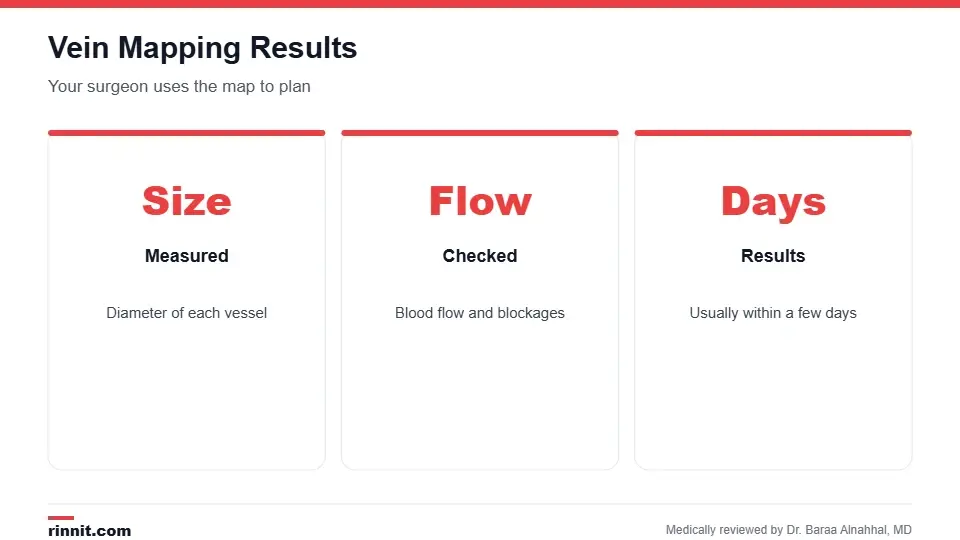
Your surgeon uses the map to plan your procedure.
A vascular medicine physician reviews the images and sends the results to your provider, usually within a few days, or right away if they're urgent. The map helps your surgeon choose vessels and plan the procedure. Sources: [1, 2, 3]
Conclusion
Vein mapping is a simple, safe ultrasound that gives your surgeon a detailed guide to your blood vessels. It helps choose the best vessels for bypass surgery or dialysis access, with no discomfort or recovery time.
Keep learning: read about vascular ultrasound and Doppler ultrasound.
Frequently asked questions
What is vein mapping?
An ultrasound that maps the size and blood flow of your arteries and veins.
Why is vein mapping done before dialysis?
To find an artery and vein that can be joined into a fistula.
Why is it done before bypass surgery?
To find a healthy vein or artery to use as a graft.
Does vein mapping hurt?
No. It's painless.
How long does it take?
About 30 to 90 minutes.
Do I need to prepare?
No special preparation is needed.
Are there side effects?
No. There are no needles, dyes or radiation.
What are the pen marks for?
They show your surgeon where suitable vessels are; don't wash them off.
Who reads the results?
A vascular medicine physician.
When will I get results?
Usually within a few days.
Related Reading
Vascular Ultrasound: How It Checks Blood Flow, What It Finds and What to Expect an overview of blood vessel ultrasound.
Doppler Ultrasound: How It Works, Types, Uses and Results the ultrasound method that measures blood flow.
Venous Extremity Ultrasound: Checking Arm and Leg Veins for Blood Clots ultrasound of arm and leg veins.
Coronary Revascularization: PCI vs. Bypass Surgery, Risks and Recovery bypass surgery that may use a mapped vein.
Peripheral Artery Bypass: Restoring Blood Flow to the Limbs leg bypass surgery planned with mapping.
References
Cleveland Clinic. Vein Mapping: Ultrasound Procedure and Results. Cleveland Clinic. Last updated July 25, 2022. https://my.clevelandclinic.org/health/diagnostics/17607-arterial--venous-mapping
Georgiadis GS, Charalampidis DG, Argyriou C, et al. The necessity for routine pre-operative ultrasound mapping before arteriovenous fistula creation: a meta-analysis. European Journal of Vascular and Endovascular Surgery. 2015;49(5):600-605. PMID 25736517. https://doi.org/10.1016/j.ejvs.2015.01.012
Kosa SD, Al-Jaishi AA, Moist L, et al. Preoperative vascular access evaluation for haemodialysis patients. Cochrane Database of Systematic Reviews. 2015;(9):CD007013. PMID 26418347. https://doi.org/10.1002/14651858.CD007013.pub2
Medical disclaimer
This article is for general education only and does not replace advice from a qualified healthcare professional. Talk to your doctor about your own diagnosis and treatment, and seek emergency care right away for severe or sudden symptoms.



Comments