Venous Extremity Ultrasound: Checking Arm and Leg Veins for Blood Clots

Updated: 2 days ago
Written and medically reviewed by Dr. Baraa Alnahhal, MD · Last reviewed: November 2026 · How we review
Quick Answer
A venous extremity ultrasound uses sound waves to look at the veins in the arms or legs, mainly to check for blood clots such as deep vein thrombosis (DVT). It uses no radiation or needles and takes about an hour. If a clot is found, treatment with blood thinners usually starts right away.
What the research says
A negative whole-leg ultrasound is reassuring: a meta-analysis of 7 studies with 4,731 people with suspected leg DVT and a negative whole-leg ultrasound who didn't receive blood thinners found only 0.57% had a blood clot event in the next 3 months (Johnson SA et al., JAMA, 2010) [2]
Different scanning strategies are similarly safe: a meta-analysis of 40 studies with 21,250 people found clot rates after a negative scan of 1.0% for whole-leg ultrasound and 1.4–1.9% for limited or repeated scans of the thigh and knee veins (Kraaijpoel N et al., PLoS One, 2020) [3]
Key takeaways
Checks arm or leg veins for blood clots, mainly DVT.
A vein that won't compress under the probe suggests a clot.
No radiation, needles or side effects; about 60 minutes.
Usually no preparation; results within about 24 hours.
A negative result makes a clot very unlikely.
What is a venous extremity ultrasound?
This is a type of vascular ultrasound focused on the veins. It combines regular ultrasound images with Doppler ultrasound, which shows the direction and speed of blood flow. The technologist checks one or both arms or legs, depending on your symptoms. Sources: [1]
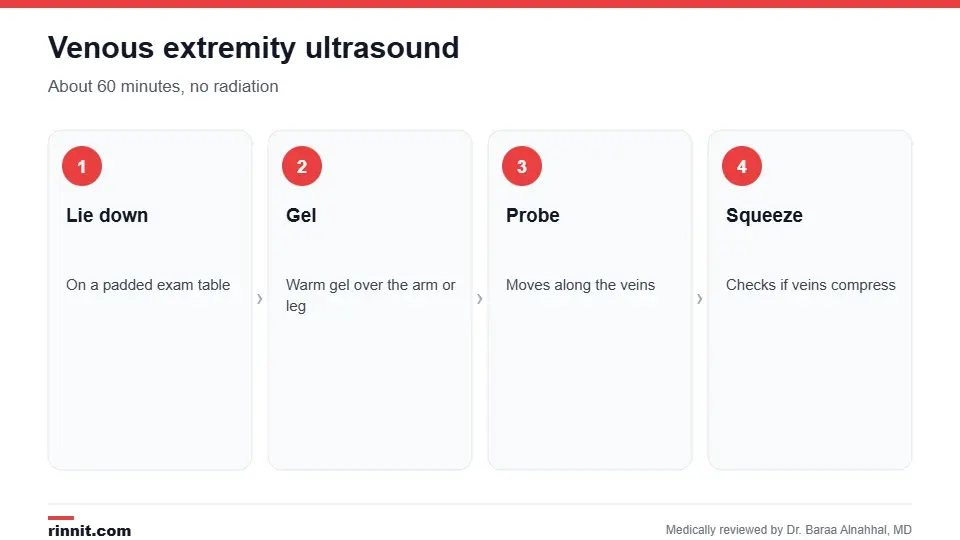
A venous ultrasound takes about an hour.
Why is it done?

The main goal is to find or rule out a blood clot.
Swelling, pain, tenderness, warmth or redness in an arm or leg.
Suspected deep vein thrombosis (DVT) or a clot in an arm vein, such as axillo-subclavian vein thrombosis.
Suspected thrombophlebitis, a clot in a vein near the skin.
A suspected pulmonary embolism, to look for its source.
Following up a known clot during treatment.
Checking veins for chronic venous insufficiency. Sources: [1]
It's often ordered with a D-dimer blood test. Sources: [2, 3]
How do I prepare?
Usually there's no preparation for an arm or leg vein ultrasound; you can eat and drink normally. Wear loose clothing that's easy to remove, and follow any instructions from the imaging center. Sources: [1]
What happens during the test?
You lie on a padded table; you may be asked to change into a gown.
The technologist applies warm, water-based gel to your skin over the veins.
They move a handheld probe along the veins from the groin or armpit down the limb.
They press gently on the veins at intervals; normal veins collapse under pressure.
They may squeeze your calf or arm to check blood flow with Doppler. Sources: [1]
The test takes about 60 minutes. The gel wipes off easily and won't stain clothing. Sources: [1]
Understanding your results
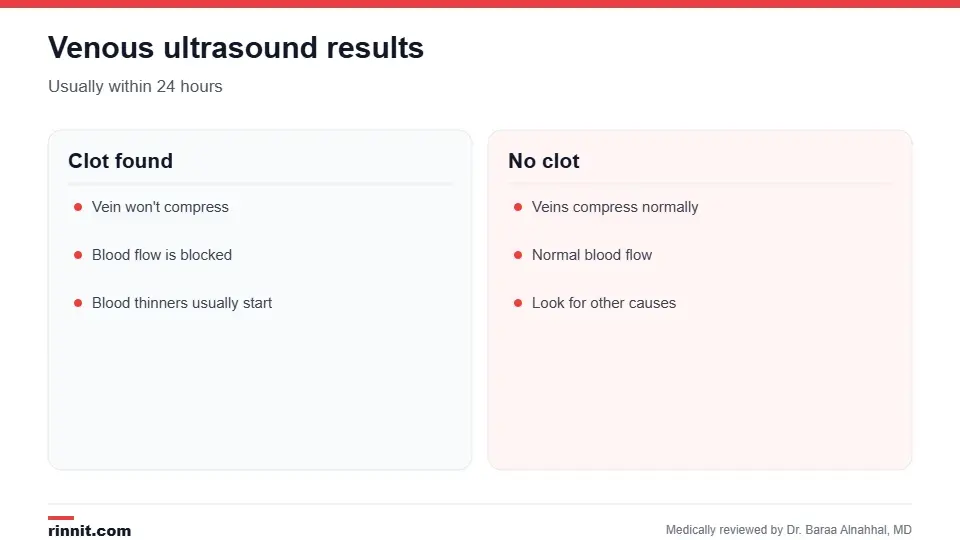
Results usually come back within 24 hours.
A board-certified radiologist reads the images, and results are usually available within 24 hours on weekdays. If a clot is found, your provider will explain its location and size and usually start blood thinners. If no clot is seen, a clot is very unlikely, though your provider may repeat the scan if symptoms continue or look for other causes, such as a muscle injury or cyst. If a deeper vein problem is still suspected, a venogram or CT may be considered. Sources: [1, 2, 3]
Risks
Venous ultrasound is safe, with no radiation and no known harmful effects. Pressing on a tender area may be briefly uncomfortable. Sources: [1]
Seek emergency care for sudden shortness of breath, chest pain or coughing up blood, which can signal a clot in the lungs.
Conclusion
A venous extremity ultrasound is the main test for finding blood clots in the arms and legs. It's fast, painless and safe, and a negative result is reliable enough that most people don't need blood thinners afterward.
Keep learning: read about DVT and venous thromboembolism.
Frequently asked questions
What does a venous ultrasound check?
The veins in your arms or legs, mainly for blood clots.
Is it painful?
No, though pressure on a sore area may be uncomfortable.
How long does it take?
About 60 minutes.
Do I need to prepare?
Usually not for arm or leg veins.
Does it use radiation?
No. It uses sound waves.
How does it show a clot?
A vein with a clot doesn't squeeze flat when pressed.
How soon will I get results?
Usually within 24 hours.
What if no clot is found?
A clot is very unlikely; your provider may look for other causes.
Is it the same as a Doppler ultrasound?
It uses Doppler as part of the exam.
When should I go to the ER?
For sudden shortness of breath, chest pain or coughing up blood.
Related Reading
Vein Mapping: Ultrasound Before Bypass Surgery or Dialysis Access explains the ultrasound that maps blood vessels before surgery or dialysis access.
Deep Vein Thrombosis (DVT): Symptoms, Causes, Diagnosis & Treatment — Complete Guide the clot this ultrasound looks for.
Venous Thromboembolism: Understanding DVT and Pulmonary Embolism DVT and pulmonary embolism together.
Vascular Ultrasound: How It Checks Blood Flow, What It Finds and What to Expect the broader ultrasound of arteries and veins.
Thrombophlebitis: Symptoms, Causes & Treatment inflamed veins with clots near the skin.
Axillo-Subclavian Vein Thrombosis: The Blood Clot Condition That Strikes Active People — and How It's Treated a clot in the arm and shoulder veins.
References
Cleveland Clinic. Venous Extremity Ultrasound. Cleveland Clinic. Last updated June 1, 2014. https://my.clevelandclinic.org/health/diagnostics/15765-upper-or-lower-venous-extremity-ultrasound
Johnson SA, Stevens SM, Woller SC, et al. Risk of deep vein thrombosis following a single negative whole-leg compression ultrasound: a systematic review and meta-analysis. JAMA. 2010;303(5):438-445. PMID 20124539. https://doi.org/10.1001/jama.2010.43
Kraaijpoel N, Carrier M, Le Gal G, et al. Diagnostic accuracy of three ultrasonography strategies for deep vein thrombosis of the lower extremity: a systematic review and meta-analysis. PLoS One. 2020;15(2):e0228788. PMID 32045437. https://doi.org/10.1371/journal.pone.0228788
Medical disclaimer
This article is for general education only and does not replace advice from a qualified healthcare professional. Talk to your doctor about your own diagnosis and treatment, and seek emergency care right away for severe or sudden symptoms.



Comments