D-dimer Test: What It Is, Why It's Done, How It Works and What Results Mean

Updated: 7 days ago
Written and medically reviewed by Dr. Baraa Alnahhal, MD · Last reviewed: November 2026 · How we review
Quick Answer: What is a D-dimer test?
A D-dimer test is a blood test that measures D-dimer, a protein fragment your body releases when a blood clot breaks down. Levels are normally very low or undetectable. A normal result most likely means you do not have a clotting disorder, while a high result means you may need more tests, usually imaging, to find out why. [1]
What the research says
Adjusting the cutoff for age safely rules out a clot in more older adults. In 3,346 emergency patients with suspected pulmonary embolism, using an age-adjusted cutoff (age × 10 for people 50 and older) instead of the standard 500 µg/L raised the share of patients aged 75 or older in whom a clot could be ruled out from 6.4% to 29.7%. Only 1 of 331 patients left untreated on this basis had a clot within 3 months (0.3%). (Righini et al., JAMA, 2014) [2]
The test is very good at ruling out a leg clot, but poor at confirming one. A review of 43 studies found that high-sensitivity D-dimer tests picked up 96.1% of deep vein thrombosis cases, but only 35.7% of people without a clot had a negative result. This is why a high result needs follow-up testing rather than being treated as a diagnosis. (Bhatt et al., Blood Advances, 2020) [3]
Key takeaways
A D-dimer test measures a protein fragment released when a blood clot breaks down. [1]
It helps providers check for deep vein thrombosis (DVT), pulmonary embolism (PE), disseminated intravascular coagulation (DIC) and stroke. [1]
A normal or negative result most likely means you do not have a clotting disorder. [1]
A high result does not confirm a clot and cannot show the type of clotting condition or where a clot is, so more testing is needed. [1]
Pregnancy, heart disease, recent surgery, trauma, infection and older age can also raise D-dimer. [1]
No preparation is needed, and the blood draw usually takes less than five minutes. [1]
What is a D-dimer test?
A D-dimer test is a blood test that measures D-dimer, a protein fragment made when a blood clot dissolves. D-dimer is normally undetectable or very low unless your body is forming and breaking down a significant number of clots. [1]
How blood clots form and break down
When you are injured, threads of a protein called fibrin and cells called platelets join together to form a clot that stops the bleeding. Once the wound has healed, an enzyme called plasmin breaks the clot into small pieces called fibrin degradation products. D-dimer is one of these pieces. [1]
In a clotting disorder, clots can form when there is no injury, or they may not break down when they should. These conditions can be serious and even life-threatening. [1]
Why is a D-dimer test done?
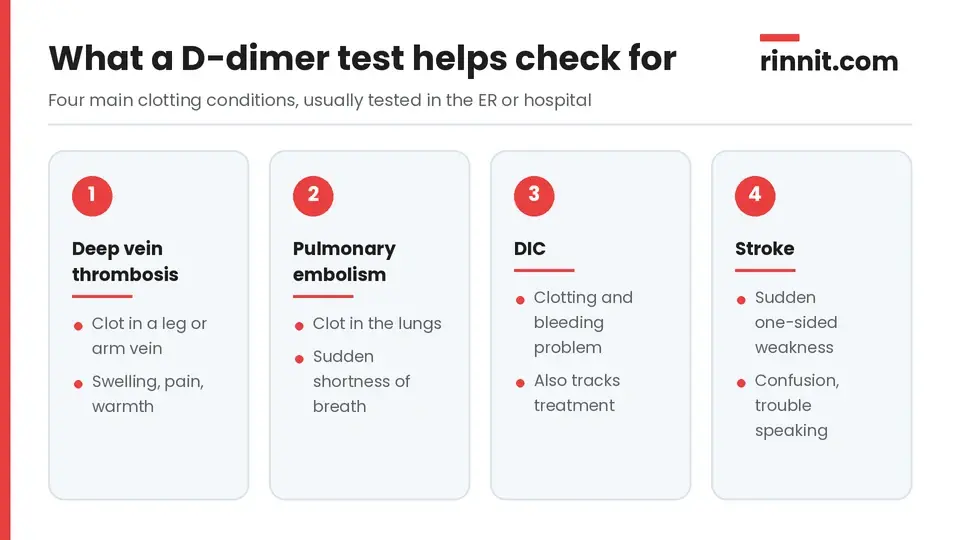
A D-dimer test helps providers look for four main clotting conditions.
Providers use a D-dimer test to help identify or evaluate four main conditions. For DIC, it is also used to check how well treatment is working. The test is usually done in an emergency room or hospital. [1]
Condition | Common symptoms that may lead to testing |
Deep vein thrombosis (DVT) | Leg or arm swelling, pain or tenderness, warmth, red or discolored skin, enlarged surface veins |
Pulmonary embolism (PE) | Sudden shortness of breath, sharp chest pain, cough, fast heart rate, dizziness or fainting |
Disseminated intravascular coagulation (DIC) | Bleeding gums, nausea or vomiting, severe muscle and belly pain, seizures, less urine |
Stroke | Sudden numbness or weakness on one side, confusion, trouble speaking, seeing or walking |
Sources: [1]
Some people with DVT have no symptoms at all. Leg or arm pain from DVT is often worse when you stand or walk. [1]
PE chest pain often gets worse when you cough or move, and you may also have back pain, heavy sweating or a cough that brings up blood. A stroke can also cause dizziness, loss of balance or a sudden, severe headache with no known cause. [1]
Who is at higher risk of abnormal clotting?
Factors that raise your risk of abnormal blood clots include: [1]
Major surgery or trauma
Long periods without moving, such as long trips sitting down or extended bed rest
Birth control pills or hormone replacement therapy
Pregnancy or recent childbirth
A family history of clots, or conditions such as Factor V Leiden, antiphospholipid syndrome or polycythemia vera
Certain cancers
COVID-19
Obesity
Smoking
How do you prepare for a D-dimer test?
You do not need to do anything special to prepare for a D-dimer test. [1]
What happens during a D-dimer test?

The blood draw usually takes less than five minutes.
A phlebotomist usually draws your blood, and a medical laboratory scientist runs the test on lab machines called analyzers. [1]
A provider finds a vein, usually on the inside of your arm where it bends at the elbow.
They clean the skin over the vein.
They insert a small needle. You may feel a small pinch.
Blood is collected into a test tube.
The needle is removed, and gauze and a bandage are placed over the site.
The whole process usually takes less than five minutes. The lab then processes your sample, and your provider shares the results with you. [1]
Are there risks?
The risk is very low. You may have slight tenderness or a bruise where the needle went in, but this usually goes away quickly. [1]
What do D-dimer test results mean?
There is no single universal normal range for D-dimer, because labs use different testing methods. Your lab report will show whether your result is normal, low, high, positive or negative. [1]
Results from an emergency test usually come back within a few hours. Results from a test used to monitor a condition usually take one to two business days. [1]
Result | What it most likely means | If you are being treated for DIC |
Normal, low or negative | You most likely do not have a clotting disorder | Treatment is most likely working |
High or positive | You may have a clotting condition; more testing is needed | Treatment is most likely not working well |
Sources: [1]
Other causes of a high D-dimer
A high level does not always mean you have a clotting disorder. Other things can raise D-dimer, including: [1]
Pregnancy
Heart disease
Recent surgery
Trauma
Infection
Older age, since levels tend to rise as you get older
Rheumatoid arthritis can also cause a false-positive result. [1]
In older adults, some studies use a cutoff that rises with age so that fewer people need imaging while very few clots are missed. [2]
What happens if your D-dimer is high?
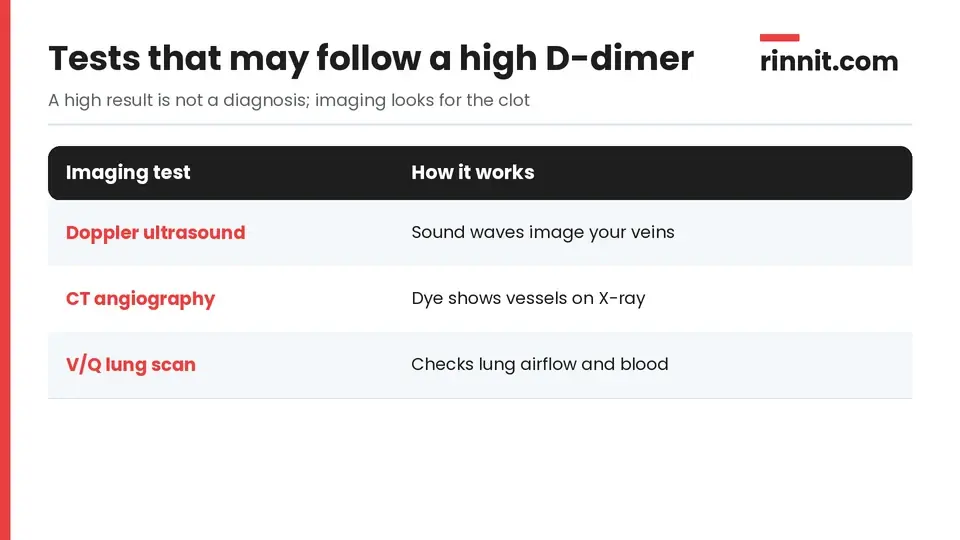
A high result is usually followed by an imaging test to look for a clot.
Because a high result cannot show what kind of clotting problem you have or where a clot is, your provider will likely order an imaging test. [1]
Imaging test | How it works |
Doppler ultrasound | Uses sound waves to make pictures of your veins |
CT angiography | A dye injected into a vein makes your blood vessels show up on X-ray images |
Ventilation-perfusion (V/Q) lung scan | Uses small amounts of radioactive substances to check airflow and blood flow in your lungs |
Sources: [1]
When to get emergency care
Call 911 or go to the nearest emergency room right away if you have symptoms of a stroke or a pulmonary embolism. If you have symptoms of DVT, call your provider as soon as possible. [1]
Conclusion
A D-dimer test is a quick blood test that helps your provider check for serious clotting problems such as DVT, pulmonary embolism, DIC and stroke. A normal result is reassuring and most likely means you do not have a clotting disorder.
A high result is a signal to look further, not a diagnosis. Many things can raise D-dimer, so your provider will usually follow up with an imaging test before deciding on treatment.
Keep learning: Read our guide to deep vein thrombosis or our guide to pulmonary embolism. For more trusted, doctor-reviewed health guides, visit Rinnit.com.
FAQ
What is a D-dimer test?
It is a blood test that measures a protein fragment released when a blood clot breaks down.
What does a D-dimer test check for?
It helps check for deep vein thrombosis, pulmonary embolism, disseminated intravascular coagulation and stroke.
Do I need to prepare for a D-dimer test?
No, you do not need any special preparation.
How long does a D-dimer test take?
The blood draw usually takes less than five minutes.
What is a normal D-dimer level?
There is no single normal range because lab methods differ, so your report will mark your result as normal or high.
What does a negative D-dimer result mean?
It most likely means you do not have a clotting disorder.
Does a high D-dimer mean I have a blood clot?
Not always; it means you may have a clotting condition and need more tests to find out.
What else can raise D-dimer?
Pregnancy, heart disease, recent surgery, trauma, infection, older age and sometimes rheumatoid arthritis.
What tests come after a high D-dimer?
Usually imaging, such as a Doppler ultrasound, CT angiography or a V/Q lung scan.
How soon do D-dimer results come back?
Emergency results usually take a few hours, and monitoring results take one to two business days.
Related Reading
Partial Thromboplastin Time (PTT) Test: Normal Range and Results explains the blood clotting test used to monitor heparin and check bleeding problems.
Fibrinogen Test: Normal Range and What High or Low Fibrinogen Means explains the blood test for a key clotting protein.
Deep Vein Thrombosis (DVT): Symptoms, Causes, Diagnosis & Treatment — Complete Guide explains leg and arm clots, one of the main reasons a D-dimer test is ordered.
Pulmonary Embolism Guide: Symptoms, Causes, Diagnosis, and Treatment covers clots in the lungs and the emergency signs to watch for.
Venous Thromboembolism: Understanding DVT and Pulmonary Embolism shows how DVT and pulmonary embolism are linked.
Disseminated Intravascular Coagulation (DIC): A Rare Blood Clotting Disorder That Causes Organ Damage and Uncontrollable Bleeding — Symptoms, Causes, Diagnosis and Treatment — What You Need to Know describes the clotting and bleeding disorder that D-dimer helps diagnose and monitor.
Stroke: Symptoms, Causes, Diagnosis, and Treatment — A Complete Guide explains stroke warning signs and why fast emergency care matters.
Blood Clots Explained: Symptoms, Emergency Signs, and Treatment Options gives an overview of how blood clots form and how they are treated.
Antiphospholipid Syndrome: Symptoms, Causes, Treatment & Complete Guide covers an immune condition that raises the risk of abnormal clotting.
References
Cleveland Clinic. D-Dimer Test: What It Is, What It Is Used For, Risks & Results. Cleveland Clinic. Last updated November 9, 2021. https://my.clevelandclinic.org/health/diagnostics/22045-d-dimer-test
Righini M, Van Es J, Den Exter PL, et al. Age-adjusted D-dimer cutoff levels to rule out pulmonary embolism: the ADJUST-PE study. JAMA. 2014;311(11):1117-1124. PMID 24643601. https://doi.org/10.1001/jama.2014.2135
Bhatt M, Braun C, Patel P, et al. Diagnosis of deep vein thrombosis of the lower extremity: a systematic review and meta-analysis of test accuracy. Blood Adv. 2020;4(7):1250-1264. PMID 32227213. https://doi.org/10.1182/bloodadvances.2019000960
Medical disclaimer
This article is for general education only and does not replace advice from a qualified healthcare professional. Talk to your doctor about your own diagnosis and treatment, and seek emergency care right away for severe or sudden symptoms.



Comments