Fibrinogen Test: Normal Range and What High or Low Fibrinogen Means

Updated: 2 days ago
Written and medically reviewed by Dr. Baraa Alnahhal, MD · Last reviewed: November 2026 · How we review
Quick Answer
A fibrinogen test (also called a factor I activity test) is a blood test that measures fibrinogen, a clotting protein made by the liver. A typical normal range is about 200 to 400 mg/dL. Providers order it for unexplained or excessive bleeding, abnormal PT/INR or PTT results and inherited clotting disorders.
What the research says
Low fibrinogen predicts severe bleeding after birth: in 128 women with postpartum hemorrhage, fibrinogen was the only clotting marker independently linked to severe bleeding; each 1 g/L drop raised the risk about 2.6-fold, and a level of 2 g/L or less had a 100% positive predictive value for severe hemorrhage (Charbit B et al., Journal of Thrombosis and Haemostasis, 2007) [2]
High fibrinogen is linked to heart disease and stroke: an analysis of 154,211 people in 31 studies found each 1 g/L higher fibrinogen level was associated with about 2.4 times the risk of coronary heart disease and 2.1 times the risk of stroke, though whether fibrinogen directly causes disease is unclear (Fibrinogen Studies Collaboration (Danesh J et al.), JAMA, 2005) [3]
Key takeaways
Fibrinogen is a liver-made protein needed for stable blood clots.
Normal is about 200 to 400 mg/dL (2 to 4 g/L).
Low levels can cause bleeding; high levels are linked with clotting and heart risk.
It's ordered for unexplained bleeding, abnormal clotting tests or suspected DIC.
Usually no preparation is needed.
What is fibrinogen?
Fibrinogen is clotting factor I. When a blood vessel is injured, a chain of clotting factors turns fibrinogen into fibrin, which weaves through platelets to form a firm clot. If you don't have enough fibrinogen, or it doesn't work properly, you can bleed too easily. Fibrinogen also rises with inflammation. Sources: [1]
Why it's done

The test helps explain bleeding and clotting problems.
Signs of too much bleeding, such as bleeding gums, nosebleeds, easy bruising, blood in urine or stool, or coughing up blood.
Following up abnormal PT or PTT results.
Checking for DIC, a dangerous clotting and bleeding disorder.
Looking for inherited fibrinogen disorders.
Evaluating repeated pregnancy loss. Sources: [1]
Normal range

Ranges can differ slightly between labs.
Result | Level | What it may mean |
Low | Below about 200 mg/dL (2 g/L) | Bleeding risk; inherited deficiency, DIC, liver disease or heavy blood loss |
Normal | About 200–400 mg/dL (2–4 g/L) | Expected range |
High | Above about 400 mg/dL (4 g/L) | Inflammation; linked with clotting and heart disease risk |
Your results are interpreted with other clotting tests, such as the D-dimer test. Sources: [1, 3]
Inherited fibrinogen disorders
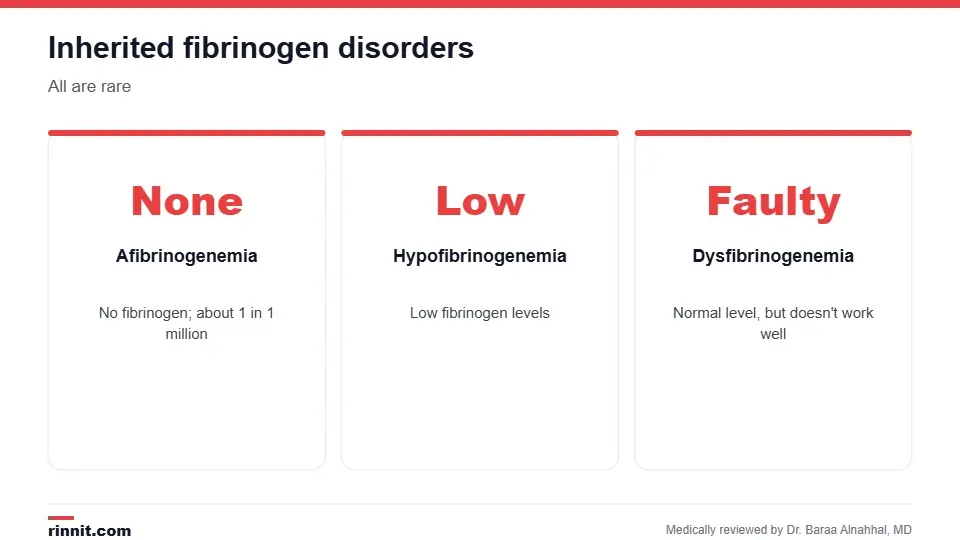
Inherited disorders are rare.
Type | What happens | How common |
Afibrinogenemia | No fibrinogen in the blood | Extremely rare, about 1 in 1 million |
Hypofibrinogenemia | Low fibrinogen levels | More common than afibrinogenemia |
Dysfibrinogenemia | Normal level, but fibrinogen doesn't work properly | Many people have no symptoms |
Fibrinogen deficiency can be treated with IV fibrinogen, often before surgery, after injury and around childbirth. Sources: [1]
How the test is done
A provider draws blood from a vein in your arm. You usually don't need to prepare, though your provider may briefly pause blood thinners. Drinking water beforehand can make the draw easier. You may have mild bruising that fades within a day or two. Sources: [1]
Conclusion
The fibrinogen test is a simple blood test that helps explain bleeding and clotting problems. Your provider reads it together with your symptoms and other clotting tests to find the cause and plan treatment.
Keep learning: read about the PT/INR test and DIC.
Frequently asked questions
What does a fibrinogen test measure?
The amount of fibrinogen, a clotting protein, in your blood.
What is a normal fibrinogen level?
About 200 to 400 mg/dL (2 to 4 g/L).
What does low fibrinogen mean?
A higher risk of bleeding; causes include DIC, liver disease and inherited disorders.
What does high fibrinogen mean?
Often inflammation; it's also linked with heart disease and stroke risk.
Do I need to fast?
Usually not.
Should I stop blood thinners?
Only if your provider tells you to.
What is another name for the test?
Factor I activity test.
What is afibrinogenemia?
A very rare inherited condition with no fibrinogen in the blood.
How is low fibrinogen treated?
Often with IV fibrinogen.
Is the test risky?
No. Risks are those of a routine blood draw.
Related Reading
Partial Thromboplastin Time (PTT) Test: Normal Range and Results explains the blood clotting test used to monitor heparin and check bleeding problems.
Prothrombin Time (PT/INR) Test: Normal Ranges, Warfarin Targets and Results another common clotting test.
D-dimer Test: What It Is, Why It's Done, How It Works and What Results Mean a test that checks for clot breakdown.
Disseminated Intravascular Coagulation (DIC): A Rare Blood Clotting Disorder That Causes Organ Damage and Uncontrollable Bleeding — Symptoms, Causes, Diagnosis and Treatment — What You Need to Know a serious condition that lowers fibrinogen.
What Is von Willebrand Disease? A Plain-Language Guide to the Lifelong Bleeding Condition You're Usually Born With the most common inherited bleeding disorder.
Hemophilia A: Understanding Factor VIII Deficiency and Treatment another inherited clotting factor disorder.
References
Cleveland Clinic. Fibrinogen Test: What It Is, Purpose, Procedure & Results. Cleveland Clinic. Last updated April 13, 2022. https://my.clevelandclinic.org/health/diagnostics/22791-fibrinogen-test
Charbit B, Mandelbrot L, Samain E, et al. The decrease of fibrinogen is an early predictor of the severity of postpartum hemorrhage. Journal of Thrombosis and Haemostasis. 2007;5(2):266-273. PMID 17087729. https://doi.org/10.1111/j.1538-7836.2007.02297.x
Fibrinogen Studies Collaboration, Danesh J, Lewington S, et al. Plasma fibrinogen level and the risk of major cardiovascular diseases and nonvascular mortality: an individual participant meta-analysis. JAMA. 2005;294(14):1799-1809. PMID 16219884. https://doi.org/10.1001/jama.294.14.1799
Medical disclaimer
This article is for general education only and does not replace advice from a qualified healthcare professional. Talk to your doctor about your own diagnosis and treatment, and seek emergency care right away for severe or sudden symptoms.



Comments