Prothrombin Time (PT/INR) Test: Normal Ranges, Warfarin Targets and Results

Updated: 2 days ago
Written and medically reviewed by Dr. Baraa Alnahhal, MD · Last reviewed: November 2026 · How we review
Quick Answer
A prothrombin time (PT) test, reported with the international normalized ratio (INR), is a blood test that measures how long the blood takes to clot. It's mostly used to monitor the blood thinner warfarin. A normal INR is 0.8 to 1.1; for many people taking warfarin, the target is 2.0 to 3.0, but your provider sets your own target.
What the research says
Home INR testing improves warfarin care: a Cochrane review of randomized trials found that people who tested their own INR at home, and especially those who also adjusted their own warfarin dose, had fewer blood clots than people on standard clinic monitoring, without more major bleeding (Heneghan CJ et al., Cochrane Database of Systematic Reviews, 2016) [2]
Testing frequency matters: a network meta-analysis of 16 trials with 5,895 people on warfarin found that self-testing or self-management at least once a week kept INR in the target range about 6–8 percentage points more of the time than usual care (Dhippayom T et al., Thrombosis and Haemostasis, 2022) [3]
Key takeaways
Measures how fast your blood clots; INR standardizes results between labs.
Normal PT: about 11–13.5 seconds; normal INR: about 0.8–1.1.
Common warfarin target: INR 2.0–3.0, though your provider sets yours.
High INR: slower clotting and higher bleeding risk; low INR: faster clotting and higher clot risk.
Results in hours to a day; finger-prick tests give results in minutes.
What is prothrombin time?
Prothrombin (factor II) is one of several clotting proteins made by your liver with the help of vitamin K. The PT test adds a substance called thromboplastin to your blood sample and times how long a clot takes to form. Because different labs use different reagents, the result is also reported as the INR, which lets results be compared anywhere. Sources: [1]
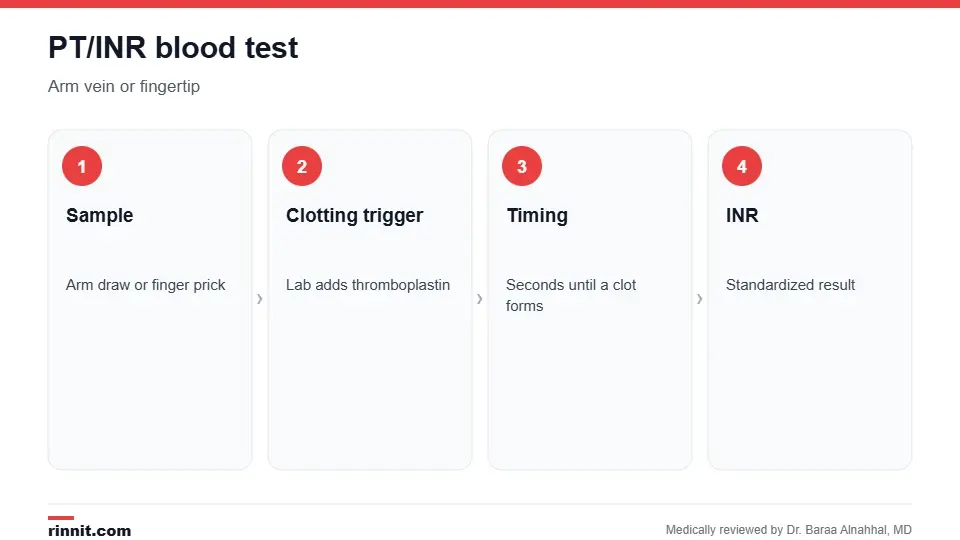
PT/INR measures how long blood takes to clot.
Why is it done?
To monitor warfarin and adjust the dose, for example in atrial fibrillation, blood clots or mechanical heart valves.
To check liver function, since the liver makes clotting factors; PT/INR is part of scores such as MELD and Child-Pugh.
Before surgery, to check bleeding risk.
To help diagnose bleeding and clotting disorders, often with a partial thromboplastin time (PTT) test. Sources: [1]
How the test is done
A provider draws blood from a vein in your arm, or pricks your fingertip. No special preparation is usually needed, but tell your provider about all medicines and supplements, and ask whether any foods or medicines could affect the result. Most results come back within a few hours to a day; finger-prick tests give results in minutes. Sources: [1]
People who take warfarin long term can sometimes use a home INR monitor with a finger prick, sharing results with their care team or adjusting their dose under a set plan. Sources: [1, 2, 3]
What do the results mean?
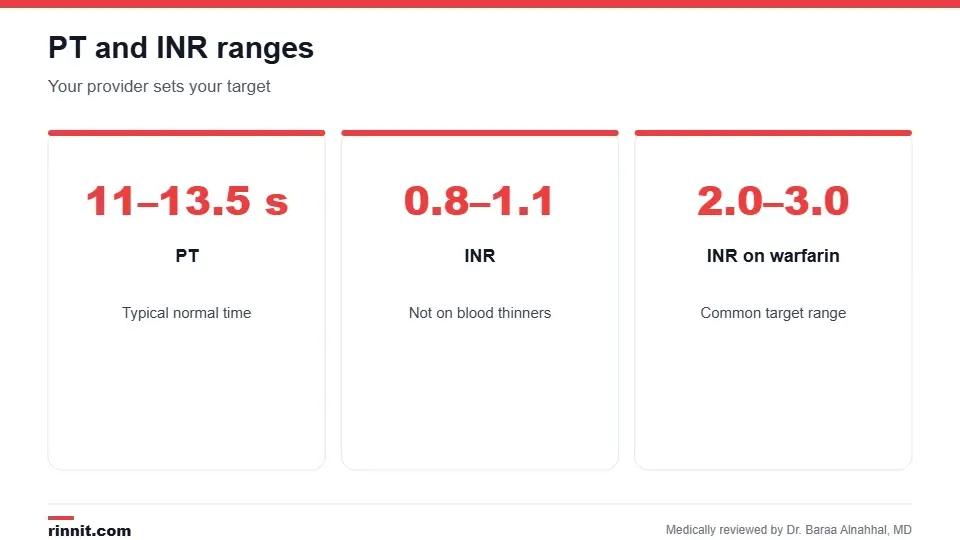
Your provider tells you your personal target.
Measure | Typical range |
PT | 11–13.5 seconds |
INR, not on blood thinners | 0.8–1.1 |
INR on warfarin | Usually 2.0–3.0 (some conditions need a higher target) |
Sources: [1]

High means slower clotting; low means faster clotting.
High PT/INR (slow clotting): warfarin effect or a dose that's too high, liver disease such as cirrhosis, vitamin K deficiency, or a bleeding disorder such as hemophilia or DIC.
Low PT/INR (fast clotting): too much vitamin K from food or supplements, a warfarin dose that's too low, or a clotting disorder. Sources: [1]
If you take warfarin, your provider uses your INR to adjust your dose. Call your provider right away for unusual bleeding or bruising, blood in your urine or stool, or signs of a clot, such as leg swelling or sudden shortness of breath. Sources: [1]
Things that affect INR
Changes in how much vitamin K you eat, such as leafy greens.
Many medicines, including antibiotics, and some supplements.
Alcohol.
Illness, such as fever or diarrhea.
Missed or extra warfarin doses. Sources: [1]
Risks
The test is safe. You may have slight bruising or discomfort at the needle site. Sources: [1]
Conclusion
The PT/INR test is a quick blood test that shows how well your blood clots. It's essential for keeping warfarin in a safe range and useful for checking liver health and bleeding risk. If you take warfarin, regular testing and consistent habits keep your INR on target.
Keep learning: read about warfarin and blood clotting disorders.
Frequently asked questions
What does a PT/INR test measure?
How long your blood takes to clot.
What is a normal INR?
About 0.8–1.1 if you don't take blood thinners.
What INR should I have on warfarin?
Often 2.0–3.0, but your provider sets your target.
What does a high INR mean?
Your blood clots more slowly, which raises bleeding risk.
What does a low INR mean?
Your blood clots faster, which raises clot risk.
Do I need to fast?
Usually not; ask your provider about foods or medicines to avoid.
Can I test my INR at home?
Yes. Home finger-prick monitors are available for some people on warfarin.
What affects INR?
Vitamin K intake, medicines, alcohol, illness and missed doses.
Is PT the same as PTT?
No. They check different clotting pathways and are often ordered together.
How long do results take?
Hours to a day; finger-prick tests take minutes.
Related Reading
Partial Thromboplastin Time (PTT) Test: Normal Range and Results explains the blood clotting test used to monitor heparin and check bleeding problems.
Fibrinogen Test: Normal Range and What High or Low Fibrinogen Means explains the blood test for a key clotting protein.
Understanding Warfarin: A Guide to Anticoagulant Therapy the blood thinner monitored with INR.
Blood Clotting Disorders: Causes, Symptoms, and Treatment Explained disorders a PT test helps diagnose.
Hemophilia: Symptoms, Causes, Diagnosis & Treatment Guide an inherited bleeding disorder.
Cirrhosis of the Liver: What It Is, How Permanent Scarring Damages Your Liver, and What Treatment Involves liver scarring that prolongs PT.
Understanding Prothrombin Gene Mutation: Risks and Management an inherited clotting risk involving prothrombin.
References
Cleveland Clinic. Prothrombin Time (PT/INR) Test. Cleveland Clinic. Last updated May 1, 2026. https://my.clevelandclinic.org/health/diagnostics/prothrombin-time-test
Heneghan CJ, Garcia-Alamino JM, Spencer EA, et al. Self-monitoring and self-management of oral anticoagulation. Cochrane Database Syst Rev. 2016;7(7):CD003839. PMID 27378324. https://doi.org/10.1002/14651858.CD003839.pub3
Dhippayom T, Boonpattharatthiti K, Thammathuros T, et al. Clinical outcomes of different warfarin self-care strategies: a systematic review and network meta-analysis. Thromb Haemost. 2022;122(4):492-505. PMID 34695873. https://doi.org/10.1055/a-1677-9608
Medical disclaimer
This article is for general education only and does not replace advice from a qualified healthcare professional. Talk to your doctor about your own diagnosis and treatment, and seek emergency care right away for severe or sudden symptoms.



Comments