
Understanding Prothrombin Gene Mutation: Risks and Management

Updated: 3 days ago
Medically reviewed by Dr. Baraa Alnahhal, MD · Last reviewed: October 2026
Definition: An inherited genetic condition that causes the body to produce excess prothrombin, increasing the risk of venous blood clots.
Key Risks: Predisposition to Deep Vein Thrombosis (DVT) and Pulmonary Embolism (PE), though many carriers never develop a clot.
Inheritance: Can be heterozygous (one gene copy) or homozygous (two copies), with homozygous carriers facing a higher risk.
Management: Focuses on lifestyle modifications and the use of anticoagulants when clots occur or during high-risk periods like pregnancy.
Quick Answer
Prothrombin gene mutation, also known as Factor II mutation, is an inherited disorder that causes overproduction of prothrombin, a protein essential for blood clotting. This raises the risk of abnormal vein clots such as deep vein thrombosis or pulmonary embolism. It is the second most common inherited clotting disorder, though many people never develop a harmful clot. [1]
What the research says
Carrying one copy roughly doubles venous clot risk; two copies raises it about fivefold. A systematic review and meta-analysis of 107 publications (107,130 adults, 21,560 with venous thromboembolism) found odds ratios of 2.21 (95% CI 1.70 to 2.87) for heterozygous and 5.16 (95% CI 3.12 to 8.52) for homozygous prothrombin G20210A, compared with people without the mutation (Alnor et al., Ann Hematol, 2024).
In pregnancy, the absolute risk for heterozygous carriers is low. A systematic review and Bayesian meta-analysis of 36 observational studies found that combined antepartum and postpartum absolute risks of a first clot were below 3% for women with a heterozygous prothrombin G20210A mutation. The authors concluded such women should generally not be prescribed clot prophylaxis on the basis of the mutation and family history alone (Croles et al., BMJ, 2017).
The mutation is also linked to a higher risk of a repeat clot. A meta-analysis of 16 prospective studies (16,174 participants) found carriers had a relative risk of recurrent venous thromboembolism of 1.60 (95% CI 1.20 to 2.14), and 1.79 for heterozygotes. The association was significant with 5 or more years of follow-up but not in the short term (Wang and Wu, Ann Vasc Surg, 2024).
What is Prothrombin Gene Mutation?
Prothrombin gene mutation, frequently referred to as Factor II mutation or Prothrombin G20210A, is a genetic condition that alters the body’s natural clotting process. In individuals with this mutation, the body produces more prothrombin—a critical coagulation protein—than is necessary for normal clot formation. This overabundance creates a predisposition for blood to clot more easily, particularly in the veins. [1]
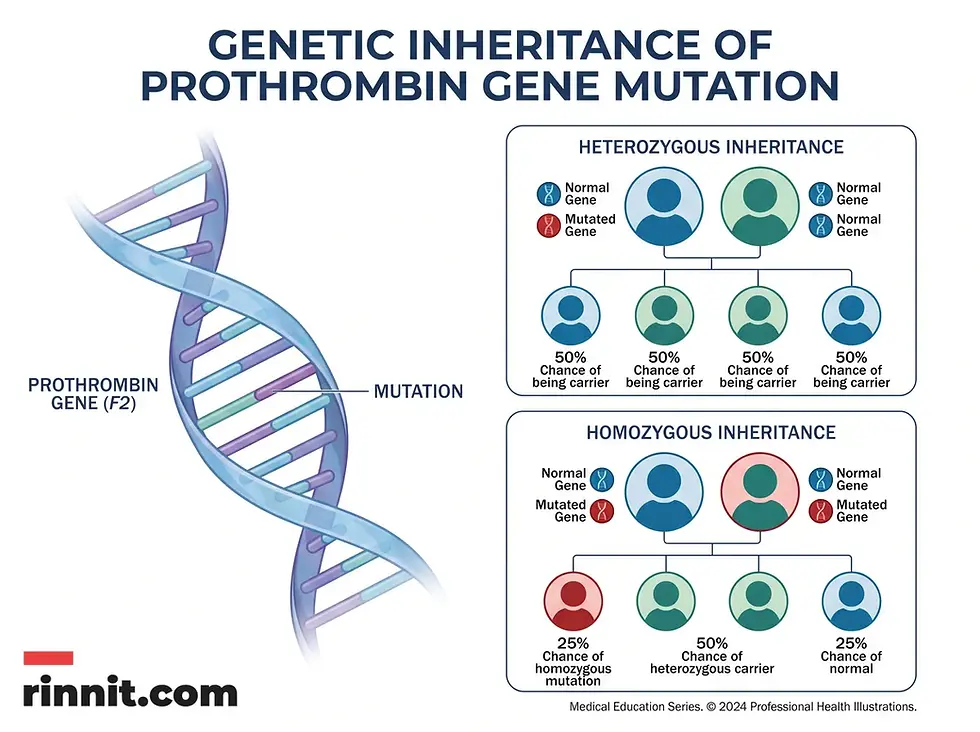
The condition is inherited in two primary forms: heterozygous and homozygous. Heterozygous carriers have inherited one abnormal gene copy from one parent, while homozygous carriers have inherited abnormal copies from both. While both forms increase the risk of venous clots, the risk is significantly higher for those with two abnormal copies.
Mutation Type | Inheritance | Estimated Risk of DVT/PE |
Heterozygous | One abnormal gene copy. | About 2 to 3 times higher than in people without the mutation. |
Homozygous | Two abnormal gene copies. | Higher still; about 5 times higher than in people without the mutation. |
What are the symptoms and risks of a prothrombin gene mutation?
The prothrombin gene mutation itself does not cause any direct symptoms. Most individuals are unaware they have the condition until they undergo specific genetic testing, often following the development of a blood clot. The primary concerns associated with this mutation are Deep Vein Thrombosis (DVT) and Pulmonary Embolism (PE).
Symptoms of a venous blood clot vary depending on its location:
Deep Vein Thrombosis (DVT): Typically occurring in the leg or arm, symptoms include localized pain, swelling, warmth, and skin that appears red or purple.
Pulmonary Embolism (PE): Occurring when a clot travels to the lungs, this is a medical emergency characterized by chest pain, shortness of breath, a rapid heartbeat, and fainting.
It is important to note that while this mutation increases the risk of vein-based clots, it does not appear to increase the risk of arterial issues such as heart attacks or strokes. Furthermore, the majority of people born with this mutation will never develop a dangerous blood clot during their lifetime. [1]
How is a prothrombin gene mutation diagnosed and who is at risk?
Diagnosis of prothrombin gene mutation requires a specific blood test to identify the genetic marker. Healthcare providers typically recommend this testing for individuals who have experienced recurrent blood clots, those who develop a clot at a young age, or those with a strong family history of clotting disorders.

While the genetic mutation provides the baseline risk, several external factors can further increase the likelihood of developing a clot:
Lifestyle and Health: Smoking, obesity, and regular physical inactivity.
Medical Situations: Recent surgery, hospitalization, or having a limb in a cast.
Hormonal Factors: Use of birth control pills, hormone replacement therapy, and pregnancy.
Environmental Triggers: Long-duration travel, such as extended flights or road trips. [1]
How is a prothrombin gene mutation managed with treatment and lifestyle care?
A prothrombin gene mutation is a permanent part of a person's genetic makeup, so no treatment can alter it. Instead, management focuses on preventing the formation of clots and treating them effectively if they occur. For those who develop DVT or PE, anticoagulants (blood thinners) are the standard treatment. The duration of this treatment varies, ranging from a few months to a lifelong requirement depending on the individual’s risk profile.
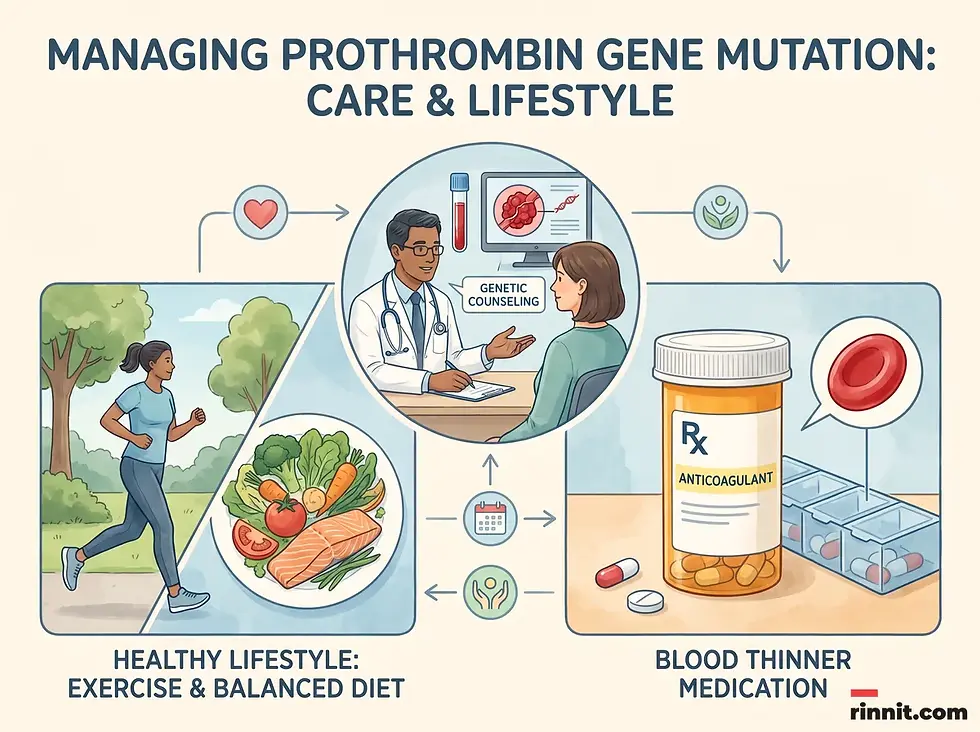
During pregnancy, management is personalized. While many women with the mutation have healthy pregnancies without intervention, those with a history of clots may require preventive doses of injectable blood thinners like heparin, which are safe for the developing baby. For all carriers, leading a healthy lifestyle—including maintaining a healthy weight, quitting smoking, and exercising regularly—is the most effective way to minimize overall risk. [1]
Conclusion and Next Steps
Prothrombin gene mutation is a lifelong condition that requires awareness rather than constant medical intervention for most people. By understanding the warning signs of blood clots and managing external risk factors, individuals with this mutation can lead full, active lives. If you have a family history of clotting issues or are planning a major surgery or pregnancy, consult your healthcare provider to discuss whether genetic testing or preventive measures are appropriate for your situation.
Frequently Asked Questions
Can I pass this mutation to my children?
Yes. Heterozygous parents have a 50% chance of passing it on, while homozygous parents will always pass the mutation to their children.
Is prothrombin gene mutation common?
Prothrombin gene mutation is the second most common inherited clotting disorder, affecting about 1 in 50 white people in Europe and North America.
Does this mutation cause heart attacks?
No, it only increases the risk of clots in the veins (DVT and PE), not arterial clots like those causing heart attacks.
Can I donate blood if I have this mutation?
Yes, provided you are not currently taking blood thinners. Always check with your healthcare provider first.
What is the most common inherited clotting disorder?
Factor V Leiden is the most common, with prothrombin gene mutation being the second.
Will I definitely get a blood clot if I have this mutation?
No. The majority of people with this mutation will never develop an abnormal blood clot in their lifetime.
Are blood thinners safe during pregnancy?
Injectable anticoagulants like heparin are considered safe for the baby and are used when preventive measures are necessary.
What are the main symptoms of a lung clot?
Shortness of breath, chest pain, rapid heartbeat, and fainting are key signs of a pulmonary embolism.
How is the condition diagnosed?
Diagnosis requires a specific genetic blood test, often ordered after a clot occurs or due to family history.
Is there a cure for the mutation?
No, as it is a genetic condition, it lasts for life, but the risks it poses can be managed.
Related Reading
Prothrombin Time (PT/INR) Test: Normal Ranges, Warfarin Targets and Results explains the clotting test used to monitor warfarin and liver function.
References
Cleveland Clinic. Prothrombin Gene Mutation. Cleveland Clinic Health Library. Accessed October 11, 2026. https://my.clevelandclinic.org/health/diseases/21810-prothrombin-gene-mutation
Alnor AB, Gils C, Vinholt PJ. Venous thromboembolism risk in adults with hereditary thrombophilia: a systematic review and meta-analysis. Ann Hematol. 2024;103(10):4285-4294. PMID: 39167180. DOI: https://doi.org/10.1007/s00277-024-05926-2
Croles FN, Nasserinejad K, Duvekot JJ, Kruip MJ, Meijer K, Leebeek FW. Pregnancy, thrombophilia, and the risk of a first venous thrombosis: systematic review and bayesian meta-analysis. BMJ. 2017;359:j4452. PMID: 29074563. DOI: https://doi.org/10.1136/bmj.j4452
Wang Z, Wu H. The association of prothrombin gene G20210A mutation with recurrent venous thromboembolism: evidence from a meta-analysis. Ann Vasc Surg. 2024;110(Pt B):295-305. PMID: 39096951. DOI: https://doi.org/10.1016/j.avsg.2024.06.044
Medical disclaimer
This article is for informational purposes only and is not a substitute for professional medical advice, diagnosis, or treatment. Always seek the advice of your physician or other qualified health provider with any questions you may have about a medical condition.



Comments