Hemophilia: Symptoms, Causes, Diagnosis & Treatment Guide

Updated: 2 days ago
Medically reviewed by Dr. Baraa Alnahhal, MD · Last reviewed: September 2026
Hemophilia is a rare inherited condition where the blood doesn't clot well because of missing or low levels of blood-clotting proteins called clotting factors. The two main types are hemophilia A (low factor 8, most common) and hemophilia B (low factor 9). Signs include heavy bleeding from cuts, surgery or dental work, many large bruises, hot swollen painful joints, blood in urine or stool, and unexplained nosebleeds. The main treatment is replacement therapy — the missing clotting factor given into a vein — and newer options include medicines that don't contain clotting factors and FDA-approved gene therapy. Bleeding that won't stop, hot painful swollen joints, or any signs of bleeding into the brain are medical emergencies.
Quick Answer
What is hemophilia? Hemophilia is a rare condition in which the blood doesn't clot well, because it doesn't have enough blood-clotting proteins called clotting factors. People with hemophilia may bleed longer after an injury than they would if the blood clotted as it should.
Key points at a glance:
Hemophilia is caused by a missing or low level of a clotting factor, almost always due to gene changes passed through families.
The most common type is hemophilia A (low factor 8); the next most common is hemophilia B (low factor 9).
Because the changed gene sits on the X chromosome, hemophilia is much more common in people assigned male at birth.
Severe hemophilia usually shows up in the first two years of life; milder forms may not be discovered until adulthood, often after injury or surgery.
The main treatment is replacement therapy — the missing clotting factor delivered into a vein, either from donated blood or made in a lab.
Newer options include medicines without clotting factors (such as emicizumab) and FDA-approved gene therapy for both types.
Seek emergency care for bleeding that won't stop, hot swollen painful joints, or signs of bleeding into the brain.
What Is Hemophilia?
Hemophilia is a rare condition in which the blood doesn't clot well. That happens because the blood doesn't have enough of certain blood-clotting proteins, called clotting factors. As a result, people with hemophilia might bleed longer after an injury than they would if their blood clotted as it should.
It helps to understand how normal clotting works. Clotting factors are proteins in the blood that team up with tiny blood cells called platelets to form a clot. Normally, when you bleed, blood cells pool together to form a clot that plugs the leak and stops the bleeding. A missing or low clotting factor keeps blood from clotting well in people with hemophilia.
Small cuts usually aren't much of a problem. For people with a serious form of hemophilia, the main concern is bleeding inside the body. Internal bleeding can damage organs and tissues and, depending on where it happens, can be life-threatening.

Hemophilia basics — the blood doesn't clot well because of low clotting factors, and internal bleeding most often affects the joints, deep muscles, and in rare cases the brain, throat, or neck.
Gene changes that are passed through families — called inherited changes — are almost always the cause. Treatment includes regular replacement of the specific clotting factor that is low, and newer therapies that don't use clotting factors at all are now available.
What Does Hemophilia Bleeding Look Like? Signs & Symptoms
Symptoms of hemophilia vary depending on the level of clotting factors in the blood. People with a slightly low clotting-factor level might bleed only after surgery or injury. People with a low amount of clotting factor may bleed easily for what seems like no reason — a pattern called spontaneous bleeding (bleeding that happens without any clear injury).
People with serious hemophilia often have symptoms in the first two years of life. For instance, an infant with severe hemophilia may first bleed too much during a heel stick to draw blood for newborn screening tests. People with milder hemophilia might not know they have the condition until later in life — maybe after an injury or surgery.
The seven warning signs of hemophilia
Heavy bleeding from cuts: lots of bleeding from cuts or injuries, or after surgery or dental work
Large or deep bruises: many large or deep bruises
Bleeding after vaccinations: more bleeding than is typical after a shot
Hot, swollen, painful joints: bleeding is common in the knees, ankles and elbows
Blood in urine or stool: visible blood in what you pee or poop
Unexplained nosebleeds: nosebleeds with no known cause
Unexplained crankiness in infants: being cranky for no known reason

Seven warning signs of hemophilia, the two main types (A and B), the biggest risk factors, and the three situations that call for emergency care.
Bleeding into the Brain: The Most Serious Complication
A simple bump on the head can cause bleeding into the brain for some people with serious hemophilia. This is rare, but it's one of the most serious complications of the condition. Watch for these symptoms:
A painful, long-lasting headache
Repeated vomiting
Feeling sleepy or sluggish
Convulsions or seizures
When to Get Emergency Care
Seek emergency care if you or your child has any of the following:
Symptoms of bleeding into the brain (severe headache, vomiting, sleepiness, seizures)
Bleeding that won't stop after an injury
Swollen joints that feel hot and are painful
What Causes Hemophilia?
The cause of hemophilia is a missing or low level of a clotting factor. Remember, clotting factors are proteins in the blood that work with cells called platelets to form clots. When that factor is missing or low, blood can't clot as it should.
Congenital Hemophilia (the Inherited Form)
Hemophilia is most often inherited — meaning a person is born with the condition. This is called congenital hemophilia (present from birth). It is classified by which clotting factor is low:
Hemophilia A: low factor 8 — the most common type
Hemophilia B: low factor 9 — the next most common type
Acquired Hemophilia (the Non-Inherited Form)
Some people get hemophilia with no family history of the condition. This is called acquired hemophilia. It happens when a person's immune system attacks clotting factor 8 or 9 in the blood. It can be linked with:
Pregnancy
Autoimmune conditions
Cancer
Multiple sclerosis
Drug reactions
Why Hemophilia Mostly Affects Males
The genetics explain the pattern. In the most common types of hemophilia, the changed gene is on the X chromosome. Everyone has two sex chromosomes, one from each parent. People assigned female at birth get an X chromosome from the mother and an X chromosome from the father. People assigned male at birth get an X chromosome from the mother and a Y chromosome from the father.
Because males have only one X chromosome, most people who get hemophilia are people assigned male at birth. The condition passes from mother to son through one of the mother's genes. Most people assigned female at birth who carry the changed gene are carriers — they tend to have no hemophilia symptoms, though some carriers can have bleeding symptoms if their clotting factors are lowered slightly.
What Are the Risk Factors for Hemophilia?
Family history: the biggest risk factor is having family members who also have the condition
Sex: people assigned male at birth are much more likely to have hemophilia than people assigned female at birth
What Complications Can Hemophilia Cause?
Left untreated, hemophilia can lead to serious complications:
Deep internal bleeding: bleeding in deep muscle can make the arms and legs swell; the swelling can press on nerves, causing numbness or pain, and depending on the location, it may be life-threatening
Bleeding into the throat or neck: this can cause trouble with breathing
Joint damage: internal bleeding puts pressure on the joints, causing pain; frequent untreated internal bleeding can cause arthritis or destroy the joint
Infection: if the clotting factors used in treatment come from human blood, there's a risk of viral infections such as hepatitis C — though the risk is low because of donor blood screening
Reaction to clotting factor treatment: in some people, the immune system reacts to the clotting factors used to treat bleeding and makes proteins that keep the clotting factors from working, which may keep treatment from working well
How Is Hemophilia Diagnosed?
Most people with serious hemophilia get a diagnosis within the first year of life. People with mild forms may not know they have the condition until they're adults, and some people learn they have hemophilia after bleeding more than expected during a surgical procedure.
Four kinds of tests help make the diagnosis:
Screening tests: blood tests that show how well the blood clots
Clotting-factor tests: blood tests that show a lack of a clotting factor, and also reveal the type of hemophilia and whether it is mild, moderate or severe
Genetic tests: for people with a family history — shows who is a carrier and helps with decisions about becoming pregnant
Prenatal tests: it's possible to learn during pregnancy whether hemophilia affects the unborn baby, but the testing poses some risks to the fetus — talk with your healthcare professional about the pros and cons
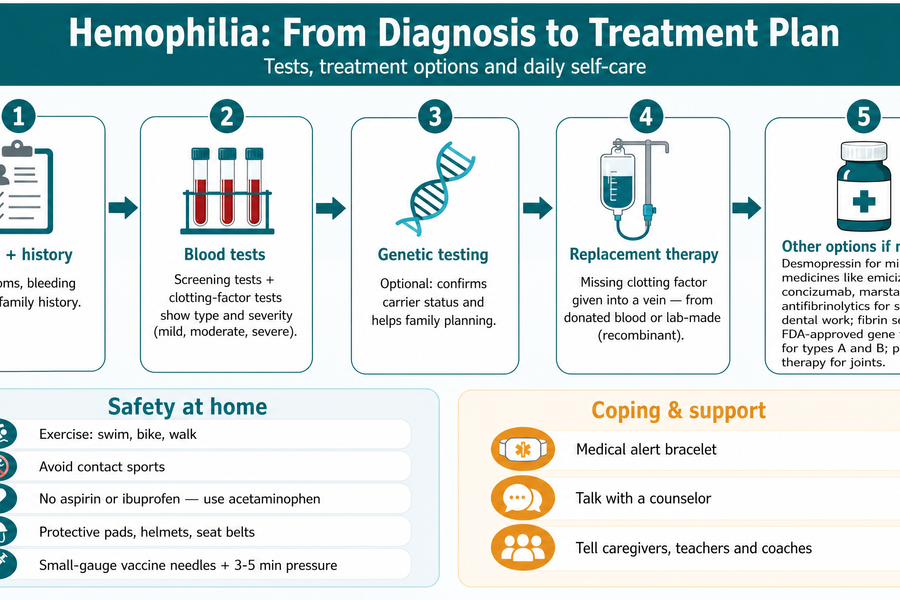
The path from diagnosis to treatment — blood tests identify the type and severity, replacement therapy replaces the missing factor, and additional options fill in when needed.
How Is Hemophilia Treated?
The main treatment for severe hemophilia involves replacing the missing or low clotting factor through a tube in a vein (intravenously, or IV). This therapy can treat a bleeding episode as it's happening. Some people get the treatment on a regular schedule at home to help prevent bleeding episodes, while others get ongoing replacement therapy.
Replacement clotting factor can come from donated blood. Other products, called recombinant clotting factors, come from a laboratory rather than human blood.
The Full Menu of Treatment Options
Replacement therapy (main treatment): missing or low clotting factor given into a vein — treats a bleeding episode as it happens; can also be given on a schedule at home to prevent episodes
Desmopressin: a hormone that triggers the body to release more clotting factor in some forms of mild hemophilia; given slowly into a vein or used as a nasal spray
Emicizumab (Hemlibra): a newer medicine that doesn't contain clotting factors; helps prevent bleeding in hemophilia A
Concizumab (Alhemo) and marstacimab (Hympavzi): newer medicines that help prevent bleeding in both hemophilia A and B
Clot-preserving medicines (antifibrinolytics): help keep clots from breaking down; examples include aminocaproic acid (Amicar) and tranexamic acid (Lysteda); taken by mouth; useful around surgery and dental work
Fibrin sealants: a medicine called thrombin that goes on the skin; may help with bleeding from surgery and dental work
Gene therapy: the FDA has approved valoctocogene roxaparvovec (Roctavian) for serious hemophilia A and etranacogene dezaparvovec-drlb (Hemgenix) for hemophilia B; given into a vein; these one-time treatments cause the body to make more of the missing clotting factor
Physical therapy: can ease symptoms if internal bleeding has damaged the joints; more serious damage might need surgery
Living with Hemophilia: Lifestyle and Home Steps
Daily habits make a real difference for people with hemophilia:
Exercise regularly: swimming, bike riding and walking build muscles while protecting joints. Contact sports such as football, hockey or wrestling aren't safe
Choose pain medicine carefully: aspirin and ibuprofen (Advil, Motrin IB, others) can make bleeding worse — use acetaminophen (Tylenol, others) for mild pain instead
Avoid blood thinners: these include heparin, warfarin (Jantoven), clopidogrel (Plavix), prasugrel (Effient), ticagrelor (Brilinta), rivaroxaban (Xarelto), apixaban (Eliquis), edoxaban (Savaysa) and dabigatran (Pradaxa)
Take care of your teeth: the goal is to prevent tooth and gum disease, which can lead to bleeding
Stay up to date on vaccines: get vaccinations at the right ages, including hepatitis A and B; ask for the smallest gauge needle, and put pressure or ice on the site for 3 to 5 minutes after the shot to lower the risk of bleeding
Protect children from injury: knee pads, elbow pads, helmets and safety belts help; make sure home furniture doesn't have sharp corners
Treat minor wounds at home: pressure and a bandage most often stop bleeding of a minor cut; use an ice pack for small areas of bleeding under the skin; an ice pop can slow minor bleeding in the mouth
Coping and Support
Three support steps help families manage hemophilia day to day:
Get a medical alert bracelet. It tells medical professionals that you or your child has hemophilia, and shows the type of clotting factor that's best in an emergency.
Talk with a counselor. Finding the balance between keeping your child safe and keeping them active is tricky — a social worker or therapist who knows about hemophilia can help you set the right limits.
Let people know. Tell anyone who takes care of your child — babysitters, child care workers, relatives, friends, teachers, and coaches if your child plays noncontact sports.
How to Prepare for Your Appointment
If you or your child has symptoms of hemophilia, your main healthcare professional may send you to a doctor who specializes in blood disorders, called a hematologist.
Before the visit, make a list of:
Symptoms and when they began
Key medical information, including other conditions and a family history of bleeding disorders
All medicines, vitamins and supplements, including dosages
Questions Worth Asking Your Healthcare Professional
What's the most likely cause of these symptoms?
What tests diagnose this condition?
What treatment do you suggest?
What activity restrictions do you suggest?
What is the risk of long-term complications?
Do you think that meeting with a genetic counselor can help our family?
Be sure to ask all the questions you have.
Your Healthcare Professional May Ask You
Have you seen any heavy bleeding, such as nosebleeds or bleeding a long time from a cut or vaccination?
If you or your child has had surgery, did the surgeon talk about a lot of bleeding?
Do you or your child get large, deep bruises?
Do you or your child have pain or warmth around joints?
Bottom Line
Hemophilia is a rare but well-understood bleeding disorder. The pattern to remember is simple: not enough clotting factor means blood doesn't clot as it should, which leads to prolonged bleeding after injury, surgery or dental work — and, in serious forms, dangerous bleeding inside the body. The good news is that today's treatments are more effective than ever, ranging from routine replacement therapy to newer medicines and one-time gene therapy approved for both major types.
If you notice any of the warning signs in this guide — heavy bleeding from minor cuts, many large bruises, hot swollen painful joints, or unexplained nosebleeds — don't wait it out. Start with a conversation with your healthcare professional, ask about blood tests, and consider whether a hematologist referral makes sense for your family.
Your next step: If you or your child has unexplained bleeding or bruising, book an appointment and bring the appointment-prep checklist from this guide. In an emergency — bleeding that won't stop, hot swollen painful joints, or any sign of bleeding into the brain — seek emergency care right away.
Explore more of our guide on childhood joint and limb pain: growing pains and when they're (usually) harmless.
Frequently Asked Questions
What is hemophilia in simple terms?
Hemophilia is a rare condition in which the blood doesn't clot well because it doesn't have enough blood-clotting proteins called clotting factors. People with hemophilia may bleed longer after an injury than they would if their blood clotted as it should. Small cuts usually aren't a big problem, but internal bleeding can be serious.
Is hemophilia A or B worse?
Neither type is automatically "worse" — the severity depends on how low the clotting factor level is, not on whether it's type A (low factor 8) or type B (low factor 9). Hemophilia A is the most common type, and hemophilia B is the next most common. Severe forms of either type can cause spontaneous bleeding and joint damage if untreated.
Is hemophilia inherited? How does it pass through families?
Yes — gene changes passed through families are almost always the cause. The changed gene sits on the X chromosome, so the condition most often passes from mother to son. Most people assigned male at birth who inherit the gene develop hemophilia, while most people assigned female at birth who carry the gene have no symptoms (though some can have mild bleeding symptoms).
Can you get hemophilia without a family history?
Yes. This is called acquired hemophilia. It happens when a person's immune system attacks clotting factor 8 or 9 in the blood. It can be linked with pregnancy, autoimmune conditions, cancer, multiple sclerosis, or drug reactions.
How is hemophilia treated today?
The main treatment for severe hemophilia is replacing the missing or low clotting factor through a tube in a vein — either from donated blood or made in a lab (recombinant). Other options include desmopressin for mild cases, newer medicines that prevent bleeding without clotting factors (such as emicizumab, concizumab and marstacimab), clot-preserving medicines for surgery and dental work, fibrin sealants, FDA-approved gene therapy for types A and B, and physical therapy for damaged joints.
What should you not do if you have hemophilia?
Avoid aspirin and ibuprofen (they can make bleeding worse — use acetaminophen instead), avoid blood-thinning medicines, avoid contact sports such as football, hockey and wrestling, and take care of your teeth to prevent gum disease that can lead to bleeding. Also tell your healthcare team about your hemophilia before any surgery or dental work.
Can hemophilia be cured?
There is no cure, but treatment has advanced significantly. Replacement therapy manages the condition long term, and FDA-approved gene therapy (Roctavian for hemophilia A and Hemgenix for hemophilia B) offers one-time treatment that causes the body to make more of the missing clotting factor. These treatments are given into a vein.
Is hemophilia a life-threatening condition?
It can be. Internal bleeding can damage organs and tissues and, depending on where it happens, may be life-threatening. Bleeding into the brain is rare but is one of the most serious complications. That's why the warning signs in this guide matter — and why emergency care is essential for bleeding that won't stop, hot swollen painful joints, or any sign of head injury.
References
This article is for informational purposes only and is not a substitute for professional medical advice, diagnosis, or treatment. The clinical information in this guide reflects source material last reviewed in May 2026.
Comments