Partial Thromboplastin Time (PTT) Test: Normal Range and Results

Updated: 2 days ago
Written and medically reviewed by Dr. Baraa Alnahhal, MD · Last reviewed: November 2026 · How we review
Quick Answer
A partial thromboplastin time (PTT) test is a blood test that measures how long the blood takes to form a clot. A normal PTT is about 25 to 35 seconds, though ranges vary by lab. It's used to investigate unusual bleeding or bruising, check bleeding risk before a procedure and monitor heparin, a blood thinner.
What the research says
It guides heparin dosing: in a trial of 115 people on heparin with PTT checks every 6 hours, 97% on weight-based dosing reached at least the minimum target level within 24 hours vs. 77% with standard dosing (Raschke RA et al., Ann Intern Med, 1993) [2]
Routine pre-surgery testing has limits: British guidelines found clotting tests poorly predict bleeding before surgery and advise against routine testing in people with no history of bleeding (Chee YL et al., Br J Haematol, 2008) [3]
Key takeaways
The PTT test measures how long your blood takes to clot.
A normal result is about 25 to 35 seconds.
It's used to monitor heparin and investigate bleeding or clotting problems.
A prolonged PTT can point to clotting factor problems or medicines.
No preparation is needed.
What is a PTT test?
Clotting depends on a chain of proteins called clotting factors. The PTT tests one part of this chain, called the intrinsic and common pathways. In the lab, the liquid part of your blood (plasma) is mixed with substances that start clotting, and the time until a clot forms is measured in seconds. It's often ordered with a PT/INR and a fibrinogen test. Sources: [1]
Why it's done
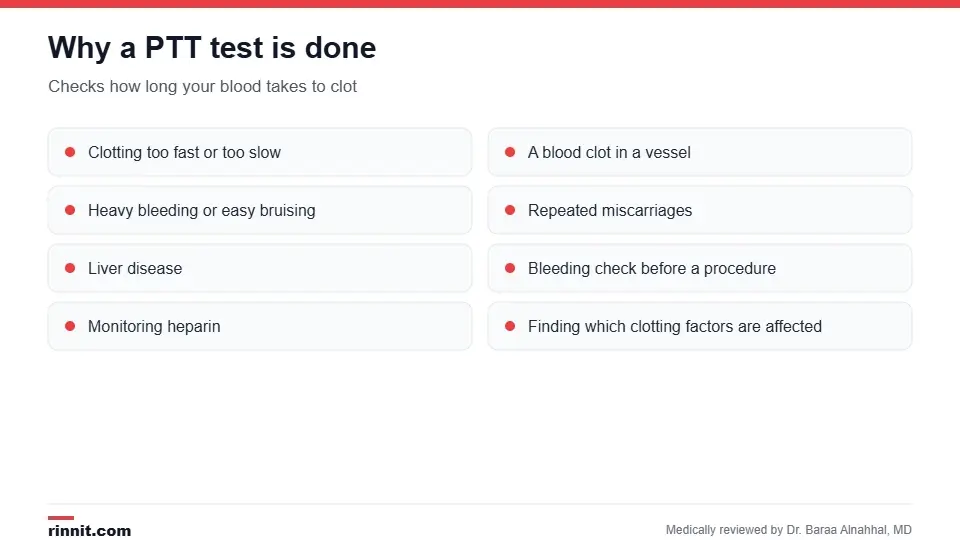
The PTT helps find and manage clotting problems.
Blood that clots too quickly or too slowly.
A blood clot in a vein or artery.
Heavy bleeding or many bruises.
Repeated miscarriages.
Liver disease.
Checking bleeding risk before surgery or a procedure.
Monitoring heparin doses.
Finding which clotting factors are involved. Sources: [1]
How to prepare
No special preparation is needed.
Drinking plenty of water may make your vein easier to find.
Wear short sleeves or sleeves that roll up easily.
Tell your provider about any blood thinners or supplements you take. Sources: [1]
What happens during the test

The blood draw takes just a few minutes.
You sit with your arm extended, and a band is tied around your upper arm.
The skin is cleaned and a small needle is inserted into a vein.
Blood is collected into a tube.
The band and needle are removed, pressure is applied and a bandage is placed.
In the lab, the plasma is activated and calcium is added to trigger clotting, and the time is measured. Sources: [1]
Risks
The PTT is a routine blood draw. You may feel a brief pinch, and a small bruise may appear that usually fades within a few days. Sources: [1]
What the results mean

Your provider interprets PTT with your symptoms and other tests.
Result | What it may mean |
About 25 to 35 seconds | Normal clotting time |
Prolonged (high) | Blood takes longer to clot |
Prolonged while on heparin | Expected; dose may be adjusted to stay in the target range |
Causes of a prolonged PTT include too much heparin, autoimmune disease, liver disease, a type of leukemia, inherited bleeding disorders such as hemophilia or von Willebrand disease, and vitamin K deficiency. An abnormal result may lead to more testing or a change in your heparin dose. Research shows that, for people with no history of bleeding, routine clotting tests before surgery predict bleeding poorly, so your provider weighs your history too. Sources: [1, 2, 3]
Conclusion
The PTT test is a quick blood test that shows how well part of your clotting system works. It helps diagnose bleeding and clotting disorders and keeps heparin treatment safe and effective.
Keep learning: read about the PT/INR test and blood clotting disorders.
Frequently asked questions
What is a PTT test?
A blood test that measures how long your blood takes to clot.
Is PTT the same as aPTT?
Yes, the terms are often used interchangeably.
What is a normal PTT?
About 25 to 35 seconds, depending on the lab.
What does a high PTT mean?
Your blood takes longer than normal to clot.
Why is PTT used with heparin?
To make sure the dose is in the right range.
What's the difference between PT and PTT?
They check different groups of clotting factors.
Do I need to fast?
No.
Does it hurt?
Only a brief pinch from the needle.
When will I get results?
Often the same day or within a few days.
What happens if my PTT is abnormal?
More tests or a medicine adjustment may follow.
Related Reading
Prothrombin Time (PT/INR) Test: Normal Ranges, Warfarin Targets and Results the companion clotting test.
Fibrinogen Test: Normal Range and What High or Low Fibrinogen Means a test of a key clotting protein.
D-dimer Test: What It Is, Why It's Done, How It Works and What Results Mean a test for blood clot breakdown.
Blood Clotting Disorders: Causes, Symptoms, and Treatment Explained conditions that affect clotting.
Understanding Warfarin: A Guide to Anticoagulant Therapy a common blood thinner.
References
Cleveland Clinic. Partial Thromboplastin Time (PTT) Test. Cleveland Clinic. Last updated June 20, 2023. https://my.clevelandclinic.org/health/diagnostics/25101-partial-thromboplastin-time
Raschke RA, Reilly BM, Guidry JR, et al. The weight-based heparin dosing nomogram compared with a "standard care" nomogram: a randomized controlled trial. Ann Intern Med. 1993;119(9):874-881. PMID 8214998. https://doi.org/10.7326/0003-4819-119-9-199311010-00002
Chee YL, Crawford JC, Watson HG, et al. Guidelines on the assessment of bleeding risk prior to surgery or invasive procedures. Br J Haematol. 2008;140(5):496-504. PMID 18275427. https://doi.org/10.1111/j.1365-2141.2007.06968.x
Medical disclaimer
This article is for general education only and does not replace advice from a qualified healthcare professional. Talk to your doctor about your own diagnosis and treatment, and seek emergency care right away for severe or sudden symptoms.



Comments