MELD Score: What It Measures, How to Read It and What It Means for a Liver Transplant

Updated: 6 days ago
Written and medically reviewed by Dr. Baraa Alnahhal, MD · Last reviewed: November 2026 · How we review
Quick Answer: What is a MELD score?
A MELD (Model for End-Stage Liver Disease) score is a number, usually between 6 and 40, that shows how sick you are with liver disease and how soon you may need a liver transplant. A higher score means more severe disease. [1]
Providers calculate it from blood tests (INR, bilirubin, creatinine, sodium and albumin) and your sex at birth; your care team also weighs your health history. It applies to people 12 and older; younger children use the PELD score. [1]
What the research says
MELD reliably predicts 3-month survival. Tested in four independent groups, the MELD scale predicted death within 3 months with concordance statistics of 0.78 to 0.87, and complications of portal hypertension added little to its accuracy. (Kamath et al., Hepatology, 2001) [2]
MELD 3.0 is more accurate and fairer to women. Using US waitlist data from 2016 to 2018, the updated MELD 3.0 (adding sex and albumin) discriminated slightly better than MELDNa (0.869 vs 0.862), moved a net 8.8% of people who died into a higher tier, and was projected to reduce waitlist deaths (7,788 vs 7,850). (Kim et al., Gastroenterology, 2021) [3]
Key takeaways
MELD stands for Model for End-Stage Liver Disease. [1]
Scores usually range from 6 to 40; higher means sicker. [1]
It uses INR, total bilirubin, creatinine, serum sodium and albumin, plus your sex at birth. [1]
It estimates your 90-day risk of death and how urgently you need a transplant. [1]
Some conditions can earn extra points when the score underestimates urgency. [1]
What is a MELD score?
MELD stands for Model for End-Stage Liver Disease. It is a mathematical formula that turns your blood test results, age and health history into a number, usually between 6 and 40. The number shows how soon you need a liver transplant: the higher your score, the sicker you are with liver disease. [1]
The MELD formula is for people 12 and older. For younger children, providers use the Pediatric End-Stage Liver Disease (PELD) model instead. [1]
How is a MELD score calculated?

Five lab values plus your health history.
Your MELD score includes more than your blood tests. The lab values it uses are: [1]
Lab value | What it shows |
INR (international normalized ratio) | How fast your blood clots; slower clotting usually means poorer liver function |
Total bilirubin | How well your liver processes and clears bile; higher levels mean poorer function |
Creatinine | Kidney function, which matters because the kidneys stop working as liver disease advances |
Serum sodium | Low levels point to poor liver function |
Albumin | A liver-made protein that holds water in the blood; low levels can signal poor liver function |
Sources: [1]
Other factors your care team considers
Your medical history, including the type and severity of your liver disease
Your age and sex recorded at birth
Other health conditions and whether they could cause complications
Social and lifestyle factors that may affect transplant success
What does your MELD score mean?
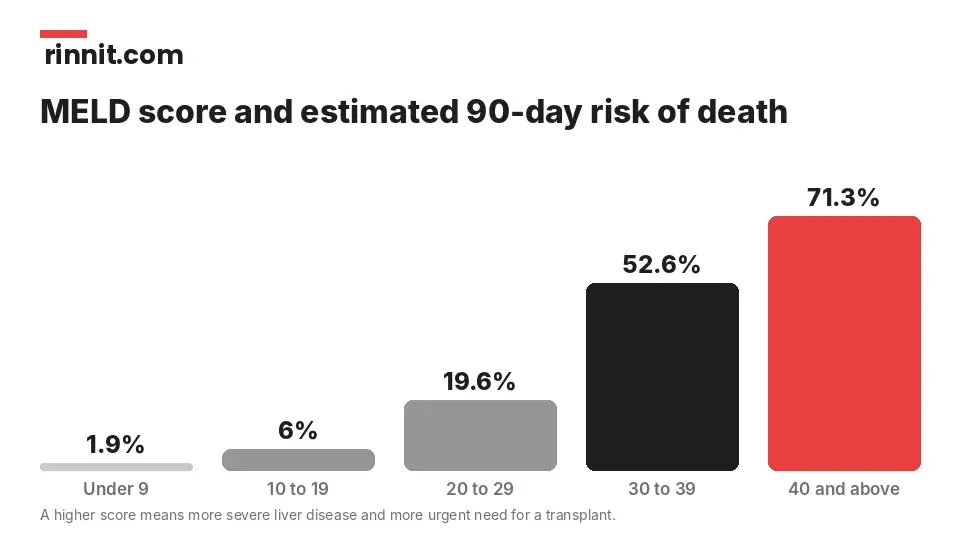
Risk rises steeply as the score climbs.
Providers use your score to estimate your risk of dying from liver disease within the next 90 days and how urgently you need a transplant: [1]
MELD score | Estimated 90-day risk of death |
Less than 9 | 1.9% |
10 to 19 | 6% |
20 to 29 | 19.6% |
30 to 39 | 52.6% |
Higher than 40 | 71.3% |
Sources: [1]
These are estimates for groups of people. It is impossible to know for sure what any one person's life expectancy is, so talk with your provider before drawing conclusions from your number. [1]
How is the MELD score used for the transplant list?
Your MELD score is one factor in where you are placed on the liver transplant waiting list, not the only one. Your blood type and how many donor livers are available in your region also affect how long you may wait. [1]
Does your MELD score change?
Yes. Your provider orders new blood tests regularly, and how often depends on how quickly your condition changes. Your score may go up if your condition worsens or down if it improves. [1]
Can you get extra MELD points?
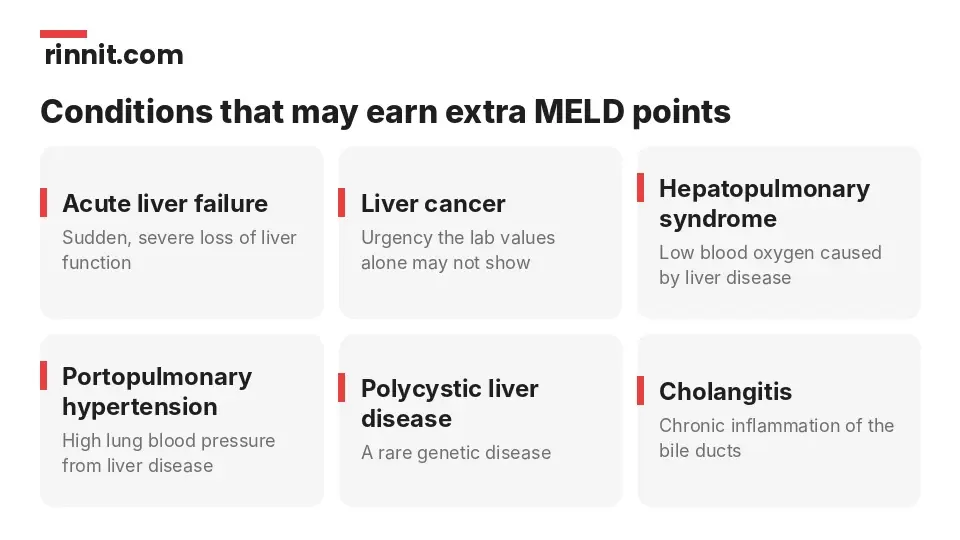
When the score may underestimate urgency.
Sometimes a score does not reflect how urgently someone needs a transplant. In that case, your provider can request extra points. Conditions that may qualify include: [1]
Acute liver failure
Liver cancer
Hepatopulmonary syndrome (low blood oxygen caused by liver disease)
Portopulmonary hypertension (high blood pressure in the lungs caused by liver disease)
Polycystic liver disease, a rare genetic disease
Cholangitis (chronic inflammation of the bile ducts)
What should you ask your care team?
Your MELD score is just one piece of the puzzle. Try not to overthink what it means until you have talked it through with your provider. Useful questions include how often your score will be updated, what is driving it up or down, and what else affects your place on the list. [1]
Conclusion
The MELD score turns a handful of blood tests and your health history into one number that guides how urgently you need a liver transplant. Higher scores mean more severe disease and a higher short-term risk. [1]
Because your score changes as your health changes, regular blood tests and open conversations with your transplant team matter as much as the number itself. [1]
Keep learning: Read our guides to cirrhosis and liver transplant, or see how liver function tests are read. For more background, see MedlinePlus on liver transplantation.
FAQ
What is a MELD score?
A number from about 6 to 40 that shows how severe liver disease is and how soon a transplant may be needed. [1]
What does MELD stand for?
Model for End-Stage Liver Disease. [1]
What blood tests are used in the MELD score?
INR, total bilirubin, creatinine, serum sodium and albumin. [1]
What is a high MELD score?
Higher scores mean sicker liver disease; a score of 30 to 39 carries an estimated 52.6% 90-day risk of death. [1]
What does a MELD score of 10 to 19 mean?
An estimated 6% risk of death within 90 days. [1]
Does the MELD score decide my place on the transplant list?
It is one factor; blood type and regional donor availability also matter. [1]
How often is a MELD score updated?
Your provider repeats blood tests regularly, depending on how fast your condition changes. [1]
Can a MELD score go down?
Yes, it can fall if your condition improves. [1]
What are MELD exception points?
Extra points your provider can request when the score underestimates urgency, such as for liver cancer. [1]
Is there a MELD score for children?
Children younger than 12 use the PELD score instead. [1]
Related Reading
Cirrhosis of the Liver: What It Is, How Permanent Scarring Damages Your Liver, and What Treatment Involves explains the scarring behind most end-stage liver disease.
Acute Liver Failure (Fulminant Hepatic Failure): Symptoms, Causes, and Emergency Treatment covers a condition that may qualify for extra MELD points.
Portal Hypertension: Complete Guide to Symptoms, Causes, Diagnosis, and Treatment explains a common complication of advanced liver disease.
Understanding Hepatorenal Syndrome: When Liver Disease Impacts Kidney Function explains why kidney function is part of the MELD score.
Liver Transplant: Who Qualifies, Surgery, Recovery and Survival explains the surgery the MELD score helps prioritize.
References
Cleveland Clinic. MELD (model for end-stage liver disease) Score. Cleveland Clinic. Last updated August 14, 2025. https://my.clevelandclinic.org/health/diagnostics/meld-score
Kamath PS, Wiesner RH, Malinchoc M, et al. A model to predict survival in patients with end-stage liver disease. Hepatology. 2001;33(2):464-470. PMID 11172350. https://doi.org/10.1053/jhep.2001.22172
Kim WR, Mannalithara A, Heimbach JK, et al. MELD 3.0: The Model for End-Stage Liver Disease Updated for the Modern Era. Gastroenterology. 2021;161(6):1887-1895.e4. PMID 34481845. https://doi.org/10.1053/j.gastro.2021.08.050
Medical disclaimer
This article is for general education only and does not replace advice from a qualified healthcare professional. Talk to your doctor about your own diagnosis and treatment, and seek emergency care right away for severe or sudden symptoms.



Comments