Child-Pugh Score: How Liver Disease Severity Is Calculated and What Classes A, B and C Mean

Updated: 2 days ago
Written and medically reviewed by Dr. Baraa Alnahhal, MD · Last reviewed: November 2026 · How we review
Quick Answer: What is the Child-Pugh score?
The Child-Pugh score is a scoring system that rates how severe chronic liver disease is, most often cirrhosis. It adds up points for five factors: bilirubin, albumin, clotting time, ascites and hepatic encephalopathy. Each factor scores 1 to 3 points, for a total of 5 to 15, which places you in class A, B or C. [1]
What the research says
Child-Pugh and MELD predict outcomes about equally well in most situations. A review of 119 studies with 269 head-to-head comparisons found no significant difference in 99; 44 favored MELD and 16 favored Child-Pugh, and Child-Pugh was more specific in people having surgery. (Peng et al., Medicine, 2016) [2]
Class C signals a higher long-term risk after intensive care. In a pooled analysis of 13 studies with 2,523 people with cirrhosis admitted to intensive care, Child-Pugh class C more than doubled the odds of death within 6 months among survivors (odds ratio 2.43). (Weil et al., Annals of Intensive Care, 2017) [3]
Hidden brain effects are common and track with Child-Pugh class. Across 101 studies, about 40.9% of people with cirrhosis had covert (minimal) hepatic encephalopathy, and its presence was linked to a worse Child-Pugh class. (Lv et al., American Journal of Gastroenterology, 2024) [4]
Key takeaways
The Child-Pugh score grades how severe liver disease is, mainly in people with cirrhosis. [1]
It scores five factors from 1 to 3 points each, for a total of 5 to 15 points. [1]
Class A (5 to 6 points) means the least severe, well-compensated disease, class B (7 to 9) moderate damage and class C (10 to 15) severe damage. [1]
Blood tests, imaging and a cognitive check are needed to work out the score. [1]
The score guides treatment choices, surgery decisions and the need for a liver transplant. [1]
Outlook figures tied to each class are only estimates, so talk them through with your provider. [1]
What is the Child-Pugh score?
The Child-Pugh score, also called the Child-Turcotte-Pugh score, is a tool providers use to rate how severe advanced liver disease is. It shows how well your liver is still working and how close it may be to failing. [1]
It is mainly used for people with cirrhosis, a late stage of chronic liver disease in which years of injury leave permanent scarring. Knowing the score helps your care team decide on next steps, including whether a liver transplant should be considered. [1]
What factors does the Child-Pugh score look at?
The score combines three blood test results with two clinical findings: [1]

Each of the five factors scores 1 to 3 points.
Total bilirubin: a yellow waste product that builds up in the blood when the liver cannot clear it
Serum albumin: a protein the liver makes; low levels suggest the liver is making less
Prothrombin time (PT) or INR: how long blood takes to clot, which depends on clotting proteins made by the liver
Ascites: fluid that collects in the abdomen
Hepatic encephalopathy: changes in thinking and alertness caused by toxins that build up when the liver is damaged
How do I get a Child-Pugh score?
Your provider gathers the information from a physical exam, blood tests and imaging. These may happen on different days and in different places. [1]
Blood tests: measure bilirubin, albumin and PT or INR
Imaging: an ultrasound or CT scan checks for ascites
Cognitive exam: checks memory, attention and thinking to look for hepatic encephalopathy
How is the Child-Pugh score calculated?
Each factor earns 1, 2 or 3 points, with 1 the least severe and 3 the most severe. Your provider adds the five scores together for a total between 5 and 15. [1]

The points from all five rows are added for a total of 5 to 15.
Factor | 1 point | 2 points | 3 points |
Total bilirubin (mg/dL) | Less than 2 | 2 to 3 | More than 3 |
Serum albumin (g/dL) | More than 3.5 | 2.8 to 3.5 | Less than 2.8 |
PT (seconds prolonged) or INR | Less than 4 seconds or INR less than 1.7 | 4 to 6 seconds or INR 1.7 to 2.3 | More than 6 seconds or INR more than 2.3 |
Ascites | None | Slight | Moderate |
Hepatic encephalopathy | None | Grade 1 to 2 | Grade 3 to 4 |
Sources: [1]
What do Child-Pugh classes A, B and C mean?
Your total points place you in one of three classes: [1]
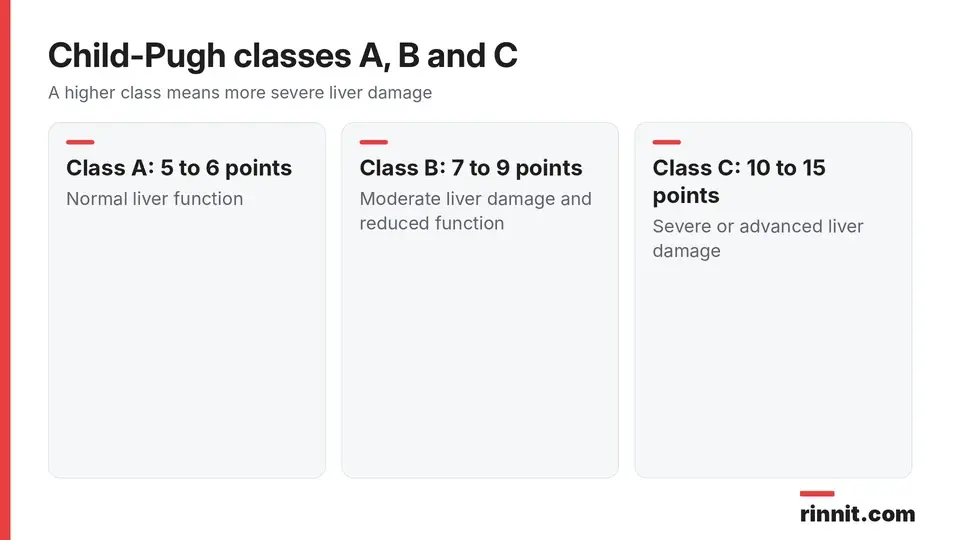
A higher class means more severe liver damage.
Class | Total points | What it means |
Class A | 5 to 6 | Least severe; the liver still works fairly well |
Class B | 7 to 9 | Moderate liver damage and reduced function |
Class C | 10 to 15 | Severe or advanced liver damage |
Sources: [1]
What does my Child-Pugh score tell my provider?
Your score helps your care team in three main ways: [1]
Guiding treatment: it helps decide whether medicine, surgery or a liver transplant is likely to help
Weighing surgery: it helps estimate the risk of an operation and the quality of life you can expect afterward
Estimating outlook: it helps predict prognosis and the risk of death with or without treatment
Survival figures linked to each class are estimates based on groups of people, not predictions for any one person. [1]
How does the Child-Pugh score compare with the MELD score?
The MELD (Model for End-Stage Liver Disease) score is another widely used tool for rating cirrhosis. In a large review, the two scores had similar predictive value in most situations, though each performed better in some specific groups, such as Child-Pugh in people having surgery. [2]
When should I call my provider?
Reach out to your provider if you have questions about your score, how it was worked out, what it means for you or what the next steps are. [1]
Try not to focus too much on the numbers before you talk with your provider. They can explain your result in the context of your overall health, and you are part of any treatment decision. [1]
Conclusion
The Child-Pugh score turns five pieces of information, three blood tests, a check for belly fluid and a check for brain effects, into a single number that shows how severe liver disease is. Classes A, B and C help your care team match treatment, surgery decisions and transplant planning to how well your liver is working.
Because the score is built from results that can change, ask your provider how your class was calculated and what it means for your own care plan.
Keep learning: Read our liver function tests guide. For more background, see StatPearls on the Child-Pugh score.
FAQ
What is the Child-Pugh score?
A scoring system that rates how severe chronic liver disease, usually cirrhosis, is.
What are the five factors in the Child-Pugh score?
Bilirubin, albumin, PT or INR, ascites and hepatic encephalopathy.
How is the Child-Pugh score calculated?
Each of the five factors gets 1 to 3 points, and the points are added for a total of 5 to 15.
What does Child-Pugh class A mean?
A score of 5 to 6 points, the least severe class, in which the liver still works fairly well.
What does Child-Pugh class B mean?
A score of 7 to 9 points, which means moderate liver damage.
What does Child-Pugh class C mean?
A score of 10 to 15 points, which means severe or advanced liver damage.
What tests are needed for a Child-Pugh score?
Blood tests, an ultrasound or CT scan for ascites and a cognitive exam for encephalopathy.
Is the Child-Pugh score the same as the Child-Turcotte-Pugh score?
Yes. They are two names for the same scoring system.
What is the Child-Pugh score used for?
To guide treatment, judge surgical risk, consider transplant and estimate outlook.
Is Child-Pugh better than MELD?
Research shows the two scores predict outcomes similarly in most situations.
Related Reading
Cirrhosis of the Liver: What It Is, How Permanent Scarring Damages Your Liver, and What Treatment Involves explains the condition the Child-Pugh score is mainly used to grade.
Hepatic Encephalopathy: Symptoms, Causes, and Treatment Explained covers the brain effects scored as one of the five factors.
Ascites: Fluid Buildup in the Belly — Causes, Symptoms, Grades, Diagnosis & Treatment (Complete Guide) describes the belly fluid that adds points to the score.
Portal Hypertension: Complete Guide to Symptoms, Causes, Diagnosis, and Treatment explains a common complication of cirrhosis that often leads to ascites.
References
Cleveland Clinic. Child-Pugh Score: How To Calculate & Classifications. Cleveland Clinic. Last updated August 22, 2025. https://my.clevelandclinic.org/health/diagnostics/child-pugh-score
Peng Y, Qi X, Guo X. Child-Pugh Versus MELD Score for the Assessment of Prognosis in Liver Cirrhosis: A Systematic Review and Meta-Analysis of Observational Studies. Medicine (Baltimore). 2016;95(8):e2877. PMID 26937922. https://doi.org/10.1097/MD.0000000000002877
Weil D, Levesque E, McPhail M, et al. Prognosis of cirrhotic patients admitted to intensive care unit: a meta-analysis. Ann Intensive Care. 2017;7(1):33. PMID 28321803. https://doi.org/10.1186/s13613-017-0249-6
Lv XH, Lu Q, Deng K, et al. Prevalence and Characteristics of Covert/Minimal Hepatic Encephalopathy in Patients With Liver Cirrhosis: A Systematic Review and Meta-Analysis. Am J Gastroenterol. 2024;119(4):690-699. PMID 37856206. https://doi.org/10.14309/ajg.0000000000002563
Medical disclaimer
This article is for general education only and does not replace advice from a qualified healthcare professional. Talk to your doctor about your own diagnosis and treatment, and seek emergency care right away for severe or sudden symptoms.



Comments