Disseminated Intravascular Coagulation (DIC): A Rare Blood Clotting Disorder That Causes Organ Damage and Uncontrollable Bleeding — Symptoms, Causes, Diagnosis and Treatment — What You Need to Know

Updated: 2 days ago
Medically reviewed by Dr. Baraa Alnahhal, MD | Last reviewed: October 7, 2026
Medical emergency: Call 911 or go to the nearest emergency room immediately if you have heavy bleeding you cannot control, heart attack symptoms or stroke symptoms. This condition can cause serious complications, and these warning signs need emergency care right away.

Quick Answer
Disseminated intravascular coagulation (DIC) is a rare blood clotting disorder that can cause organ damage and uncontrollable bleeding. [1] It is a complication of serious conditions such as sepsis, cancer and pancreatitis. [1] Small clots first block blood vessels, then clotting factors run out and bleeding cannot be controlled. [1] [5] Treatment targets the trigger, plus transfusions and anticoagulants. [1]
What the research says
DIC carries a high risk of death, and the risk depends on the underlying disease. A systematic review and meta-analysis of 119 studies (sepsis was the most common underlying disease in 52 studies and trauma in 31) found that developing DIC raised the odds of dying by 3.15 times in sepsis and 4.80 times in trauma. Pooled mortality among people with DIC was 42% in sepsis, 36% in trauma, 32% in heat stroke, 28% in leukemia and 8% in snakebite (Umemura et al., Journal of Thrombosis and Haemostasis, 2025) [2].
Blood thinners may help only in the subgroup with sepsis-induced DIC. A meta-analysis of 24 randomized trials with 14,767 patients found no significant drop in mortality in the overall sepsis population or in sepsis-induced coagulopathy, but a significant reduction in sepsis-induced DIC (risk ratio 0.72, 95% confidence interval 0.62–0.85). Bleeding complications tended to increase similarly in all three groups (Umemura et al., Journal of Thrombosis and Haemostasis, 2016) [3].
Heparin alone has not been shown to improve survival in sepsis-associated DIC. A meta-analysis of three randomized trials (426 patients) found no significant difference in 28-day or in-hospital mortality with heparin (risk ratio 0.86, 95% CI 0.60–1.24); in the sepsis-associated DIC subgroup (109 patients) the risk ratio was 0.84 (95% CI 0.51–1.38). Bleeding complications were not increased (risk ratio 0.49, 95% CI 0.24–0.99) (Totoki et al., Thrombosis Journal, 2024) [4].
What is disseminated intravascular coagulation (DIC)?
Disseminated intravascular coagulation (DIC) is a rare blood clotting disorder that can cause organ damage and uncontrollable bleeding. It is a complication of different serious medical conditions that can be life-threatening if you do not receive treatment. [1]
What are the symptoms of DIC?
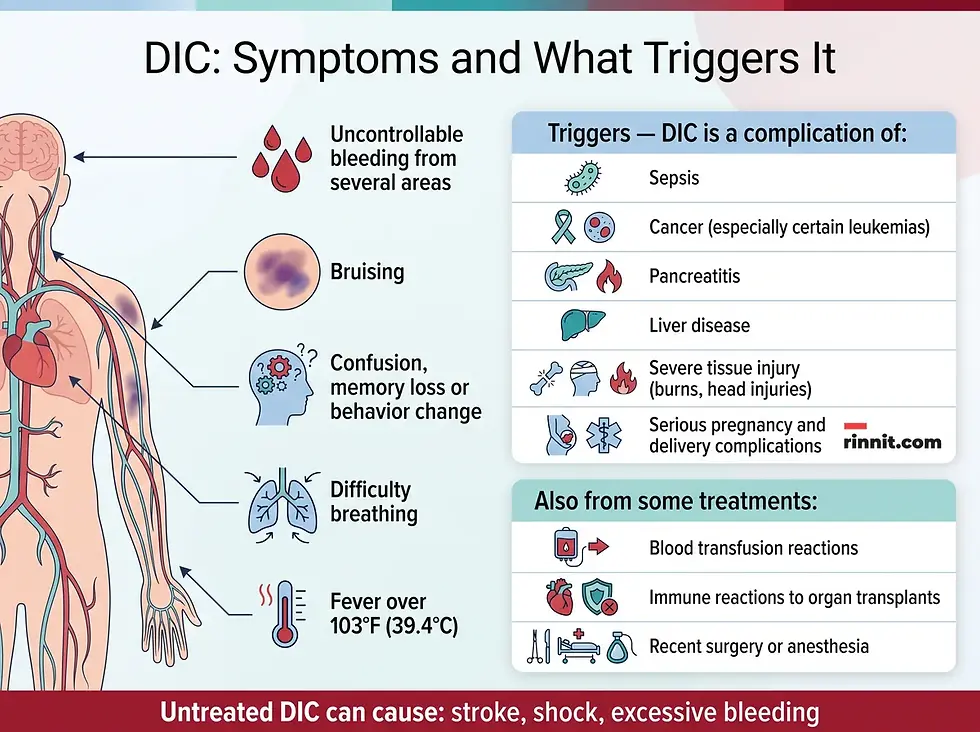
Symptoms may include uncontrollable bleeding from several areas of your body, bruising, confusion, memory loss or change of behavior, difficulty breathing (dyspnea), and a fever of more than 103 degrees Fahrenheit (39.4 degrees Celsius). [1]
Symptom | What you will notice |
Uncontrollable bleeding | Bleeding from several areas of your body that you cannot control |
Bruising | Bruises appearing around your body |
Confusion | Confusion, memory loss or change of behavior |
Difficulty breathing | Trouble catching your breath (dyspnea) |
High fever | Fever higher than 103°F (39.4°C) |
What causes DIC?
Your liver makes clotting factors (proteins) that stick to platelets in your blood to form a blood clot. [1] Normally, clots stop or slow bleeding and start your body’s healing process. In this disorder, your body develops more blood clots than you need. [1] There are two stages.
Stage | What happens |
Stage 1: clotting | Small blood clots start to block your blood vessels. This cuts off the blood supply to major organs. |
Stage 2: bleeding | Your platelets and clotting factors run out, leaving your body without a way to control bleeding. |
What conditions trigger DIC?
Risk factors include having serious infections or injuries, certain medical conditions or complications of some medical treatments.
Triggering condition | Detail |
Sepsis | A serious, body-wide infection |
Cancer | Especially certain types of leukemia |
Pancreatitis | Inflammation of the pancreas |
Liver disease | Disease affecting the organ that makes clotting factors |
Severe tissue injury | Including burns and head injuries |
Pregnancy complications | Serious complications from pregnancy and delivery |
Certain medical treatments can also cause it, including blood transfusion reactions, severe immune system reactions to organ transplants, and recent surgery or anesthesia. [1]
What are the complications of DIC?
Without treatment, the condition can cause stroke, shock and excessive bleeding. [1]
How is DIC diagnosed?
Healthcare providers will do a physical examination and ask about your medical history, specifically whether you have sepsis, cancer or other medical conditions that cause it. They may also use blood tests to confirm the diagnosis. [1]
Test | What it measures |
Complete blood count (CBC) | Overall blood cell levels |
Partial thromboplastin time (PTT) | How long your blood takes to clot via one pathway |
Prothrombin time (PT) test | How long your blood takes to clot via another pathway |
Fibrinogen test | Levels of the fibrinogen protein involved in clotting |
D-dimer test | Fragments left behind when a clot breaks down |
How is DIC treated?
Treatment starts with treating the condition or injury that triggered blood clot development. [1] [5] [7] Healthcare providers also take steps to reduce bleeding.
Treatment | What it does |
Plasma transfusions | Replace blood clotting factors affected by the disorder |
Red blood cell and/or platelet transfusions | Restore the cells your body has used up |
Anticoagulant medications (blood thinners) | Used in some cases, mainly when clotting rather than bleeding is the main problem, to help stop new clots from forming |
A note on anticoagulants: they may cause internal bleeding. [1] If you receive them, your healthcare provider will explain what steps you should take to reduce your risk of internal bleeding.

Can someone recover from DIC?
Yes, they can. Supportive treatments like anticoagulants and blood and platelet transfusions may stop blood clots from forming. [1] But healthcare providers still need to treat the medical issue that triggers it. [1]
How do you live with DIC?
Most people who have this condition are already coping with serious medical conditions or illnesses. If that is your situation, this diagnosis means you have another serious medical issue to manage. These suggestions may help.
Management step | Detail |
Take medicines regularly | Take all medicines as your healthcare provider prescribes; do not change the amount or skip a dose unless they tell you to |
Check before taking OTC products | Ask your provider before taking over-the-counter products such as pain relievers, vitamins, supplements or herbal remedies |
Schedule monitoring visits | Talk with your provider about how often to schedule office visits and blood tests to monitor your medications |
Keep all providers informed | If you are taking anticoagulants, make sure all your providers know so they can adjust treatment accordingly |
When should I seek care?
Call 911 or go to the nearest emergency room immediately if you have heavy bleeding that you cannot control, heart attack symptoms or stroke symptoms. [1] This condition can cause serious complications, and these warning signs require emergency care right away.
What questions should I ask my healthcare provider?
What is DIC?
Why did I develop it?
What are the chances of having it again?
What symptoms can I monitor?
What medications treat it, and how long will I need to take them?
What are the side effects, and how will the medications interact with others I take for other conditions?
A note from the experts: If you have this condition, you are already dealing with other serious medical issues, so it likely means more symptoms to monitor, more medications to take and more treatments to manage. If you feel overwhelmed, talk to your healthcare provider. They will understand what you are going through and can suggest programs or services that help.
The Bottom Line: What You Need to Know About DIC
Disseminated intravascular coagulation (DIC) is a rare blood clotting disorder that can cause organ damage and uncontrollable bleeding, and it is always a complication of something more serious: sepsis, cancer (especially certain leukemias), pancreatitis, liver disease, severe tissue injury, serious pregnancy and delivery complications, or a reaction to a medical treatment such as a blood transfusion, organ transplant rejection or recent surgery. [1]
The mechanism is paradoxical but logical once you see the two stages. First, your body develops more blood clots than you need, and small clots block your blood vessels and cut off the blood supply to major organs. Then your platelets and clotting factors, which your liver makes, run out, and your body has no way to control bleeding. [1] [5] That is why the symptoms mix both problems: uncontrollable bleeding from several areas, bruising, confusion or behavior changes, difficulty breathing and a fever over 103°F (39.4°C). [1]
Left untreated, it can cause stroke, shock and excessive bleeding. [1] Treatment means treating the trigger first, then supportive care: plasma transfusions to replace clotting factors, red blood cell and/or platelet transfusions, and anticoagulants, which carry their own internal-bleeding risk that your provider will help you manage. [1]
Recovery is possible. Supportive treatments may stop the clots from forming, but the underlying medical issue must still be treated [1], and living with the condition usually means managing it alongside other serious conditions. Take your medicines exactly as prescribed, ask before adding any over-the-counter product or supplement, keep all your providers informed if you are on anticoagulants, and talk to your provider if you feel overwhelmed.
Take the first step. If you or someone you care about is seriously ill (with sepsis, cancer, pancreatitis, a severe injury or a pregnancy complication) and starts bleeding from several places, acting confused, struggling to breathe or running a high fever, get emergency medical help immediately.
Frequently Asked Questions
What is disseminated intravascular coagulation (DIC)?
A rare blood clotting disorder that can cause organ damage and uncontrollable bleeding. It is a complication of different serious medical conditions that can be life-threatening without treatment.
Is it a disease on its own?
No. The disorder is a complication of different serious medical conditions, including sepsis, cancer, pancreatitis, liver disease, severe tissue injury and serious pregnancy complications.
What causes DIC?
In this disorder, your body develops more blood clots than you need. First, small blood clots block your blood vessels and cut off the blood supply to major organs. Then your platelets and clotting factors run out, leaving your body unable to control bleeding.
What are the symptoms of DIC?
Uncontrollable bleeding from several areas of your body, bruising, confusion, memory loss or change of behavior, difficulty breathing (dyspnea), and a fever higher than 103°F (39.4°C).
How high does the fever get?
A fever of more than 103 degrees Fahrenheit (39.4 degrees Celsius).
What conditions can trigger DIC?
Sepsis, cancer (especially certain types of leukemia), pancreatitis, liver disease, severe tissue injury (including burns and head injuries), and serious complications from pregnancy and delivery.
Can medical treatments cause it?
Yes. Blood transfusion reactions, severe immune system reactions to organ transplants, and recent surgery or anesthesia can all trigger it.
How common is it?
The condition is rare.
How is DIC diagnosed?
With a physical exam and a medical history focused on whether you have sepsis, cancer or other conditions that can cause it, plus lab tests: CBC, PTT, PT, fibrinogen and D-dimer.
How is the liver involved?
Your liver makes the clotting factors (proteins) that stick to platelets in your blood to form a clot, so liver disease is one of the conditions that can trigger it.
What happens if it is left untreated?
Without treatment, the condition can cause stroke, shock and excessive bleeding, and it can be life-threatening.
Is DIC an emergency?
Yes. Seek care or go to the ER right away if you have heavy bleeding you cannot control, heart attack symptoms or stroke symptoms.
How is DIC treated?
Treatment starts with treating the condition or injury that triggered the clotting. Providers then reduce bleeding with plasma transfusions to replace clotting factors, red blood cell and/or platelet transfusions, and anticoagulant medications (blood thinners).
Can anticoagulants cause side effects?
Yes. Anticoagulants may cause internal bleeding. Your provider will explain the steps you should take to reduce that risk.
Is full recovery possible?
Yes. Supportive treatments like anticoagulants and blood and platelet transfusions may stop blood clots from forming, but providers still need to treat the medical issue that triggered it.
What are the chances of having it again?
That is one of the key questions to ask your provider. It depends on the underlying condition that triggered it.
How do I take care of myself during treatment?
Take all medicines regularly as prescribed, and do not change the amount or skip a dose unless your provider says to. Ask before taking any OTC products, including pain relievers, vitamins, supplements or herbal remedies. Schedule office visits and blood tests to monitor your medications, and make sure all your providers know if you are taking anticoagulants.
Why should all my providers know I am on anticoagulants?
So they can adjust your treatment accordingly.
Why does coordinated care matter?
Most people with this disorder are already coping with serious medical conditions or illnesses, so this diagnosis means another serious medical issue to manage alongside them.
What questions should I ask my healthcare provider?
What is DIC? Why did I develop it? What are the chances of having it again? What symptoms can I monitor? What medications treat it, and how long will I need them? What are the side effects? How will they interact with my other medications?
Can it cause confusion?
Yes. Confusion, memory loss or a change of behavior are among the recognized symptoms of this disorder.
Can bleeding and clotting happen at the same time?
That is the two-stage paradox of this disorder: clotting first (small clots block vessels and cut off organ blood supply), then bleeding (platelets and clotting factors run out, so the body cannot control bleeding).
Related reading on Rinnit
D-dimer Test: What It Is, Why It's Done, How It Works and What Results Mean explains how a D-dimer test helps diagnose DIC and check whether treatment is working.
Sources
Cleveland Clinic. Disseminated Intravascular Coagulation (DIC). Cleveland Clinic. Last updated August 30, 2023. https://my.clevelandclinic.org/health/diseases/21836-disseminated-intravascular-coagulation-dic
Umemura Y, Scarlatescu E, Nwagha TU, et al. Mortality, diagnosis, and etiology of disseminated intravascular coagulation-a systematic review and meta-analysis: communication from the ISTH SSC subcommittee on disseminated intravascular coagulation. J Thromb Haemost. 2025;23(8):2663-2679. PMID 40383152. https://doi.org/10.1016/j.jtha.2025.04.033
Umemura Y, Yamakawa K, Ogura H, et al. Efficacy and safety of anticoagulant therapy in three specific populations with sepsis: a meta-analysis of randomized controlled trials. J Thromb Haemost. 2016;14(3):518-530. PMID 26670422. https://doi.org/10.1111/jth.13230
Totoki T, Koami H, Makino Y, et al. Heparin therapy in sepsis and sepsis-associated disseminated intravascular coagulation: a systematic review and meta-analysis. Thromb J. 2024;22(1):84. PMID 39350146. https://doi.org/10.1186/s12959-024-00653-0
Levi M, Scully M. How I treat disseminated intravascular coagulation. Blood. 2018;131(8):845-854. PMID 29255070. https://doi.org/10.1182/blood-2017-10-804096
Papageorgiou C, Jourdi G, Adjambri E, et al. Disseminated Intravascular Coagulation: An Update on Pathogenesis, Diagnosis, and Therapeutic Strategies. Clin Appl Thromb Hemost. 2018;24(9_suppl):8S-28S. PMID 30296833. https://doi.org/10.1177/1076029618806424
Adelborg K, Larsen JB, Hvas AM. Disseminated intravascular coagulation: epidemiology, biomarkers, and management. Br J Haematol. 2021;192(5):803-818. PMID 33555051. https://doi.org/10.1111/bjh.17172
Related Reading
Fibrinogen Test: Normal Range and What High or Low Fibrinogen Means explains the blood test for a key clotting protein.
Medical disclaimer
This article is provided for general educational purposes only and is not a substitute for professional medical advice, diagnosis or treatment. DIC is a life-threatening medical emergency: seek immediate emergency care for heavy uncontrolled bleeding, heart attack symptoms or stroke symptoms. Only a qualified healthcare provider can diagnose DIC, identify its underlying trigger and manage its complex, dual-phase treatment safely.



Comments