Axillo-Subclavian Vein Thrombosis: The Blood Clot Condition That Strikes Active People — and How It's Treated

Updated: 2 days ago
Medically reviewed by Dr. Baraa Alnahhal, MD. Last reviewed October 13, 2026. This content is for educational purposes and is not medical advice.

Quick Answer
Axillo-subclavian vein thrombosis, also called Paget-Schroetter syndrome, is a blood clot in the shoulder or armpit vein caused when a rib or muscle compresses it, often from repetitive overhead arm movements. It mainly affects active people ages 15 to 45 and causes sudden arm swelling and pain. Treatment includes clot-dissolving drugs and months of blood thinners.
What the research says
Blood thinners alone are usually not enough. A review of effort thrombosis concluded that conservative management with anticoagulation alone is inadequate and leads to significant residual disability. It found that an aggressive multimodal strategy, catheter-directed thrombolysis with or without early thoracic outlet decompression, is essential for optimizing outcomes, and that Doppler ultrasonography is the preferred first test while contrast venography remains the gold standard (Alla et al., Western Journal of Emergency Medicine, 2010).
The vein is squeezed in a specific anatomic spot, which changes how it is treated. A vascular surgery review describes subclavian vein effort thrombosis as a condition of young, active, otherwise healthy people caused by compression and repetitive injury of the vein between the first rib and the collarbone, along with nearby muscles and ligament. It is distinct from other deep vein thromboses and calls for early venography, thrombolysis, and prompt surgical decompression of the thoracic outlet (Thompson, Seminars in Interventional Radiology, 2012).
Early diagnosis and treatment improve symptoms and quality of life. A review of venous thoracic outlet syndrome (Paget-Schroetter syndrome) describes treatment as anticoagulation, catheter-directed thrombolysis, and surgical decompression, and concludes that early diagnosis and treatment can improve symptoms and quality of life (Hangge et al., Cardiovascular Diagnosis and Therapy, 2017).
What Is Axillo-Subclavian Vein Thrombosis?
Axillo-subclavian vein thrombosis (ASVT) occurs when a blood vessel in your upper arm gets compressed by a nearby rib or muscle and blood clots develop. ASVT may develop in the subclavian vein in your shoulder or the axillary vein in your armpit.
It usually results from injury or repeated stress to one or both of your upper arms. Because of that connection to physical effort, providers also call the condition Paget-Schroetter syndrome or "effort-induced thrombosis."
Is Axillo-Subclavian Vein Thrombosis the Same as Deep Vein Thrombosis?
ASVT is a form of deep vein thrombosis (DVT), a blood clot that forms in a vein deep in your body, usually in your legs. But the two conditions differ in meaningful ways. DVT risk factors include obesity, inactivity, advanced age, and underlying blood vessel disorders. ASVT, on the other hand, is usually the result of sudden injury or overuse. The two conditions present with different symptoms and need different treatment.
Feature | ASVT | Typical leg DVT |
Location | Subclavian vein (shoulder) or axillary vein (armpit) | Vein deep in the body, usually the legs |
Typical cause | Sudden injury or overuse. Vein compression by a rib or muscle. | Obesity, inactivity, advanced age, blood vessel disorders |
Typical patient | Active, healthy people ages 15 to 45 | Broader population, often with mobility or health risk factors |
Treatment approach | Thrombolysis, thrombectomy, blood thinners, sometimes decompression surgery | Different protocols from ASVT |
How Common Is Axillo-Subclavian Vein Thrombosis?
ASVT isn't common. It affects 1 to 2 people out of every 100,000 per year. But it accounts for 10% to 20% of all instances of upper extremity DVT (blood clots in the arms).
Who Gets Axillo-Subclavian Vein Thrombosis?
Anyone can get ASVT, but it's most common in people who are active and otherwise healthy; are between 15 and 45 years old; play sports or have jobs that require repetitive overhead arm movements or heavy lifting; and have blood clotting disorders.
Risk factor | Why it matters |
Ages 15 to 45 | The age range where ASVT is most common |
Active and otherwise healthy | The condition often strikes fit, athletic people |
Repetitive overhead arm movements | Sports and jobs with overhead motion or heavy lifting stress the vein |
Blood clotting disorders | Underlying clotting issues raise the risk |
Are There Different Types of Axillo-Subclavian Vein Thrombosis?
ASVT is a type of upper extremity DVT. There are two types:
Type | Cause |
Primary ASVT | The result of strenuous arm movements |
Secondary ASVT | The result of medical devices implanted in your upper chest |
Devices that can cause secondary ASVT include a central venous catheter, defibrillator, pacemaker, or medication port.
What Are the Symptoms of Axillo-Subclavian Vein Thrombosis?
Symptoms of ASVT may include arm pain; bulging arm veins; cyanosis, or a bluish tint to the skin of your arm; heaviness or fatigue in your arm; and sudden swelling in your arm.
The most important thing to understand about these symptoms: in 10% to 20% of cases, the clots can dislodge from upper arm veins and travel to your lungs. This clot is called a pulmonary embolism (PE). A PE can cause serious lung damage or even death.
Symptom | What you notice |
Arm pain | Pain in the affected arm |
Bulging arm veins | Veins in the arm look enlarged or stand out |
Cyanosis | A bluish tint to the skin of your arm |
Heaviness or fatigue | The arm feels heavy or tired |
Sudden swelling | The arm swells up quickly |
Pulmonary embolism (10% to 20% of cases) | A clot breaks off and travels to the lungs, which can cause serious lung damage or even death |

What Causes Axillo-Subclavian Vein Thrombosis?
Repetitive arm movements can cause inflamed muscles around your shoulder or armpit to put pressure on and injure veins. This may cause scar tissue to form, narrowing your blood vessels and reducing blood flow. This type of thoracic outlet syndrome (TOS) might not cause problems initially. But over time, clots can form in the subclavian or axillary veins and lead to serious problems. Sometimes abnormalities in your first rib bone, muscles, or ligaments surrounding the axillary and subclavian veins contribute to ASVT.
Cause | How it leads to a clot |
Repetitive arm movements | Inflamed muscles around the shoulder or armpit press on and injure veins |
Scar tissue | Narrows blood vessels and reduces blood flow |
Thoracic outlet syndrome (TOS) | May not cause problems at first, but clots can form over time |
Rib, muscle, or ligament abnormalities | Abnormalities in the first rib or surrounding structures contribute to vein compression |
How Is Axillo-Subclavian Vein Thrombosis Diagnosed?
A healthcare provider typically notices signs of ASVT during a physical examination. Your provider may order tests to examine your blood vessels, such as:
Test | What it does |
Duplex ultrasound | Uses sound waves to look at blood flow in the vein |
Catheter-guided venography | A catheter delivers dye to visualize the veins |
CTA (computerized tomography angiography) | CT imaging of the blood vessels |
MRA (magnetic resonance angiography) | MRI imaging of the blood vessels |
How Is Axillo-Subclavian Vein Thrombosis Treated?
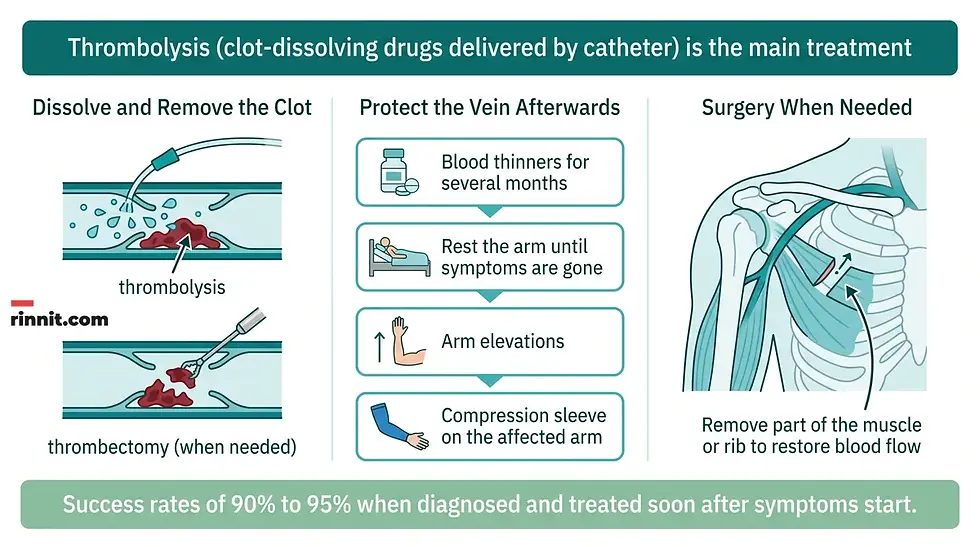
Thrombolysis, or thrombolytic therapy, is the main treatment for ASVT. Your healthcare provider delivers a clot-dissolving drug directly to the blocked vein through a catheter (a thin, flexible tube). They may combine this with a thrombectomy, a procedure to physically remove blood clots. After thrombolysis, you receive blood-thinning medication for several months to prevent new clots.
Your healthcare provider will also likely have you:
Avoid using your arm until symptoms are gone.
Do arm elevations.
Participate in physical therapy.
Use a compression sleeve on the affected arm.
Treatment step | What happens |
Thrombolysis (main treatment) | A clot-dissolving drug is delivered directly to the blocked vein through a catheter |
Thrombectomy (sometimes) | A procedure to physically remove blood clots |
Blood-thinning medication | Taken for several months after thrombolysis to prevent new clots |
Arm rest | Avoid using your arm until symptoms are gone |
Arm elevations | Elevating the arm helps recovery |
Physical therapy | Helps restore function |
Compression sleeve | Worn on the affected arm |
Will I Need Surgery for Axillo-Subclavian Vein Thrombosis?
In some cases, you may need surgery to decompress the affected veins completely. The surgery may involve removing a portion of the muscle or rib nearest the vein to restore blood flow.
What's the Outlook After Treatment?
Most people have excellent outcomes after ASVT treatment. Studies show success rates of 90% to 95% if the condition is diagnosed and treated soon after symptoms start. But some people develop a complication called post-thrombotic syndrome (PTS). PTS can cause chronic pain, heaviness, and swelling in your affected arm.
How Can I Prevent Axillo-Subclavian Vein Thrombosis?
You can reduce your risk of ASVT by doing regular, gentle arm movements and stretches; not overworking your arm muscles; resting between periods of heavy lifting or intense physical activity; and using your non-dominant arm when you can.
Prevention habit | How it helps |
Regular, gentle arm movements and stretches | Keeps the veins and muscles around the shoulder and armpit moving |
Not overworking your arm muscles | Reduces the repetitive stress that compresses the vein |
Resting between heavy lifting or intense activity | Gives the arm time to recover from strain |
Using your non-dominant arm | Spreads the workload and reduces strain on one side |
When Should I Contact My Healthcare Provider?
Contact your healthcare provider right away at the first signs of ASVT. Call 911 or go to the emergency room if you experience chest pain; numbness in your upper or lower limbs; or shortness of breath (dyspnea). Shortness of breath may signal a pulmonary embolism.
What Questions Should I Ask My Healthcare Provider?
Are there lifestyle changes I can make to reduce my risk of blood clots?
Can I continue to exercise and perform overhead arm movements?
How can I prevent blood clots from forming again?
How long do I need to take blood-thinning medication?
Conclusion and next steps
Axillo-subclavian vein thrombosis may be rare, but its pattern is unmistakable: an active, healthy person between 15 and 45 develops sudden arm swelling, pain, bulging veins, and a bluish tint to the skin after heavy overhead activity. The clot forms because a rib or muscle compresses the vein in the shoulder or armpit. The good news is that treatment works: thrombolysis, often combined with thrombectomy and followed by months of blood thinners, brings success rates of 90% to 95% when the condition is caught early. Rest the arm, elevate it, do physical therapy, and wear a compression sleeve while you recover.
Take action: Knowing the warning signs (sudden arm swelling, pain, bulging veins, and a bluish tint) helps you act before a clot travels to your lungs. Don't wait: in 10% to 20% of cases a clot can break off and travel to the lungs. And simple habits like gentle stretching, resting between heavy lifting sessions, and using your non-dominant arm can lower your risk in the first place.
Frequently asked questions
What is axillo-subclavian vein thrombosis? ASVT occurs when a blood vessel in your upper arm gets compressed by a nearby rib or muscle and blood clots develop. It may affect the subclavian vein in your shoulder or the axillary vein in your armpit, and it's also called Paget-Schroetter syndrome or "effort-induced thrombosis" [1].
Is ASVT a form of deep vein thrombosis? Yes. ASVT is a form of DVT (a blood clot that forms in a deep vein), but unlike typical leg DVT it's usually the result of sudden injury or overuse rather than obesity, inactivity, or advanced age, and the two conditions need different treatment [1] [5].
Who is most likely to get ASVT? Anyone can get it, but it's most common in active, otherwise healthy people ages 15 to 45 who play sports or have jobs requiring repetitive overhead arm movements or heavy lifting, or who have blood clotting disorders [1].
How common is ASVT? It isn't common. It affects 1 to 2 people out of every 100,000 per year, but it accounts for 10% to 20% of all upper extremity DVT cases [1].
What's the difference between primary and secondary ASVT? Primary ASVT results from strenuous arm movements. Secondary ASVT results from medical devices implanted in your upper chest, such as a central venous catheter, defibrillator, pacemaker, or medication port [1].
What are the symptoms of ASVT? Symptoms may include arm pain, bulging arm veins, cyanosis (a bluish tint to the skin of your arm), heaviness or fatigue in your arm, and sudden swelling in your arm [1].
What causes ASVT? Repetitive arm movements can cause inflamed muscles around your shoulder or armpit to press on and injure veins, forming scar tissue that narrows blood vessels and reduces blood flow. Abnormalities in the first rib, muscles, or ligaments can also contribute [1] [4].
How dangerous is ASVT? In 10% to 20% of cases, a clot can dislodge from the upper arm veins and travel to the lungs as a pulmonary embolism (PE), which can cause serious lung damage or even death [1].
How is ASVT diagnosed? A provider typically notices signs during a physical exam and may order a duplex ultrasound, catheter-guided venography, CTA (computerized tomography angiography), or MRA (magnetic resonance angiography) to examine the blood vessels [1] [2].
How is ASVT treated? The main treatment is thrombolysis, a clot-dissolving drug delivered directly to the blocked vein through a catheter. It may be combined with thrombectomy (physically removing the clot), followed by several months of blood-thinning medication, plus arm rest, elevations, physical therapy, and a compression sleeve [1] [2] [3].
Will I need surgery? In some cases, yes. Surgery can decompress the affected veins completely by removing a portion of the muscle or rib nearest the vein to restore blood flow [1] [4].
What is the outlook after treatment? Most people have excellent outcomes. Studies show success rates of 90% to 95% if the condition is diagnosed and treated soon after symptoms start [1].
What is post-thrombotic syndrome? A complication some people develop after treatment. PTS can cause chronic pain, heaviness, and swelling in the affected arm [1].
Can I prevent ASVT? You can reduce your risk by doing regular, gentle arm movements and stretches, not overworking your arm muscles, resting between periods of heavy lifting or intense activity, and using your non-dominant arm when you can [1].
When should I seek immediate care? Contact your healthcare provider right away at the first signs of ASVT. Call 911 or go to the emergency room if you experience chest pain, numbness in your upper or lower limbs, or shortness of breath. These can signal a clot has traveled to your lungs [1].
Related Reading
Deep Vein Thrombosis (DVT): Symptoms, Causes, Diagnosis & Treatment — Complete Guide: the broader condition ASVT belongs to.
Pulmonary Embolism Guide: Symptoms, Causes, Diagnosis, and Treatment: the serious complication 10% to 20% of ASVT cases can develop.
Venous Thoracic Outlet Syndrome: Understanding Subclavian Vein Compression: the compression mechanism behind ASVT.
Venous Extremity Ultrasound: Checking Arm and Leg Veins for Blood Clots explains the ultrasound that checks arm and leg veins for blood clots.
Trusted External Resources
References
Cleveland Clinic. Axillo-Subclavian Vein Thrombosis. Cleveland Clinic. Last updated May 2, 2022. https://my.clevelandclinic.org/health/diseases/16770-axillo-subclavian-vein-thrombosis
Alla VM, et al. Paget-schroetter syndrome: review of pathogenesis and treatment of effort thrombosis. West J Emerg Med. 2010;11(4):358-62. PMID 21079709. https://pubmed.ncbi.nlm.nih.gov/21079709/
Hangge P, et al. Paget-Schroetter syndrome: treatment of venous thrombosis and outcomes. Cardiovasc Diagn Ther. 2017;7(Suppl 3):S285-S290. PMID 29399532. https://doi.org/10.21037/cdt.2017.08.15
Thompson RW. Comprehensive management of subclavian vein effort thrombosis. Semin Intervent Radiol. 2012;29(1):44-51. PMID 23448848. https://doi.org/10.1055/s-0032-1302451
Cleveland Clinic. Deep Vein Thrombosis. Cleveland Clinic. Last updated December 23, 2025. https://my.clevelandclinic.org/health/diseases/16911-deep-vein-thrombosis-dvt
Medical disclaimer
This article is for general informational purposes only and is not a substitute for professional medical advice, diagnosis, or treatment. Always seek the advice of your physician or other qualified health provider with any questions you may have regarding a medical condition. Never disregard professional medical advice or delay in seeking it because of something you have read here. If you experience chest pain, shortness of breath, or numbness in your limbs, seek emergency medical care immediately.



Comments