Chronic Venous Insufficiency (CVI): What It Is, Why It Happens, and How It Gets Treated

Updated: 3 days ago
Medically reviewed by Dr. Baraa Alnahhal, MD · Last reviewed: October 2026
Quick answer
Chronic venous insufficiency (CVI) is a condition in which damaged leg vein valves let blood flow backward and pool in the legs [1] [4]. It affects about 1 in 20 adults, often from weakened vein valves [1]. Symptoms include leg swelling, heavy legs, skin discoloration and ankle ulcers [1]. Treatment includes compression stockings, elevation, walking and, if needed, surgery [1] [3].
What the research says
According to PubMed:
Compression helps venous ulcers heal faster. A Cochrane review of 14 randomized trials (1,391 participants) found moderate-certainty evidence that compression bandages or stockings shorten the time to complete healing of venous leg ulcers (pooled hazard ratio 2.17, 95% CI 1.52–3.10; 5 studies, 733 participants), make complete healing within 12 months more likely (risk ratio 1.77, 95% CI 1.41–2.21), and probably lower pain (mean difference −1.39). (Shi et al., Cochrane Database of Systematic Reviews, 2021) [2].
Pain is a common first symptom, and lifestyle change is the foundation of treatment. A comprehensive review describes pain as often the presenting symptom of CVI, with lifestyle modification as the foundation of treatment, compression devices and medications as safe and effective options, and minimally invasive vein procedures reducing complications and recovery time (long-term outcomes still need research). (Orhurhu et al., Cardiology and Therapy, 2021) [3].
Water-based therapy may help comfort, but not disease severity. A Cochrane review of 7 randomized trials (891 participants) of balneotherapy found moderate-certainty evidence of improved quality of life and pain compared with no treatment, but no improvement in venous clinical severity score or leg ulcer incidence. (de Moraes Silva et al., Cochrane Database of Systematic Reviews, 2019) [4].
What is chronic venous insufficiency?
Chronic venous insufficiency (CVI) is a form of venous disease. It happens when the veins in your legs are damaged and can't handle blood flow the way they should. Blood in your legs has a hard time returning to your heart. It pools in the leg veins instead, which drives up pressure and causes symptoms such as swelling and ulcers [1].
CVI can start in any of three types of leg veins:
Vein type | Where it is | What it does |
|---|---|---|
Deep veins | Large veins deep in the body, running through muscle | Carry most of the blood back toward the heart |
Superficial veins | Close to the skin's surface | Smaller veins near the top |
Perforating veins | Between the deep and superficial veins | Connect the two systems |
CVI often starts with mild symptoms. Over time, though, it can interfere with daily life and lead to serious complications [1].

Is chronic venous insufficiency serious?
Chronic venous insufficiency (CVI) usually isn't life-threatening and doesn't lead to amputation, but it's a progressive disease [1] [4]. Without treatment, the high pressure in your leg veins can burst your smallest blood vessels (capillaries). When that happens, the skin turns reddish-brown and breaks open easily if bumped or scratched [1]. Burst capillaries can cause:
Complication | What it is |
|---|---|
Tissue inflammation | Swelling and irritation in the affected area |
Tissue damage | Harm to the skin and tissue below |
Venous stasis ulcers | Open sores on the skin's surface that don't heal easily |
Venous stasis ulcers heal slowly and can become infected [1]. An infection can spread into nearby tissue, a condition called cellulitis that is dangerous without prompt treatment.
How common is chronic venous insufficiency?
Vein problems are very common overall. Varicose veins affect about 1 in 3 adults, and each year about 1 in 50 adults with varicose veins go on to develop CVI [1]. The condition usually affects people over age 50, and the risk climbs with age [1]. In total, about 1 in 20 adults has CVI.
What are the symptoms of chronic venous insufficiency?
CVI causes many symptoms in the legs and feet. They can get worse over time, or new ones can appear as the condition progresses. You may have only one or two, depending on how far it has advanced.
Symptom | What it feels or looks like |
|---|---|
Achy or tired legs | Soreness and fatigue in the legs |
Burning or tingling | A "pins and needles" sensation in the legs |
Night cramping | Leg cramps at night |
Swelling (edema) | Puffy lower legs and ankles, worse after standing a while or at the end of the day |
Heavy, full legs | A sense of weight and fullness in the legs |
Skin changes | Reddish-brown discoloration, flaking, itching, or leathery-looking skin |
Varicose veins | Bulging, twisted surface veins |
Ulcers | Open sores, usually near the ankles; very painful ones may be infected |
Severe swelling can cause scar tissue to form in the lower leg [1]. That scar tissue traps fluid, and the calf can feel large and hard to the touch, which leaves the skin more vulnerable to persistent ulcers.
What are the stages of chronic venous insufficiency?
Providers grade venous disorders on a scale from stage 0 to stage 6, based on clinical signs they can see or feel when examining your legs [1].
Stage | What it means |
|---|---|
0 | No visible or palpable signs; you may feel achy or tired legs |
1 | Visible blood vessels, including spider veins |
2 | Varicose veins at least 3 millimeters wide |
3 | Swelling (edema) with no skin changes |
4 | Changes to skin color and/or texture |
5 | A healed ulcer |
6 | An active (acute) ulcer |
You're diagnosed with CVI at stage 3 or above. Varicose veins alone don't mean you have CVI, but they signal blood flow problems that can worsen, so tell your provider about any new ones.
What causes chronic venous insufficiency?
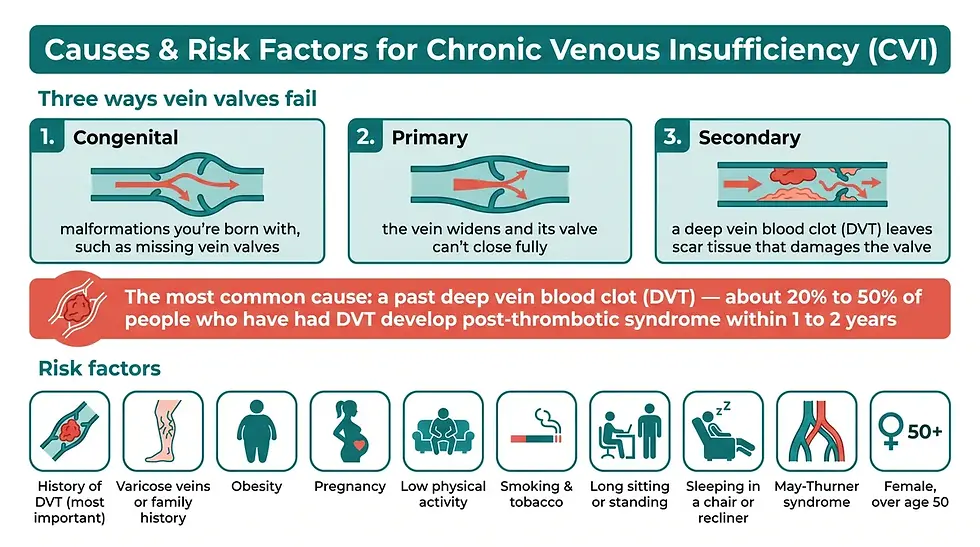
Chronic venous insufficiency is caused by damaged one-way valves in the leg veins, which normally keep blood moving toward the heart [1] [4]. If a valve is damaged, it can't close properly, gravity takes over, and blood flows backward [1] [4]. This backward flow is called venous reflux, and it's the core problem in CVI. Valve malfunction has three groups of causes:
Cause type | How it damages the valve |
|---|---|
Congenital | Vein malformations you're born with, such as missing leg vein valves |
Primary | Changes to the vein itself, such as widening that keeps the valve from closing fully |
Secondary | Another medical problem that damages the vein — usually a deep vein blood clot (DVT) whose scar tissue injures the valve |
A major cause is deep vein thrombosis (DVT), a blood clot in a deep leg vein. After the clot is gone, scar tissue can damage the vein, so people with a history of DVT face a higher risk of CVI [1]. About 20% to 50% of people who have had DVT develop post-thrombotic syndrome (CVI caused by a clot), usually within one to two years [1]. Learn more in our guide to deep vein thrombosis.
What are the risk factors?
History of DVT (the most important)
Varicose veins or a family history of varicose veins
Obesity
Pregnancy
Not getting enough physical activity
Smoking and tobacco use
Sitting or standing for long periods
Sleeping in a chair or recliner
May-Thurner syndrome
Being female
Being over age 50
How is chronic venous insufficiency diagnosed?
Diagnosis takes two main steps: a careful physical exam and imaging [1]. Your provider looks for clinical signs such as ulcers or skin color changes, then performs a vascular ultrasound, a painless test that uses sound waves to create an image of your veins and show which parts are damaged. They'll also rule out other conditions that could explain your symptoms, which may involve tests such as an MRI [1].
Many people with CVI also have peripheral artery disease (PAD), a separate circulation problem in the arteries, so your provider may check for it. Having both conditions changes how compression therapy should be used [1]. See our guide to peripheral artery disease for more.
What are the treatments for chronic venous insufficiency?
Treatment combines lifestyle changes and compression therapy [1] [3]. If those aren't enough, a procedure or surgery may be recommended, depending on how far the condition has progressed and on your other health conditions [1] [3]. The goals are to help blood flow better, help ulcers heal and stay healed, improve the skin's appearance, and reduce pain and swelling [1].
Treatment | What it involves |
|---|---|
Lifestyle changes | Leg elevation, walking and exercise, weight management — usually the first step |
Compression therapy | Prescription or over-the-counter stockings and bandages that ease swelling |
Medications | Antibiotics, blood thinners, or a medicated Unna boot wrap |
Procedures and surgery | Sclerotherapy, ablation, vein removal, SEPS, or vein bypass |
Lifestyle changes
Leg elevation. Lifting your legs above heart level reduces pressure in the leg veins. A common recommendation is 30 minutes or longer, at least three times per day [1].
Exercise. Walking improves blood flow. Each step squeezes your calf muscle, which pumps blood back toward the heart [1]. This "calf muscle pump" is sometimes called your "second heart." Your provider may also suggest foot and ankle flexing exercises.
Weight management. Extra weight presses on the veins and can damage valves [1]. Your provider can help you find a healthy weight and a plan to reach it.
Compression therapy
Compression stockings and bandages are a core CVI treatment that eases swelling and discomfort [1] [3]. There are many types, and very tight stockings require a prescription [1]. "Graduated" stockings are tighter at the ankle and looser further up the leg [1]. Many people struggle to keep wearing them long-term, so if that's you, talk with your provider: a different type or a more workable routine can make a big difference. If stockings don't help, intermittent pneumatic compression (IPC) devices are inflatable sleeves worn on the legs that push blood through the veins [1]. People with PAD need to use compression carefully [1], and some are advised against it entirely, depending on how extensive their PAD is.
Research supports compression for venous ulcers: a Cochrane review found that people using compression bandages or stockings probably heal faster and are more likely to have their ulcers completely heal [2] (Shi et al., 2021).
Medications
Medication | What it does |
|---|---|
Antibiotics | Clear skin infections or infected ulcers (they don't treat CVI itself) |
Anticoagulants ("blood thinners") | Treat blood clots and prevent new ones from forming |
Unna boot | A medicated wrap combining multilayer compression with a zinc oxide gel wound cover that forms a semi-rigid bandage |
Nonsurgical and surgical options
Procedure | How it works |
|---|---|
Sclerotherapy | A foam or liquid is injected into a spider or varicose vein, causing it to collapse or disappear |
Endovenous thermal ablation | Laser or radio-frequency heat closes a diseased large vein while leaving it in place, with minimal bleeding or bruising |
Ligation and stripping | Problem veins are cut and tied off (ligation), and larger veins are surgically removed through two small incisions (stripping) |
Microincision phlebectomy | A minimally invasive procedure that removes varicose veins near the skin's surface through small incisions or needle punctures |
SEPS (subfascial endoscopic perforator surgery) | A minimally invasive clip blocks damaged perforating veins above the ankle, helping ulcers heal and preventing recurrence |
Vein bypass | A healthy vein from elsewhere in the body reroutes blood around the damaged vein; reserved for severe cases when nothing else works |

Can chronic venous insufficiency be reversed or cured?
Treatment can't reverse the damage to your vein valves, and CVI can't be cured [1]. But treatment can reverse your symptoms, so you feel better and have a better quality of life. Some procedures remove or close damaged veins so blood no longer flows through them. The condition is manageable with lifestyle changes and the treatments your provider recommends, although venous ulcers are difficult to treat and may return even after healing [1]. That's why it's essential to keep every appointment and follow your plan closely.
How can I prevent chronic venous insufficiency?
Chronic venous insufficiency (CVI) sometimes can't be prevented, but everyday habits can lower your risk [1].
Risk factor | Prevention step |
|---|---|
Smoking and tobacco use | Avoid smoking and tobacco entirely |
Long sitting or standing | Get up and move as often as you can |
Restrictive clothing | Skip tight girdles and belts |
Unhealthy weight | Keep a healthy weight and eat a heart-healthy diet with less sodium |
Physical inactivity | Exercise regularly |
Past DVT | Your provider may recommend blood thinners (anticoagulants) |
How can you take care of chronic venous insufficiency at home?
Caring for chronic venous insufficiency at home includes avoiding long periods of standing or sitting, elevating your legs, exercising and wearing compression stockings as recommended [1].
Avoid long periods of standing or sitting. On long car or plane rides, flex and extend your legs, feet, and ankles about 10 times every 30 minutes [1]. If you must stand, take frequent breaks to sit and elevate your feet.
Check your skin every time you shower. Call your provider if you notice any changes, including new ulcers.
Elevate your legs above heart level when sitting or lying down.
Exercise regularly, especially walking.
Manage your weight with your provider's guidance.
Practice good skin hygiene. Wash and moisturize daily to prevent flaking and cracks that could become infected.
Wear compression stockings as recommended. This is one of the best ways to manage CVI, and your provider can advise on the right type and how to wash and care for them.
Call your provider if you have questions, new or changing symptoms, or stockings that don't fit right. Stockings that bunch up can block blood flow and make your condition worse [1].
When to seek emergency care: call your local emergency number right away if you develop symptoms of a pulmonary embolism, a life-threatening complication of deep vein thrombosis that needs immediate medical attention [1].
What questions should I ask my healthcare provider?
Useful questions about chronic venous insufficiency include what stage you are at, how to manage it at home and whether you need a procedure or surgery.
What stage of chronic venous insufficiency am I at?
How can I manage CVI at home?
How can you help me stick with compression therapy?
Do I need a procedure or surgery?
What can I do to prevent my CVI from getting worse?
What's the bottom line?
Chronic venous insufficiency starts quietly, with a tired, achy leg at the end of the day, but it's a progressive condition that deserves attention long before skin changes or ulcers appear. It's caused by damaged vein valves, most often after a deep vein blood clot, and it can't be cured [1]. It is highly manageable, though: leg elevation, regular walking, skin care, and compression therapy give most people meaningful relief and protect their skin, with procedures available when needed.
Ready to learn more? Visit Rinnit.com for trusted, easy-to-understand health guides like this one.
Conclusion
CVI can be frustrating when symptoms don't vanish overnight, but sticking with your plan is the key. You can't change the damaged valves, but you can change how much they affect your day-to-day life. If you notice swelling that builds during the day, visible vein changes, or skin discoloration, especially if you've had a blood clot, talk with your healthcare provider about a vascular ultrasound and a personalized plan.
Find more compassionate, plain-English health guides at Rinnit.com.
Related reading on Rinnit
Vascular Ultrasound: How It Checks Blood Flow, What It Finds and What to Expect explains the ultrasound that checks blood flow in arteries and veins.
Frequently Asked Questions
What is chronic venous insufficiency (CVI)?
CVI is a condition in which damaged valves in the leg veins can't keep blood flowing toward the heart. Blood pools in the legs instead, raising pressure in the leg veins and causing symptoms such as swelling and ulcers.
What does CVI feel like?
Most people describe achy, tired, heavy legs, swelling in the lower legs and ankles (especially at the end of the day), burning or tingling, night cramps, and skin that itches, flakes, or turns reddish-brown.
What causes chronic venous insufficiency?
Damaged vein valves let blood flow backward (venous reflux). The cause can be congenital (present at birth), primary (changes to the vein itself), or secondary (usually a deep vein blood clot that leaves scar tissue).
Is CVI the same as post-thrombotic syndrome?
Post-thrombotic syndrome is CVI caused by a past deep vein blood clot (DVT). About 20% to 50% of people who have had DVT develop it, usually within one to two years.
How common is CVI?
About 1 in 20 adults has it. Risk rises after age 50, and about 1 in 50 adults with varicose veins develop it each year.
Is chronic venous insufficiency serious?
Chronic venous insufficiency is usually not life-threatening and doesn't lead to amputation, but it's progressive. Untreated, it can cause skin discoloration, tissue damage, and hard-to-heal ulcers that can become infected (cellulitis).
What are the stages of CVI?
Venous disorders are staged 0 to 6 based on visible signs: 0 (no visible signs), 1 (spider veins), 2 (varicose veins 3 mm or wider), 3 (swelling), 4 (skin color or texture changes), 5 (healed ulcer), and 6 (active ulcer). CVI is diagnosed at stage 3 or higher.
Do varicose veins mean I have CVI?
Not necessarily. CVI is diagnosed at stage 3 or above (swelling or later). But varicose veins signal blood flow problems that can worsen, so report new ones to your provider.
How is CVI diagnosed?
With a physical exam of the legs plus a vascular ultrasound, a painless sound-wave test that images the veins and shows which parts are damaged. Other tests, such as an MRI, may rule out other conditions.
Does CVI go away on its own?
No. CVI can't be cured and valve damage can't be reversed, but symptoms can be reversed or well controlled with lifestyle changes, compression, medication, and procedures.
What is the best treatment for CVI?
Treatment is individualized. Most people start with leg elevation, walking, weight management, and compression stockings. If those aren't enough, options include medications, sclerotherapy, thermal ablation, vein ligation and stripping, SEPS, or vein bypass.
Do compression stockings really help?
Yes. They're one of the best ways to manage CVI, easing swelling and discomfort. Very tight stockings require a prescription, and graduated stockings are tighter at the ankle. Follow your provider's guidance on type and wear schedule, and speak up if they're hard to keep wearing.
What is an Unna boot?
A medicated wrap that combines multilayer compression with a zinc oxide gel-based wound cover, forming a semi-rigid bandage to help treat ulcers.
When is surgery needed for CVI?
When lifestyle changes and compression aren't enough. Options range from minimally invasive procedures such as sclerotherapy and SEPS to ligation and stripping. Vein bypass is reserved for severe cases when nothing else works.
Can I prevent chronic venous insufficiency?
Not always, but you can lower your risk by avoiding smoking, moving regularly instead of sitting or standing for long periods, avoiding tight restrictive clothing, eating a heart-healthy lower-sodium diet, exercising, and keeping a healthy weight. After a DVT, your provider may recommend blood thinners.
Does sitting all day make CVI worse?
Sitting or standing for long periods is a risk factor. On long trips, flex and extend your legs, feet, and ankles about 10 times every 30 minutes, and take breaks to sit and elevate your feet if you stand a lot.
What skin care should I do with CVI?
Wash and moisturize daily to prevent flaking and cracks that could become infected. Check your skin each time you shower and call your provider about any changes or new ulcers.
Why do my legs swell more at the end of the day?
Gravity pulls blood down into the legs. With damaged valves, the leg veins can't push it back efficiently, so swelling builds with standing and peaks toward evening. Elevating your legs above your heart helps.
Will my venous ulcers come back?
Venous ulcers can. Venous ulcers are difficult to treat and may return even after healing. Keeping all appointments, wearing compression as directed, and protecting your skin give you the best chance of staying ulcer-free.
When should I go to the ER for a vein problem?
Call your local emergency number right away if you have symptoms of a pulmonary embolism, a life-threatening complication of deep vein thrombosis. Call your provider promptly about very painful ulcers (which may be infected) or sudden symptom changes.
This article is for general informational purposes only and does not constitute medical advice, diagnosis, or treatment. Always seek the guidance of your physician or other qualified health provider with any questions about a medical condition. Never disregard professional medical advice or delay seeking care because of something you have read here. If you think you may have a medical emergency, call your local emergency number immediately.
References
Cleveland Clinic. Chronic Venous Insufficiency (CVI). Cleveland Clinic. Last updated July 17, 2022. https://my.clevelandclinic.org/health/diseases/16872-chronic-venous-insufficiency-cvi
Shi C, Dumville JC, Cullum N, Connaughton E, Norman G. Compression bandages or stockings versus no compression for treating venous leg ulcers. Cochrane Database Syst Rev. 2021;7(7):CD013397. PMID 34308565. https://doi.org/10.1002/14651858.CD013397.pub2
Orhurhu V, Chu R, Xie K, et al. Management of Lower Extremity Pain from Chronic Venous Insufficiency: A Comprehensive Review. Cardiol Ther. 2021;10(1):111-140. PMID 33704678. https://doi.org/10.1007/s40119-021-00213-x
de Moraes Silva MA, Nakano LC, Cisneros LL, Miranda F. Balneotherapy for chronic venous insufficiency. Cochrane Database Syst Rev. 2019;8(8):CD013085. PMID 31449319. https://doi.org/10.1002/14651858.CD013085.pub2



Comments