Coronary Artery Bypass Graft (CABG) Surgery: Procedure and Recovery

Updated: 2 days ago
Written and medically reviewed by Dr. Baraa Alnahhal, MD · Last reviewed: November 2026 · How we review
Quick Answer
Coronary artery bypass graft (CABG) surgery, or heart bypass surgery, creates a new path for blood to flow around a blocked coronary artery using a healthy blood vessel from the leg, arm or chest. It's the most common heart surgery in the world and treats coronary artery disease. About 8 in 10 people get relief from angina.
What the research says
Bypass helped most in three-vessel disease over 10 years: in the SYNTAX trial of 1,800 people with severe coronary disease, 24% died within 10 years after bypass surgery versus 28% after stenting, a difference that wasn't statistically significant overall; in three-vessel disease, deaths were 21% versus 28% (Thuijs DJFM et al., Lancet, 2019) [2]
One or two chest-artery grafts gave similar survival: in 3,102 bypass patients, 10-year death rates were similar with two internal chest-artery grafts (20.3%) or one (21.2%) (Taggart DP et al., New England Journal of Medicine, 2019) [3]
Key takeaways
CABG reroutes blood around blocked heart arteries.
Grafts come from blood vessels in your leg, arm or chest.
Surgery takes three to six hours.
Most people stay five to seven days and recover in about six weeks.
About 8 in 10 people get relief from angina.
What is CABG?
Over time, plaque can build up and narrow the coronary arteries that feed your heart. If not enough blood gets through, heart muscle can be damaged. CABG has been done since the 1960s and is the best option for many people with several blockages or blockages in certain locations. The average patient is about 66 years old. Sources: [1]
Why it's done
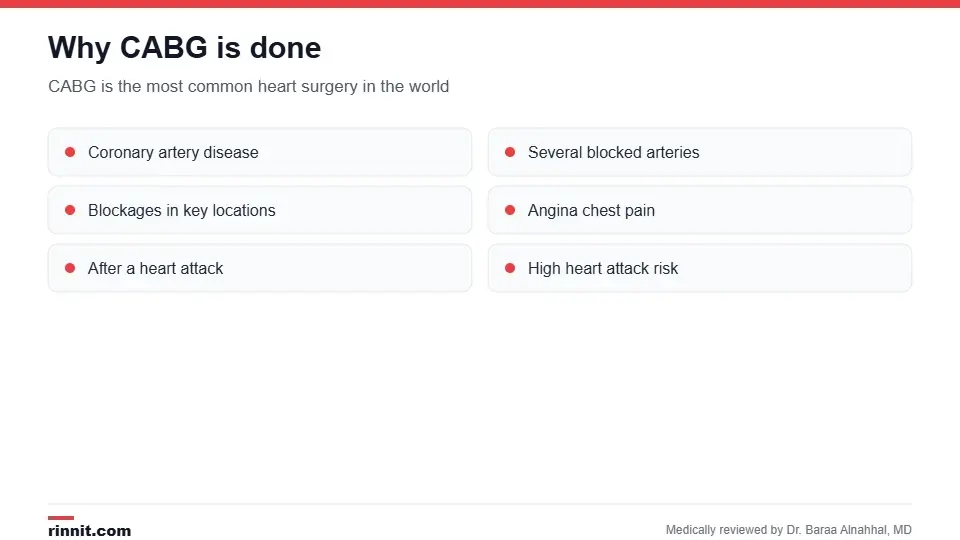
CABG is the most common heart surgery in the world.
Coronary artery disease with blockages in several arteries or in certain key locations.
Angina (chest pain) that medicines don't control.
A heart attack or a high risk of one.
Silent ischemia, when the heart doesn't get enough blood without causing symptoms. Sources: [1]
Compared with angioplasty, bypass surgery has a lower chance of needing another procedure later. Sources: [1, 2]
Types of bypass surgery
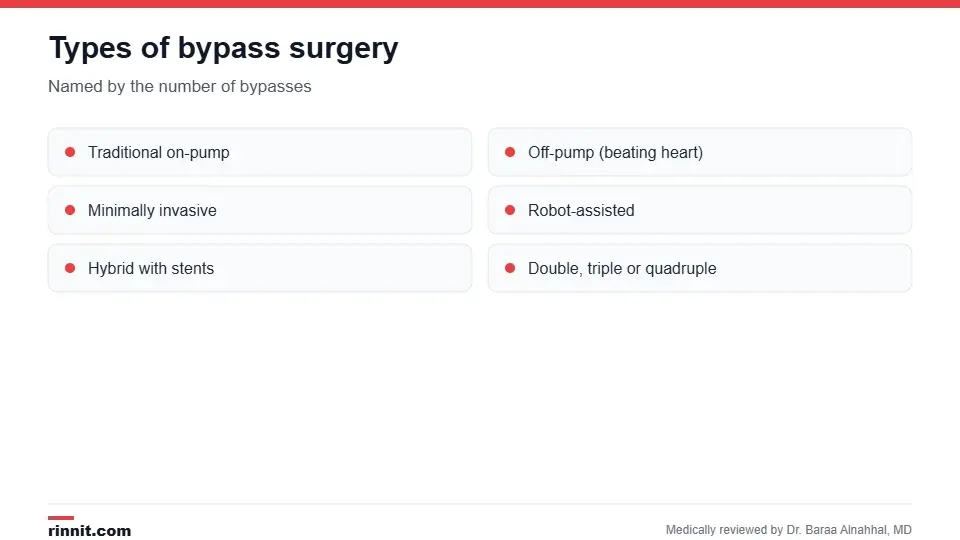
The number of bypasses gives it its name: double, triple or quadruple.
Type | What it means |
Traditional (on-pump) | The heart is stopped and a heart-lung machine takes over |
Surgery on a beating heart, without the machine | |
Minimally invasive | Smaller cuts between the ribs |
Robot-assisted or endoscopic | The breastbone isn't opened; several very small cuts |
Hybrid | Bypass on at least one artery plus stents in others |
The name depends on how many arteries are bypassed: double (2), triple (3) or quadruple (4). Grafts come from a leg vein, an arm artery or the internal mammary artery in the chest. Sources: [1]
How to prepare
You may have an EKG, echocardiogram, stress test, cardiac catheterization, CT angiography and blood and urine tests.
Your provider will tell you which medicines to stop or keep taking.
You'll stop eating and drinking several hours before surgery. Sources: [1]
What happens during surgery

Surgery takes three to six hours.
You get general anesthesia and are fully asleep.
The surgeon makes a cut down the middle of your chest and opens the breastbone, or uses smaller cuts in some cases.
A heart-lung machine takes over if your heart is stopped.
The graft is attached from just past the blockage to the aorta, or the internal mammary artery is connected below the blockage.
Your heart is restarted, your breastbone is wired together and the chest is closed. Sources: [1]
Risks
Risk | Notes |
Abnormal heart rhythms | Common after heart surgery |
Bleeding | May need treatment |
Infection | Including the chest wound |
Confusion or delirium | Usually temporary |
Kidney problems | Uncommon |
Stroke or heart attack | Rare |
Sources: [1]
Recovery
You'll start in the ICU, then move to a regular room.
Hospital stay is usually five to seven days, longer after a heart attack.
Full recovery takes about six weeks.
Cardiac rehab helps you rebuild strength safely.
Counseling can help with anxiety or depression after surgery.
Your provider will tell you when you can drive and return to work. Sources: [1]
Results
CABG is linked to longer survival, and about 8 in 10 people in clinical trials get relief from angina. Some people need another bypass 8 to 10 years later. Lowering your LDL cholesterol, avoiding tobacco, taking daily aspirin as prescribed and using more artery grafts help grafts last. Many people do well for 20 years or more. Sources: [1, 2, 3]
When to get emergency care
Chest pain, trouble breathing or a fast heartbeat.
Dizziness, lightheadedness or fainting.
Face drooping, weakness on one side or slurred speech.
Fever or chills. Sources: [1]
Conclusion
Bypass surgery restores blood flow to the heart and can ease chest pain and extend life, especially for people with several blocked arteries. Cardiac rehab and heart-healthy habits help keep your new grafts open.
Keep learning: read about coronary revascularization and open-heart surgery.
Frequently asked questions
What is CABG?
Surgery that reroutes blood around blocked heart arteries using a graft.
What is a triple bypass?
Bypass surgery on three blocked arteries.
Where do the grafts come from?
A vein from the leg, an artery from the arm or an artery in the chest.
How long does surgery take?
Three to six hours.
How long is the hospital stay?
Usually five to seven days.
How long is recovery?
About six weeks.
Is bypass better than a stent?
For several blockages, bypass often lowers the need for repeat procedures and may improve survival.
How long do bypass grafts last?
Many last 10 to 20 years or more; some people need another bypass 8 to 10 years later.
What are the risks?
Abnormal rhythms, bleeding, infection, confusion and, rarely, stroke.
What is off-pump bypass?
Surgery on a beating heart without a heart-lung machine.
Related Reading
Heart Surgery: Types, What to Expect and Recovery explains the types of heart surgery and recovery.
Cardiopulmonary Bypass: How the Heart-Lung Machine Works explains how the heart-lung machine supports heart surgery.
Triple Bypass Surgery: Who Needs It, What Happens, Risks, and Recovery bypass surgery on three arteries.
Off-Pump Bypass Surgery: How Beating-Heart CABG Works, Risks and Recovery bypass without stopping the heart.
Coronary Revascularization: PCI vs. Bypass Surgery, Risks and Recovery comparing stents and bypass surgery.
Understanding Radial Artery and Saphenous Vein Harvesting how graft vessels are taken.
Angioplasty: Procedure, Types, Risks and Recovery opening arteries with a balloon and stent.
References
Cleveland Clinic. Coronary Artery Bypass Graft (CABG) Surgery. Cleveland Clinic. Last updated August 22, 2025. https://my.clevelandclinic.org/health/treatments/16897-coronary-artery-bypass-surgery
Thuijs DJFM, Kappetein AP, Serruys PW, et al. Percutaneous coronary intervention versus coronary artery bypass grafting in patients with three-vessel or left main coronary artery disease: 10-year follow-up of the multicentre randomised controlled SYNTAX trial. Lancet. 2019;394(10206):1325-1334. PMID 31488373. https://doi.org/10.1016/S0140-6736(19)31997-X
Taggart DP, Benedetto U, Gerry S, et al. Bilateral versus single internal-thoracic-artery grafts at 10 years. New England Journal of Medicine. 2019;380(5):437-446. PMID 30699314. https://doi.org/10.1056/NEJMoa1808783
Medical disclaimer
This article is for general education only and does not replace advice from a qualified healthcare professional. Talk to your doctor about your own diagnosis and treatment, and seek emergency care right away for severe or sudden symptoms.



Comments