Heart Surgery: Types, What to Expect and Recovery

Updated: 2 days ago
Written and medically reviewed by Dr. Baraa Alnahhal, MD · Last reviewed: November 2026 · How we review
Quick Answer
Heart surgery (cardiac surgery) is any operation that treats problems with the heart or the blood vessels connected to it. It's used for coronary artery disease, heart valve disease, heart failure, arrhythmias, aortic aneurysms and congenital heart disease. Common types include coronary artery bypass grafting and valve repair. Recovery after open-heart surgery takes six to 12 weeks.
What the research says
Bypass surgery improved survival in three-vessel disease: in the SYNTAX trial of 1,800 people followed for 10 years, 24% died after bypass surgery versus 28% after stenting overall, and in three-vessel disease bypass clearly improved survival (21% vs. 28% deaths) (Thuijs DJFM et al., Lancet, 2019) [2]
Cardiac rehab lowered death risk after bypass: a meta-analysis of 31 studies with 228,337 patients found joining cardiac rehab after bypass surgery was linked to about 38% lower risk of death in retrospective cohorts (Salzwedel A et al., European Journal of Preventive Cardiology, 2020) [3]
Key takeaways
Heart surgery treats problems with the heart and its blood vessels.
Common types include bypass, valve surgery and device placement.
It can be open, off-pump, minimally invasive or robotic.
Open-heart recovery takes six to 12 weeks.
Cardiac rehab helps you recover.
What is heart surgery?
Heart surgery is usually planned, but it can be an emergency, such as after a heart attack. It can restore blood flow to the heart, repair valves or add a device to help your heart beat. Some conditions can be treated with less invasive options, such as PCI or EVAR. Sources: [1]
Conditions it treats

Surgery can restore blood flow, repair valves or add a device.
Coronary artery disease.
Heart failure.
Arrhythmias.
Congenital and structural heart disease. Sources: [1]
Types of heart surgery
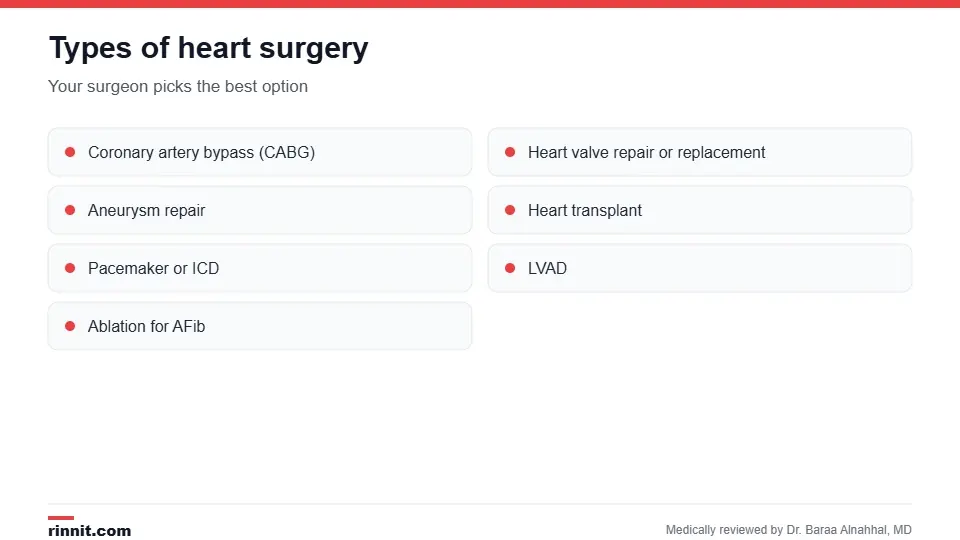
Your surgeon recommends the best type for your condition.
Surgery | What it does |
Reroutes blood around blocked arteries | |
Repairs or replaces a valve | |
Aneurysm surgery | Repairs a bulging artery |
Replaces a failing heart | |
Pacemaker or ICD | Controls heart rhythm |
Helps a weak heart pump | |
Ablation | Treats atrial fibrillation |
Sources: [1]
Surgical approaches
Approach | How it's done |
Open-heart | A 6- to 8-inch chest incision; a heart-lung machine takes over |
The heart keeps beating; no bypass machine | |
Smaller cuts, such as a 3- to 4-inch partial sternotomy | |
The surgeon controls robotic arms through small cuts |
Off-pump surgery is most common when bypassing one or two coronary arteries. Sources: [1]
How to prepare
You'll have tests such as blood tests, an EKG, echocardiogram, stress test, chest X-ray, coronary angiogram, cardiac CT or heart MRI.
Stop smoking and drinking alcohol.
You may need to stop some medicines.
Don't eat the day before surgery as instructed. Sources: [1]
What happens during surgery

Bypass surgery takes about three to six hours.
You get medicine to relax, then general anesthesia.
For open-heart surgery, the surgeon opens your chest and connects you to a heart-lung bypass machine.
The repair is done.
Your chest is closed, and you go to the ICU. Sources: [1]
Bypass surgery takes about three to six hours. Sources: [1]
Risks
Allergic reaction to anesthesia.
Irregular heart rhythms.
Bleeding or infection.
Confusion.
Damage to nearby vessels or organs.
Stroke. Sources: [1]
Risks are higher with diabetes, COPD, kidney disease, a higher BMI, peripheral artery disease and smoking. Sources: [1]
Recovery
You'll stay in the ICU for at least a day, then move to a regular room.
Chest clicking, bruising, constipation, poor sleep, low appetite and mood changes are common at first.
Recovery after open-heart surgery takes six to 12 weeks.
Cardiac rehab is recommended.
Quit smoking, eat a heart-healthy diet, take your medicines and keep follow-up visits. Sources: [1, 3]
Outlook
Heart surgery can save and change your life, and many people feel healthier afterward. Some live many years or decades after surgery. Sources: [1, 2]
When to get help
Chest pain that doesn't improve.
Fever, nausea or vomiting.
Shortness of breath.
Oozing or redness at the incision.
Chest clicking that lasts more than a week or two.
Call 911 for stroke signs: balance problems, vision changes, facial drooping, arm or leg weakness or trouble speaking. Sources: [1]
Conclusion
Heart surgery treats many serious heart problems and can greatly improve your health. Following your recovery plan and joining cardiac rehab help you get back to life.
Keep learning: read about coronary artery bypass surgery and heart valve surgery.
Frequently asked questions
What is heart surgery?
Surgery to treat problems with the heart or connected blood vessels.
What are the most common types?
Bypass surgery, valve surgery and placing devices like pacemakers.
What is open-heart surgery?
Surgery through a 6- to 8-inch chest incision, often using a heart-lung machine.
What is off-pump surgery?
Bypass surgery done while the heart keeps beating.
How long does bypass surgery take?
About three to six hours.
How long is recovery?
Six to 12 weeks after open-heart surgery.
Will I be in the ICU?
Yes, for at least a day.
What is cardiac rehab?
A supervised program to help you recover and strengthen your heart.
What are the risks?
Bleeding, infection, irregular heartbeat and stroke.
Is bypass better than stenting?
In three-vessel disease, studies show bypass improves survival.
Related Reading
Coronary Artery Bypass Graft (CABG) Surgery: Procedure and Recovery the most common heart surgery.
Heart Valve Surgery: Types, Procedure and Recovery repairing or replacing heart valves.
Minimally Invasive Heart Surgery: Types, Benefits, Risks, and Recovery heart surgery through smaller cuts.
Cardiac Rehab: Phases, Exercises, Benefits and What to Expect recovering after heart surgery.
Open-Heart Surgery: Procedure, Preparation, and Recovery more on open-heart surgery.
References
Cleveland Clinic. Heart (Cardiac) Surgery: Types and Recovery. Cleveland Clinic. Last updated April 2, 2026. https://my.clevelandclinic.org/health/treatments/17525-heart-surgery
Thuijs DJFM, Kappetein AP, Serruys PW, et al. Percutaneous coronary intervention versus coronary artery bypass grafting in patients with three-vessel or left main coronary artery disease: 10-year follow-up of the multicentre randomised controlled SYNTAX trial. Lancet. 2019;394(10206):1325-1334. PMID 31488373. https://doi.org/10.1016/S0140-6736(19)31997-X
Salzwedel A, Jensen K, Rauch B, et al. Effectiveness of comprehensive cardiac rehabilitation in coronary artery disease patients treated according to contemporary evidence based medicine: update of the Cardiac Rehabilitation Outcome Study (CROS-II). Eur J Prev Cardiol. 2020;27(16):1756-1774. PMID 32089005. https://doi.org/10.1177/2047487320905719
Medical disclaimer
This article is for general education only and does not replace advice from a qualified healthcare professional. Talk to your doctor about your own diagnosis and treatment, and seek emergency care right away for severe or sudden symptoms.



Comments