Heart Valve Surgery: Types, Procedure and Recovery

Updated: 2 days ago
Written and medically reviewed by Dr. Baraa Alnahhal, MD · Last reviewed: November 2026 · How we review
Quick Answer
Heart valve surgery repairs or replaces a heart valve that leaks or is too narrow. Options include valve repair, replacement with a tissue or mechanical valve, and transcatheter procedures such as TAVR that don't open the chest. Full recovery from open surgery takes about four to eight weeks. It's the only effective long-term fix for most valve disease.
What the research says
TAVR beat open surgery in lower-risk patients: in the PARTNER 3 trial of 1,000 low-risk people with severe aortic stenosis, death, stroke or rehospitalization at 1 year occurred in 8.5% after TAVR versus 15.1% after open surgery (Mack MJ et al., New England Journal of Medicine, 2019) [2]
Another valve type showed similar results: in 1,468 low-risk patients, death or disabling stroke at 2 years was 5.3% with TAVR versus 6.7% with surgery; TAVR caused less atrial fibrillation but more pacemakers (Popma JJ et al., New England Journal of Medicine, 2019) [3]
Key takeaways
Heart valve surgery repairs or replaces a leaking or narrowed valve.
Options include repair, tissue or mechanical valves, and catheter-based TAVR.
Surgery can be open-heart, minimally invasive or transcatheter.
Most people recover in four to eight weeks.
Mechanical valves need lifelong blood thinners.
What is heart valve surgery?
Your heart has four valves: the aortic, mitral, tricuspid and pulmonary valves. They open and close with each heartbeat. Heart valve disease happens when a valve becomes narrow (stenosis) or leaky (regurgitation). It doesn't go away on its own, and medicines become less helpful as it worsens, so surgery is the only effective long-term solution. Sources: [1]
Why it's done
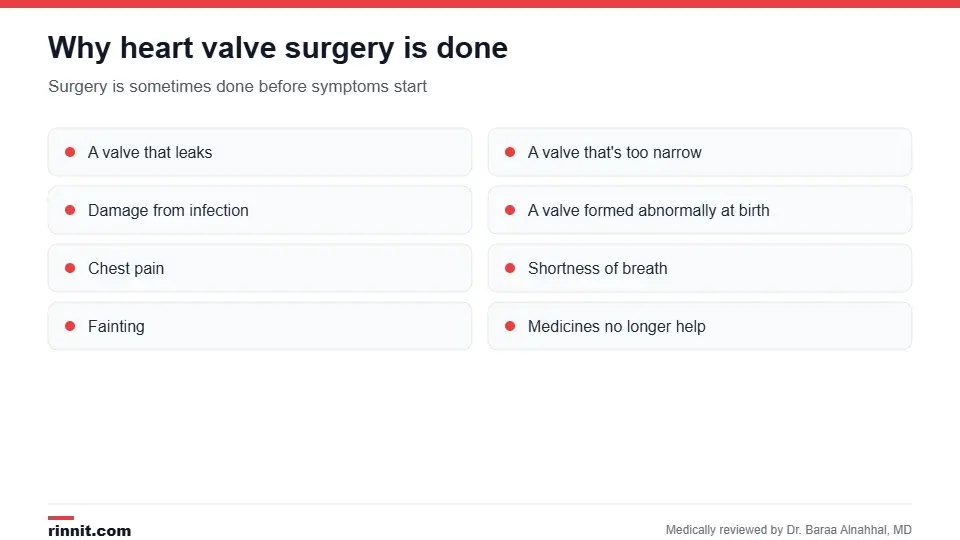
Surgery is sometimes done before symptoms start.
A valve that leaks (regurgitation).
A valve that's too narrow (stenosis).
A valve damaged by infection (endocarditis).
A valve that didn't form normally at birth.
Symptoms such as chest pain, shortness of breath or fainting that medicines no longer control. Sources: [1]
Types of heart valve surgery

Your team chooses based on the valve, your age and your health.
Option | What it involves |
A catheter balloon stretches a narrow valve | |
Valve repair | Fixes your own valve; mitral valves are repaired most often |
Biological valve replacement | A valve made from pig, cow or human tissue |
Mechanical valve replacement | A durable valve made of metal or carbon |
Transcatheter replacement (TAVR) | A new valve placed through a catheter in a leg artery; the chest isn't opened |
Repair keeps more of your own tissue, lowers infection risk and often avoids lifelong blood thinners. The Ross procedure is another option for some people. Sources: [1]
Surgical approaches
Approach | Incision |
6 to 8 inches through the breastbone | |
Minimally invasive | 3 to 4 inches or smaller; may be endoscopic or robot-assisted |
Transcatheter | A small opening in a large artery, usually in the groin |
Minimally invasive approaches usually mean less bleeding, a lower infection risk and a shorter hospital stay. Sources: [1]
How to prepare
You may have tests such as a chest X-ray, echocardiogram, EKG, CT scan, cardiac catheterization and blood tests.
Ask which medicines to take or stop.
Don't eat or drink after midnight before surgery.
Wear loose clothes and arrange for someone to drive you. Sources: [1]
What happens during surgery

Open valve replacement takes two to five hours.
You get anesthesia through an IV and are asleep.
The surgeon makes the smallest cut possible for your procedure.
For most open procedures, your heart is stopped and a heart-lung machine takes over.
The valve is repaired or replaced.
Your heart is restarted, the machine is disconnected and the cut is closed. Sources: [1]
Risks
Risk | Notes |
Abnormal heart rhythm | Some people need a pacemaker |
Bleeding, blood clots, stroke | Uncommon |
Infection, including endocarditis | Good dental care and sometimes antibiotics before dental work help |
Heart attack or heart failure | Rare |
Your risk depends on your age, other health conditions and how many procedures are done at once. Sources: [1, 2, 3]
Recovery
Hospital stay is usually three to seven days, starting in the ICU.
You'll start eating, drinking and walking soon after surgery.
Expect to feel tired for about three weeks.
Don't drive for a few weeks or lift more than 15 pounds for six to eight weeks.
Most people return to work in six to 12 weeks.
Cardiac rehab can help you recover. Sources: [1]
Living with a new valve
Mechanical valves rarely wear out but need lifelong blood thinners such as warfarin. Biological valves may need replacing in the future, especially in younger people. After repair or a biological valve, you may need blood thinners for only a few weeks or not at all. Staying active in the first year is linked to better survival. Sources: [1]
When to call your provider
Chest pain or pain near the incision.
Blood or pus from the wound.
A fever.
Weight gain of more than 5 pounds, which may mean fluid buildup.
Feeling depressed. Sources: [1]
Conclusion
Heart valve surgery restores normal blood flow and relieves symptoms for most people. Today's options, from repair to catheter-based valves, let your care team choose the safest approach for you.
Keep learning: read about TAVR and mitral valve repair.
Frequently asked questions
What is heart valve surgery?
Surgery to repair or replace a heart valve that leaks or is too narrow.
What's the difference between repair and replacement?
Repair fixes your own valve; replacement swaps it for a tissue or mechanical valve.
What is TAVR?
A catheter-based valve replacement that doesn't open the chest.
How long does the surgery take?
Open valve replacement takes two to five hours.
How long is the hospital stay?
Usually three to seven days.
How long is recovery?
About four to eight weeks.
Will I need blood thinners?
Yes, for life with a mechanical valve; often briefly or not at all with tissue valves.
How long do replacement valves last?
Mechanical valves rarely wear out; tissue valves may need replacing later.
What are the risks?
Abnormal rhythms, bleeding, stroke, infection and, rarely, heart attack.
When can I go back to work?
Usually six to 12 weeks after surgery.
Related Reading
Heart Surgery: Types, What to Expect and Recovery explains the types of heart surgery and recovery.
Heart Valve Replacement: Valve Types, Procedure and Recovery explains tissue and mechanical valve replacement.
Cardiopulmonary Bypass: How the Heart-Lung Machine Works explains how the heart-lung machine supports heart surgery.
Heart Valve Disease: Symptoms, Causes & Treatment the conditions that lead to valve surgery.
TAVR (Transcatheter Aortic Valve Replacement): Procedure, Risks and Recovery catheter-based aortic valve replacement.
Aortic Valve Replacement: What It Is, Who Needs It and How Recovery Works surgery to replace the aortic valve.
Mitral Valve Repair: Surgery Steps, Recovery Time, Risks and How Long It Lasts repairing the most commonly fixed valve.
Open-Heart Surgery: Procedure, Preparation, and Recovery what to expect from open-heart surgery.
References
Cleveland Clinic. Heart Valve Surgery: Types, Recovery & What To Expect. Cleveland Clinic. Last updated April 2, 2026. https://my.clevelandclinic.org/health/treatments/17089-heart-valve-surgery
Mack MJ, Leon MB, Thourani VH, et al. Transcatheter aortic-valve replacement with a balloon-expandable valve in low-risk patients. New England Journal of Medicine. 2019;380(18):1695-1705. PMID 30883058. https://doi.org/10.1056/NEJMoa1814052
Popma JJ, Deeb GM, Yakubov SJ, et al. Transcatheter aortic-valve replacement with a self-expanding valve in low-risk patients. New England Journal of Medicine. 2019;380(18):1706-1715. PMID 30883053. https://doi.org/10.1056/NEJMoa1816885
Medical disclaimer
This article is for general education only and does not replace advice from a qualified healthcare professional. Talk to your doctor about your own diagnosis and treatment, and seek emergency care right away for severe or sudden symptoms.



Comments