Mitral Valve Repair: Surgery Steps, Recovery Time, Risks and How Long It Lasts

Updated: 6 days ago
Written and medically reviewed by Dr. Baraa Alnahhal, MD · Last reviewed: October 2026 · How we review
Quick Answer: What is mitral valve repair?
Mitral valve repair is open-heart surgery that fixes a leaky, narrow or floppy mitral valve while keeping your own valve. Surgeons usually add an annuloplasty ring and fix the leaflets or chords. Most people stay in hospital about a week, recover in four to eight weeks, and 95% need no further surgery for 10 years. [1]
What the research says
Repair beats replacement for survival — at every age. A meta-analysis of 12 studies (2,950 repairs vs 1,252 replacements) in people with degenerative mitral regurgitation found replacement carried a 57% higher risk of death over follow-up (HR 1.57) and about 4.5 times the risk of early death. The survival benefit of repair was similar across all ages. (Jung et al., Am J Cardiol, 2019) [6]
Back-leaflet prolapse can almost always be repaired, and the repair holds. In 1,036 people who had robotic mitral surgery, back (posterior) leaflet prolapse was repairable in more than 99% of cases. At 10 years, 92% were free of a more-than-moderate leak or repeat procedure (83% when the front or both leaflets were involved). (Roach et al., Ann Thorac Surg, 2022) [7]
Front- or both-leaflet repairs do as well long term. A meta-analysis of 10 studies found no difference in long-term survival (risk ratio 1.00) or freedom from reoperation (risk ratio 0.96) between front/both-leaflet repairs and back-leaflet repairs — supporting repair over replacement for these valves too. (Iqbal et al., Curr Probl Cardiol, 2022) [8]
Key takeaways
Mitral valve repair keeps your own valve instead of swapping it for a new one. [1]
It treats severe mitral regurgitation (leak), mitral stenosis (narrowing) and mitral valve prolapse (floppy flaps). [1]
Almost every repair uses an annuloplasty ring, often combined with leaflet or chord repair. [1][3]
Expect 1–2 days in intensive care, about a week in hospital and 4–8 weeks of recovery. [1]
Repair is durable: 95% of people go 10 years and 90% go 20 years without another valve surgery. [1]
You will need a yearly echocardiogram after surgery. [1]
What is mitral valve repair and how does the mitral valve work?
Mitral valve repair is a heart operation that fixes a damaged mitral valve so it opens and closes properly again. [1]
The mitral valve is the "door" between the two chambers on the left side of your heart. Oxygen-rich blood from the lungs enters the left atrium, passes through the mitral valve into the left ventricle, and is then pumped out to the body through the aorta. [1]
When the valve leaks or narrows, the heart has to work harder. Over time, this can damage the heart and lungs. A timely repair can help prevent or delay that damage. [1]
When surgery is needed, doctors usually prefer repair over replacement — especially for a leaking valve — because keeping your own valve brings more benefits and fewer risks. [1][4]
Which conditions does mitral valve repair treat?
Mitral valve repair treats three main problems of the mitral valve: regurgitation, stenosis and prolapse. [1]
Condition | What goes wrong | When surgery may be needed |
Mitral valve regurgitation | The valve flaps don't close fully, so blood leaks backward | The leak is severe or causes symptoms |
Mitral valve stenosis | The valve opening narrows and limits blood flow | Severe narrowing with severe symptoms, or a very narrow opening (a balloon procedure may be tried first) |
Mitral valve prolapse | The valve flaps are too floppy or stretchy | The prolapse causes a significant leak |
About 6 in 10 mitral valve operations are for leaky valves caused by leaflet prolapse. [1][3] Learn more about mitral valve stenosis and leaky heart valves.
Who needs mitral valve repair surgery?
Mitral valve repair is usually recommended for people with severe mitral valve disease, particularly when the valve leaks. [1]
You may also need surgery if your left ventricle isn't pumping enough blood to your body (left-sided heart failure) or if your heart has become enlarged. [1]
Mild disease often doesn't need surgery. Your doctor may prescribe medicines for symptoms and check your valve regularly with echocardiograms. Surgery may come later if the disease gets worse or starts to damage your heart. [1]
How should you prepare for mitral valve repair?
Preparing for mitral valve repair means following your care team's instructions in the weeks and hours before surgery. [1] Your doctor may ask you to:
Stop certain medicines in the weeks before surgery, including blood thinners such as aspirin and warfarin
Work with them to stop smoking
Wash with an antimicrobial soap the night before surgery
Take certain medicines on the day of surgery
Stop eating and drinking after a set time on the day of surgery
Never stop a blood thinner on your own — always follow your doctor's specific plan. [1]
What happens during mitral valve repair surgery?
Mitral valve repair surgery follows eight main steps, from anesthesia to a final ultrasound check of the valve. [1]
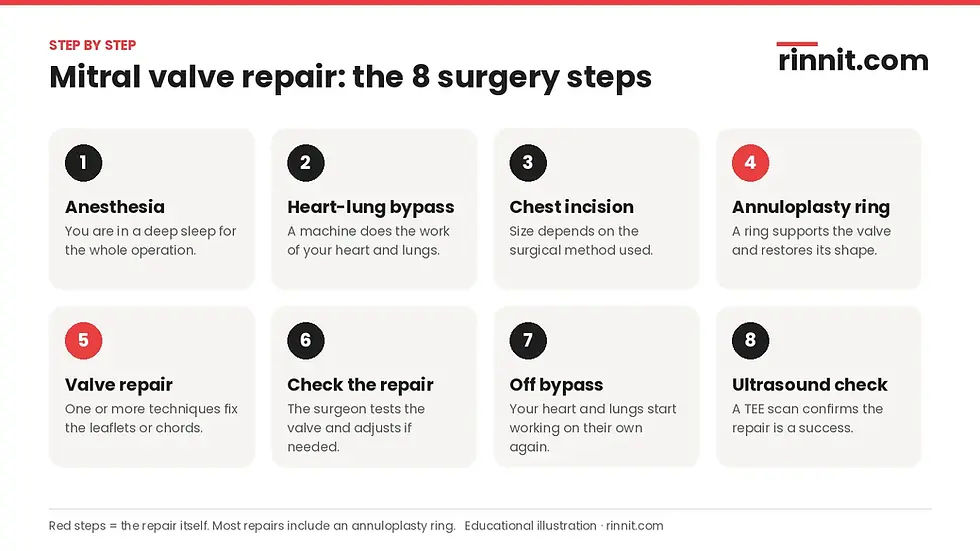
Anesthesia — you are in a deep sleep for the whole procedure.
Heart-lung bypass — a cardiopulmonary bypass machine does the work of your heart and lungs.
Chest incision — the size of the cut depends on the surgical method.
Annuloplasty ring — a ring, like a cloth washer, supports the valve and returns it to a more typical shape.
Valve repair — the surgeon fixes the valve using one or more techniques.
Check the repair — the surgeon tests the valve and adjusts it if needed.
Off bypass — you are disconnected from the machine so your heart and lungs work again.
Ultrasound check — a transesophageal echocardiogram (TEE) confirms the repair worked. [1]
Which incisions can surgeons use for mitral valve repair?
Surgeons can reach the mitral valve through a full, partial or small side incision, or with robotic tools through several tiny cuts. [1]
Approach | Where the cut is |
Full sternotomy | Down the middle of the chest |
Partial sternotomy | Through part of the chest |
Right thoracotomy | A smaller cut between two ribs |
Robotic-assisted | Several small cuts between the ribs |
Some people are candidates for minimally invasive repair or catheter-based (percutaneous) procedures instead of standard open-heart surgery. Your age and overall health help your doctor choose. [1] See how standard open-heart surgery works.
What techniques do surgeons use to repair a mitral valve?
Surgeons repair a mitral valve with four main techniques — annuloplasty, leaflet resection, chordal repair and calcium removal — often combining more than one. [1]

Annuloplasty. Almost all repairs include a complete or partial ring, flexible or rigid, sewn around the valve rim. The ring helps the repair last a long time. [1][3]
Triangular or quadrangular resection. This is the most common fix for back (posterior) leaflet prolapse. The surgeon removes the damaged part of the leaflet and sews the edges together — a small triangular cut for limited damage, or a rectangular cut for a larger area. [1]
Chordal repair. The chordae are tough strings that support the valve. Torn or stretched chords are removed and replaced with new chords made of a synthetic material, or with healthy chords moved from another part of the valve (chordal transfer). Both give excellent long-term results. [1]
Calcium removal. If calcium has built up on the leaflets or the valve rim, the surgeon separates the leaflet, removes the calcium and rebuilds the valve with a patch or stitches. [1]
Is mitral valve repair better than mitral valve replacement?
Mitral valve repair is the better option for most people with mitral regurgitation, and doctors recommend it over replacement whenever possible. [1][4]
Repair | Replacement | |
Survival after surgery | Better chance of surviving surgery and living longer | Lower |
Heart function | Better preserved | Less well preserved |
Stroke and endocarditis risk | Lower | Higher |
Long-term blood thinners | Not needed | May be needed |
Operation | Longer and more complex | Shorter and less complex |
Best for | Most leaky (regurgitant) valves | Some situations where repair isn't the best fit |
Source: [1]
How successful is mitral valve repair?
Mitral valve repair succeeds in most cases: 10 years after surgery, nearly 94% of people have no significant mitral regurgitation. [1][2]
The risk of dying from an isolated mitral valve repair is less than 1 in 1,000 at experienced centers. [1]
What are the risks and complications of mitral valve repair?
Mitral valve repair carries the risks of any heart surgery, including abnormal heart rhythms, bleeding, heart block, heart failure, infection and stroke. [1]
Abnormal heart rhythms (arrhythmias)
Bleeding
Heart block (a problem with the heartbeat signal)
Heart failure
Infection
Ask your surgeon about your personal risks, your chances of survival, and what to expect if you don't have surgery. [1]
What happens after mitral valve repair surgery?
After mitral valve repair, most people spend one to two days in intensive care and about a week in hospital in total. [1]
ICU (1–2 days): your team closely watches your pulse, breathing and other vital signs.
Hospital room (several more days): you keep recovering and get stronger.
Before you go home: you learn about cardiac rehab and how to care for your incision. [1]
How long is the recovery after mitral valve repair?
Recovery from mitral valve repair usually takes four to eight weeks, and some people need longer. [1][5]

Recovery looks different for everyone. Don't compare yourself with others or push to feel better right away. [1] Three factors shape how fast you recover:
Factor | How it affects recovery |
Heart disease before surgery | Reduced heart function means it takes longer to regain strength |
General health | Conditions such as heart failure or kidney failure slow recovery |
Surgical method | After a full sternotomy, the breastbone needs 6–8 weeks to heal; smaller incisions heal faster |
Source: [1]
At home, set small, manageable goals and get enough rest as you slowly return to your routine. Your doctor will tell you when it's safe to drive, lift heavy objects and exercise. [1]
What follow-up do you need after mitral valve repair?
Follow-up after mitral valve repair includes a yearly echocardiogram to check how your valve works. [1] You may also need antibiotics before certain procedures to prevent endocarditis, an infection of the valve. [1]
How long does a mitral valve repair last?
A mitral valve repair is a durable fix: 95% of people go at least 10 years, and 90% go 20 years, without needing another valve operation. [1]
Most people never need another mitral valve surgery after a successful repair. [1]
What is the life expectancy after mitral valve repair?
Life expectancy after mitral valve repair depends on how severe the valve disease was and your overall health. [1]
People who have the repair at the right time can expect a life expectancy similar to others of the same age and sex. [1]
When should you call your doctor after mitral valve repair?
Call your care team after mitral valve repair if you notice any sign of a complication. [1] Warning signs include:
Chest pain
Chills or fever
Coughing up blood, or yellow or green mucus
Dizziness or fainting
A very severe headache
An irregular pulse (too slow or too fast)
Nausea and vomiting
Pain, redness or swelling in your lower leg
Incision pain that won't go away, or oozing and redness around the incision
Shortness of breath
Slurred speech or other signs of a stroke
If you take blood thinners, also call if you fall, bleed heavily anywhere (including the nose or gums) or notice many bruises. [1]
When in doubt, call. It's better to be checked and told nothing is wrong than to ignore a problem. For stroke signs or severe chest pain, seek emergency care immediately. [1]
Can other heart procedures be done during mitral valve repair?
Yes — a surgeon can perform more than one procedure in the same operation. [1]
Many people with mitral valve disease also have atrial fibrillation (AFib). In that case, the surgeon can perform the maze procedure to treat AFib during the same surgery. [1]
Surgeons can also repair a valve damaged by infection (endocarditis) by removing all infected tissue. If enough healthy tissue remains, the valve is rebuilt; if not, it may need to be replaced. [1]
Conclusion
Mitral valve repair fixes your own heart valve rather than replacing it, which is why doctors choose it whenever they can. It treats severe leaks, narrowing and floppy valve flaps, usually with an annuloplasty ring plus leaflet or chord repair. Most people leave hospital in about a week, recover within two months, and keep their repair for decades — with survival close to that of people their age when surgery is done at the right time. [1]
Mitral valve surgery is complex, so ask your care team plenty of questions about your options, your risks and the lifestyle changes that will protect your heart long after surgery.
Next step: If you've been told you have a leaky or narrowed mitral valve, read our guide to mitral valve disease, then bring your questions to your cardiologist or heart surgeon. Planning recovery? Our cardiac rehab guide shows what each phase involves.
FAQ
Is mitral valve repair open-heart surgery?
Mitral valve repair is usually open-heart surgery performed on a heart-lung bypass machine. Some people can have a minimally invasive repair through smaller cuts between the ribs, robotic surgery, or a catheter-based procedure, depending on their age and overall health. [1]
How long does it take to recover from mitral valve repair?
Recovery from mitral valve repair usually takes four to eight weeks, after about a week in hospital. The breastbone needs six to eight weeks to heal after a full sternotomy, while smaller incisions heal faster. [1]
How long does a mitral valve repair last?
A mitral valve repair lasts a long time: 95% of people go at least 10 years and 90% go 20 years without another valve surgery. Most people never need a second mitral valve operation. [1]
What is the life expectancy after mitral valve repair?
Life expectancy after a well-timed mitral valve repair is similar to that of other people of the same age and sex. Your own outlook depends on how severe the valve disease was and your overall health. [1]
Is mitral valve repair better than replacement?
Mitral valve repair is better than replacement for most people with mitral regurgitation. Repair offers better survival, better heart function, a lower risk of stroke and endocarditis, and no need for long-term blood thinners. Replacement is shorter and simpler and suits some situations better. [1]
What are the risks of mitral valve repair?
The main risks of mitral valve repair are abnormal heart rhythms, bleeding, heart block, heart failure, infection and stroke. The risk of death from an isolated repair is less than 1 in 1,000 at experienced centers. [1]
What symptoms after mitral valve repair need urgent care?
Chest pain, shortness of breath, fainting, fever or chills, an irregular pulse, leg swelling or pain, and signs of stroke after mitral valve repair need prompt medical attention. Seek emergency care right away for stroke signs or severe chest pain. [1]
Can AFib be treated during mitral valve repair?
Atrial fibrillation can be treated during mitral valve repair with the maze procedure in the same operation. Many people with mitral valve disease also have AFib. [1]
Is there a less invasive option than open-heart mitral valve repair?
Yes. Some people can have minimally invasive surgery through small chest incisions. People at high risk from surgery may be able to have a catheter-based repair through a vein in the leg.
Will I need blood thinners after mitral valve repair?
Some people take a blood thinner for a short time after mitral valve repair, and people with atrial fibrillation may need one longer. Your care team will decide which medicine is right for you.
Related Reading
Mitral Valve Replacement: Surgery, Valve Types and Recovery explains mitral valve replacement surgery.
Annuloplasty: Heart Valve Repair, Recovery and Results explains annuloplasty heart valve repair.
Heart Valve Surgery: Types, Procedure and Recovery explains how heart valves are repaired or replaced.
References
Cleveland Clinic. Mitral Valve Repair: Procedure & Recovery. Cleveland Clinic. Last updated January 30, 2025. https://my.clevelandclinic.org/health/treatments/17240-mitral-valve-repair
Vaidya Y, Sharma S, Widrich J. Mitral Valve Repair. In: StatPearls [Internet]. Treasure Island (FL): StatPearls Publishing. Last updated April 12, 2026. PMID 31751069. https://www.ncbi.nlm.nih.gov/books/NBK549879/
Gammie JS, Chikwe J, Badhwar V, et al. Isolated Mitral Valve Surgery: The Society of Thoracic Surgeons Adult Cardiac Surgery Database Analysis. Ann Thorac Surg. 2018;106(3):716-727. PMID 30032907. https://doi.org/10.1016/j.athoracsur.2018.03.086
Otto CM, Nishimura RA, Bonow RO, et al. 2020 ACC/AHA Guideline for the Management of Patients With Valvular Heart Disease: Executive Summary: A Report of the American College of Cardiology/American Heart Association Joint Committee on Clinical Practice Guidelines. Circulation. 2021;143(5):e35-e71. PMID 33332149. https://doi.org/10.1161/CIR.0000000000000932
American Heart Association. Heart Valve Surgery Recovery and Follow-Up. American Heart Association. Last updated July 17, 2026. https://www.heart.org/en/health-topics/heart-valve-problems-and-disease/recovery-and-healthy-living-goals-for-heart-valve-patients/heart-valve-surgery-recovery-and-follow-up
Jung JC, Jang MJ, Hwang HY. Meta-Analysis Comparing Mitral Valve Repair Versus Replacement for Degenerative Mitral Regurgitation Across All Ages. Am J Cardiol. 2019;123(3):446-453. PMID 30471709. https://doi.org/10.1016/j.amjcard.2018.10.024
Roach A, Trento A, Emerson D, et al. Durable Robotic Mitral Repair of Degenerative Primary Regurgitation With Long-Term Follow-Up. Ann Thorac Surg. 2022;114(1):84-90. PMID 34437853. https://doi.org/10.1016/j.athoracsur.2021.07.060
Iqbal K, Haque IU, Shaikh VF, et al. Mitral Valve Repair for Anterior/Bi-leaflet Versus Posterior Leaflet Degenerative Mitral Valve Disease: A Systematic Review and Meta-analysis. Curr Probl Cardiol. 2022;47(12):101355. PMID 35970298. https://doi.org/10.1016/j.cpcardiol.2022.101355
Medical disclaimer
This article is for educational purposes only and is not a substitute for professional medical advice, diagnosis or treatment. Always talk with your doctor or another qualified health professional about your own health and before making any decision about surgery or medicines. If you think you are having a medical emergency, call your local emergency number immediately.



Comments