Aortic Valve Replacement: What It Is, Who Needs It and How Recovery Works

Updated: 7 days ago
Written and medically reviewed by Dr. Baraa Alnahhal, MD · Last reviewed: October 2026 · How we review
Quick Answer: What is aortic valve replacement?
Aortic valve replacement is open-heart surgery that swaps a narrowed or leaky aortic valve for a new mechanical or biological valve. Surgery takes 2 to 4 hours, followed by about 5 days in hospital and 4 to 8 weeks of recovery. For most people, the risk of serious complications, including stroke or death, is 1% to 2%. [1]
What the research says
Low-risk patients can expect many years of life after surgery. In a study of 8,353 people aged 60 and older who received a tissue valve, low-risk patients had a median survival of 10.9 years, rising to 16.2 years in those aged 60 to 64. (Martinsson et al., J Am Coll Cardiol, 2021) [2]
Age shapes which valve type helps you live longer. Across 25 studies covering 17,683 valves, survival was similar under age 50, better with mechanical valves at ages 50 to 70 (24% lower risk of death), and better with biological valves over 70. Mechanical valves had more major bleeding; biological valves needed more repeat operations. (Tasoudis et al., Eur J Cardiothorac Surg, 2022) [3]
Open surgery and the catheter approach show similar survival. A review of 9 randomized trials (8,818 patients) found no clear difference in death from any cause at 5 years. The catheter method shortened the hospital stay by about 3 days but raised the need for a permanent pacemaker. (Swift et al., BMJ Open, 2021) [4]
Key takeaways
Aortic valve replacement treats a narrowed or leaky aortic valve.
Mild valve disease usually doesn't need surgery; severe or symptomatic disease often does.
Your age guides the valve choice: mechanical under 50, biological over 65, either from 50 to 65.
Expect about 5 days in hospital and 4 to 8 weeks of recovery.
A less invasive catheter option exists, but it isn't right for everyone.
What is aortic valve replacement?
Aortic valve replacement is surgery that removes a damaged aortic valve and sews a new one in its place. [1]
Your aortic valve is the "door" between your heart and your aorta, the body's main artery. Each heartbeat pushes blood through this door and out to your body. [1]
Sometimes the door can't open wide enough. Less blood gets out with each beat. Other times it can't close properly, like a warped wooden door in summer, so blood leaks backward. [1]
Either problem is called aortic valve disease. Surgical aortic valve replacement (often shortened to SAVR) removes the damaged valve and sews a new one in its place. [1]
Surgeons have performed this operation for more than 50 years. Tens of thousands of people have it every year. [1]
Why would you need a new aortic valve?
You may need a new aortic valve when aortic valve disease becomes severe or causes symptoms, because the extra strain on your heart can damage the heart muscle over time. [1]
Aortic valve disease can be mild with no symptoms at first. As it worsens, your heart has to work harder to pump enough blood. [1]
Untreated, severe valve disease can be life-threatening. A new valve can help you feel better, protect your heart and help you live longer. [1]
Conditions this surgery treats
Condition | What goes wrong | Common symptoms |
Aortic stenosis | The valve is narrowed and can't open fully | Chest pain, feeling short of breath |
Aortic regurgitation | The valve leaks, letting blood flow backward | Chest pain, working harder to breathe |
[1]
When surgery is (and isn't) needed
Situation | Usual approach |
Mild stenosis or regurgitation | Regular monitoring, plus medicines to help your heart work better |
Severe disease | Surgery is often recommended |
Disease causing symptoms | Surgery is often recommended |
[1] [5]
How do you prepare for aortic valve replacement?
To prepare for aortic valve replacement, your care team checks your overall health and studies your heart closely. This tells them which type of procedure suits you best, including whether open surgery or a less invasive catheter procedure is the better fit. [1]
Tests you may need
Test | What it shows |
Echocardiogram (echo) | Moving ultrasound pictures of your valve and heart |
Electrocardiogram (EKG) | Your heart's electrical rhythm |
Cardiac catheterization | Pressures inside the heart and the state of your arteries |
CT scan | Detailed images of your heart and aorta |
Chest X-ray | Your heart and lungs |
Blood and urine tests | General health and organ function |
[1]
Instructions you'll receive
Your team will give you personal instructions covering:
When to stop eating and drinking before surgery
Whether to pause any of your medicines
What time to arrive at the hospital
What to bring and what to leave at home
If you smoke or use tobacco, quit as early as you can. Stopping lowers your risk of complications, and your doctor can connect you with support. [1]
Which is better for aortic valve replacement: a mechanical or biological valve?
The right valve for aortic valve replacement depends mainly on your age and health: mechanical valves are often recommended under 50 and biological valves over 65. Choosing your new valve is one of the biggest decisions before surgery. [1]
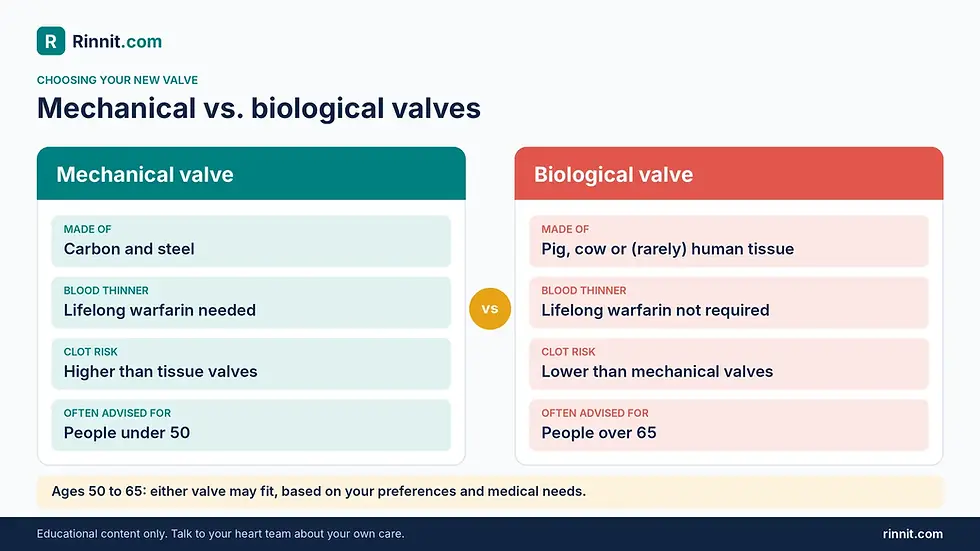
Feature | Mechanical valve | Biological (tissue) valve |
Made of | Carbon and steel | Pig, cow or (rarely) human tissue, sometimes with artificial support parts |
Lifelong blood thinner (warfarin) | Yes | Not required |
Blood clot risk | Higher | Lower |
Often recommended for | People under 50 | People over 65 |
[1]
Between ages 50 and 65, either valve may be suitable. The choice depends on your preferences and medical needs, so talk it through openly with your surgeon. [1]
What happens during aortic valve replacement?
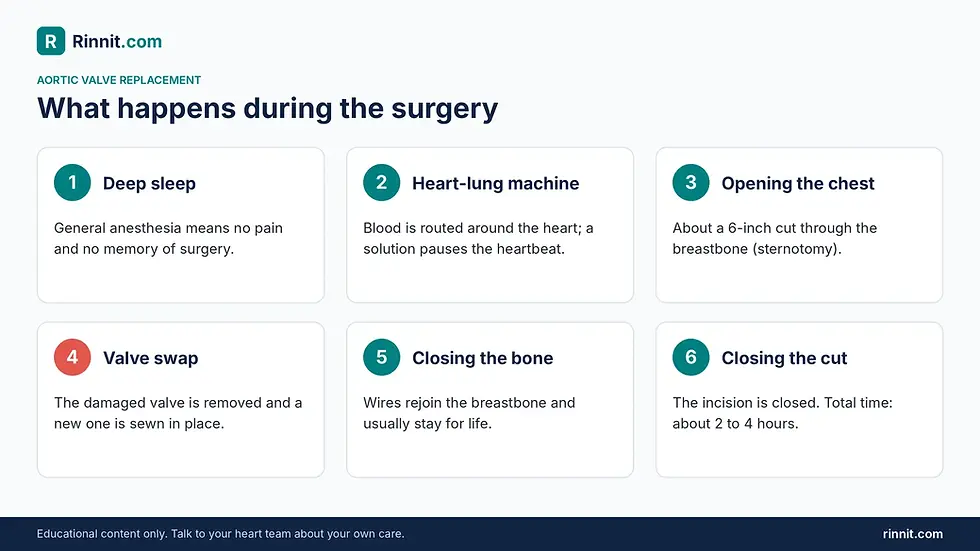
During aortic valve replacement, the surgeon opens the breastbone, removes the damaged valve and sews in a new one. The operation usually takes 2 to 4 hours and follows these steps: [1]
Anesthesia. You're put into a deep sleep. You won't feel pain or remember the surgery.
Heart-lung machine. This machine carries your blood around your heart and lungs. A special solution pauses your heart so the surgeon can work safely.
Opening the chest. The surgeon makes a vertical cut of about 6 inches through your breastbone. This is called a sternotomy.
Replacing the valve. The damaged valve is removed and the new valve is sewn in.
Closing the breastbone. Wires join the two halves of the bone. They usually stay in for life.
Closing the skin. The incision is closed.
Minimally invasive options
Some surgeons can replace the valve through a smaller opening. Options include a partial sternotomy or a small cut between the ribs on the right side of the chest (right anterior thoracotomy). Your surgeon will tell you if either suits you. [1]
How long is recovery after aortic valve replacement?
Recovery after aortic valve replacement usually takes 4 to 8 weeks at home, after a hospital stay of about 5 days. [1]

Stage | Typical length | What happens |
Surgery | 2–4 hours | Valve replaced under general anesthesia |
Hospital stay | About 5 days | Vital signs monitored; you walk a little more each day |
Home recovery | 4–8 weeks (as little as 2 weeks after minimally invasive surgery) | Rest, gradual return to daily activities |
Cardiac rehab | About 12 weeks | Supervised exercise, education and lifestyle support |
[1]
In the hospital
Your care team will watch your vital signs and check on you often. They'll also help you get up and move a little more each day. [1]
At home
Recovery is a process. Feeling tired for several weeks is normal, because your body needs time to heal. [1]
Don't rush back to your usual routine. Follow your surgeon's advice on when it's safe to drive, lift, work and exercise. [1]
Cardiac rehab
Once you've healed, usually 6 to 8 weeks after surgery, you'll likely start cardiac rehab. This supervised program usually lasts about 12 weeks. [1]
Rehab helps you return to exercise slowly and safely. You'll also get education, counseling and support for lasting changes, such as eating a heart-healthy diet or quitting tobacco. [1]
What are the risks and benefits of aortic valve replacement?
Aortic valve replacement can save your life, and for most people the chance of a serious complication, including stroke or death, is 1% to 2%. [1]
Benefits
Replacing a valve that no longer works can save your life. Without treatment, severe aortic valve disease can be fatal. [1]
Success rate
For most people, the chance of a serious complication, including stroke or death, is 1% to 2%. [1]
Surgeons use risk formulas based on your age, overall health and other factors. These scores place you in a low, intermediate or high risk group. People with lower surgical risk tend to live longer after surgery. [1] [2]
Possible complications
Complication | What it means |
Arrhythmia (especially atrial fibrillation) | An irregular heartbeat |
Permanent pacemaker | A small device may be needed to keep your heartbeat steady |
Bleeding | Blood loss during or after surgery |
Infection | At the incision or inside the body |
Stroke | Blocked or reduced blood flow to the brain |
Death | Rare, but possible with any major heart surgery |
[1]
Your age and other medical conditions affect your personal risk. Ask your surgeon what your risk level is and what can be done to lower it. [1]
Is there an alternative to open aortic valve replacement surgery?
Transcatheter aortic valve replacement (TAVR) is a less invasive alternative for some people. Instead of opening the chest, the doctor uses small entry points and thin, flexible tubes (catheters) to place a new valve inside the old one, and recovery is easier. [1] [4]
Your heart team will weigh your age, surgical risk and other conditions before recommending one method. [1]
Open surgery may give better short- and long-term results for some groups, including: [1]
People born with an abnormal aortic valve, such as a bicuspid valve
People who also need other heart procedures, like coronary artery bypass grafting or repair or replacement of another valve
Open surgery (SAVR) | Catheter procedure (TAVR) | |
How the valve is placed | Through a cut in the breastbone or chest | Through small entry points using catheters |
Old valve | Removed | Left in place; new valve sits inside it |
Recovery | Longer (4–8 weeks) | Easier |
Often preferred when | Bicuspid valve, or other heart surgery is needed at the same time | Your team judges it the better fit for your age and risk |
[1]
When should you call your doctor after aortic valve replacement?
Call your healthcare provider right away if you notice chest pain, fever, incision problems, leg swelling, palpitations or fast weight gain after aortic valve replacement. Watch for: [1]
Chest pain or pressure
Fever or chills
Drainage or pus from your incision
Pain, swelling or redness around your incision
Swelling in your legs or feet
A fluttering, flip-flopping or skipped-beat feeling in your chest (palpitations)
Weight gain of more than 3 pounds (about 1.4 kg) in one week
Conclusion
Learning that you need a new heart valve can feel frightening. But aortic valve replacement is a long-established operation that helps your heart do its job again.
The key decisions, such as which valve and which approach, are made with your heart team based on your age, health and preferences. Go into those conversations prepared, ask about your personal risk, and give your body the time it needs to heal.
Want clear, trusted answers about your heart health? Explore more doctor-reviewed guides in the Rinnit Health Library, and save or share this article so you can bring it to your next appointment.
FAQ
How long does aortic valve replacement surgery take?
The operation usually takes about 2 to 4 hours.
How long will I stay in the hospital after aortic valve replacement?
Most people stay about 5 days after surgery.
How long is recovery after aortic valve replacement?
Most people need 4 to 8 weeks. Recovery can be as short as 2 weeks after minimally invasive surgery.
Will I need blood thinners for life after aortic valve replacement?
With a mechanical valve, yes. You'll take warfarin for the rest of your life to lower the risk of blood clots. Lifelong warfarin isn't required with a biological valve.
Which valve is better, mechanical or biological?
Neither is best for everyone. Mechanical valves are often recommended under age 50 and biological valves over age 65. Between 50 and 65, either may work depending on your preferences and health.
Is aortic valve replacement dangerous?
It's major surgery, but for most people the chance of serious complications, including stroke or death, is 1% to 2%.
Do the wires in my breastbone stay forever?
Usually, yes. The wires that hold your breastbone together typically stay in for life.
Does everyone with aortic valve disease need surgery?
No. Mild disease is usually monitored and may be treated with medicines. Surgery is mainly for severe disease or disease that causes symptoms.
What is the difference between SAVR and TAVR?
SAVR is open surgery that removes the old valve. TAVR uses catheters to place a new valve inside the old one through small entry points, with an easier recovery.
What is cardiac rehab, and do I need it?
It's a supervised program, usually about 12 weeks long, that helps you return to exercise safely and build heart-healthy habits. Most people start once they've healed, about 6 to 8 weeks after surgery.
Related reading on Rinnit.com
Helpful external resources
Related Reading
Heart Valve Replacement: Valve Types, Procedure and Recovery explains tissue and mechanical valve replacement.
Heart Valve Surgery: Types, Procedure and Recovery explains how heart valves are repaired or replaced.
References
Cleveland Clinic. Aortic Valve Replacement Surgery. Cleveland Clinic. Last updated June 6, 2023. https://my.clevelandclinic.org/health/treatments/25057-aortic-valve-replacement
Martinsson A, Nielsen SJ, Milojevic M, et al. Life Expectancy After Surgical Aortic Valve Replacement. J Am Coll Cardiol. 2021;78(22):2147-2157. PMID 34823657. https://doi.org/10.1016/j.jacc.2021.09.861
Tasoudis PT, Varvoglis DN, Vitkos E, et al. Mechanical versus bioprosthetic valve for aortic valve replacement: systematic review and meta-analysis of reconstructed individual participant data. Eur J Cardiothorac Surg. 2022;62(1):ezac268. PMID 35445694. https://doi.org/10.1093/ejcts/ezac268
Swift SL, Puehler T, Misso K, et al. Transcatheter aortic valve implantation versus surgical aortic valve replacement in patients with severe aortic stenosis: a systematic review and meta-analysis. BMJ Open. 2021;11(12):e054222. PMID 34873012. https://doi.org/10.1136/bmjopen-2021-054222
Otto CM, Nishimura RA, Bonow RO, et al. 2020 ACC/AHA guideline for the management of patients with valvular heart disease: A report of the American College of Cardiology/American Heart Association Joint Committee on Clinical Practice Guidelines. J Thorac Cardiovasc Surg. 2021;162(2):e183-e353. PMID 33972115. https://doi.org/10.1016/j.jtcvs.2021.04.002
Medical disclaimer
This article is for general education only and is not a substitute for professional medical advice, diagnosis or treatment. Always talk with your doctor or heart team about your own care.



Comments