TAVR (Transcatheter Aortic Valve Replacement): Procedure, Risks and Recovery

Updated: 6 days ago
Written and medically reviewed by Dr. Baraa Alnahhal, MD · Last reviewed: October 2026 · How we review
Quick Answer: What is TAVR?
Transcatheter aortic valve replacement (TAVR) is a minimally invasive procedure that replaces a narrowed aortic valve without open-heart surgery. A doctor threads a thin tube through an artery, usually in the groin, and places a new valve inside the old one. It treats aortic stenosis, takes about one to two hours, and most people go home within a day. [1]
What the research says
TAVR beat open surgery on a combined outcome in low-risk patients. In a randomized trial of 1,000 people with severe aortic stenosis and low surgical risk (average age 73), the rate of death, stroke or rehospitalization at 1 year was 8.5% after TAVR versus 15.1% after surgery. The TAVR group also had a shorter hospital stay. (Mack et al., N Engl J Med, 2019) [2]
A second large trial found TAVR as safe as surgery at 2 years, with different side effects. Among 1,468 low-risk patients, death or disabling stroke at 24 months was 5.3% with TAVR versus 6.7% with surgery. At 30 days, TAVR caused less bleeding (2.4% vs 7.5%) and atrial fibrillation (7.7% vs 35.4%), but more pacemaker implants (17.4% vs 6.1%). (Popma et al., N Engl J Med, 2019) [3]
Pooled trials show no overall difference in survival, but a shorter hospital stay. A review of 9 randomized trials (8,818 people) found no clear difference in death from any cause between TAVR and surgery. TAVR shortened the hospital stay by about 3 days, lowered major bleeding and kidney injury, and raised the risk of pacemaker implantation and major blood vessel complications. (Swift et al., BMJ Open, 2021) [4]
Key takeaways
TAVR replaces the aortic valve through a catheter, so your chest and ribs are not opened. [1]
It treats aortic stenosis, a narrowing that makes your heart overwork and can lead to heart failure. [1]
The procedure usually takes one to two hours, and most people leave the hospital within one day. [1]
Complications are uncommon, but they can include a need for a pacemaker, a leak around the new valve, stroke and bleeding. [1]
Full recovery takes six to 10 weeks, with regular check-ups for life. [1]
TAVR at a glance
Question | Short answer |
Other name | Transcatheter aortic valve implantation (TAVI) |
What it treats | Aortic stenosis (a narrowed aortic valve) |
Who performs it | An interventional cardiologist |
Usual entry point | The femoral artery in the upper thigh (groin) |
Anesthesia | Sedation and/or anesthesia |
Procedure time | About 1–2 hours |
Hospital stay | Same day to next day for most; some stay 2 days or more |
Back to work | About 2 weeks |
Driving | After about 1 month |
Full recovery | 6–10 weeks |
Source for table: [1]
What is TAVR and how does it work?
TAVR is a procedure that gives you a new aortic valve without opening your chest. Doctors also call it transcatheter aortic valve implantation, or TAVI. [1]
Your heart pumps blood through the aortic valve and out to your entire body. When that valve narrows, your heart has to push harder with every beat. [1]
Over time, this extra workload can damage the heart muscle and lead to heart failure. A new valve takes that strain away, which can help you feel better, protect your heart and live longer. [1]
During TAVR, an interventional cardiologist passes a thin tube (catheter) through an artery, usually in the groin, up to the heart. The catheter carries the new valve and sets it inside your old one. [1]
What does TAVR treat?
TAVR treats aortic stenosis, a narrowing of the aortic valve or the area around it. [1]
The narrowing usually comes from one of three causes: [1]
Cause | What happens |
Age-related wear and tear | Calcium builds up and the valve thickens, especially after age 70 |
Rheumatic heart disease | Past inflammation scars and stiffens the valve |
Bicuspid aortic valve | The valve has two flaps instead of three, which strains it over time |
To learn how this condition develops and how it is staged, read our full guide to heart valve disease.
Who is a good candidate for TAVR?
TAVR is an option for people at high, intermediate or low risk from open-heart surgery, and it is especially helpful for those at high risk. Many people who need a new aortic valve fall into this group because of severe stenosis or other health problems. [1]
Still, open surgery remains the better choice for some people. Your care team weighs your heart's structure, your other conditions and your preferences before recommending aortic valve replacement surgery or TAVR. [1]
Who should not have TAVR?
TAVR is not right for everyone. The most common reasons a doctor may advise against it are: [1]
Reason | Why it matters |
Heart attack within the last month | The heart needs time to recover first |
Problems present at birth can change the heart's structure | |
A space too short for the new valve | The valve may not fit or seat properly |
Severe weakening of parts of the heart | The heart may not handle the procedure well |
Other valve problems, like a leaky mitral valve | Another valve may need treatment too (see mitral valve disease) |
Recent stroke or transient ischemic attack (TIA) | Raises the risk of another brain event |
Severe kidney disease | Makes the procedure riskier |
How should you prepare for TAVR?
Preparing for TAVR usually means fasting and adjusting some medicines before the procedure. You may need to avoid food and drinks other than water, and stop certain medications. [1]
Your doctor may also order blood tests and imaging tests to plan the procedure. [1]
Follow your care team's instructions closely, and ask about anything that isn't clear. [1]
What happens during a TAVR procedure?
A TAVR procedure begins with sedation and/or anesthesia, plus medicine to prevent blood clots. [1]
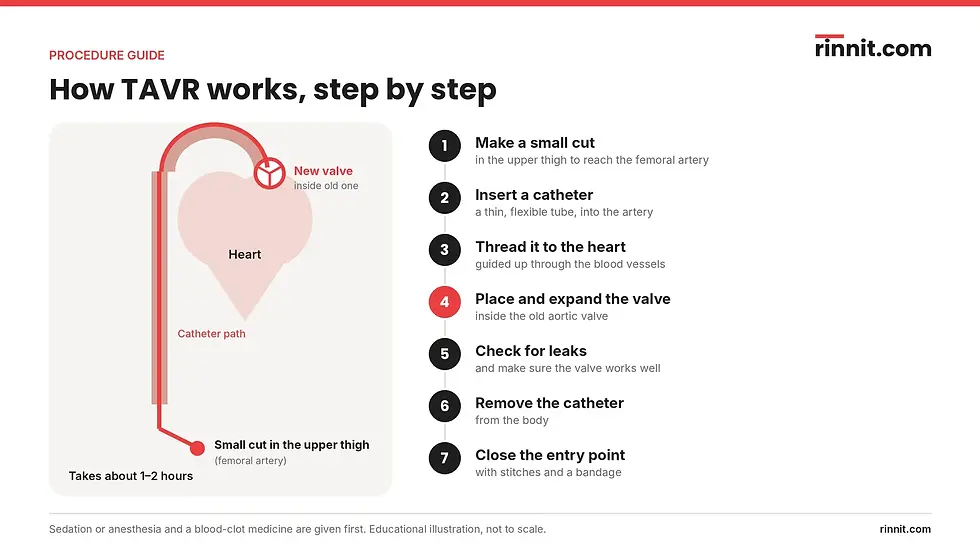
Then the interventional cardiologist: [1]
Makes a small cut in your upper thigh to reach the femoral artery (another entry point can be used if needed, but this one is the most common).
Inserts a catheter into the artery.
Threads the catheter up to your heart.
Places the new valve inside your old aortic valve and expands it, so the new valve sits in place with the old one pressed behind it.
Checks for leaks and other problems.
Removes the catheter from your body.
Stitches the entry point closed and bandages it.
The whole procedure typically takes about one to two hours from start to finish. [1]
How does TAVR compare with open-heart surgery?
TAVR is less invasive than open-heart surgery, which usually means less pain, an easier recovery and a shorter hospital stay. [1]

Feature | TAVR | Open-heart valve surgery |
Incision | One small cut, usually in the groin | Large cuts in the chest |
Ribs and organs | No need to move ribs or organs | Rib cage is often lifted or opened |
Healing | Less tissue to heal, less pain | More tissue to heal |
Hospital stay | Often same day or next day | Longer |
Best suited for | Many people at high surgical risk | Some people who benefit more from surgery |
Source for table: [1]
For a closer look at the surgical options, see our guide to aortic valve surgery: repair and replacement.
What are the risks and complications of TAVR?
TAVR complications are uncommon thanks to advances in valve and catheter technology. When problems do happen, they can include: [1]
A disruption in the heart's electrical system that needs a pacemaker (learn more about cardiac devices)
A leak around the outer edge of the new valve
Bleeding
Infection
Injury to the kidneys, heart or blood vessels
Damage to the aorta
A need for follow-up surgery
Reactions to anesthesia or other medicines used during the procedure
Choosing a team with a lot of experience performing TAVR can give you extra peace of mind. [1]
What is TAVR recovery like?
TAVR recovery is usually quick: most people return to most normal activities within days, and full recovery takes six to 10 weeks. [1]

Right after the procedure, you stay in bed for at least several hours. This prevents bleeding from the spot where the catheter went in, and your care team checks that the stitches are secure before you get up. [1]
You may get medicine to prevent infection or blood clots after the procedure. [1]
Time after TAVR | What to expect |
First several hours | Bed rest to protect the entry site |
Within about 1 day | Most people leave the hospital; some stay 2 days or more |
First few days | Return to most normal activities; start cardiac rehab |
At least 1 week | Avoid heavy lifting and strenuous physical activity |
About 2 weeks | Most people can go back to work |
About 1 month | Driving is usually allowed; first follow-up visit |
6–10 weeks | Complete recovery |
Source for table: [1]
Your own timeline depends on how the procedure went and your overall health, so your doctor will tell you what to expect. [1]
What follow-up care is needed after TAVR?
Follow-up care after TAVR includes cardiac rehab and regular check-ups. [1]
Most people are referred to a cardiac rehab program, a prescribed exercise plan run by a team of specialists. You start within several days of the procedure to build your heart's strength and endurance. [1]
Expect a check-up about one month after TAVR, then once a year. At these visits, your doctor checks your heart, asks how you feel and may run tests to confirm the new valve is working well. [1]
When should you call a doctor after TAVR?
Call your doctor after TAVR if you notice any of these signs: [1]
Sign | Where to watch |
Fever | Whole body |
Bleeding | Entry site |
Pain or bruising that gets worse | Entry site |
Redness or discoloration | Entry site |
Swelling | Entry site or legs |
Chest pain | Chest |
Dizziness | Whole body |
Shortness of breath | Breathing |
If chest pain is severe or comes with trouble breathing, seek emergency care right away.
Conclusion
TAVR gives people with aortic stenosis a new valve through a small cut, without opening the chest. For many people, especially those at high risk from open-heart surgery, it means less pain, a shorter hospital stay and a faster return to daily life. [1]
It isn't right for everyone, and the decision depends on your heart's structure and overall health. Talk openly with your heart team, follow your recovery plan and keep every follow-up visit.
Want to understand your heart valve better? Start with our aortic stenosis guide, then explore the rest of our heart health library for clear, doctor-reviewed answers.
FAQ
Is TAVR open-heart surgery?
No, TAVR is not open-heart surgery. TAVR replaces the aortic valve through a catheter placed in an artery, usually in the groin, so the chest and ribs are not opened. [1]
How long does a TAVR procedure take?
A TAVR procedure typically takes about one to two hours from start to finish. Afterward, you stay in bed for at least several hours to protect the catheter entry site. [1]
How long do you stay in the hospital after TAVR?
Most people leave the hospital within one day after TAVR. Some stay two days or more, depending on how the procedure went and their overall health. [1]
When can you drive and go back to work after TAVR?
Most people can return to work about two weeks after TAVR and drive after about one month. Heavy lifting and strenuous activity should wait at least one week, and complete recovery takes six to 10 weeks. [1]
Is TAVR the same as TAVI?
Yes, TAVR and TAVI are the same procedure. TAVI stands for transcatheter aortic valve implantation, another name for transcatheter aortic valve replacement. [1]
Will I need a pacemaker after TAVR?
A pacemaker is needed after TAVR only if the procedure disrupts the heart's electrical system. This is one of the known complications, and your care team monitors your heart rhythm closely afterward. [1]
Who should not have TAVR?
TAVR may not be recommended for people with a heart attack in the last month, congenital heart defects, too little space for the new valve, or severe heart weakening. Other reasons include another valve problem, a recent stroke or TIA, and severe kidney disease. [1]
What symptoms after TAVR need medical attention?
Fever, bleeding, worsening pain or bruising at the entry site, redness, swelling, chest pain, dizziness and shortness of breath after TAVR all need a call to your doctor. Seek emergency care for severe chest pain or trouble breathing. [1]
Will I need blood thinners after TAVR?
Most people take a medicine that helps prevent clots, such as aspirin, for a period after TAVR. Some people need a stronger blood thinner for another condition, and your cardiologist will decide what is right for you.
Do I need antibiotics before dental work after TAVR?
People with a replacement heart valve, including a TAVR valve, are usually advised to take antibiotics before certain dental procedures to help prevent a heart valve infection. Tell your dentist that you have a new valve.
Related Reading
Heart Valve Replacement: Valve Types, Procedure and Recovery explains tissue and mechanical valve replacement.
Heart Valve Surgery: Types, Procedure and Recovery explains how heart valves are repaired or replaced.
References
Cleveland Clinic. Transcatheter Aortic Valve Replacement (TAVR). Cleveland Clinic. Last updated January 9, 2026. https://my.clevelandclinic.org/health/treatments/17570-transcatheter-aortic-valve-replacement-tavr
Mack MJ, Leon MB, Thourani VH, et al. Transcatheter Aortic-Valve Replacement with a Balloon-Expandable Valve in Low-Risk Patients. N Engl J Med. 2019;380(18):1695-1705. PMID 30883058. https://doi.org/10.1056/NEJMoa1814052
Popma JJ, Deeb GM, Yakubov SJ, et al. Transcatheter Aortic-Valve Replacement with a Self-Expanding Valve in Low-Risk Patients. N Engl J Med. 2019;380(18):1706-1715. PMID 30883053. https://doi.org/10.1056/NEJMoa1816885
Swift SL, Puehler T, Misso K, et al. Transcatheter aortic valve implantation versus surgical aortic valve replacement in patients with severe aortic stenosis: a systematic review and meta-analysis. BMJ Open. 2021;11(12):e054222. PMID 34873012. https://doi.org/10.1136/bmjopen-2021-054222
Medical disclaimer
This article is for general education only and is not a substitute for professional medical advice, diagnosis or treatment. Always talk with your doctor or a qualified healthcare provider about your own heart condition and treatment options. If you have severe chest pain, trouble breathing or signs of a stroke, call your local emergency number right away.



Comments