Congenital Heart Disease (CHD): Types, Causes, Symptoms, and Survival Outlook

Updated: 1 day ago
Medically reviewed by Dr. Baraa Alnahhal, MD · Last reviewed: October 2026
Quick Answer
Congenital heart disease (CHD) is a structural problem with the heart present at birth, such as a hole in the heart wall or faulty valves, that disrupts blood flow. It affects 1% of U.S. births. Signs include bluish skin and a heart murmur. Treatment ranges from observation to surgery, and about 90% of children now survive into adulthood. [1]
What the research says
How common it is worldwide. A systematic review and meta-analysis of 114 papers (24,091,867 live births) found that CHD birth prevalence rose from 0.6 per 1,000 live births in 1930 to 1934 to 9.1 per 1,000 (95% CI 9.0 to 9.2) after 1995, then stabilized, which corresponds to about 1.35 million newborns with CHD every year [4].
Survival. In a Swedish nationwide registry study of 64,396 patients with CHD, mortality risk was highest in the first 4 years of life (hazard ratio 19.6; 95% CI 18.5 to 20.7), but survival rose across birth decades and reached 97% in children born from 2010 to 2017 [5]. This figure comes from one high-income country and is higher than the roughly 90% reported by Cleveland Clinic, so survival depends on the population, the defect, and the care available.
Newborn screening. A meta-analysis of 13 studies (229,421 newborns) found that pulse oximetry detects critical CHD with a sensitivity of 76.5% (95% CI 67.7 to 83.5) and a specificity of 99.9%, with a false-positive rate of 0.14% [6]. In other words, a normal result is reassuring but does not rule out every defect.
Pulse oximetry catches most critical heart defects in newborns with very few false alarms. A Cochrane systematic review of 21 studies (457,202 participants) found that pulse oximetry screening detected critical congenital heart defects with a sensitivity of 76.3% (95% CI 69.5–82.0) and a specificity of 99.9% (95% CI 99.7–99.9); the false-positive rate was 0.14%, and it was lower when testing was done more than 24 hours after birth. (Plana et al., Cochrane Database Syst Rev, 2018) [7]
Maternal diabetes is a major, partly modifiable risk factor. A meta-analysis of 59 population-based studies (80,437,056 participants) found a relative risk of congenital heart defects in offspring of 3.46 (95% CI 2.77–4.32) with pre-gestational diabetes and 1.50 (95% CI 1.38–1.64) with gestational diabetes. (Zhang et al., PLoS Med, 2022) [8]
Infections in early pregnancy are linked to higher risk. A meta-analysis of 30 studies (1,732,295 pregnancies) found that any first-trimester maternal infection was associated with higher odds of congenital heart defects in offspring (pooled OR 1.63, 95% CI 1.41–1.88), with rubella virus showing the highest odds (OR 2.78, 95% CI 2.08–3.72). (Su et al., Eur Heart J, 2026) [9]
What Is Congenital Heart Disease?
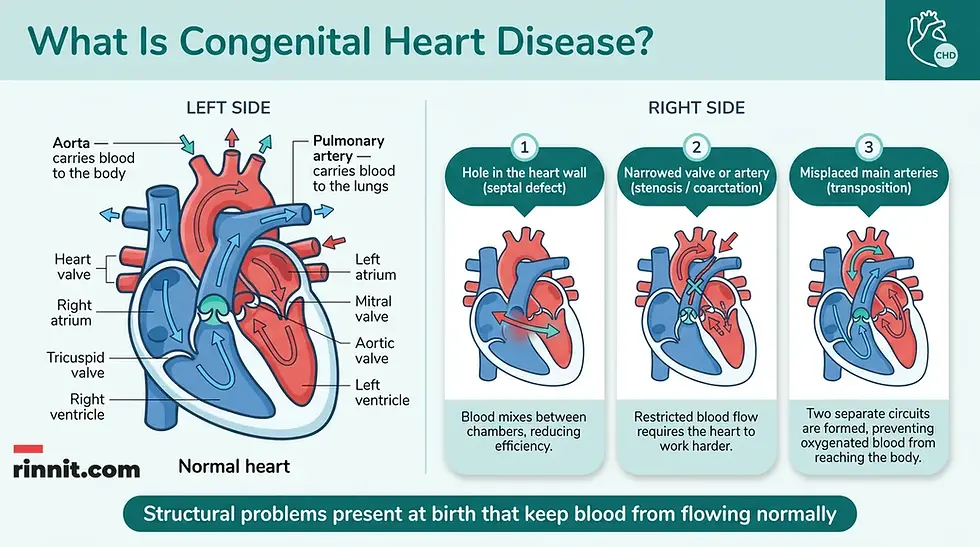
Congenital heart disease (CHD) is a problem with the heart's structure that is present at birth. The word congenital simply means present at birth. These structural problems keep blood from flowing normally through the heart and out to the rest of the body.
The problems can take several forms. A baby's heart may have a hole in its wall. Its blood vessels may be abnormal: there may be too many or too few, or blood may flow too slowly, to the wrong place, or in the wrong direction. The heart's valves, the flaps that control the direction and timing of blood flow, may not work correctly.
Term | Plain-language meaning |
Congenital | Present at birth |
CHD | A structural problem with the heart present at birth |
Heart valve | A flap-like gate that controls how blood flows through the heart |
Aorta | The main artery carrying blood from the heart to the rest of the body |
Pulmonary artery | The artery carrying blood from the heart to the lungs to pick up oxygen |
Some cases of CHD are simple and may never cause any symptoms. But others can be life-threatening and require treatment in infancy. Healthcare providers can often detect heart defects early, before or shortly after birth. Sometimes, however, people do not receive a CHD diagnosis until childhood, adolescence, or even adulthood.
What Are the Types of Congenital Heart Disease?
The two main types of congenital heart disease (CHD) are cyanotic and acyanotic, named for whether the defect lowers the oxygen level in the blood. The names come from whether the defect lowers the oxygen level in the blood.
Group | What it means | Typical need for treatment |
Cyanotic CHD | Low oxygen in the blood | Babies usually have low oxygen levels and need surgery |
Acyanotic CHD | Blood oxygen level is acceptable | Varies; many cases are less urgent |
Cyanotic Congenital Heart Disease
Cyanotic heart defects reduce the amount of oxygen the heart can deliver to the rest of the body. Babies born with these defects usually have low oxygen levels and need surgery. They fall into three subtypes.
Left heart obstructive lesions reduce blood flow between the heart and the rest of the body. Examples include hypoplastic left heart syndrome, in which the left side of the heart is too small, and interrupted aortic arch, in which the aorta is incomplete.
Right heart obstructive lesions reduce blood flow between the heart and the lungs. Examples include tetralogy of Fallot (a group of four anomalies that occur together), Ebstein's anomaly, pulmonary atresia, and tricuspid atresia, in which the valves do not develop correctly.
Mixing lesions cause the body to mix blood from the two circulation loops: blood headed to the body and blood headed to the lungs. One example is transposition of the great arteries, in which the two main arteries leaving the heart are in the wrong place. Another is truncus arteriosus, in which the heart has only one main artery instead of two to carry blood to the body.
Acyanotic Congenital Heart Disease
Acyanotic CHD involves an issue that makes blood pump through the body in an abnormal way, even though the blood's oxygen level stays acceptable.
The most common type is a hole in the heart. One of the heart's walls can have an abnormal opening. Depending on where the hole sits, it may be called an atrial septal defect (ASD), an atrioventricular canal defect, a patent ductus arteriosus (PDA), or a ventricular septal defect (VSD).
Problems with the aorta, the main artery that carries blood away from the heart to the body, are another group. The aorta can be too narrow, a condition called aortic coarctation. The aortic valve, which opens and closes to regulate blood flow, may be restricted in its opening or may have only two flaps instead of the usual three. A valve with two flaps is called a bicuspid aortic valve.
Problems with the pulmonary artery, the artery that carries blood from the right side of the heart to the lungs to get oxygen, form the third group. If this artery is too narrow, it is called pulmonary artery stenosis.
How Common Is Congenital Heart Disease?
Congenital heart disease is the most common type of congenital condition. Heart defects affect 1% of U.S. births [1].
What Are the Symptoms of CHD?
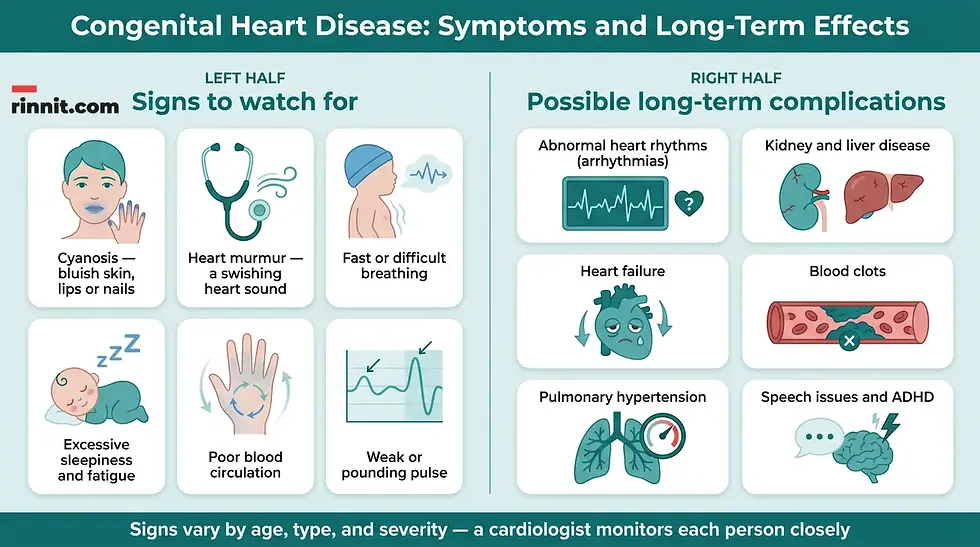
Symptoms may begin as soon as a baby is born, or they may not appear until later in life.
Symptom | What it looks like |
Cyanosis | Bluish skin, lips or nails |
Excessive sleepiness | The baby sleeps far more than expected |
Fast or difficult breathing | Breathing that is rapid or labored |
Fatigue | Extreme tiredness |
Tiring during exercise | Getting unusually tired or out of breath with activity |
Heart murmur | A swishing sound the heart makes that may indicate abnormal blood flow |
Poor blood circulation | Weak circulation through the body |
Weak or pounding pulse | A pulse that feels weak or unusually forceful |
The signs and symptoms of congenital heart defects vary widely. They depend on the child's age, the number of heart issues (a person can be born with more than one), the severity of the condition, and the type of congenital condition.
What Causes Congenital Heart Disease?
CHD happens when the fetal heart does not develop correctly in the womb. Scientists do not fully understand why this occurs, but research points to several possible factors.
Risk factor | How it may contribute |
Abnormal chromosomes or genetics | Gene changes that come from parents or happen randomly |
Smoking or secondhand smoke during pregnancy | Exposure to tobacco smoke while the heart forms |
Alcohol during pregnancy | Drinking alcohol while the heart forms |
Certain medications during pregnancy | Some drugs for high blood pressure, high cholesterol, or acne |
Illness during pregnancy | Conditions such as diabetes or phenylketonuria, or viral infections like rubella |
Random gene mutations are considered the most fundamental cause researchers understand today. The other factors raise the risk but do not guarantee a defect will occur [1].
What Complications Can CHD Cause?
Congenital heart defects can raise the likelihood of several other health problems over time.
Complication | What happens |
Arrhythmias | Abnormal heart rhythms |
Heart failure | The heart cannot pump effectively |
Pulmonary hypertension | High blood pressure in the lung arteries |
Endocarditis | An infection of the inner lining of the heart |
Kidney disease | The kidneys are damaged over time |
Liver disease | Liver problems develop |
Blood clots | Clots form more easily in the circulation |
Speech issues | Difficulties with speech |
ADHD | Attention-deficit/hyperactivity disorder |
How Is Congenital Heart Disease Diagnosed?
Diagnosis can happen before birth, shortly after birth, or much later in life.
A provider may find a heart defect during a routine prenatal ultrasound. If anything unusual appears, the next step is often a fetal echocardiogram, a test that uses harmless sound waves to create pictures of the fetal heart.
Soon after birth, providers can diagnose cyanotic CHD with pulse oximetry. This simple, painless test uses small sensors placed on the baby's fingers or toes to find out whether oxygen levels are too low.
For newborns, children, and adults, several tests help confirm and map the defect.
Test | What it does |
Physical exam | The provider listens to the heart for abnormal sounds, such as a murmur |
Chest X-ray | Pictures of the chest reveal structural abnormalities |
Electrocardiogram (EKG or ECG) | Measures the electrical activity of the heart |
Echocardiogram (echo) | Ultrasound creates images of the heart's valves and chambers |
Heart catheterization | Also called cardiac catheterization or coronary angiography; shows how well the heart pumps and circulates blood |
MRI | Creates detailed pictures of the heart |
How Is Congenital Heart Disease Treated?
Treatment depends entirely on the type and severity of the defect. Some cases of CHD may not need any treatment at all. Others are life-threatening and need treatment soon after birth.
Treatment option | What it involves |
Catheter procedure | A plug is placed into a defect through a catheter |
Nonsurgical closure | A closing device fixes an issue without open surgery |
Medications | Help the heart work more efficiently or manage blood pressure |
Oxygen therapy | Provides higher oxygen levels than normal room air |
Prostaglandin E1 | A medicine that relaxes smooth heart muscle and keeps the ductus arteriosus open (a blood vessel that normally closes after birth), helping provide needed circulation |
Surgery | Repairs the issue, opens up blood flow, or redirects blood; in severe cases, a heart transplant may be needed |
Can Treatment Cause Complications?
Complications of CHD treatment vary by procedure. Possible complications include bleeding, infection, arrhythmia (abnormal heart rhythm), scar tissue, blood clots, aneurysm (a stretched blood vessel), heart attack, and a leaky heart valve.
What Is Recovery Like?
Recovery time depends on the procedure. A child may need several days, a week, or even several months to recover. A child's provider can explain what to expect for the specific procedure being planned.

What Is the Outlook for People With CHD?
The outlook for people with congenital heart disease depends on the type of issue and its severity. Although serious cases can be life-threatening, many people with CHD live long, relatively normal and fulfilling lives.
The progress over the past several decades has been dramatic. Decades ago, only 10% of children with CHD survived into adulthood. Advances in diagnosis and treatment now help about 90% survive [1].
One important reality to understand: even after a surgical repair, CHD is a medical condition that needs to be shared with healthcare providers for years to come. Depending on the individual's situation, problems related to CHD can develop later in life.
Can CHD Be Prevented?
Congenital heart disease (CHD) has no proven prevention strategies, but parents-to-be can avoid some pregnancy risk factors, such as recreational drugs and smoking. People are born with it, usually from unknown causes, and it is beyond their control. Scientists do not have all the answers about what causes heart defects other than random gene mutations.
However, some factors place a pregnancy at higher risk, and parents-to-be can avoid them. During pregnancy, healthcare providers recommend not using recreational drugs, stopping smoking and avoiding secondhand smoke, avoiding alcohol, managing health conditions such as diabetes and phenylketonuria, and getting all recommended screening tests so problems are detected as early as possible.
How Do You Live With CHD?
People living with CHD can protect their heart health and reduce the risk of complications with everyday habits.
Self-care step | Why it matters |
Eat well-balanced, nutritious meals with heart-healthy foods | Keeps the heart as healthy as possible |
Exercise regularly, with the cardiologist's approval | Supports heart fitness safely |
Maintain a healthy weight | Reduces strain on the heart |
Tell all providers about the heart issue, medications, and surgeries | Prevents harmful interactions and missed risks |
Understand your specific type of CHD and its complications | Helps you act quickly if problems appear |
Plan pregnancy with your cardiologist, obstetrician, and PCP in advance | Risks can be understood and managed throughout pregnancy |
People with CHD should see a cardiologist regularly throughout life. A cardiologist monitors the condition, manages it over time, and detects complications early. Some people need more than one treatment over the years as new issues develop.
An encouraging note: Just because a provider uses the term "congenital heart defect" does not mean your child is defective. Children with CHD can still live a fulfilling life. Treatments have come a long way and can help many children who have heart issues at birth. If your baby has a heart issue, it is important to see a cardiologist who specializes in CHD, and to learn all you can about your child's condition.
When Should You Seek Emergency Care?
Take a person with congenital heart disease to the emergency room, or call 911 or your local emergency service number, if they experience dizziness, shortness of breath, chest pain, or fainting.
Conclusion: CHD Is Common, Treatable, and No Longer What It Used to Be
Congenital heart disease is a structural problem with the heart present at birth, ranging from simple holes in the heart wall to complex defects that limit blood flow. It is the most common birth condition, affecting 1% of U.S. births. While serious cases can be life-threatening in infancy, modern diagnosis and treatment now help about 90% of children with CHD survive into adulthood, a dramatic change from the 10% of decades past. Many go on to live long, relatively normal and fulfilling lives with regular cardiology care, healthy habits, and timely treatment when needed. If your child or you have been diagnosed with CHD, build a relationship with a cardiologist who specializes in congenital conditions and stay informed about your specific type of defect.
Get clear answers and trusted health guidance. For more plain-language health guides written to help you make confident decisions, visit Rinnit.com.
Frequently Asked Questions
What is congenital heart disease in simple terms?
Congenital heart disease is a structural problem with the heart that is present at birth, such as a hole in the heart wall, abnormal blood vessels, or faulty valves, that keeps blood from flowing normally.
Is congenital heart disease the same as a heart attack?
No. CHD is a structural defect present from birth, while a heart attack is damage caused when blood flow to part of the heart muscle is blocked.
How common is congenital heart disease?
Congenital heart disease is the most common type of congenital condition, affecting 1% of U.S. births.
Is congenital heart disease curable?
Many defects can be repaired with surgery, catheter procedures, or closing devices, but CHD remains a condition that needs lifelong follow-up with a cardiologist, even after repair.
Can a baby be born with more than one heart defect?
Yes. A person can be born with more than one heart issue, and symptoms vary depending on the number, type, and severity of the defects.
What is cyanotic congenital heart disease?
Cyanotic congenital heart disease is a group of heart defects that reduce the oxygen the heart delivers to the body, causing low blood oxygen levels. Babies with cyanotic CHD usually need surgery.
What is acyanotic congenital heart disease?
Acyanotic congenital heart disease is a group of defects that make blood pump through the body in an abnormal way, but the blood oxygen level stays acceptable.
What is a ventricular septal defect (VSD)?
A ventricular septal defect (VSD) is a type of acyanotic CHD: a hole in the wall between the lower chambers (ventricles) of the heart.
What is tetralogy of Fallot?
Tetralogy of Fallot is a cyanotic heart defect made up of a group of four anomalies that occur together and reduce blood flow between the heart and the lungs.
What is hypoplastic left heart syndrome?
Hypoplastic left heart syndrome is a cyanotic defect in which the left side of the heart is too small, reducing blood flow to the rest of the body.
What is a bicuspid aortic valve?
A heart valve that has only two flaps instead of the usual three, restricting how it opens to regulate blood flow.
What is a heart murmur?
A swishing sound the heart makes that may indicate abnormal blood flow. It is one of the common signs of CHD.
What are the symptoms of CHD in a newborn?
Bluish skin, lips or nails; excessive sleepiness; fast or difficult breathing; extreme tiredness; poor circulation; and a weak or pounding pulse.
Can CHD go unnoticed for years?
Yes. Some mild cases cause no symptoms and may not be diagnosed until childhood, adolescence, or adulthood.
How is CHD diagnosed?
Sometimes before birth through routine prenatal ultrasound and fetal echocardiogram, or after birth through pulse oximetry, chest X-ray, EKG, echocardiogram, heart catheterization, or MRI.
What is pulse oximetry?
A simple, painless newborn test that uses sensors on the baby's fingers or toes to measure whether blood oxygen levels are too low.
What is an echocardiogram?
A test that uses ultrasound to create images of the heart's valves and chambers.
How is CHD treated?
Treatment may include observation, medications, oxygen therapy, a catheter procedure with a plug, a nonsurgical closing device, prostaglandin E1, surgery, or, in severe cases, a heart transplant.
What is prostaglandin E1 used for in CHD?
Prostaglandin E1 relaxes smooth heart muscle and keeps the ductus arteriosus, a blood vessel that normally closes after birth, open, helping provide needed circulation.
Does every child with CHD need surgery?
No. Some cases may not need any treatment, while others are life-threatening and need treatment soon after birth.
What is the survival rate for congenital heart disease?
About 90% of children with CHD now survive into adulthood, compared with only 10% decades ago. Large registry studies from high-income countries report even higher survival in children born in recent years.
What complications can CHD cause over time?
Arrhythmias, heart failure, pulmonary hypertension, endocarditis, kidney disease, liver disease, blood clots, speech issues, and ADHD.
Can CHD cause kidney disease?
Yes. Congenital heart defects can make you more likely to develop kidney disease over time.
Can a person with CHD play sports and exercise?
Many can exercise regularly, but only with their cardiologist's approval, since activity limits depend on the specific defect and its severity.
When should someone with CHD go to the emergency room?
If they experience dizziness, shortness of breath, chest pain, or fainting, they should go to the ER or call 911 (or the local emergency service number).
Can CHD be prevented?
There are no proven prevention strategies; CHD is usually caused by unknown factors and random gene mutations. Avoiding smoking, alcohol, certain medications, and recreational drugs during pregnancy, and managing conditions like diabetes, may lower the risk.
What questions should parents ask about their child's CHD?
Which type of CHD does my child have? Is it minor or major? What treatment is best? Will my child need surgery? Is there a support group for parents?
Does CHD go away after surgery?
No. Even after surgical repair, CHD is a condition you need to tell your providers about for years to come, as problems can develop later.
Can women with CHD have a safe pregnancy?
Many can, but risks should be discussed with a cardiologist, obstetrician, and primary care provider well in advance so risks can be managed throughout the pregnancy.
Related Reading
ASD Closure: Procedure, Risks and Recovery explains ASD closure.
Nuchal Translucency (NT) Scan: Timing, Procedure, Accuracy and Results explains the first-trimester ultrasound that screens for this condition.
References
Cleveland Clinic. Congenital Heart Disease: Symptoms & Treatment. Cleveland Clinic. Last updated February 26, 2024. https://my.clevelandclinic.org/health/diseases/21674-congenital-heart-disease
MedlinePlus, National Library of Medicine. Congenital Heart Defects. MedlinePlus. Last updated March 12, 2025. https://medlineplus.gov/congenitalheartdefects.html
American Heart Association. Congenital Heart Disease. American Heart Association. Accessed October 15, 2026. https://www.heart.org/en/health-topics/congenital-heart-defects
van der Linde D, et al. Birth prevalence of congenital heart disease worldwide: a systematic review and meta-analysis. J Am Coll Cardiol. 2011;58(21):2241-2247. PMID 22078432. https://doi.org/10.1016/j.jacc.2011.08.025
Mandalenakis Z, et al. Survival in Children With Congenital Heart Disease: Have We Reached a Peak at 97%? J Am Heart Assoc. 2020;9(22):e017704. PMID 33153356. https://doi.org/10.1161/JAHA.120.017704
Thangaratinam S, et al. Pulse oximetry screening for critical congenital heart defects in asymptomatic newborn babies: a systematic review and meta-analysis. Lancet. 2012;379(9835):2459-2464. PMID 22554860. https://doi.org/10.1016/S0140-6736(12)60107-X
Plana MN, Zamora J, Suresh G, et al. Pulse oximetry screening for critical congenital heart defects. Cochrane Database Syst Rev. 2018;3(3):CD011912. PMID 29494750. https://doi.org/10.1002/14651858.CD011912.pub2
Zhang TN, Huang XM, Zhao XY, et al. Risks of specific congenital anomalies in offspring of women with diabetes: a systematic review and meta-analysis of population-based studies including over 80 million births. PLoS Med. 2022;19(2):e1003900. PMID 35104296. https://doi.org/10.1371/journal.pmed.1003900
Su H, Guo E, Woodward M, et al. First trimester maternal infections and offspring congenital heart defects: a meta-analysis. Eur Heart J. 2026;47(7):794-812. PMID 40878857. https://doi.org/10.1093/eurheartj/ehaf564
Medical disclaimer
This article is for general educational purposes only and is not a substitute for professional medical advice, diagnosis, or treatment. Always seek the advice of your physician or other qualified healthcare provider with any questions you may have about a medical condition. Never disregard professional medical advice or delay seeking care because of something you have read here. If you think you may have a medical emergency, call your doctor or emergency services immediately.



Comments