Nuchal Translucency (NT) Scan: Timing, Procedure, Accuracy and Results

Updated: 2 days ago
Written and medically reviewed by Dr. Baraa Alnahhal, MD · Last reviewed: November 2026 · How we review
Quick Answer: What is a nuchal translucency scan?
A nuchal translucency (NT) scan is a prenatal ultrasound, done between 11 and 13 weeks of pregnancy, that measures the fluid-filled space at the back of the fetus's neck. A small amount of fluid is normal; more fluid can point to a higher chance of a chromosomal condition or a heart problem. It's a screening test, not a diagnosis. [1]
What the research says
A thick NT often signals a problem that a blood test alone can miss. In 1,901 Dutch pregnancies with NT at or above the 95th percentile, 43% had at least one abnormality (21% with NT between the 95th and 99th percentile, 62% at the 99th or above). The authors estimated 34% of these problems could go undetected if a cell-free DNA blood test replaced the scan. (Bardi et al., Prenatal Diagnosis, 2020) [2]
Early heart scans around NT time find most major heart defects. A meta-analysis of 18 studies (26,201 fetal hearts) found first-trimester fetal echocardiography had 75% sensitivity for any congenital heart defect and 83.8% for major defects, with near-perfect specificity. (Yu et al., Journal of Ultrasound in Medicine, 2020) [3]
Key takeaways
The NT scan is done between 11 and 13 weeks, when the fetus measures 45 to 84 mm from crown to rump. [1]
It's a low-risk ultrasound, usually through the belly. [1]
On its own it detects about 70% of Down syndrome cases; with noninvasive prenatal testing (NIPT), about 95%. [1]
A measurement above 3 mm at 12 weeks usually leads to a talk about more testing. [1]
An abnormal result means higher risk, not a diagnosis. [1]
What does a nuchal translucency scan check for?
A small amount of fluid behind the neck is normal in every fetus. More fluid can mean a higher chance of: [1]
Down syndrome (trisomy 21)
Edwards syndrome (trisomy 18)
Patau syndrome (trisomy 13)
Congenital heart conditions
During the scan, your provider also checks early physical features, such as the nasal bone. Anyone who is 11 to 13 weeks pregnant can choose to have it. [1]
When is the NT scan done?
Timing matters because the fluid is reabsorbed after 14 weeks, which makes it harder to measure. [1]

Detail | What to know |
Weeks of pregnancy | Between 11 and 13 weeks |
Fetal size | 45 mm to 84 mm from crown to rump |
After 14 weeks | Fluid is reabsorbed and becomes hard to measure |
Sources: [1]
What happens during a nuchal translucency scan?
Most NT scans are abdominal ultrasounds, though a vaginal ultrasound is sometimes used. [1]
Gel is spread on your belly.
The provider moves a handheld wand (transducer) over the gel to see the fetus.
They measure the fluid-filled space behind the neck in millimeters and check early features like the nasal bone.
Sources: [1]
The scan uses only ultrasound, so it's low risk. It can't tell you the baby's sex. [1]
How accurate is the NT scan?
Your NT measurement is usually combined with all your first-trimester screening results, including blood work, to calculate risk. This makes it more accurate. [1]
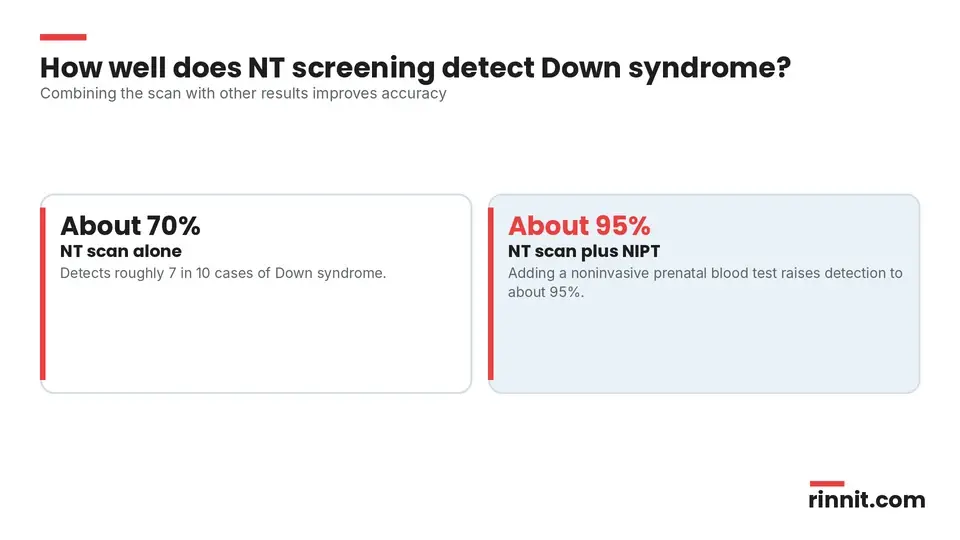
Screening approach | Down syndrome detection |
NT scan alone | About 70% |
NT scan plus NIPT | About 95% |
Sources: [1]
What do nuchal translucency results mean?
Your provider usually reads the ultrasound the same day, but blood work takes a few days to weeks. Most providers wait for all results before calculating your risk. [1]
Results are given as a chance, such as 1 in 300. That means one in every 300 fetuses with that result had a congenital condition. Providers don't diagnose anything from the NT scan alone; they use it to decide whether more testing is needed. [1]
What is an abnormal NT measurement?
A measurement above 3 mm at 12 weeks usually prompts a conversation about further testing. An abnormal scan does not diagnose Down syndrome; it only shows a higher risk. [1]
What happens after an abnormal result?
Your provider may refer you to a genetic counselor and offer follow-up tests such as: [1]
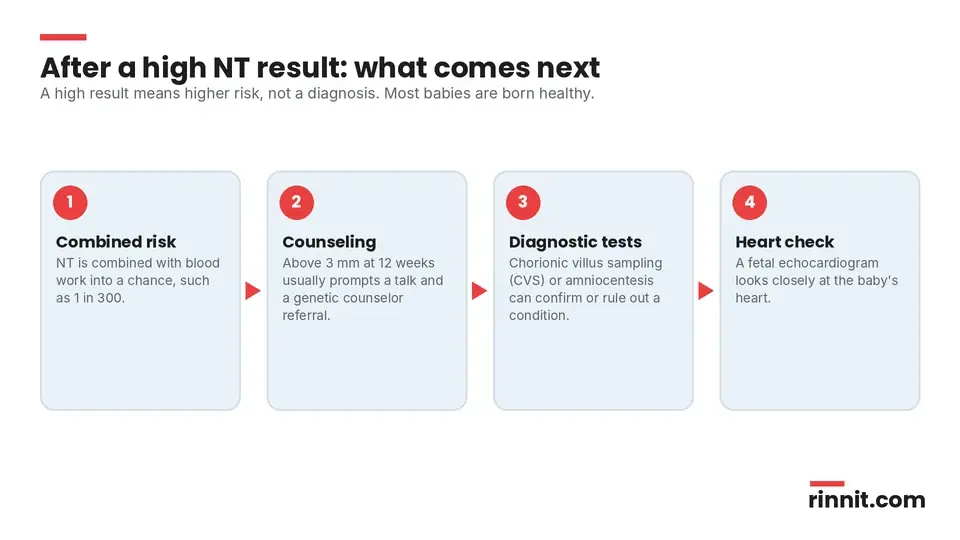
Chorionic villus sampling (CVS)
Amniocentesis
A fetal echocardiogram to look at the baby's heart
Most babies are born without health conditions, and an irregular result usually means more testing, not a certain problem. [1]
Do you need both NIPT and an NT scan?
Not necessarily. NIPT is a blood test and the NT scan is an ultrasound. Your health history, insurance and risk factors all affect which one fits you best, so talk it through with your provider. [1] Research suggests the scan can still pick up some problems a blood test alone may miss. [2]
Conclusion
The nuchal translucency scan is a quick, low-risk ultrasound in the first trimester that helps estimate your baby's chance of certain chromosomal and heart conditions. Its power comes from timing and from being combined with blood work.
If your NT result comes back high, remember it shows risk, not a diagnosis. Ask about a genetic counselor and which follow-up test makes sense for you.
Keep learning: Read our guide to Down syndrome or learn how extra chromosomes cause trisomies. For more background, see the ACOG guide to prenatal genetic screening tests.
FAQ
What is a nuchal translucency scan?
It's a first-trimester ultrasound that measures the fluid behind the fetus's neck to estimate the risk of certain conditions.
When is the NT scan done?
Between 11 and 13 weeks of pregnancy, when the fetus measures 45 to 84 mm from crown to rump.
What does the NT scan screen for?
Down syndrome, Edwards syndrome, Patau syndrome and congenital heart conditions.
What is a normal nuchal translucency measurement?
A small amount of fluid is normal; above 3 mm at 12 weeks usually prompts discussion of more testing.
How accurate is the nuchal translucency scan?
Alone it detects about 70% of Down syndrome cases; combined with NIPT, about 95%.
Is the NT scan safe?
Yes. It's a low-risk ultrasound with no radiation.
Is the NT scan abdominal or vaginal?
Usually abdominal, though a vaginal ultrasound is sometimes used.
Can the NT scan tell the baby's sex?
No. The nuchal translucency scan can't determine the baby's sex.
Does an abnormal NT scan mean my baby has Down syndrome?
No. It means a higher risk; tests like CVS or amniocentesis are needed to diagnose.
What tests follow an abnormal NT result?
Options include chorionic villus sampling, amniocentesis and a fetal echocardiogram, often with genetic counseling.
Do I need both NIPT and an NT scan?
Not always; your provider will help you choose based on your history, risk factors and insurance.
Related Reading
Down Syndrome: Symptoms, Causes, Types & Life Expectancy — Complete Guide explains trisomy 21, the main condition the NT scan screens for.
Edwards Syndrome (Trisomy 18): Symptoms, Causes, Diagnosis, Treatment, Survival Rates and When to Seek Emergency Care — What You Need to Know covers trisomy 18, another condition linked to extra neck fluid.
Trisomy Explained: Understanding Extra Chromosomes and Genetic Health explains how extra chromosomes cause the conditions this scan screens for.
Congenital Heart Disease (CHD): Types, Causes, Symptoms, and Survival Outlook covers heart conditions that a thick NT can point to.
Prenatal Genetic Testing: Screening vs Diagnostic Tests, Timing and Accuracy explains the screening and diagnostic tests that can detect this condition during pregnancy.
References
Cleveland Clinic. Nuchal Translucency Scan: Purpose, Procedure & Results. Cleveland Clinic. Last updated March 3, 2026. https://my.clevelandclinic.org/health/diagnostics/23333-nuchal-translucency
Bardi F, Bosschieter P, Verheij J, et al. Is there still a role for nuchal translucency measurement in the changing paradigm of first trimester screening? Prenat Diagn. 2020;40(2):197-205. PMID 31697852. https://doi.org/10.1002/pd.5590
Yu D, Sui L, Zhang N. Performance of First-Trimester Fetal Echocardiography in Diagnosing Fetal Heart Defects: Meta-analysis and Systematic Review. J Ultrasound Med. 2020;39(3):471-480. PMID 31463979. https://doi.org/10.1002/jum.15123
Medical disclaimer
This article is for general education only and does not replace advice from a qualified healthcare professional. Talk to your doctor about your own diagnosis and treatment, and seek emergency care right away for severe or sudden symptoms.



Comments