Down Syndrome: Symptoms, Causes, Types & Life Expectancy — Complete Guide

Updated: 3 days ago
Medically reviewed by Dr. Baraa Alnahhal, MD · Last reviewed: October 2026
Quick Answer
Down syndrome is a genetic condition present at birth, caused by an extra full or partial copy of chromosome 21, which leads to its developmental changes and physical features. It usually causes lifelong, mostly mild to moderate intellectual disability. Many children with Down syndrome today can expect to live more than 60 years, and with support most live fulfilling lives.
What the research says
About half of people with Down syndrome have a congenital heart defect. A systematic review and meta-analysis of 102 studies (60,610 people with Down syndrome) found that the pooled prevalence of congenital heart defects was 49.9% (95% CI 46.8–53.0%), and the authors called for all newborns suspected of Down syndrome to be screened for heart defects. (Xu et al., J Epidemiol Community Health, 2025) [3]
Blood-based screening is very accurate, but it is still a screening test. A Cochrane review of 65 studies (86,139 pregnancies) found that in high-risk pregnancies, genomics-based cell-free DNA testing using massively parallel shotgun sequencing detected trisomy 21 with a pooled sensitivity of 99.7% (95% CI 98.0–100%) and specificity of 99.9% (95% CI 99.8–100%); the authors still concluded that invasive fetal karyotyping remains the required way to confirm a chromosomal abnormality before irreversible decisions are made. (Badeau et al., Cochrane Database Syst Rev, 2017) [4]
Lifespan has risen dramatically, and Alzheimer's disease is a key limiting factor. An analysis of US death certificates (77,347 records with a Down syndrome code, 1968–2019) found that median age at death rose from 1 year in 1968 to 57 years in 2019, while a meta-analysis estimated the average age at onset of Alzheimer's dementia at 53.8 years (95% CI 53.1–54.5); the authors noted the oldest ages at death had changed little in recent decades (90th percentile 63 years in 1990 and 65 years in 2019). (Iulita et al., JAMA Netw Open, 2022) [5]
At a Glance
Topic | Key Facts |
What it is | Genetic condition — an extra full or partial copy of chromosome 21 |
Frequency | Most common chromosomal cause of intellectual disability in children |
Main signs | Distinct facial features; developmental and speech delays; low muscle tone; shorter height |
Types | Trisomy 21 (~95%), mosaic (rare), translocation (small number) |
Cause | Random unusual cell division; risk rises after maternal age 35 |
Before birth | Screening tests estimate risk; CVS and amniocentesis confirm it |
Health concerns | Heart defects (~half), digestive problems, sleep apnea, thyroid issues, immune differences, higher Alzheimer's risk |
Life expectancy | More than 60 years for children born today, depending on health severity |
Main support | Early intervention, therapies, special education, specialist team care |
What Is Down Syndrome?
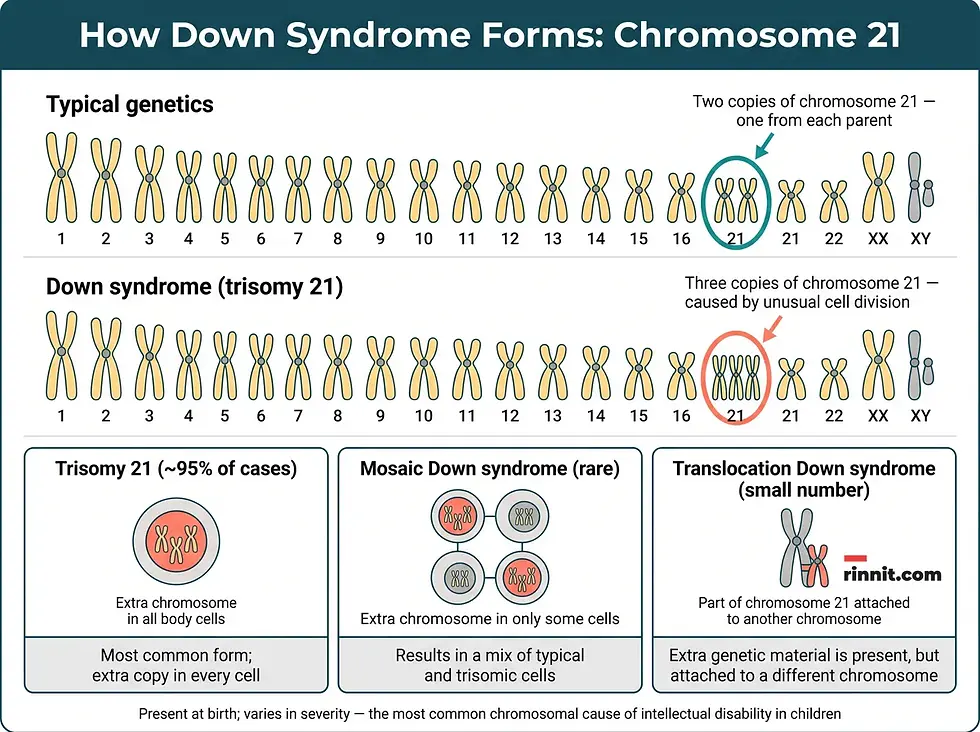
Down syndrome is a genetic condition caused when an unusual cell division results in an extra full or partial copy of chromosome 21. This extra genetic material causes the developmental changes and physical features of Down syndrome.
To understand why, it helps to know how chromosomes work. Human cells usually contain 23 pairs of chromosomes — 46 in total. One chromosome in each pair comes from the sperm, the other from the egg. In Down syndrome, there are three copies of chromosome 21 instead of the usual two.
The term "syndrome" refers to a set of symptoms that tend to happen together. The condition is named after the English physician John Langdon Down, who first described it.
Down syndrome varies in severity among individuals. It causes lifelong intellectual disability and developmental delays, and it is the most common genetic chromosomal cause of intellectual disability in children. It also commonly causes other medical conditions, including heart and digestive system problems.
Better understanding of Down syndrome and early interventions can greatly improve the quality of life for children and adults with this condition and help them live fulfilling lives.
Signs and Symptoms
Each person with Down syndrome is an individual. Problems with intellect and development are usually mild to moderate. Some people are healthy, while others have serious health issues such as heart problems present at birth.
Children and adults with Down syndrome often have distinct face and body features. Though not everyone has the same features, the more common ones include:
Feature | What you may notice |
Face and nose | Flattened face and small nose with a flat bridge |
Head and neck | Small head; short neck |
Mouth | Tongue that tends to stick out of the mouth |
Eyes | Upward slanting eyelids; skin fold of the upper eyelid covering the inner corner; tiny white spots on the iris called Brushfield's spots |
Ears | Small, rounded ears |
Hands | Wide, small hands with a single crease in the palm and short fingers |
Feet | Small feet with a space between the first and second toes |
Height | Short height; infants may start average size but grow slowly |
Muscles and joints | Poor muscle tone in infancy; loose, over-flexible joints |
When to see a doctor: Down syndrome is usually diagnosed before or at birth. If you have any questions about your pregnancy or your child's growth and development, talk with your doctor or healthcare professional.
Developmental Delays
Children with Down syndrome take longer to reach developmental milestones such as sitting, talking, and walking. Occupational therapy, physical therapy, and speech and language therapy can help improve physical functioning and speech.
Intellectual Disabilities
Most children with Down syndrome have mild to moderate cognitive impairment. This means they have problems with memory, learning new things, focusing and thinking, or making decisions that affect everyday life. Language and speech are delayed.
Early intervention and special education services can help children and teens reach their full potential, and services for adults can help support living a full life.
Causes: The Three Types of Down Syndrome
Any one of three genetic changes can cause Down syndrome, and each affects the cells differently.
Type | How it happens | How common |
Trisomy 21 | An unusual cell division during the development of the sperm or egg cell puts three copies of chromosome 21 in every cell of the body | About 95% of cases |
Mosaic Down syndrome | An unusual cell division after the egg is fertilized creates a mosaic of typical cells and cells with an extra chromosome 21 — only some cells carry the extra copy | Rare form |
Translocation Down syndrome | A part of chromosome 21 becomes attached (translocated) onto another chromosome, before or at conception — the person has the usual two copies of chromosome 21 plus extra chromosome 21 material on a different chromosome | A small number of people |
Is Down Syndrome Inherited?
Most of the time, Down syndrome is not passed down in families. It is caused by a random unusual cell division — during the development of the sperm cell or egg cell, or during early development of the baby in the womb.
Translocation Down syndrome can be passed from parent to child, but only a small number of children with Down syndrome have the translocation form, and only some of those inherited it from a parent.
A parent may carry a balanced translocation — rearranged genetic material from chromosome 21 on another chromosome, but no extra material. Such a parent shows no signs of Down syndrome but can pass an unbalanced translocation to children, causing Down syndrome.
Risk Factors
Some parents have a greater risk of having a baby with Down syndrome.
Older age: The chance of having a child with Down syndrome increases after a pregnant person is 35 years of age, because older eggs have a greater risk of unusual chromosome division. However, most children with Down syndrome are born to pregnant people under age 35 — because they have far more babies overall.
Carrying the genetic translocation: Either parent can pass the translocation for Down syndrome to their children.
Having had one child with Down syndrome: Both parents — and parents who carry a translocation themselves — are at higher risk of having another child with Down syndrome. A genetic counselor can help parents understand the risk of having a second child with Down syndrome.

Possible Complications
Health concerns from Down syndrome can be mild, moderate, or severe. Some children are healthy, while others have serious health problems, and some concerns become more prominent with age.
Health concern | What to know |
Heart problems | About half of children with Down syndrome are born with a heart condition present at birth; some are life-threatening and may require surgery in early infancy |
Digestive system problems | Structural stomach and intestinal changes; higher risk of intestinal blockage, GERD (heartburn), and celiac disease |
Immune system problems | Higher risk of autoimmune disorders, some forms of cancer, and infections such as pneumonia |
Sleep apnea | Soft tissue and spinal changes can block the airways, raising the risk of obstructive sleep apnea |
Weight | People with Down syndrome are more likely to be overweight or obese than the general population |
Spinal problems | Atlantoaxial instability — the top two neck vertebrae may not align properly, raising the risk of serious spinal cord injury from activities that bend the neck too far (contact sports, horseback riding) |
Leukemia | Young children with Down syndrome have a higher risk of leukemia |
Alzheimer's disease | Down syndrome greatly raises the risk; symptoms may begin around age 50 |
Other problems | Thyroid problems, dental problems, seizures, ear infections, hearing and vision problems; depression, anxiety, autism, and ADHD may also be more common |
Life Expectancy
Over the years, there have been significant advances in healthcare for children and adults with Down syndrome. Because of these advances, children born today with Down syndrome are likely to live a longer life than in the past. People with Down syndrome can expect to live more than 60 years, depending on how severe their health problems are.
Prevention
There's no way to prevent Down syndrome. If you're at higher risk of having a child with Down syndrome, or you already have one child with Down syndrome, you may want to talk with a genetic counselor before becoming pregnant. A counselor can help you understand your chances, explain the prenatal tests available, and walk through the pros and cons of testing.
How Down Syndrome Is Diagnosed
The American College of Obstetricians and Gynecologists recommends offering the option of screening tests and diagnostic tests for Down syndrome to all who are pregnant, regardless of age.
Screening tests suggest the likelihood that you're carrying a baby with Down syndrome, but they can't tell for sure. Diagnostic tests can tell for sure whether your baby has Down syndrome.
Screening Tests During Pregnancy
Screening is offered as a routine part of prenatal care. The main approaches:
Screening test | How it works |
First trimester combined test | Two steps: a blood test measuring PAPP-A and the pregnancy hormone HCG (levels outside the standard range may indicate a problem), plus a nuchal translucency ultrasound measuring fluid in the tissue at the back of the baby's neck (more fluid suggests chromosome changes); combined with your age, these estimate risk |
Integrated screening test | Two parts combined: first trimester blood test (PAPP-A) and nuchal translucency ultrasound, plus a second-trimester quad screen measuring four substances — alpha fetoprotein, estriol, HCG, and inhibin A |
Cell-free DNA testing | Examines placental DNA released into the bloodstream for extra chromosome 21 material; available from 10 weeks for those at risk; a positive result usually needs diagnostic testing to confirm |
Diagnostic Tests During Pregnancy
If screening results are positive or uncertain, or you're at high risk, diagnostic testing can confirm the diagnosis:
Chorionic villus sampling (CVS): Cells are taken from the placenta to look at the baby's chromosomes. Done in the first trimester, between 10 and 14 weeks. The risk of miscarriage is very low.
Amniocentesis: A sample of the amniotic fluid surrounding the baby is withdrawn through a needle into the uterus to look at the baby's chromosomes. Done in the second trimester, after 15 weeks. Risk of miscarriage is also very low.
Couples undergoing in vitro fertilization (IVF) who know they're at increased risk of passing on certain genetic conditions may choose to have the embryo tested for genetic changes before implantation.
Diagnostic Tests for Newborns
A physical exam is usually enough to identify Down syndrome in an infant within the first 24 hours after birth. To confirm, the doctor orders a chromosomal karyotype — a blood test that looks at the child's chromosomes. If there's an extra full or partial chromosome 21 in all or some cells, the diagnosis is Down syndrome.
Treatment and Ongoing Care
Early intervention for infants and children with Down syndrome can make a major difference in improving quality of life. Because each child is unique, treatment depends on your child's needs — and as your child enters different stages of life, care and services may change.
Team Care
If your child has Down syndrome, you'll likely rely on a team of specialists:
Specialist | Role |
Primary care pediatrician | Coordinates and gives routine childhood care |
Pediatric cardiologist | Heart specialist for congenital heart conditions |
Pediatric gastroenterologist | Digestive system specialist |
Pediatric endocrinologist | Hormone-related conditions |
Developmental pediatrician | Specialist with expertise in Down syndrome; child DS specialty clinics may offer many services in one place |
Pediatric neurologist | Nervous system specialist |
Pediatric ENT specialist | Ear, nose, and throat specialist |
Pediatric ophthalmologist | Eye doctor |
Audiologist | Hearing professional |
Speech-language pathologist | Speech and language therapy |
Physical therapist | Motor skills and movement |
Occupational therapist | Daily-life skills and function |
Getting routine medical care and treating issues when needed helps maintain a healthy lifestyle throughout life.
Adults with Down Syndrome
As your child becomes an adult, healthcare needs change. Alongside general adult screenings, ongoing care covers conditions more common in adults with Down syndrome: vision and hearing problems, dental issues, hypothyroidism (low thyroid), diabetes, celiac disease and GERD, heart disease, stroke and high cholesterol, obesity, sleep apnea, mood and behavior changes, Alzheimer's disease, and bone problems such as spine problems, arthritis, and osteoporosis. Adult Down syndrome specialty clinics may be available.
Beyond health, caring for an adult loved one includes planning for living arrangements, social and recreational opportunities, support programs and jobs, financial support, and guardianship.
Coping and Support
Learning your child has Down syndrome can bring a range of emotions. Information and support can ease these concerns. Practical steps that help:
Ask about early intervention programs — available in most U.S. states for infants and young children from birth until age 3; they develop motor, language, social, and self-help skills, most offer free screening, and an Individual Family Service Plan (IFSP) outlines services for your child.
Learn about educational options — mainstreaming, support staff in regular classes, special education, or combinations; an Individualized Education Plan (IEP) with your school district spells out how your child's education will meet their needs.
Connect with other families — support groups exist in communities, through national organizations, and online.
Participate in social and leisure activities — park district programs, Special Olympics, sports teams, ballet; some adjustments may help your child take part fully.
Encourage independence — with practice, your child may manage packing a lunch, bathing, dressing, cooking, cleaning, and laundry; a daily checklist of tasks can help them feel independent and accomplished.
Prepare for the transition to adulthood — explore living, working, and social opportunities before your child leaves school, including community living, group homes, community employment, day programs, and workshops.
People with Down syndrome can live fulfilling lives. Most live with their families, in supported living settings, or independently. With the right support, most go to mainstream schools, read and write, make decisions, have friends, enjoy an active social life, and have jobs.
Frequently Asked Questions
What causes Down syndrome?
Down syndrome is caused by an unusual cell division that results in an extra full or partial copy of chromosome 21. This extra genetic material changes how the body and brain develop and is responsible for the physical features and developmental characteristics of the condition.
What are the types of Down syndrome?
There are three types: trisomy 21 (about 95% of cases, when every cell has three copies of chromosome 21), mosaic Down syndrome (a rare form where only some cells have the extra copy), and translocation Down syndrome (a small number of cases, when part of chromosome 21 attaches to another chromosome).
Is Down syndrome inherited?
Most of the time, no — it results from a random unusual cell division during the development of the sperm or egg, or during early development in the womb. Only translocation Down syndrome can be passed from parent to child, and even then only a small number of cases are inherited.
What increases the risk of having a child with Down syndrome?
The main risk factor is older maternal age — the risk increases after 35 because older eggs have a greater risk of unusual chromosome division. Carrying the genetic translocation for Down syndrome, or having already had one child with Down syndrome, also raises the risk.
What are the signs of Down syndrome in a child?
Common signs include a flattened face with a small nose, small head, short neck, tongue that tends to stick out, upward slanting eyelids, small rounded ears, wide hands with a single palm crease, short height, poor muscle tone in infancy, and loose joints — along with developmental and speech delays.
How is Down syndrome diagnosed during pregnancy?
Screening tests (first trimester combined test, integrated screening test, and cell-free DNA testing from 10 weeks) estimate the risk, while diagnostic tests (CVS at 10–14 weeks and amniocentesis after 15 weeks) can confirm the diagnosis for sure.
What is the life expectancy of someone with Down syndrome?
Children born today with Down syndrome can expect to live more than 60 years, depending on the severity of their health problems — a major improvement driven by advances in healthcare over the years.
Conclusion
Down syndrome is genetic, not something anyone causes — an unusual cell division creates an extra copy of chromosome 21, most often by chance rather than inheritance.
It's present at birth and lifelong, but highly individual — intellectual disability is usually mild to moderate, and many people are healthy while others face heart, digestive, or immune challenges.
Support changes the trajectory — early intervention, therapy, special education, specialist team care, and today's healthcare mean most people with Down syndrome live fulfilling lives, and children born today can expect to live more than 60 years.
This guide covered what Down syndrome is, the three genetic types, the signs to recognize, prenatal and newborn diagnosis, possible health concerns, and the care and community support that make the biggest difference. For more complete health guides, see the full collection at rinnit.com.
Your Next Steps
Share your thoughts — comment below with your questions or experience.
Stay updated — sign up on rinnit.com for new complete guides and health updates.
This content is provided for general educational purposes only and is not a substitute for professional medical advice. Always consult a qualified healthcare professional for diagnosis and treatment.
Related Reading
Genetic Testing (DNA Tests): Types, Uses, Risks and What Results Mean explains the DNA tests that can confirm this condition or show carrier status.
Nuchal Translucency (NT) Scan: Timing, Procedure, Accuracy and Results explains the first-trimester ultrasound that screens for this condition.
Prenatal Genetic Testing: Screening vs Diagnostic Tests, Timing and Accuracy explains the screening and diagnostic tests that can detect this condition during pregnancy.
Learn more in our guide to NIPT Test (Noninvasive Prenatal Testing): What It Screens For, Accuracy and Results.
Preimplantation Genetic Testing (PGT): Types, Process, Results and Accuracy explains how IVF embryos are tested for genetic and chromosomal conditions.
Amniocentesis: Why It's Done, What Happens, Risks and What Your Results Mean explains the prenatal test that can detect this condition before birth.
Chorionic Villus Sampling (CVS): What It Is, Why It's Done, Risks and Results explains how chorionic villus sampling checks a pregnancy for genetic conditions in the first trimester.
DNA Paternity Test: Types, Accuracy, Timing and What Results Mean explains how DNA testing confirms a child's biological father.
20-Week Ultrasound (Anatomy Scan): What It Checks, How to Prepare and What Results Mean explains the mid-pregnancy scan that can detect signs of this condition before birth.
Alpha-Fetoprotein (AFP) Test: Pregnancy Screening, Cancer Marker and What Results Mean explains the blood test used in pregnancy screening and as a liver cancer marker.
Quad Screen: What the Second-Trimester Blood Test Checks For and What Results Mean explains the second-trimester blood screen for Down syndrome and neural tube defects.
Karyotype Test: What It Shows, Sample Types, Results and Limits explains the chromosome test used to diagnose this and other genetic conditions.
References
Mayo Clinic Staff. Down syndrome - Symptoms and causes. Mayo Clinic. November 12, 2024. https://www.mayoclinic.org/diseases-conditions/down-syndrome/symptoms-causes/syc-20355977
Mayo Clinic Staff. Down syndrome - Diagnosis and treatment. Mayo Clinic. November 12, 2024. https://www.mayoclinic.org/diseases-conditions/down-syndrome/diagnosis-treatment/drc-20355983
Xu CX, et al. Prevalence of congenital heart defects in people with Down syndrome: a systematic review and meta-analysis. J Epidemiol Community Health. 2025;79(6):445-450. PMID 39805637. https://doi.org/10.1136/jech-2023-220638
Badeau M, et al. Genomics-based non-invasive prenatal testing for detection of fetal chromosomal aneuploidy in pregnant women. Cochrane Database Syst Rev. 2017;11(11):CD011767. PMID 29125628. https://doi.org/10.1002/14651858.CD011767.pub2
Iulita MF, et al. Association of Alzheimer Disease With Life Expectancy in People With Down Syndrome. JAMA Netw Open. 2022;5(5):e2212910. PMID 35604690. https://doi.org/10.1001/jamanetworkopen.2022.12910



Comments