Preimplantation Genetic Testing (PGT): Types, Process, Results and Accuracy

Updated: 4 days ago
Written and medically reviewed by Dr. Baraa Alnahhal, MD · Last reviewed: November 2026 · How we review
Quick Answer: What is preimplantation genetic testing (PGT)?
Preimplantation genetic testing (PGT) checks embryos created through in vitro fertilization (IVF) for certain genetic or chromosomal conditions before one is transferred to the uterus. A few cells are removed from each embryo and tested, so embryos without the condition can be chosen. There are three types: PGT-A, PGT-M and PGT-SR. [1]
What the research says
PGT-A did not raise live births in women with good embryos. In a trial of 1,212 women aged 20 to 37 with three or more good-quality blastocysts, cumulative live births were 77.2% with PGT-A and 81.8% with conventional IVF; pregnancy loss was lower with PGT-A (8.7% vs 12.6%). (Yan et al., The New England Journal of Medicine, 2021) [2]
The overall evidence is still uncertain. A Cochrane review of 13 trials with 2,794 women found insufficient good-quality evidence that PGT-A as currently performed changes cumulative live birth or miscarriage rates, and concluded it isn't supported for routine use. (Cornelisse et al., Cochrane Database of Systematic Reviews, 2020) [3]
Key takeaways
PGT is only available to people having IVF. [1]
PGT-A checks chromosome number, PGT-M checks for a single-gene condition and PGT-SR checks for structural chromosome changes. [1]
A few cells are taken from the embryo's outer layer at the blastocyst stage. [1]
PGT adds time and cost to IVF but no extra risk beyond IVF itself. [1]
Results aren't guaranteed, so testing in pregnancy is recommended to confirm them. [1]
What is preimplantation genetic testing?
PGT is a genetic test done on embryos made through IVF. It lets fertility specialists screen embryos for certain genetic or chromosomal conditions before transfer. Embryos with these conditions are less likely to implant and more likely to end in miscarriage. Choosing embryos without them can improve the chance of a healthy pregnancy and avoid passing on a serious condition. [1]
PGT is also known as preimplantation genetic diagnosis (PGD) or preimplantation genetic screening (PGS). It is different from carrier screening, a test of the parents that shows whether both carry the same single-gene condition. Couples who are carriers may then choose PGT to test their embryos. [1]
Who might consider PGT?
You may consider PGT during IVF if: [1]
You or your partner has an inheritable genetic mutation, such as one causing cystic fibrosis
You've had repeated miscarriages due to chromosomal abnormalities
You're of advanced age and at higher risk of a chromosomal condition such as Down syndrome
You have unexplained infertility or past unsuccessful fertility treatment
A genetic counselor can help you understand your situation and choose the right type of testing. [1]
The three types of PGT
Type | What it checks | Examples |
PGT-A (aneuploidy) | Whether the embryo has 46 chromosomes, 23 from each parent | Down syndrome, Turner syndrome, Patau syndrome |
PGT-M (monogenic) | A specific single-gene condition one or both parents carry; can also find HLA-matched embryos | Sickle cell anemia, cystic fibrosis, muscular dystrophy, spinal muscular atrophy |
PGT-SR (structural rearrangements) | Chromosomes with structural changes, mainly inversions and translocations | Rearrangements that can cause serious health problems and repeat miscarriages |
Sources: [1]
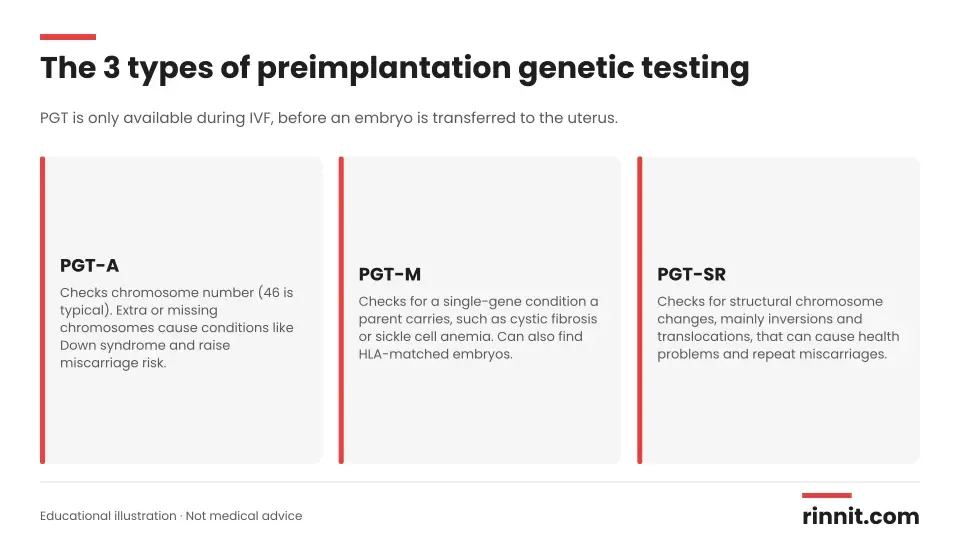
Aneuploidy, having extra or missing chromosomes, is one of the leading causes of failed implantation and miscarriage. PGT-M's ability to find HLA-compatible embryos can help when a sibling needs a bone marrow transplant. [1]
How does PGT work?
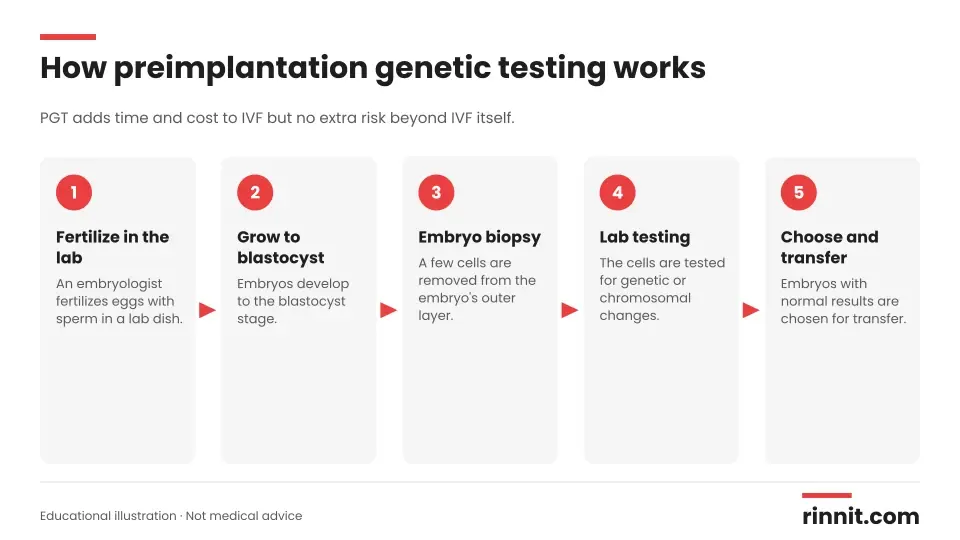
In a standard IVF cycle, embryos are chosen by how they look under a microscope. PGT adds genetic and chromosomal information to that choice. The steps are: [1]
An embryologist fertilizes eggs with sperm in a lab dish and lets them grow into embryos.
When an embryo reaches the blastocyst stage, a few cells are removed from its outer layer (embryo biopsy).
The cells are sent to a lab for genetic testing.
Embryos with abnormal results are excluded, and embryos with normal results are chosen for transfer.
Sources: [1]
Are there risks?
PGT adds no extra physical risk beyond the usual risks of IVF, but PGT-A can lead to discarding embryos that might have developed normally, and in one large trial it slightly lowered cumulative live births. Removing a few cells from the outer layer of the embryo hasn't been shown to harm it. PGT does add time and cost, so talk with your fertility specialist or genetic counselor about whether it's right for you. [1]
What do PGT results mean?
Most results come back as normal or abnormal, depending on the type of test: [1]
PGT-A: Normal if the embryo has 46 chromosomes and abnormal if it has too many or too few. A result can also be mosaic, meaning the embryo has both normal and abnormal cells.
PGT-M: Normal or abnormal for each condition tested. The embryo may also be a carrier.
PGT-SR: Normal if no rearrangements are found and abnormal if one or more are found.

How accurate is PGT?
PGT can't guarantee that a baby will be born without health conditions, and there is a small chance a result is wrong. That's why amniocentesis or chorionic villus sampling (CVS) is recommended during pregnancy to confirm PGT results. [1]
Why is PGT controversial?
Some people worry that selecting embryos echoes eugenics, the historical and discriminatory practice of choosing "desirable" traits, and could lead to rejecting people with genetic disabilities. Supporters see PGT as a way to prevent suffering. In the United States, PGT is legal and not regulated by the government, so its use is up to fertility clinics, though the FDA is working on ways to regulate it. [1]
Conclusion
IVF can be emotionally, physically and financially demanding, and genetic or chromosomal problems in embryos are a common reason it fails. PGT gives couples and their fertility team more information when choosing which embryo to transfer. [1]
Whether PGT is worth it depends on your reason for testing. If you carry a known genetic condition, PGT-M can be especially useful; for routine screening with PGT-A, ask your fertility specialist or genetic counselor about the benefits and limits for your situation.
Keep learning: Read our guide to in vitro fertilization (IVF) or learn about Down syndrome. For more background, see ACOG's committee opinion on preimplantation genetic testing.
FAQ
What is preimplantation genetic testing (PGT)?
It is testing of IVF embryos for certain genetic or chromosomal conditions before an embryo is transferred to the uterus. [1]
What are the types of PGT?
PGT-A checks chromosome number, PGT-M checks for a single-gene condition and PGT-SR checks for structural chromosome changes. [1]
What is the difference between PGT-A and PGT-M?
PGT-A looks for extra or missing chromosomes, while PGT-M looks for a specific inherited single-gene condition. [1]
How is PGT done?
A few cells are removed from the outer layer of a blastocyst-stage embryo and tested in a lab. [1]
Does PGT harm the embryo?
Testing a few outer cells hasn't been shown to harm the embryo, and PGT adds no risk beyond IVF itself. [1]
Who should consider PGT?
People with an inherited genetic mutation, repeated miscarriages, advanced age, unexplained infertility or failed fertility treatment. [1]
Is PGT 100% accurate?
No. There's a small chance of an inaccurate result, so amniocentesis or CVS is recommended to confirm. [1]
What does a mosaic PGT-A result mean?
It means the embryo has both normal and abnormal cells. [1]
Can PGT be done without IVF?
No. PGT is only available to people undergoing IVF. [1]
Is PGT the same as PGD or PGS?
Yes. PGD (preimplantation genetic diagnosis) and PGS (preimplantation genetic screening) are other names for PGT. [1]
Related Reading
In Vitro Fertilization (IVF): A Comprehensive Patient Guide explains the IVF process that PGT is part of.
Down Syndrome: Symptoms, Causes, Types & Life Expectancy — Complete Guide covers a chromosomal condition PGT-A screens for.
Cystic Fibrosis: Symptoms, Causes, Diagnosis, and Treatment (2026 Guide) covers a single-gene condition PGT-M can test for.
Unexplained Infertility: Understanding the Diagnosis and Your Path Forward discusses one reason couples consider PGT.
What Is a Miscarriage? A Plain-Language Guide to Causes, Symptoms, and Recovery explains pregnancy loss, often linked to chromosomal changes.
Carrier Screening: Genetic Testing Before or During Pregnancy explains the genetic test that shows whether you carry an inherited condition.
FISH Test: How Fluorescence In Situ Hybridization Finds Gene Changes explains the glowing-probe lab test that finds gene and chromosome changes.
References
Cleveland Clinic. Preimplantation Genetic Testing (PGT): Diagnosis & Results. Cleveland Clinic. Last updated February 10, 2026. https://my.clevelandclinic.org/health/diagnostics/preimplantation-genetic-testing-pgt
Yan J, Qin Y, Zhao H, et al. Live Birth with or without Preimplantation Genetic Testing for Aneuploidy. N Engl J Med. 2021;385(22):2047-2058. PMID 34818479. https://doi.org/10.1056/NEJMoa2103613
Cornelisse S, Zagers M, Kostova E, et al. Preimplantation genetic testing for aneuploidies (abnormal number of chromosomes) in in vitro fertilisation. Cochrane Database Syst Rev. 2020;9:CD005291. PMID 32898291. https://doi.org/10.1002/14651858.CD005291.pub3
Medical disclaimer
This article is for general education only and does not replace advice from a qualified healthcare professional. Talk to your doctor about your own diagnosis and treatment, and seek emergency care right away for severe or sudden symptoms.



Comments