What Is a Miscarriage? A Plain-Language Guide to Causes, Symptoms, and Recovery

Updated: 3 days ago
Medically reviewed by Dr. Baraa Alnahhal, MD · Last reviewed: October 2026
Quick Answer
A miscarriage is the sudden loss of a pregnancy before the 20th week, affecting about 10% to 20% of known pregnancies [1]. Signs include vaginal bleeding, cramping and passing tissue [1]. The leading cause is abnormal development, often chromosome problems [1], not exercise, sex or work [1]. Treatment may be natural, medication or a minor surgery [2], and most people later have healthy pregnancies [2].
What the research says
Miscarriage is common, and repeat losses are much rarer. A Lancet review estimated that 15.3% (95% CI 12.5–18.7%) of recognised pregnancies end in miscarriage, or about 23 million miscarriages a year worldwide. In the population, 10.8% of women have had one miscarriage, 1.9% have had two, and 0.7% have had three or more. (Quenby et al., Lancet, 2021) [3]
Age and past losses change the risk. In a Norwegian register study of 421,201 pregnancies, the risk of miscarriage was lowest at ages 25–29 (10%), rose rapidly after age 30, and reached 53% at age 45 and over. Compared with women who had no previous miscarriage, the odds of another were 1.54 times higher after one miscarriage, 2.21 times after two, and 3.97 times after three in a row. (Magnus et al., BMJ, 2019) [4]
Mifepristone plus misoprostol works better than misoprostol alone. In a randomized trial of 300 women with early pregnancy loss, complete expulsion after one dose of misoprostol occurred in 83.8% of women who first took mifepristone, versus 67.1% of women who took misoprostol alone (relative risk 1.25, 95% CI 1.09–1.43). Uterine aspiration was needed in 8.8% versus 23.5%. (Schreiber et al., N Engl J Med, 2018) [5]
What Is a Miscarriage?
A miscarriage is the sudden loss of a pregnancy before the 20th week [1]. About 10% to 20% of known pregnancies end in miscarriage [1]. The real number is likely higher, because many miscarriages happen early on, before a person realizes they are pregnant [1].
The word "miscarriage" can sound as if something went wrong while carrying the pregnancy. That is rarely true. Most miscarriages happen because the unborn baby does not develop properly [1].
Miscarriage is a somewhat common experience. But that does not make it any easier. If you have lost a pregnancy, learning what can cause it, what raises the risk, and what medical care might be needed can be a step toward healing.
What Does a Miscarriage Feel Like?
Most miscarriages happen during the first trimester — about the first 13 weeks of pregnancy [1]. The symptoms can vary, and some people notice only light spotting.
If tissue is passed from the vagina, place it in a clean container and bring it to the healthcare professional's office or the hospital. A lab can examine the tissue to check for signs of a miscarriage [1].
It is worth knowing that many pregnant people who have vaginal spotting or bleeding in the first trimester go on to have successful pregnancies [1]. But call your pregnancy care team right away if bleeding is heavy or comes with cramping pain.
What Causes a Miscarriage?
A miscarriage most often happens because the baby does not develop properly, often due to extra or missing chromosomes, while certain maternal health conditions cause a few cases [1].
Irregular Genes or Chromosomes
Most miscarriages happen because the unborn baby does not develop properly. About half to two-thirds of first-trimester miscarriages are linked to extra or missing chromosomes [1]. Chromosomes are structures inside each cell that carry genes — the instructions for how people look and function. When an egg and sperm join, two sets of chromosomes, one from each parent, come together [1]. If either set has fewer or more chromosomes than usual, that can lead to a miscarriage [1].
Chromosome condition | What happens |
Anembryonic pregnancy | No embryo forms, or the embryo forms but is absorbed back into the body [1] |
Intrauterine fetal demise | An embryo forms but stops developing and dies before any symptoms appear [1] |
Molar pregnancy | No fetus develops; often both chromosome sets come from the sperm [1]; linked with irregular placenta growth |
Partial molar pregnancy | A fetus may develop but cannot survive; there is an extra set of chromosomes (triploidy) [1], usually from the sperm |
A molar or partial molar pregnancy cannot continue because it can cause serious health problems. Sometimes these pregnancies are linked with changes of the placenta that can lead to cancer in the pregnant person [1].
Maternal Health Conditions
In a few cases, certain health conditions can lead to miscarriage. Examples include uncontrolled diabetes, infections, hormonal problems, uterus or cervix problems, thyroid disease, and obesity [1].
What Does NOT Cause a Miscarriage?
Many everyday activities do not cause a miscarriage. It is important to know this, because people who miscarry often blame themselves.
Activity | What the evidence shows |
Exercise | Safe as long as you are healthy; avoid activities that could cause injury, such as contact sports [1] |
Sex | Does not cause miscarriage [1] |
Arguments | Emotional stress and arguments do not cause miscarriage [1] |
Birth control pills | Use before pregnancy does not cause miscarriage [1] |
Working | Safe unless exposed to high doses of harmful chemicals or radiation [1] |
A person may think they lost the pregnancy because they fell or had a bad scare. But most of the time, miscarriage happens because of a random event that is no one's fault [1].
Who Is at Risk for Miscarriage?
Several factors raise the risk of miscarriage.

Risk factor | How it raises risk |
Age | Risk rises with age: about 20% at 35, 33% to 40% at 40, and 57% to 80% at 45 [1] |
Past miscarriages | One or more prior miscarriages raise the risk of another [1] |
Long-term conditions | Ongoing conditions such as uncontrolled diabetes raise the risk [1] |
Uterus or cervix problems | Weak cervical tissues (incompetent cervix) may raise the chance of loss [1] |
Smoking, alcohol, caffeine, drugs | Smokers, heavy caffeine or alcohol users, and people using illegal drugs such as cocaine face higher risk [1] |
Weight | Being underweight or overweight is linked with higher risk [1] |
Genetic conditions | A partner carrying a chromosome translocation makes miscarriage more likely [1] |
A chromosome translocation is a unique chromosome formed when pieces of two different chromosomes attach to each other [1]. A person can look and feel completely healthy and still carry one [1].
What Complications Can Follow a Miscarriage?
Sometimes pregnancy tissue that stays in the uterus after a miscarriage leads to a uterine infection about 1 to 2 days later [1]. This is called a septic miscarriage. The symptoms can include a fever higher than 100.4 degrees Fahrenheit more than two times, chills, pain in the lower stomach, foul-smelling vaginal discharge, and vaginal bleeding [1].
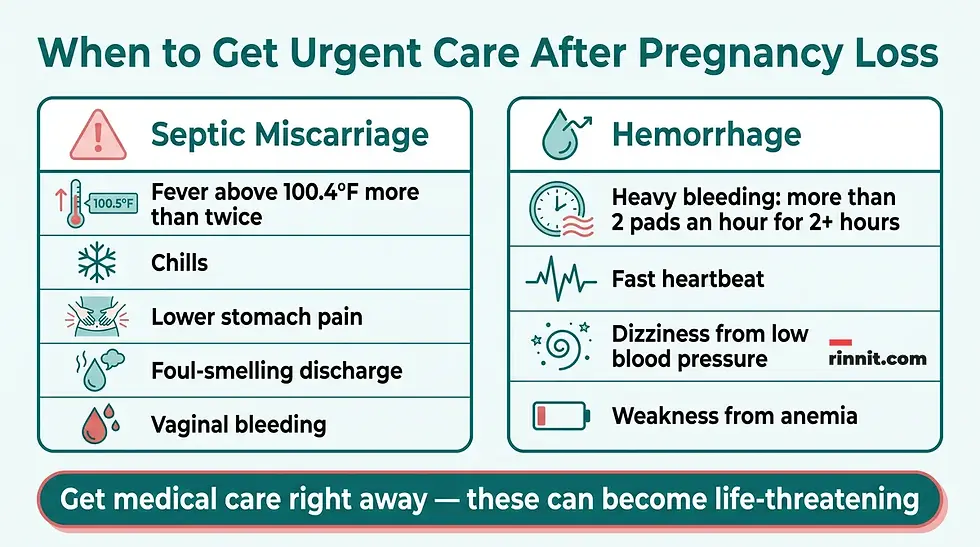
Call the healthcare professional's office, OB triage, or the emergency department if these symptoms appear [1]. The illness can worsen fast and become life-threatening without treatment [1].
Heavy bleeding, called a hemorrhage, is another complication. Along with the bleeding, a hemorrhage often brings a fast heartbeat, dizziness from low blood pressure, and tiredness or weakness from low red blood cells (anemia) [1]. Some people who have a hemorrhage need blood from a donor or surgery [1]. Get medical care at once [1].
Complication | Warning signs | What to do |
Septic miscarriage | Fever above 100.4°F more than twice, chills, lower stomach pain, foul-smelling discharge, bleeding [1] | Call healthcare team, OB triage, or emergency department right away [1] |
Hemorrhage | Heavy vaginal bleeding, fast heartbeat, dizziness, weakness [1] | Get medical care at once; donor blood or surgery may be needed [1] |
Can a Miscarriage Be Prevented?
Often, there is nothing you can do to prevent a miscarriage [1]. Instead, the focus is on taking good care of yourself and the unborn baby.
Step | What it involves |
Prenatal care | Get regular care during pregnancy [1] and right after giving birth |
Avoid risk factors | Stay away from smoking, alcohol, and illegal drugs [1] |
Multivitamin | Take a daily multivitamin [1] |
Low-dose aspirin | Ask your healthcare professional if you should take it after one or more prior miscarriages [1] |
Limit caffeine | Many experts recommend no more than 200 milligrams per day while pregnant — about a 12-ounce cup of brewed coffee [1] |
Manage conditions | Work with your team to keep long-term health conditions under control |
The effects of caffeine are not fully clear for the unborn baby, and higher amounts may be linked with miscarriage or preterm birth [1]. Check food labels for caffeine amounts [1] and ask your pregnancy care team what is right for you.
How Is a Miscarriage Diagnosed?
No single test proves a miscarriage on its own. The healthcare team may use several tests together.

Blood tests check the level of the pregnancy hormone human chorionic gonadotropin (hCG). The level is often repeated after 48 hours [2]. A low or falling hCG level can signal pregnancy loss [2]. Blood type may also be checked [2], because people who are Rh negative may be offered a shot of Rh immunoglobulin (RhoGAM) after a miscarriage, often depending on how many weeks they were pregnant [2].
A pelvic exam checks whether the cervix — the lower end of the uterus — has begun to open. If it has, a miscarriage is more likely [2].
An ultrasound checks for a fetal heartbeat and whether the pregnancy is growing properly. If the result is unclear, another ultrasound may be done in about a week [2].
Tissue tests send passed tissue to a lab to confirm a miscarriage and rule out other causes [2].
Chromosomal tests may be recommended for both partners after two or more previous miscarriages [2]. They check whether a chromosome makeup is linked with higher miscarriage risk.
Medical Terms You May Hear
Healthcare professionals use specific terms to describe what is happening.
Term | What it means |
Threatened miscarriage | Vaginal bleeding, but the cervix has not opened; such pregnancies typically continue without more problems [2] |
Inevitable miscarriage | Bleeding, cramping, and an open cervix; the miscarriage cannot be avoided [2] |
Incomplete miscarriage | Some tissue is passed, but some remains in the uterus [2] |
Missed miscarriage | Tissues remain in the uterus, but the embryo has died or was never formed [2] |
Complete miscarriage | All pregnancy tissue has been passed; common for losses before 12 weeks [2] |
Septic miscarriage | A uterine infection after miscarriage; life-threatening; needs care right away [2] |
How Is a Miscarriage Treated?
Miscarriage treatment depends on whether it is threatened or confirmed, ranging from rest and avoiding sex or tampons during bleeding to medicines or surgery if tissue does not pass [2].
Treatment for a Threatened Miscarriage
If there is bleeding early in pregnancy, the healthcare team might recommend resting until symptoms improve [2]. Bed rest and other treatments have not been proved to prevent miscarriage [2], but they are sometimes prescribed as a safeguard.
Do not use tampons or have sex while there is still bleeding [2], because these can lead to a uterine infection. It is also a good idea to delay travel — especially to places where getting quick medical care would be hard [2].
Treatment Options for a Confirmed Miscarriage
Approach | How it works | When it is used |
Expectant management | Let the miscarriage progress naturally; usually happens within a couple of weeks, but can take up to eight weeks [2] | First trimester, when there are no signs of infection [2] |
Medical treatment | When a faster, more complete process is preferred | |
Surgical treatment | Suction dilation and curettage (D&C), also called uterine aspiration, removes tissue through the opened cervix [2] | When heavy bleeding or infection signs are present [2], or by choice |
Complications from D&C are rare but can include damage to the connective tissue of the cervix or the uterine wall [2]. If pregnancy tissue is not passed on its own during expectant management, medicines or surgery will be needed.
After the Miscarriage
Physical recovery from a miscarriage usually takes only a few hours to a couple of days [2]. Call the healthcare professional if heavy bleeding occurs (soaking through more than two menstrual pads an hour for more than two hours in a row), or if there is fever, chills, or belly pain [2].
Most people get their period about two weeks after any light bleeding or spotting stops [2]. Any type of birth control can be started right after a miscarriage [2]. But do not have sex or put anything in the vagina, such as a tampon, for one to two weeks [2]. This helps prevent infection [2].
If your blood type is Rh negative, you may get a shot of Rh immunoglobulin after a miscarriage [2]. Rh negative means the blood lacks a protein called Rh factor. Without the shot, a future Rh positive baby could develop life-threatening anemia or other problems. People who are Rh positive do not need the shot [2].
What About Future Pregnancies?
It is possible to become pregnant during the menstrual cycle right after a miscarriage [2]. If you and your partner decide to try again, make sure your body and mind are ready, and ask your healthcare professional when you might try to conceive [2].
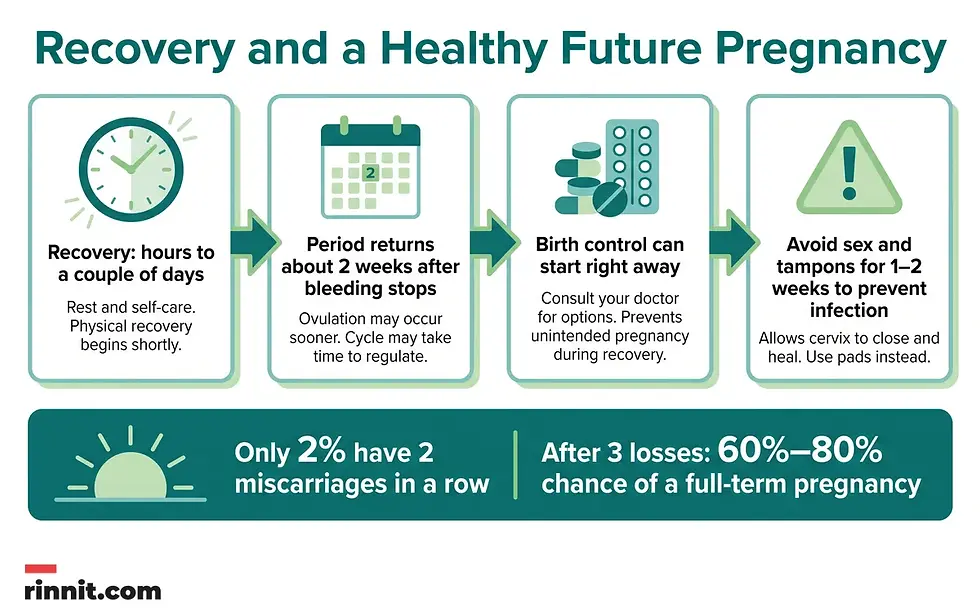
Miscarriage often happens just once [2]. Most people who miscarry go on to have a healthy pregnancy [2]. Only 2% of people have two miscarriages in a row, and up to 1% have three in a row [2].
After two to three pregnancy losses in a row, testing can look for underlying causes such as conditions of the uterus, chromosome conditions, blood clotting problems, or immune system issues [2]. Even when no cause is found, there is still hope: people who have had three miscarriages still have a 60% to 80% chance of a full-term pregnancy [2].
Conclusion and Next Steps
A miscarriage is the loss of a pregnancy before the 20th week [1], and it most often happens in the first trimester [1]. About half to two-thirds of first-trimester miscarriages are linked to chromosome problems in the embryo [1] — not to anything the pregnant person did. Spotting or light bleeding does not always mean a loss, but heavy bleeding, cramping, or passing tissue should be reported to the healthcare team right away. If a miscarriage occurs, treatment may be natural, medical, or surgical, and physical recovery is usually quick [2]. Most people who miscarry go on to have a healthy pregnancy [2].
Talk with a healthcare professional. If you are pregnant and notice bleeding, cramping, or anything that worries you, contact your pregnancy care team without waiting. And if you have lost a pregnancy, give yourself time to grieve — emotional healing can take much longer than physical healing. For more plain-language guides on pregnancy, fertility, and women's health, explore the related articles on Rinnit.com.
Frequently Asked Questions
How common is miscarriage?
About 10% to 20% of known pregnancies end in miscarriage [1], and the true number is likely higher because many losses happen before a person realizes they are pregnant [1].
What does a miscarriage feel like?
The most common signs are vaginal bleeding or spotting, pelvic or lower back cramping, passing fluid or tissue, and a fast heartbeat [1]. Most losses happen in the first trimester [1].
What causes most miscarriages?
Most miscarriages happen because the unborn baby does not develop properly [1]. About half to two-thirds of first-trimester losses are linked to extra or missing chromosomes [1].
Did I cause the miscarriage?
Almost certainly not. Exercise, sex, arguments, birth control pills, and everyday work do not cause miscarriage [1]. Most miscarriages are random events that are no one's fault [1].
How is a miscarriage diagnosed?
There is no single test. Diagnosis combines blood tests (hCG levels and blood type), a pelvic exam, ultrasound, and sometimes tissue or chromosomal tests [2].
What are the treatment options?
Depending on the situation, care may be expectant (waiting for the body to pass the tissue naturally), medical (mifepristone plus misoprostol), or surgical (D&C) [2]. Surgery is needed if there is heavy bleeding or signs of infection [2].
How long does recovery take?
Physical recovery usually takes a few hours to a couple of days [2]. The next period typically arrives about two weeks after light bleeding stops [2]. Sex and tampons should be avoided for one to two weeks to prevent infection [2].
Can I have a healthy pregnancy after a miscarriage?
Yes. Miscarriage often happens just once, and most people who miscarry go on to have a healthy pregnancy [2]. Even after three losses in a row, there is still a 60% to 80% chance of a full-term pregnancy [2].
Related Reading
Explore more plain-language guides on Rinnit.com:
Ectopic Pregnancy: Symptoms, Causes, and Treatment — a pregnancy that grows outside the uterus and needs urgent care
Preeclampsia: Symptoms, Causes & What Helps — A Complete Guide — high blood pressure during pregnancy and how it is managed
Polycystic Ovary Syndrome (PCOS): Symptoms, Causes, Diagnosis, and Treatment — a common hormonal condition that can affect fertility
Endometriosis: Symptoms, Causes, and Treatment — when uterine tissue grows outside the uterus
Pregnancy Test: When to Take It, Types, Accuracy and Results: Pregnancy tests and repeated blood hCG checks show whether hormone levels are rising as expected in early pregnancy.
Preimplantation Genetic Testing (PGT): Types, Process, Results and Accuracy explains how IVF embryos are tested for genetic and chromosomal conditions.
Learn more in our guide to Transvaginal Ultrasound: Why It's Done, How to Prepare and What to Expect.
Karyotype Test: What It Shows, Sample Types, Results and Limits explains the chromosome test used to diagnose this and other genetic conditions.
References
Mayo Clinic Staff. Miscarriage - Symptoms and causes. Mayo Clinic. Published August 22, 2026. https://www.mayoclinic.org/diseases-conditions/pregnancy-loss-miscarriage/symptoms-causes/syc-20354298
Mayo Clinic Staff. Miscarriage - Diagnosis and treatment. Mayo Clinic. Published August 22, 2026. https://www.mayoclinic.org/diseases-conditions/pregnancy-loss-miscarriage/diagnosis-treatment/drc-20354304
Quenby S, et al. Miscarriage matters: the epidemiological, physical, psychological, and economic costs of early pregnancy loss. Lancet. 2021;397(10285):1658-1667. PMID 33915094. https://doi.org/10.1016/S0140-6736(21)00682-6
Magnus MC, et al. Role of maternal age and pregnancy history in risk of miscarriage: prospective register based study. BMJ. 2019;364:l869. PMID 30894356. https://doi.org/10.1136/bmj.l869
Schreiber CA, et al. Mifepristone Pretreatment for the Medical Management of Early Pregnancy Loss. N Engl J Med. 2018;378(23):2161-2170. PMID 29874535. https://doi.org/10.1056/NEJMoa1715726
Medical disclaimer
This article is for informational purposes only and is not medical advice. Always consult a qualified healthcare professional for diagnosis and treatment decisions.



Comments