Pregnancy Test: When to Take It, Types, Accuracy and Results

Updated: 6 days ago
Written and medically reviewed by Dr. Baraa Alnahhal, MD · Last reviewed: November 2026 · How we review
Quick Answer: What is a pregnancy test?
A pregnancy test checks your urine or blood for human chorionic gonadotropin (hCG), a hormone made by the placenta once a fertilized egg implants in the uterus. A positive result means you are pregnant. Home urine tests are about 99% accurate when used correctly, and they work best after a missed period [1].
What the research says
About 1 in 10 pregnancies cannot yet be detected on the day a period is due. In a prospective cohort of 221 women trying to conceive, 14 of 136 clinical pregnancies (10%) had not implanted by the first day of the missed period, capping the best possible test sensitivity at 90% that day and 97% one week later. (Wilcox et al., JAMA, 2001) [2]
Not every home test matches the accuracy printed on its box. When 8 home tests were checked against standard hCG urine samples, technician readings matched the expected result more than 90% of the time for 5 tests but less than 50% for 2; among 72 volunteer readers, agreement topped 95% for only 2 tests. (Johnson et al., Clinical Chemistry and Laboratory Medicine, 2015) [3]
Accuracy in users' hands varies by brand. In a study of 7 visual home tests used by volunteers, 3 met their accuracy claims (97.6% to 100%), while the other 4 ranged from 81.6% to 95.9%. (Boxer et al., Journal of Immunoassay & Immunochemistry, 2019) [4]
Key takeaways
Pregnancy tests detect hCG, a hormone that rises after the fertilized egg implants, about 6 to 10 days after conception [1].
Home urine tests are about 99% accurate when used exactly as directed, similar to urine tests done in a provider's office [1].
The most reliable time to test at home is after a missed period, ideally with first-morning urine [1].
Blood tests can detect pregnancy a little earlier and are the only type that measures the exact amount of hCG [1].
False negatives usually come from testing too early; false positives are rare [1].
After a positive result, start a prenatal vitamin with folic acid and call your provider to schedule a visit [1].
What is a pregnancy test used for?
A pregnancy test tells you whether your body is making hCG, the main hormone of early pregnancy. A positive result means you are pregnant, and a negative result means the test did not find pregnancy [1].
People commonly take a pregnancy test for reasons such as these [1]:
You are trying to conceive.
Your birth control may have failed.
You are about to have a procedure or start a medication that could be complicated by pregnancy.
How does a pregnancy test work?
The placenta makes hCG. It begins to form shortly after a fertilized egg attaches to the wall of the uterus, so hCG appears only during pregnancy [1].
Levels start rising once implantation happens, about 6 to 10 days after conception. In the first weeks, hCG roughly doubles every couple of days, so the longer you wait, the more hormone there is for a test to find [1].
Urine tests use a reactive strip that changes when it meets hCG. Blood tests are run in a lab, which measures how much hCG is in your sample [1].
Why can testing too early give a negative result?
If you test before enough hCG has built up, the test may read negative even though you are pregnant [1]. Implantation timing also varies naturally; one cohort study found that 10% of pregnancies had not yet implanted on the first day of the missed period [2].
What are the types of pregnancy tests?
There are two main types: urine tests, usually taken at home, and blood tests, done at a provider's office or hospital. An ultrasound at your provider's office is another way to confirm a pregnancy [1].
Home urine pregnancy tests
Home tests are sold without a prescription in most drug and grocery stores. They are easy to use and give results within minutes [1].
When used correctly, they are about 99% accurate, which is roughly the same as a urine test done in a provider's office. Brands all detect hCG, but they differ in sensitivity, so some turn positive sooner than others [1].
Blood pregnancy tests
For a blood test, a small sample is drawn from a vein in your arm and sent to a lab. Blood tests are done less often because they usually give the same answer as a urine test [1].
Their advantage is precision. A blood test can show the exact amount of hCG and can detect pregnancy as early as about 7 to 10 days after conception. Results take anywhere from a few hours to two days [1].
Feature | Urine test | Blood test |
Where it is done | At home or in a provider's office | Provider's office or hospital |
What it shows | Whether hCG is present | Whether hCG is present and the exact amount |
Earliest detection | About 10 days after conception | About 7 to 10 days after conception |
Time to results | A few minutes | A few hours to two days |
Typical use | Routine first check | Fertility treatment or a suspected pregnancy problem |
Sources: [1]
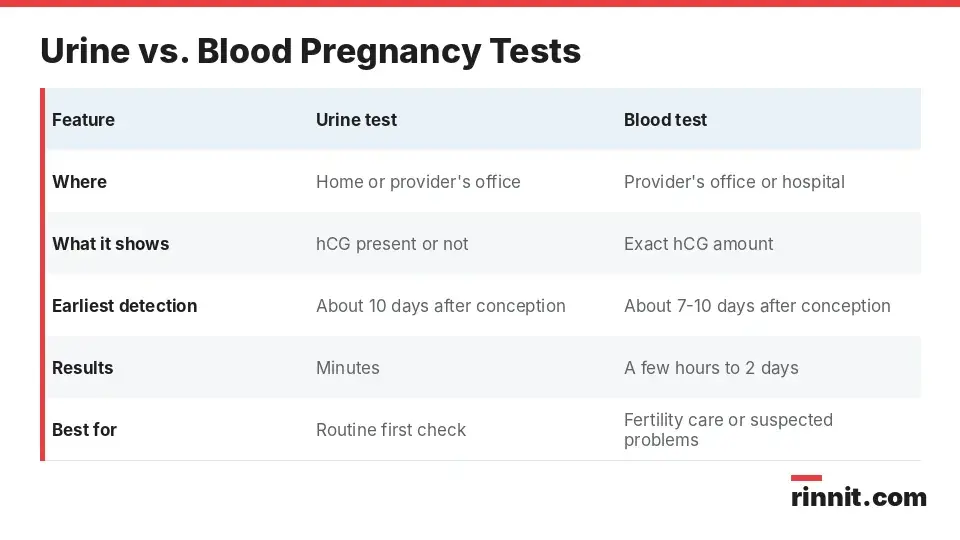
Most people start with a home urine test and move to a blood test only when their provider needs more detail.
What does a rising or falling hCG level mean?
With repeated blood tests, providers can follow the trend. hCG usually doubles about every two days in early pregnancy [1].
Levels that fail to rise may point to a problem with the pregnancy. Very high levels can suggest twins or another pregnancy issue [1].
When should you take a pregnancy test?
Some home tests can turn positive about 10 days after conception. For the most accurate result, though, wait until after you have missed your period, which usually comes about 14 days after conception [1].
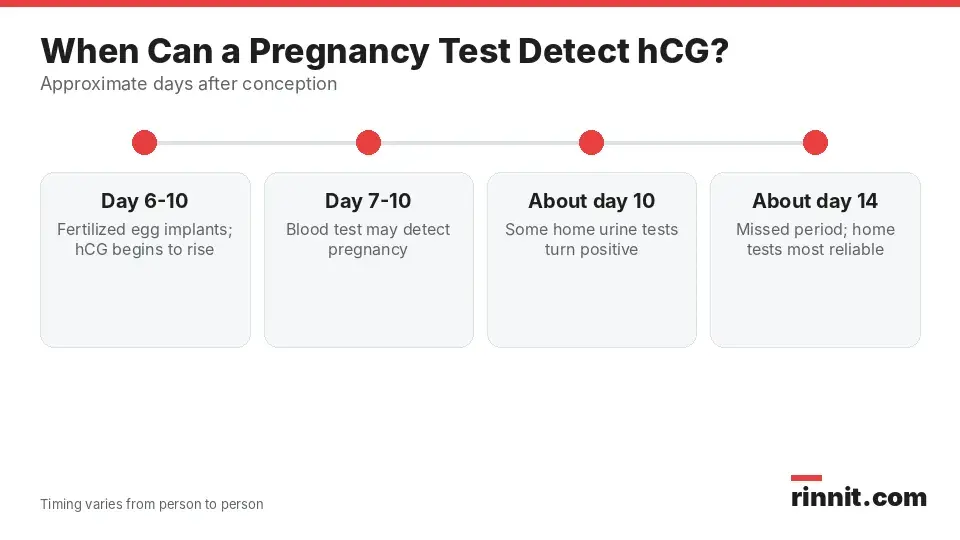
The timeline above shows why waiting a few extra days lowers the chance of a false negative.
If your test is negative and your period still has not started, take another test a few days later [1]. Taking two tests is a simple way to confirm a result [1].
What time of day is best to test?
First-morning urine is usually best because hCG is most concentrated then. Some tests are sensitive enough to work at any time, but if you test later in the day, try to let urine collect in your bladder for at least three hours [1].
How do you prepare for a pregnancy test?
Most pregnancy tests need no special preparation or lifestyle changes [1]. A few habits help you get a reliable result:
Can medicines affect a pregnancy test?
Antibiotics, pain relievers and alcohol generally do not change results. The main exception is fertility medication that contains hCG, which can sometimes cause a false positive. If you take fertility drugs, review your result with your provider [1].
How do you take a home pregnancy test?
Home tests use one of three methods, depending on the brand [1]:
Collect urine in a clean cup, then place one or more drops on the test strip.
Hold the strip directly in your urine stream.
Collect urine in a clean cup, then dip the strip into it.
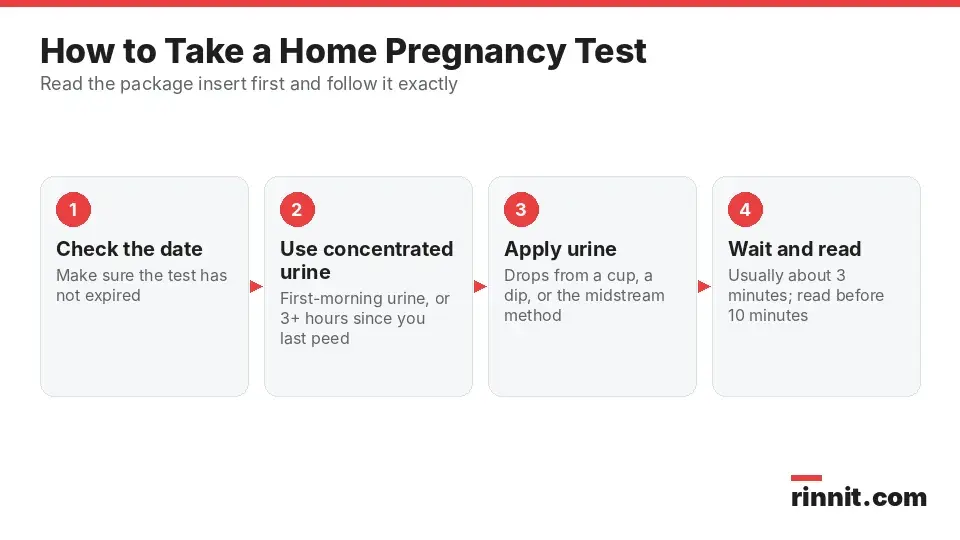
Following each step exactly as the package describes is the single biggest factor in getting an accurate result.
Most tests take about three minutes to show a result, but wait times vary by brand, so check the instructions [1].
How do you read pregnancy test results?
Depending on the brand, a positive result may appear as a plus sign, two lines or the word "pregnant." Most tests also have a control window that shows a symbol first to confirm the test is working [1].
What you see | What it usually means |
Positive symbol, two lines or "pregnant" | hCG detected; you are likely pregnant |
Faint test line | Can still mean pregnancy |
Control window symbol | The test was used correctly |
No symbol in the control window | The test may not have worked; repeat it |
A line that shows up after the reading time | May be an evaporation line, not a true result |
Sources: [1]
What is an evaporation line?
An evaporation line can form if you look at the test too long after the urine dries. Most tests advise reading the result within 10 minutes, and reading too late may give an inaccurate answer [1].
If you are still unsure after several tests, contact your healthcare provider [1].
How accurate are pregnancy tests?
Manufacturers state that home tests are 98% to 99% accurate when used exactly as directed. A positive result can generally be trusted [1].
Independent lab studies show that real-world accuracy can vary by brand and by how easy the result is to read [3, 4]. Choosing a clearly labeled test and following the instructions closely helps.
What causes a false negative?
False negatives happen mainly when you [1]:
Test too early, before enough hCG has built up.
Use too much or too little urine.
What causes a false positive?
False positives are rare. They can happen with a chemical pregnancy or a pregnancy loss shortly after implantation, and occasionally with fertility drugs [1].
A blood test is usually the first to confirm a pregnancy because it detects smaller amounts of hCG [1].
What should you do after a positive pregnancy test?
Call your healthcare provider to schedule an appointment, which may be set for several weeks later [1]. In the meantime, a few steps support a healthy pregnancy:
When should you call your doctor?
Contact your provider if you have questions about your results or remain unsure after several tests [1]. Keep in mind that an ectopic pregnancy, which grows outside the uterus, still produces a positive test, so a positive result alone does not confirm where the pregnancy is located [1].
Conclusion
A pregnancy test looks for hCG, the hormone the placenta releases after implantation. Home urine tests are convenient and about 99% accurate when used correctly, and blood tests add earlier detection and an exact hCG measurement [1].
Timing matters most. Testing after a missed period with concentrated morning urine, reading the result within the stated window and repeating a negative test if your period does not come all reduce errors. Follow up with your provider after a positive result or whenever a result is unclear [1].
Keep learning: Read Understanding Human Chorionic Gonadotropin (hCG): The Pregnancy Hormone to see how hCG levels change, and Ectopic Pregnancy: Symptoms, Causes, and Treatment to learn why a positive test needs follow-up.
FAQ
What does a pregnancy test detect?
It detects human chorionic gonadotropin (hCG), a hormone the placenta makes after a fertilized egg implants in the uterus. hCG appears only during pregnancy [1].
How soon can I take a pregnancy test?
Some home tests turn positive about 10 days after conception, and blood tests may detect pregnancy at about 7 to 10 days. For the most reliable home result, wait until after a missed period [1].
What is the best time of day to take a pregnancy test?
First-morning urine is best because hCG is most concentrated then. If you test later, let urine collect in your bladder for at least three hours first [1].
How accurate are home pregnancy tests?
When used exactly as directed, home tests are about 99% accurate, similar to urine tests in a provider's office. Accuracy drops if you test too early or misread the result [1].
Can a faint line mean I am pregnant?
Yes. A faint test line can still mean pregnancy, as long as it appears within the reading time stated on the package [1].
How long does a pregnancy test take?
Most home tests show a result in about three minutes, and you should read them before 10 minutes. Blood test results take a few hours to two days [1].
Why did I get a negative test but still miss my period?
The most common reason is testing before enough hCG has built up. Take another test a few days later, and contact your provider if you remain unsure [1].
Can a pregnancy test be falsely positive?
False positives are rare. They can occur with a chemical pregnancy, a very early pregnancy loss or fertility drugs that contain hCG [1].
Why would my doctor order a blood pregnancy test?
Blood tests measure the exact amount of hCG and detect pregnancy earlier. Providers use them during fertility treatment or when they suspect a problem with the pregnancy [1].
When should I call my doctor after a pregnancy test?
Call after a positive result to schedule a visit, and call any time you have questions or unclear results after several tests [1].
Related Reading
Morning-After Pill: How It Works, Types and Effectiveness explains how emergency contraception pills work.
Understanding Human Chorionic Gonadotropin (hCG): The Pregnancy Hormone explains the hormone every pregnancy test measures, including how its levels rise in early pregnancy.
Ectopic Pregnancy: Symptoms, Causes, and Treatment covers pregnancies that implant outside the uterus, which still produce a positive test and need prompt medical care.
What Is a Miscarriage? A Plain-Language Guide to Causes, Symptoms, and Recovery explains early pregnancy loss, one reason hCG levels may fail to rise or a test may turn negative.
Female Infertility: Causes, Signs, and Treatment Options Explained covers fertility problems and treatments, a setting where blood hCG tests are often used.
References
Cleveland Clinic. Pregnancy Test: When To Take, Types & Accuracy. Cleveland Clinic. Last updated November 28, 2022. https://my.clevelandclinic.org/health/diagnostics/9703-pregnancy-tests
Wilcox AJ, Baird DD, Dunson D, et al. Natural limits of pregnancy testing in relation to the expected menstrual period. JAMA. 2001;286(14):1759-1761. PMID 11594902. https://doi.org/10.1001/jama.286.14.1759
Johnson S, Cushion M, Bond S, et al. Comparison of analytical sensitivity and women's interpretation of home pregnancy tests. Clin Chem Lab Med. 2015;53(3):391-402. PMID 25274958. https://doi.org/10.1515/cclm-2014-0643
Boxer J, Weddell S, Broomhead D, et al. Home pregnancy tests in the hands of the intended user. J Immunoassay Immunochem. 2019;40(6):642-652. PMID 31556778. https://doi.org/10.1080/15321819.2019.1671861
Medical disclaimer
This article is for general education only and does not replace advice from a qualified healthcare professional. Talk to your doctor about your own diagnosis and treatment, and seek emergency care right away for severe or sudden symptoms.



Comments