Understanding Human Chorionic Gonadotropin (hCG): The Pregnancy Hormone

Updated: 2 days ago
Medically reviewed by Dr. Baraa Alnahhal, MD · Last reviewed: October 2026
Quick Answer: What is human chorionic gonadotropin (hCG)?
Human chorionic gonadotropin (hCG) is the pregnancy hormone made by the placenta after conception [1]. It stops menstruation and signals production of progesterone and estrogen needed for pregnancy [1]. hCG rises quickly in early pregnancy, almost doubling every three days, and peaks around 10 weeks [1]. Providers also use it in fertility treatment and as a tumor marker for some cancers [1].
What the research says
How hCG changes can matter more than a single number. In a prospective cohort of 322 women with tubal ectopic pregnancy treated with single-dose methotrexate (overall success rate 59%), any fall in serum hCG over days 1 to 4 predicted treatment success with a positive predictive value of 85%, while any rise over days 1 to 7 strongly reduced the chance of success (Mackenzie et al., Hum Reprod, 2023 [2]).
hCG also acts on other hormone systems, including the thyroid. A review of thyroid physiology in pregnancy reports that in the first trimester hCG induces a transient increase in free thyroxine (FT4), mirrored by lower TSH, after which FT4 falls by about 10 to 15% and TSH returns to normal (Moleti et al., Endocr Pract, 2014 [3]).
What does human chorionic gonadotropin (hCG) do in pregnancy?
hCG is the first pregnancy hormone the placenta makes after conception, and it serves as the primary signal to your body that a pregnancy has begun. It tells your body to stop menstruating [1], which preserves the uterine environment for the developing fetus. It also helps thicken the uterine lining [1].
hCG then signals your body to produce progesterone and estrogen. Progesterone supports pregnancy by thickening the uterine lining and keeping the uterus relaxed. Estrogen helps with fetal organ development, increases blood flow to the placenta, and helps prepare your body for labor. You can think of hCG as the first hormone that supports early pregnancy, which then calls in other hormones to help [1].
What do hCG levels mean, and how are they tested?
Everyone has small amounts of hCG in their body (almost undetectable levels). When you're pregnant, hCG rises quickly to levels that typically only exist in pregnancy. Levels vary between individuals and across the stages of pregnancy, and testing for hCG is the standard way to confirm pregnancy and monitor its early progress [1].
Testing Methods
Blood tests: a sample from your arm shows the amount of hCG as a number and can detect hCG earlier than a urine test.
Urine tests: these show only whether hCG is present, not how high or low the level is. You typically must wait until a missed period for an accurate result. At-home pregnancy tests are urine hCG tests.
An hCG level above 25 mIU/mL usually means you're pregnant, but it's not a guarantee. Your provider may recheck your level in a few days to see whether it rises, which would confirm the pregnancy [1].
Typical hCG Levels by Week
This is a general guide to hCG levels (in mIU/mL) based on the number of weeks since your last menstrual period [1]:
3 weeks: 5-50
4 weeks: 5-426
5 weeks: 18-7,340
6 weeks: 1,080-56,500
7 to 8 weeks: 7,650-229,000
9 to 12 weeks: 25,700-288,000
13 to 16 weeks: 13,300-254,000
17 to 24 weeks: 4,060-165,400
25 to 40 weeks: 3,640-117,000
These numbers are only a guide, and your levels may rise differently. It's not the number that matters as much as how the number changes, and healthy pregnancies can have lower-than-average hCG levels. hCG levels aren't routinely checked during pregnancy; providers may check them in the first trimester if there's concern about the pregnancy progressing [1].

Figure 1: A general representation of hCG levels during pregnancy. Levels vary widely between individuals.
What do variations in hCG levels mean clinically?
Monitoring the rate at which hCG changes is often more informative than a single result. A low hCG level doesn't diagnose anything on its own. It's a tool to detect potential issues [1].
Low or Declining Levels
Low or declining hCG levels could mean a blighted ovum, a miscarriage, an ectopic pregnancy, or that you don't know when you had your last period. If your level is low for the gestational age, your provider will recheck it in two or three days or do an ultrasound to confirm the pregnancy [1].
High Levels
High levels of hCG could mean the pregnancy is further along than you think, that you're pregnant with twins, triplets or more, or that you have a molar pregnancy or another gestational trophoblastic disease. In rare cases, certain types of cancer can also increase hCG levels in your blood [1].
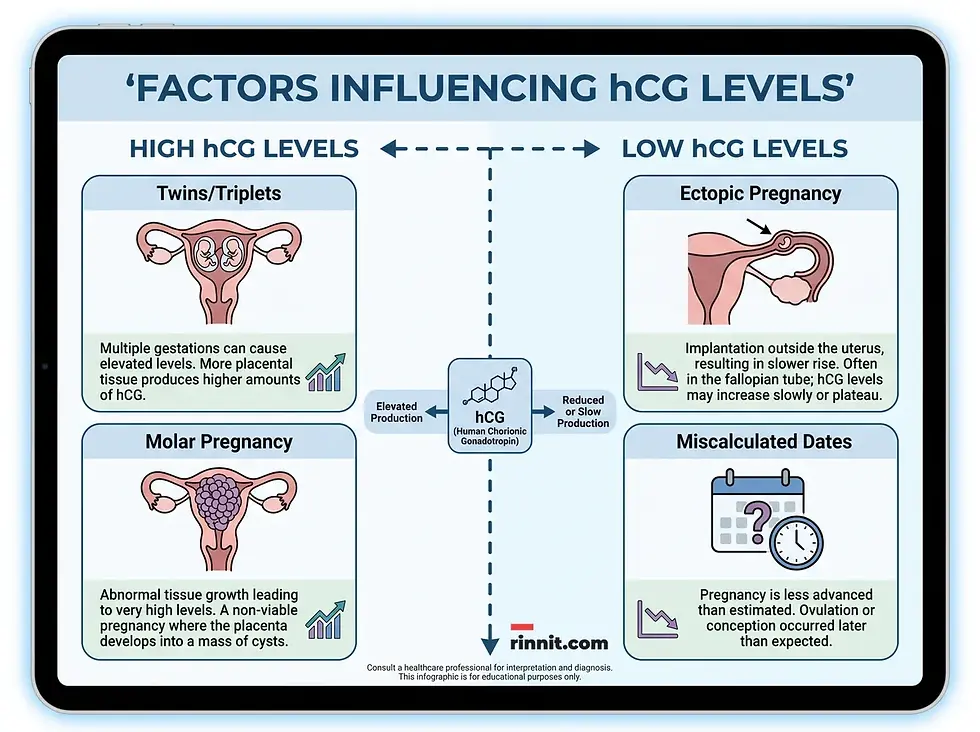
Figure 2: Factors that can raise or lower hCG levels. This is for education only; ask your provider to interpret your results.
What are the medical uses of hCG beyond pregnancy?
Beyond pregnancy, hCG is used in fertility treatment, in treating low testosterone and other male health problems, and in cancer testing [1].
Fertility treatment: an hCG injection can help you ovulate if you're using IVF or IUI, and hCG injections after ovulation may help support implantation.
Male health: in males, hCG helps treat low testosterone, male infertility, and undescended testicles.
Cancer testing: high hCG in someone who isn't pregnant may be a sign of cancer. In rare cases germ cell tumors or other cancer cells make hCG, so providers sometimes use an hCG test to help diagnose cancer, track treatment, or check for recurrence.

Figure 3: Medical applications of hCG in fertility care, male health, and cancer monitoring.
Conclusion
Human chorionic gonadotropin is the first hormone to support early pregnancy and a useful window into reproductive health. Whether it's used to confirm a pregnancy, check on its early progress, support fertility treatment, or help track certain cancers, what matters most is usually how hCG changes over time. If you have questions about your hCG test results or your fertility options, talk with your healthcare provider for a detailed review of your results.
Frequently Asked Questions
What is the main function of hCG?
hCG supports early pregnancy. It tells your body to stop menstruating, then signals your body to produce progesterone and estrogen, which thicken the uterine lining, keep the uterus relaxed, and support fetal development.
How soon can hCG be detected?
A blood test can detect hCG earlier than a urine test. A urine test, such as an at-home pregnancy test, typically needs you to wait until a missed period to give an accurate result.
What hCG level indicates pregnancy?
An hCG level above 25 mIU/mL usually means you're pregnant, but it's not a guarantee. Your provider may recheck your level in a few days to see if it rises, which would confirm the pregnancy.
How fast do hCG levels rise?
hCG increases quickly in early pregnancy, almost doubling every three days for the first eight to 10 weeks. Providers sometimes look at how quickly it rises to confirm that the pregnancy is progressing.
When do hCG levels peak?
hCG levels peak around 10 weeks of pregnancy and then gradually fall until childbirth.
What does a low hCG level mean?
Low or declining hCG levels could mean a blighted ovum, a miscarriage, an ectopic pregnancy, or that the dates of your last period are uncertain. A low level doesn't diagnose anything on its own, so your provider will usually recheck it in two or three days or use an ultrasound.
Can you have hCG in your body if you aren't pregnant?
Everyone has small, almost undetectable amounts of hCG. In rare cases, certain cancers such as germ cell tumors can cause the body to make more, which is why hCG is sometimes used as a tumor marker.
Is hCG used in fertility treatments?
Yes. An hCG injection can help you ovulate if you're using IVF or IUI to get pregnant, and you may also need hCG injections after ovulation to help support implantation.
Why is hCG used for men?
In males, hCG helps treat conditions such as low testosterone, male infertility, and undescended testicles.
Does a high hCG level always mean twins?
No. High levels can mean the pregnancy is further along than you think, a pregnancy with twins, triplets or more, or a molar pregnancy or other gestational trophoblastic disease. In rare cases certain cancers can also raise hCG.
Medical Disclaimer
The information in this article is for educational purposes only and is not a substitute for professional medical advice, diagnosis, or treatment. Always seek the advice of your physician or other qualified health provider with any questions you may have about a medical condition.
Source date: April 21, 2025.
Related Reading
Pregnancy Test: When to Take It, Types, Accuracy and Results: Pregnancy tests detect hCG in urine or blood; learn when to test, how accurate home tests are and how to read the results.
References
Cleveland Clinic. Human Chorionic Gonadotropin. Cleveland Clinic. April 21, 2025. https://my.clevelandclinic.org/health/body/22489-human-chorionic-gonadotropin
Mackenzie SC, Moakes CA, Doust AM, et al. Early (days 1-4) post-treatment serum hCG level changes predict single-dose methotrexate treatment success in tubal ectopic pregnancy. Hum Reprod. 2023;38(7):1261-1267. PMID 37178269. https://doi.org/10.1093/humrep/dead089
Moleti M, Trimarchi F, Vermiglio F. Thyroid physiology in pregnancy. Endocr Pract. 2014;20(6):589-596. PMID 24449667. https://doi.org/10.4158/EP13341.RA



Comments