Morning-After Pill: How It Works, Types and Effectiveness

Updated: 2 days ago
Written and medically reviewed by Dr. Baraa Alnahhal, MD · Last reviewed: November 2026 · How we review
Quick Answer
The morning-after pill is emergency contraception taken after unprotected sex to lower the chance of pregnancy. It works mainly by preventing or delaying ovulation and doesn't end an existing pregnancy. Levonorgestrel is sold over the counter and taken within 72 hours; ulipristal acetate needs a prescription and works up to 120 hours. Take it as soon as possible.
What the research says
Ulipristal prevented more pregnancies: in 1,696 women treated within 72 hours, pregnancy rates were 1.8% with ulipristal versus 2.6% with levonorgestrel, and pooled data showed ulipristal significantly lowered pregnancies (Glasier AF et al., Lancet, 2010) [2]
Body weight matters for levonorgestrel: in the same trial data, women with obesity had about 4.4 times the pregnancy risk after levonorgestrel, while the increase with ulipristal was smaller and not significant (Glasier A et al., Contraception, 2011) [3]
Key takeaways
The morning-after pill is emergency contraception taken after unprotected sex.
Levonorgestrel works within 72 hours and is sold over the counter.
Ulipristal (ella) works up to 120 hours and needs a prescription.
The sooner you take it, the better it works.
It doesn't end a pregnancy or affect future fertility.
What is the morning-after pill?
Despite the name, you can take it any time of day, not only in the morning. It's meant for emergencies, not as your regular birth control. It doesn't cause an abortion; it works before a pregnancy begins by stopping or delaying the release of an egg. Sources: [1]
When to use it
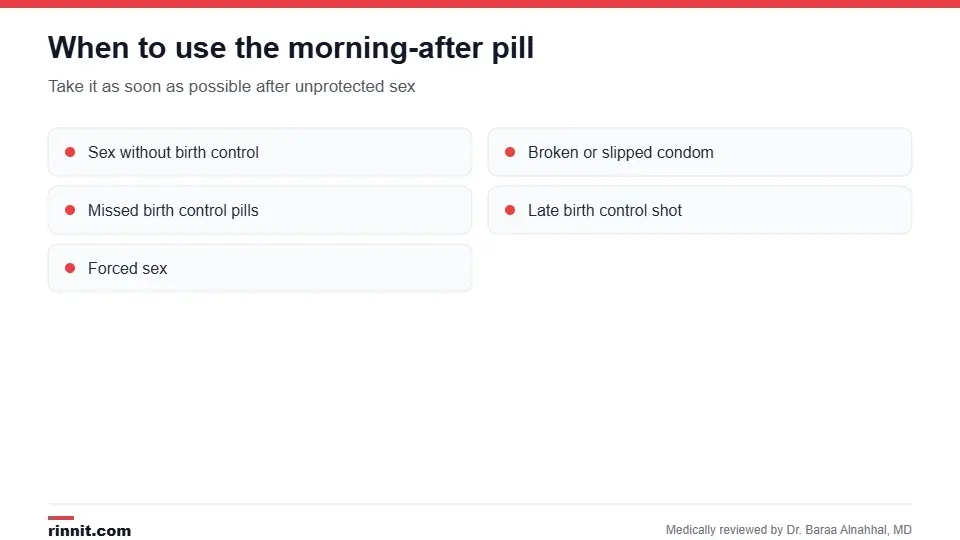
Take it as soon as possible after unprotected sex.
You had sex without birth control.
Your birth control failed, such as a broken condom or missed pills.
You missed a birth control shot.
You were forced to have sex. Sources: [1]
Types of emergency contraception pills
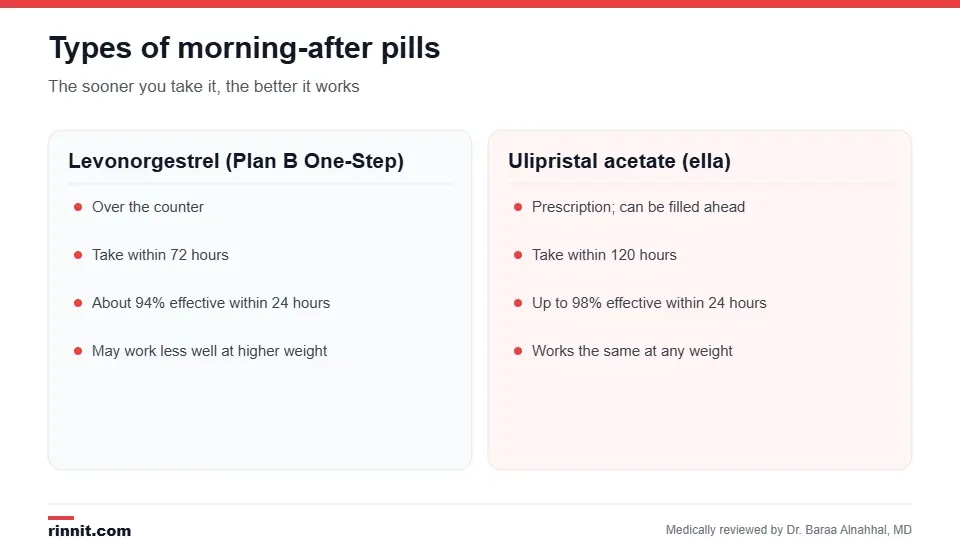
Ulipristal works longer and isn't affected as much by body weight.
Type | Brands | Time limit | How to get it |
Levonorgestrel (a progestin) | Plan B One-Step, My Choice, Option 2, Take Action, Aftera | Within 72 hours (3 days) | Over the counter |
Ulipristal acetate | ella | Within 120 hours (5 days) | Prescription; can be filled ahead |
Combined birth control pills | Regular pills in higher doses | Up to 5 days | Only with guidance from a provider or pharmacist; less effective |
Sources: [1]
How to take it
Take the pill by mouth as soon as possible after unprotected sex.
If you vomit within two hours, contact a pharmacist or provider, since you may need another dose.
Use condoms or another method until your next period, and plan a regular birth control method. Sources: [1]
Taking the pill before sex doesn't help. Some barbiturates and St. John's wort can make it less effective. Levonorgestrel may also work less well at a higher body weight, while ulipristal seems to work the same regardless of weight. Sources: [1, 3]
How well it works
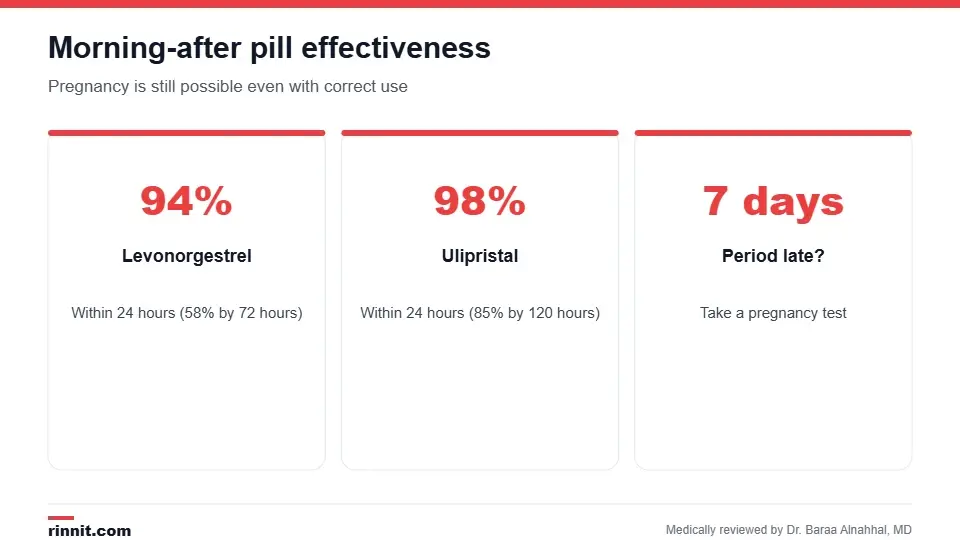
The sooner you take it, the better it works.
Pill | Within 24 hours | Later |
Levonorgestrel | About 94% | About 58% within 72 hours |
Ulipristal | Up to 98% | About 85% within 120 hours |
Pregnancy is still possible even when you take it correctly. Sources: [1, 2]
Side effects
Changes to your next period, which may come early or late.
Spotting.
Nausea or vomiting.
Tiredness, headache or dizziness.
Breast tenderness.
Belly pain or cramping. Sources: [1]
The morning-after pill is safe and doesn't affect your ability to get pregnant in the future. Sources: [1]
After taking it
Your next period may be irregular.
Take a pregnancy test if your period is more than seven days late.
Call your provider for severe belly pain or heavy bleeding, which could signal a miscarriage or ectopic pregnancy.
Talk to your provider about a reliable regular method, such as the pill or an IUD. Sources: [1]
Conclusion
The morning-after pill is a safe backup when birth control fails or isn't used. Take it as soon as you can, and plan a regular method for ongoing protection.
Keep learning: read about long-acting reversible contraception and progestin.
Frequently asked questions
What is the morning-after pill?
Emergency contraception taken after unprotected sex to prevent pregnancy.
How does it work?
It mainly prevents or delays ovulation.
Does it cause an abortion?
No. It doesn't end an existing pregnancy.
How soon do I need to take it?
As soon as possible: within 72 hours for levonorgestrel or 120 hours for ulipristal.
Do I need a prescription?
Not for levonorgestrel. Ulipristal (ella) needs a prescription.
How effective is it?
About 94% for levonorgestrel and up to 98% for ulipristal within 24 hours.
Does body weight affect it?
Levonorgestrel may work less well at higher weight; ulipristal seems unaffected.
What are the side effects?
Period changes, spotting, nausea, tiredness and headache.
Will it affect my fertility?
No.
When should I take a pregnancy test?
If your period is more than seven days late.
Related Reading
Pregnancy Test: When to Take It, Types, Accuracy and Results how to check for pregnancy afterward.
LARC: Long-Acting Reversible Contraception Explained long-lasting birth control options.
Intrauterine Device (IUD): Long-Acting Reversible Contraception a highly effective regular method.
Understanding Progestin: Synthetic Support for Hormonal Balance the hormone in levonorgestrel pills.
Birth Control Pill: Types, Effectiveness and Side Effects daily hormonal birth control.
References
Cleveland Clinic. Morning After Pill: Emergency Contraception & Side Effects. Cleveland Clinic. Last updated November 21, 2024. https://my.clevelandclinic.org/health/treatments/23386-morning-after-pill
Glasier AF, Cameron ST, Fine PM, et al. Ulipristal acetate versus levonorgestrel for emergency contraception: a randomised non-inferiority trial and meta-analysis. Lancet. 2010;375(9714):555-562. PMID 20116841. https://doi.org/10.1016/S0140-6736(10)60101-8
Glasier A, Cameron ST, Blithe D, et al. Can we identify women at risk of pregnancy despite using emergency contraception? Data from randomized trials of ulipristal acetate and levonorgestrel. Contraception. 2011;84(4):363-367. PMID 21920190. https://doi.org/10.1016/j.contraception.2011.02.009
Medical disclaimer
This article is for general education only and does not replace advice from a qualified healthcare professional. Talk to your doctor about your own diagnosis and treatment, and seek emergency care right away for severe or sudden symptoms.



Comments