Intrauterine Device (IUD): Long-Acting Reversible Contraception

Updated: 3 days ago
Medically reviewed by Dr. Baraa Alnahhal, MD · Last reviewed: October 2026
The intrauterine device (IUD) is a highly effective, long-acting reversible contraceptive (LARC) that a healthcare provider places in the uterus. Available in copper and hormonal versions, it prevents pregnancy for three to ten years, depending on the brand, and it can be removed at any time if you decide to become pregnant [1].
Quick Answer: What is an intrauterine device (IUD)?
An intrauterine device (IUD) is a small, T-shaped device placed in the uterus to prevent pregnancy for several years, offering over 99% protection. Copper IUDs create an environment toxic to sperm, while hormonal IUDs thicken cervical mucus. Insertion is a brief office procedure, and it can be removed at any time. IUDs do not protect against STIs. [1]
What the research says
IUDs and implants failed far less often than pills, patches, or rings. In a prospective cohort of 7,486 participants who received the contraceptive of their choice at no cost, the failure rate was 0.27 per 100 participant-years with long-acting reversible contraception (IUDs and implants) versus 4.55 with the pill, patch, or ring (adjusted hazard ratio 21.8), and the advantage held in participants under 21 (Winner et al., N Engl J Med, 2012 [2]).
IUD use was linked to less cervical cancer. A meta-analysis of 16 harmonized studies found that women who used an IUD had about one third less cervical cancer (summary odds ratio 0.64, 95% CI 0.53 to 0.77). The data are observational, so this shows an association rather than proof (Cortessis et al., Obstet Gynecol, 2017 [3]).
IUD use was also linked to less ovarian cancer. A meta-analysis of 11 case-control and cohort studies found an odds ratio of 0.68 (95% CI 0.62 to 0.75) for ovarian cancer with ever-use of an IUD, but the studies were retrospective with considerable heterogeneity (I² = 68%), and prospective data are limited (Wheeler et al., Obstet Gynecol, 2019 [4]).
Understanding the Intrauterine Device (IUD)
The IUD is a significant advancement in reproductive healthcare, offering a “set-and-forget” method of contraception. Unlike daily pills or barrier methods used during intercourse, it provides continuous protection once it is correctly positioned. It is classified as a long-acting reversible contraceptive (LARC), meaning it remains effective for years but allows a rapid return to fertility after removal [1].
Once an IUD is in place, there is nothing more to do about birth control until the device needs replacing, which happens after three to 10 years depending on the brand [1].

Where an IUD sits: a T-shaped device in the uterus with its strings extending through the cervix.
Types of Intrauterine Devices
There are two primary categories of IUDs: copper and hormonal. Both use a plastic, T-shaped frame, but they differ in how they work and how long they last [1].
Copper IUDs
The copper IUD, such as the Paragard brand, has a thin copper wire coiled around the plastic frame. It does not use hormones. Instead, the copper triggers an inflammatory response in the uterus that is toxic to sperm, preventing fertilization. It is the longest-lasting option, approved for up to 10 years of use [1].
Hormonal IUDs
Hormonal IUDs, including Mirena, Liletta, Kyleena, and Skyla, release small amounts of the progestin hormone levonorgestrel. This hormone thickens cervical mucus to block sperm and thins the uterine lining. Depending on the brand, these devices are effective for three to eight years [1].
Feature | Copper IUD | Hormonal IUD |
|---|---|---|
Mechanism | Copper-induced inflammation | Progestin hormone release |
Hormones | None | Levonorgestrel |
Duration | 10 years | 3 to 8 years |
Onset | Immediate | Immediate if placed during your period; up to 7 days otherwise |
FDA-approved brands | Paragard | Mirena, Liletta, Kyleena, Skyla |
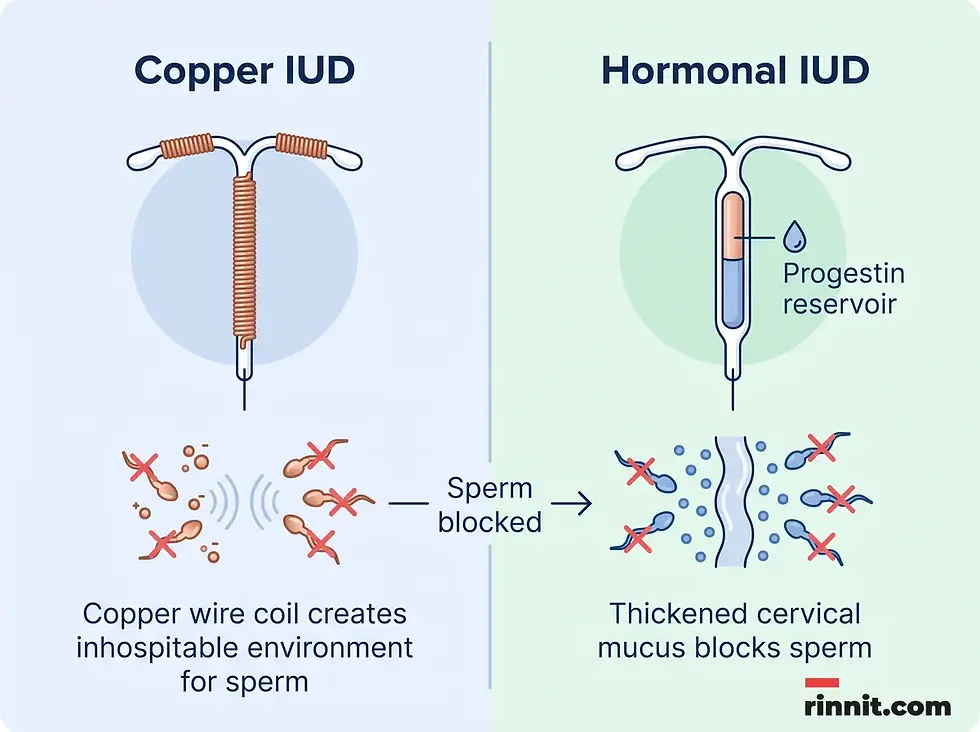
How each type works: copper creates an inhospitable environment for sperm, while a hormonal IUD thickens cervical mucus.
The Insertion Procedure
Placing an IUD is a brief medical procedure that typically takes less than 15 minutes. It is performed in a healthcare provider's office and does not require surgery or general anesthesia [1].
Preparation: A provider may perform a pregnancy test or STI screening. You may be advised to take an over-the-counter pain medicine beforehand, and the provider may numb the area.
Positioning: You are positioned as you would be for a pelvic exam or Pap smear.
Insertion: The provider uses a speculum to view the cervix and then inserts the IUD through the cervical opening into the uterus.
Finalization: The IUD strings are trimmed so they extend slightly into the vagina, which allows the device to be removed later.
You may feel mild to intense cramping during the procedure. Afterward, it is common to feel light-headed or to have cramps, backaches, and light spotting for a short period. Over-the-counter NSAID pain relievers and a heating pad can ease the discomfort, and it helps to take the rest of the day off if you can [1].

Post-insertion care: rest, water, and a heating pad can ease cramping in the hours after placement.
Benefits and Effectiveness
IUDs are more than 99% effective at preventing pregnancy, which puts them on par with permanent sterilization in reliability while remaining fully reversible. They are cost-effective over the long term and need no daily maintenance, which removes the risk of user error [1][2].
Benefit | Description |
|---|---|
Reliability | More than 99% success rate in preventing pregnancy. |
Convenience | No daily pills, patches, or injections required. |
Reversibility | Your provider can remove the device at any time, and fertility returns promptly afterward. |
Cost | In the U.S., generally covered by Medicaid and most private insurers, and low in cost over several years. |
Safety and Contraindications
IUDs are safe for most people, but certain conditions can rule them out. A healthcare provider will review your medical history to make sure you are a suitable candidate [1].
Pregnancy: An IUD cannot be inserted if you are currently pregnant.
Infections: Active pelvic inflammatory disease or certain untreated STIs are contraindications.
Cancers: Uterine or cervical cancer, and breast cancer (for hormonal types), are restrictions.
Allergies and conditions: Copper IUDs are avoided in people with a copper allergy or Wilson disease.
IUDs are excellent at preventing pregnancy, but they do not protect against sexually transmitted infections. Condoms should still be used for STI prevention [1]. Rare risks include the IUD pushing through the wall of the uterus (perforation, about 1 in 1,000 insertions) and a small chance of infection in the first few weeks; if you get pregnant with an IUD in place, see a provider right away because the pregnancy is more likely to be ectopic.
Bottom Line
The intrauterine device (IUD) is a premier option for people who want highly reliable, low-maintenance, and reversible birth control. With years of protection from a single office visit, it lets you manage your reproductive health with very little day-to-day effort.
Your next step: consult with a healthcare provider to discuss whether a copper or a hormonal IUD is the right choice for your lifestyle and health goals.
Frequently Asked Questions
What is the most common side effect after IUD insertion?
The most common immediate side effects include cramping, backaches, and light spotting as the body adjusts to the device.
How long does a copper IUD last compared to hormonal types?
A copper IUD is FDA-approved for 10 years, while hormonal types last between three and eight years depending on the brand.
Can I feel the IUD during daily activities?
No. Once properly placed in the uterus, you should not be able to feel the device, though you can check for the strings with your fingers.
Is IUD insertion painful?
Most people experience some level of cramping during insertion, ranging from mild to intense, but the process is very brief.
Does the IUD protect against STIs?
No. IUDs are only designed to prevent pregnancy. Condoms are still necessary to reduce the risk of sexually transmitted infections.
Can an IUD fall out?
While rare, expulsion can occur, where the IUD moves or falls out, usually during the first few months after placement.
How soon can I have sex after IUD insertion?
Follow your provider's advice, but generally you can have sex once any initial discomfort subsides. A copper IUD works immediately; a hormonal IUD works right away only if placed during your period, otherwise use backup contraception for about a week.
Will an IUD affect my ability to get pregnant later?
No. IUDs are fully reversible. Once your provider removes the device, your fertility returns to its normal baseline promptly.
Can I use a tampon with an IUD?
Yes. It is generally safe to use tampons or menstrual cups with an IUD, though you should be careful not to pull on the strings.
What should I do if I can't feel the IUD strings?
If you cannot feel the strings or they feel longer or shorter than usual, contact your healthcare provider for a position check.
Related Reading
Morning-After Pill: How It Works, Types and Effectiveness explains how emergency contraception pills work.
Birth Control Pill: Types, Effectiveness and Side Effects explains how birth control pills work and how to take them.
References
Cleveland Clinic. Intrauterine Device (IUD). Cleveland Clinic. November 13, 2022. https://my.clevelandclinic.org/health/treatments/24441-intrauterine-device-iud
Winner B, Peipert JF, Zhao Q, et al. Effectiveness of long-acting reversible contraception. New England Journal of Medicine. 2012;366(21):1998-2007. PMID 22621627. https://doi.org/10.1056/NEJMoa1110855
Cortessis VK, Barrett M, Brown Wade N, et al. Intrauterine device use and cervical cancer risk: a systematic review and meta-analysis. Obstetrics & Gynecology. 2017;130(6):1226-1236. PMID 29112647. https://doi.org/10.1097/AOG.0000000000002307
Wheeler LJ, Desanto K, Teal SB, et al. Intrauterine device use and ovarian cancer risk: a systematic review and meta-analysis. Obstetrics & Gynecology. 2019;134(4):791-800. PMID 31503144. https://doi.org/10.1097/AOG.0000000000003463
Medical disclaimer
This article is for informational purposes only and is not a substitute for professional medical advice, diagnosis, or treatment. The clinical information in this guide reflects source material last reviewed in November 2022.



Comments