Birth Control Pill: Types, Effectiveness and Side Effects

Updated: 2 days ago
Written and medically reviewed by Dr. Baraa Alnahhal, MD · Last reviewed: November 2026 · How we review
Quick Answer
Birth control pills (oral contraceptives) are daily pills that use hormones to prevent pregnancy. Taken every day as prescribed, the pill is 99% effective, but with everyday use about 9 in 100 people get pregnant each year, mostly from missed pills. Combination pills carry a small risk of blood clots, and the pill doesn't protect against STIs.
What the research says
Clot risk depends on the progestin: in more than 8 million woman-years in Denmark, levonorgestrel pills raised clot risk about 2.9-fold compared with non-users and some newer progestins about 6-fold, while progestin-only pills didn't raise risk (Lidegaard Ø et al., BMJ, 2011) [2]
The overall clot risk stays low: pooling 26 studies, combination pills raised the risk of a vein clot about 3.5-fold from a low baseline of about 2 to 4 per 10,000 women per year, with levonorgestrel pills at the lower end (Stegeman BH et al., BMJ, 2013) [3]
Key takeaways
The pill uses hormones to prevent pregnancy.
It's 99% effective with perfect daily use; about 9 in 100 get pregnant each year with typical use.
Combination pills have estrogen and progestin; the minipill has only progestin.
Use backup birth control for the first seven days.
The pill doesn't protect against sexually transmitted infections.
What is the birth control pill?
Birth control pills have been available for more than 60 years. They're one of the most popular forms of birth control. You need a prescription in many places, though some progestin-only pills are now sold over the counter in the U.S. Other hormonal options include the implant, ring, patch, shot and hormonal IUD. Sources: [1]
How the pill works
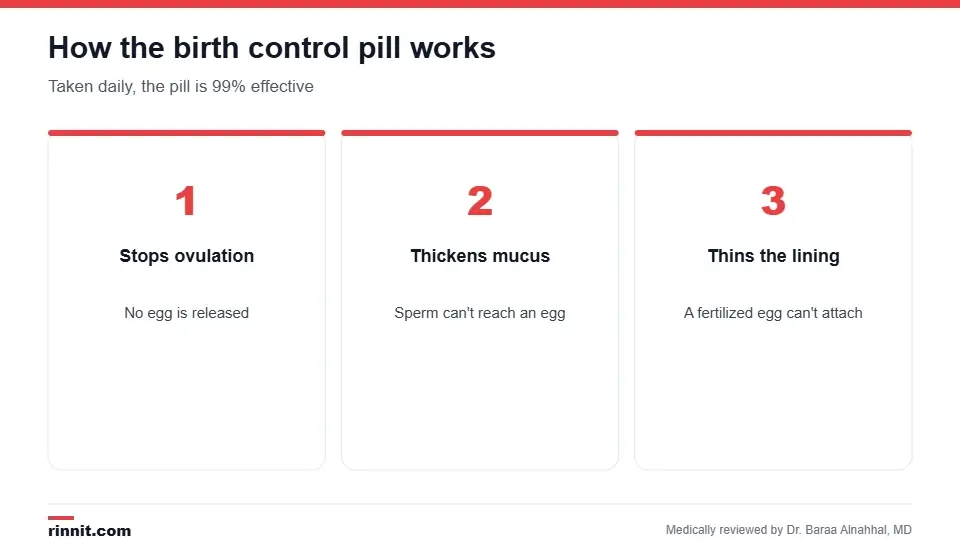
Taken daily, the pill is 99% effective.
Stops or reduces ovulation, so no egg is released.
Thickens cervical mucus so sperm can't reach an egg.
Thins the uterine lining so a fertilized egg can't attach. Sources: [1]
Types of birth control pills
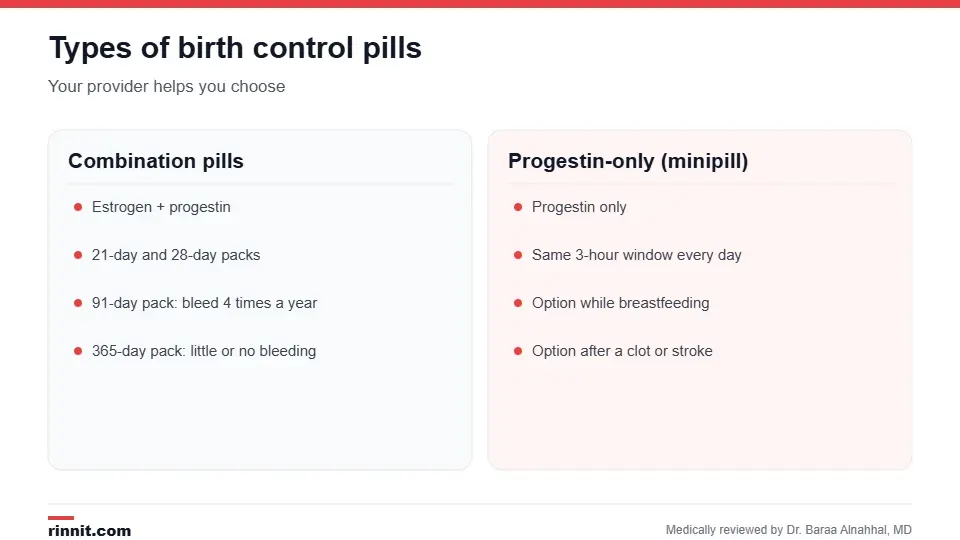
Your provider helps you choose the right pill.
Type | Hormones | How it's taken |
Combination, 28-day | Estrogen + progestin | 21 active pills + 7 inactive pills; you bleed during the inactive week |
Combination, 21-day | Estrogen + progestin | 21 active pills, then 7 days with no pills |
Combination, 91-day | Estrogen + progestin | 12 weeks of active pills + 7 inactive; bleeding about four times a year |
Combination, 365-day | Estrogen + progestin | Active pills every day; little or no bleeding |
Progestin-only (minipill) | Progestin only | One pill daily within the same three-hour window |
The minipill is often recommended if you're breastfeeding, since estrogen can lower milk supply, or if you've had a blood clot or stroke. The bleeding during inactive pills is a withdrawal bleed, not a true period. Sources: [1]
Benefits beyond birth control
Lighter, more regular periods and fewer cramps.
Less risk of anemia from heavy bleeding.
Fewer menstrual migraines and less PMS or PMDD.
Help with polycystic ovary syndrome (PCOS), endometriosis and fibroids.
Less acne and unwanted hair growth (hirsutism).
Lower risk of ovarian, uterine and colon cancer.
Fewer hot flashes during perimenopause. Sources: [1]
How to take the pill
Take one pill every day as prescribed, ideally at the same time.
Use a backup method, such as condoms, for the first seven days.
If you miss a pill, take it as soon as you remember and keep going.
Use backup until you've taken seven active pills in a row, and check the package insert.
If you miss several days, call your provider about a pregnancy test and emergency contraception. Sources: [1]
Some antiseizure medicines, certain HIV medicines and St. John's wort can make the pill less effective. Tell your provider about every medicine and supplement you take. Sources: [1]
Side effects and risks
Type | Examples |
Common, usually short-term | Nausea, headaches, mood changes, breast tenderness, spotting between periods |
Rare but serious (combination pills) | Blood clots in the legs or lungs, high blood pressure, heart attack, stroke |
Side effects usually improve after a few months; if they don't, another brand may suit you better. Combination pills carry a boxed warning: smoking raises the risk of heart attack and stroke, especially after age 35, so people over 35 who smoke shouldn't use them. Studies show the pill doesn't cause weight gain. Sources: [1, 2, 3]
Effectiveness and fertility
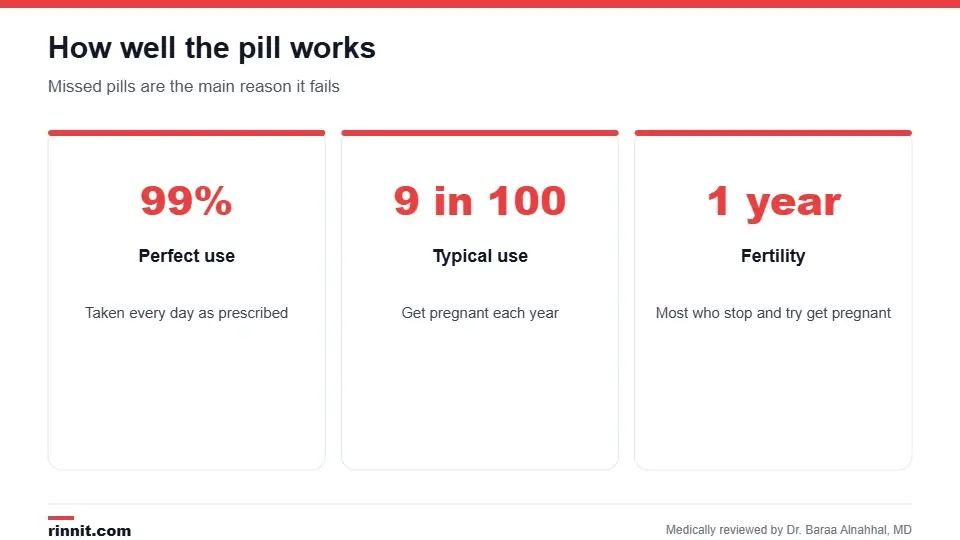
Missed pills are the main reason the pill fails.
Use | Effectiveness |
Taken every day as prescribed | 99% |
Typical use | About 9 in 100 people get pregnant each year |
Your fertility returns after you stop. Most people trying to get pregnant do so within a year, the same as people who never took the pill. Sources: [1]
Conclusion
The birth control pill is a safe, reliable and reversible way to prevent pregnancy, with extra benefits for many people. Taking it every day is the key to making it work.
Keep learning: read about long-acting reversible contraception and the IUD.
Frequently asked questions
How effective is the birth control pill?
99% with perfect use; about 9 in 100 get pregnant each year with typical use.
How does the pill prevent pregnancy?
It stops ovulation, thickens cervical mucus and thins the uterine lining.
What is the minipill?
A progestin-only pill taken within the same three-hour window each day.
How soon does the pill work?
Use backup birth control for the first seven days.
What if I miss a pill?
Take it as soon as you remember and use backup until you've had seven active pills.
Does the pill cause weight gain?
Studies show it doesn't.
What are common side effects?
Nausea, headaches, mood changes, breast tenderness and spotting.
Does the pill cause blood clots?
Combination pills slightly raise the risk; progestin-only pills don't appear to.
Does the pill protect against STIs?
No. Use condoms for STI protection.
Can I get pregnant after stopping?
Yes. Most people trying get pregnant within a year.
Related Reading
Laser Hair Removal: How It Works, Sessions and Results explains how laser hair removal works and what results to expect.
Morning-After Pill: How It Works, Types and Effectiveness explains how emergency contraception pills work.
LARC: Long-Acting Reversible Contraception Explained longer-lasting birth control options.
Intrauterine Device (IUD): Long-Acting Reversible Contraception a highly effective alternative to the pill.
Understanding Progestin: Synthetic Support for Hormonal Balance the hormone in every birth control pill.
Polycystic Ovary Syndrome (PCOS): Symptoms, Causes, Diagnosis, and Treatment a condition often treated with the pill.
Blood Clots Explained: Symptoms, Emergency Signs, and Treatment Options the rare serious risk of combination pills.
References
Cleveland Clinic. Birth Control Pill: Types, Side Effects & Effectiveness. Cleveland Clinic. Last updated July 5, 2023. https://my.clevelandclinic.org/health/treatments/3977-birth-control-the-pill
Lidegaard Ø, Nielsen LH, Skovlund CW, et al. Risk of venous thromboembolism from use of oral contraceptives containing different progestogens and oestrogen doses: Danish cohort study, 2001-9. BMJ. 2011;343:d6423. PMID 22027398. https://doi.org/10.1136/bmj.d6423
Stegeman BH, de Bastos M, Rosendaal FR, et al. Different combined oral contraceptives and the risk of venous thrombosis: systematic review and network meta-analysis. BMJ. 2013;347:f5298. PMID 24030561. https://doi.org/10.1136/bmj.f5298
Medical disclaimer
This article is for general education only and does not replace advice from a qualified healthcare professional. Talk to your doctor about your own diagnosis and treatment, and seek emergency care right away for severe or sudden symptoms.



Comments