Laser Hair Removal: How It Works, Sessions and Results

Updated: 2 days ago
Written and medically reviewed by Dr. Baraa Alnahhal, MD · Last reviewed: November 2026 · How we review
Quick Answer
Laser hair removal is a noninvasive treatment that uses laser heat to destroy hair follicles and reduce unwanted hair. You usually need six to eight sessions about six to eight weeks apart. Results last much longer than shaving or waxing, but they aren't permanent: some hair grows back. It works best on dark hair and light skin.
What the research says
About half the hair is gone in the short term: a review of 11 randomized trials with 444 people found alexandrite and diode lasers reduced hair by about 50% for up to 6 months after treatment, with few side effects (Haedersdal M and Gøtzsche PC, Cochrane Database Syst Rev, 2006) [2]
Lasers beat shaving and waxing: an evidence review of 30 trials found lasers give partial hair reduction that improves with repeated sessions and outperforms shaving, waxing and electrolysis, but no evidence of complete permanent removal (Haedersdal M and Wulf HC, J Eur Acad Dermatol Venereol, 2006) [3]
Key takeaways
Laser hair removal uses heat to damage hair follicles.
Most people need six to eight sessions, six to eight weeks apart.
Hair growth drops about 10% to 25% after the first session.
Results last long but aren't fully permanent.
It works best on dark hair and light skin.
What is laser hair removal?
The process is called selective photothermolysis. A laser sends light into the skin, where the dark pigment (melanin) in hair absorbs it. The light turns into heat, which travels down the hair shaft and damages the follicle. Follicles must be in the active growth phase (anagen) to respond, which is why several sessions are needed. Sources: [1]
Why it's done

Results last longer than shaving, waxing or plucking.
Who it works best for
Hair and skin | How well it works |
Dark, thick hair on light skin | Best results |
Dark skin | Less effective; needs an experienced provider |
Blonde, gray, white or red hair | Less effective, because there's little pigment to absorb the light |
Sources: [1]
How to prepare
Avoid tanning beds and limit sun exposure for several weeks before treatment.
Shave the area 2 to 3 days before each session; hair longer than a grain of rice won't respond well.
Don't wax, tweeze or pluck once treatment starts, since it removes the root the laser targets.
Tell your provider if you're pregnant, take acne medicines, get cold sores or genital herpes, form keloid scars or have had skin cancer. Sources: [1]
What happens during a session
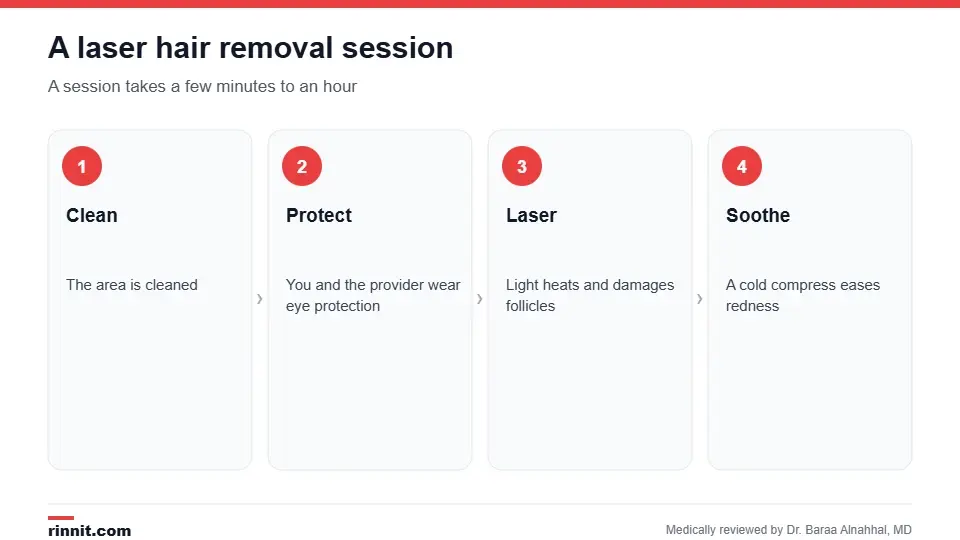
A session takes a few minutes to an hour.
Your provider cleans the area.
You and your provider put on protective eyewear.
The provider moves the laser over the skin. It may feel like a series of stings or a rubber band snapping.
You may smell smoke or burning hair; this is normal. Sources: [1]
A session takes from a few minutes for a small area, such as the upper lip, to about an hour for a large area, such as the back. Sources: [1]
Side effects and risks
Type | Examples |
Common, short-term | Redness, swelling, mild pain |
Less common | Blisters, burns, darker or lighter skin patches, cold sore outbreaks, infection, scars |
An experienced provider lowers your risk. Home laser devices exist, but they carry a higher risk of misuse and eye or skin injury, so use extreme caution and eye protection. Sources: [1]
Recovery
Skin may be red, swollen and a little sore for a short time.
Use a cold compress to ease discomfort.
Protect the area from sunlight and tanning beds.
Most people go back to normal activities right away. Sources: [1]
Results
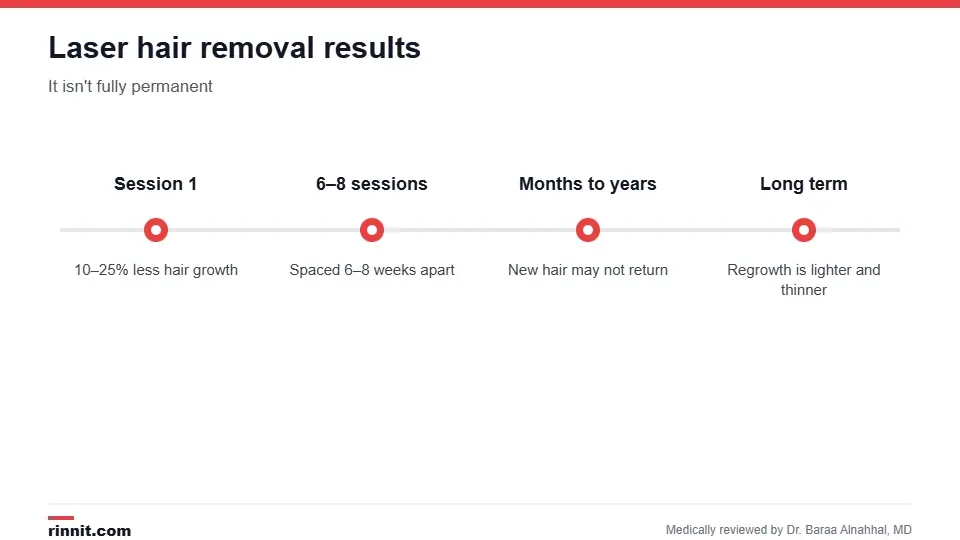
Laser hair removal isn't fully permanent.
Stage | What to expect |
After the first session | About 10% to 25% less hair growth |
After all sessions | New hair may not return for months or years |
Long term | Some hair regrows, usually lighter and thinner |
Compared with electrolysis, laser hair removal usually needs fewer sessions, hurts less and causes fewer ingrown hairs. Sources: [1, 2, 3]
Conclusion
Laser hair removal is a safe, effective way to reduce unwanted hair for the long term, especially with dark hair and light skin. A series of sessions with an experienced provider gives the best results.
Keep learning: read about electrolysis and hirsutism.
Frequently asked questions
How does laser hair removal work?
Laser light heats and damages the hair follicle so it grows less hair.
How many sessions will I need?
Usually six to eight, about six to eight weeks apart.
Is laser hair removal permanent?
No. It reduces hair for a long time, but some grows back lighter and thinner.
Does it hurt?
It feels like stings or a rubber band snapping.
Who gets the best results?
People with dark hair and light skin.
Does it work on blonde or gray hair?
It's less effective on blonde, gray, white or red hair.
Should I shave before treatment?
Yes, 2 to 3 days before each session.
Can I wax between sessions?
No. Don't wax, tweeze or pluck once treatment starts.
What are the side effects?
Redness and swelling; rarely blisters, burns, skin color changes or scars.
Is laser better than electrolysis?
It usually needs fewer sessions and hurts less.
Related Reading
Hirsutism: Causes, Symptoms, and the Treatment Options That Work excess hair growth often treated with lasers.
Electrolysis Hair Removal: How It Works, Sessions, Risks and Results another long-term hair removal option.
Polycystic Ovary Syndrome (PCOS): Symptoms, Causes, Diagnosis, and Treatment a common cause of extra hair growth.
Birth Control Pill: Types, Effectiveness and Side Effects hormone pills that can help with unwanted hair.
References
Cleveland Clinic. Laser Hair Removal: How it Works & What to Expect. Cleveland Clinic. Last updated September 1, 2021. https://my.clevelandclinic.org/health/treatments/21757-laser-hair-removal
Haedersdal M, Gøtzsche PC. Laser and photoepilation for unwanted hair growth. Cochrane Database Syst Rev. 2006;2006(4):CD004684. PMID 17054211. https://doi.org/10.1002/14651858.CD004684.pub2
Haedersdal M, Wulf HC. Evidence-based review of hair removal using lasers and light sources. J Eur Acad Dermatol Venereol. 2006;20(1):9-20. PMID 16405602. https://doi.org/10.1111/j.1468-3083.2005.01327.x
Medical disclaimer
This article is for general education only and does not replace advice from a qualified healthcare professional. Talk to your doctor about your own diagnosis and treatment, and seek emergency care right away for severe or sudden symptoms.



Comments