
Electrolysis Hair Removal: How It Works, Sessions, Risks and Results

Updated: 6 days ago
Written and medically reviewed by Dr. Baraa Alnahhal, MD · Last reviewed: October 2026 · How we review
Quick Answer: What is electrolysis?
Electrolysis is a hair removal treatment in which a trained electrologist places a very fine probe into each hair follicle and sends a small electric current to destroy the hair root. It works on most body areas and on all skin and hair types, usually needs weekly or every-other-week sessions for up to 18 months, and can remove hair permanently. [1][2]
What the research says
Electrolysis took about three times as many sessions as laser before surgery. In a survey of 52 patients preparing for genital surgery, people who had electrolysis alone needed a mean of 24.3 sessions versus 8.1 for laser alone, with sessions lasting 152 versus 26 minutes and total costs of $5,161 versus $981. (Yuan et al., Sex Med, 2022)
Laser cleared more hair at six months in a small side-by-side trial. In 12 patients who had one underarm treated with electrolysis (4 sessions) and the other with an alexandrite laser (3 sessions), average hair clearance at 6 months was 35% with electrolysis and 74% with laser. (Görgü et al., Dermatol Surg, 2000)
Guidelines place electrolysis alongside medicine for excess hair growth. An expert task force (7 specialists plus a methodologist, drawing on 2 commissioned systematic reviews) suggests adding direct hair removal such as electrolysis or laser to medication for women with hirsutism who want more cosmetic improvement, and suggests laser for most women choosing hair removal. (Martin et al., J Clin Endocrinol Metab, 2018)
Key takeaways
Electrolysis destroys the hair root with an electric current delivered through a probe that is often finer than the hair itself. [1]
It treats most body areas, including the face, underarms, bikini line, breasts, abdomen, back, legs, fingers and toes. [1]
Most people need sessions every week or two, each lasting 15 minutes to one hour, for up to a year and a half. [1]
It works on all skin tones and hair colors, including light hair that lasers cannot target. [1][2]
Side effects are usually brief redness; infection and scarring are rare and mostly linked to poor technique or unsterile equipment. [1][2]
Choose a licensed or certified electrologist rather than an at-home device. [1][2]
Electrolysis at a glance
Question | Short answer |
What it does | Destroys the hair root inside the follicle so the hair cannot regrow [1] |
Device used | A medical epilator connected to a fine probe [1] |
Who performs it | A trained, licensed or certified electrologist [1] |
Session length | 15 minutes to 1 hour [1] |
Session frequency | Every week or every other week [1] |
Total course | Varies by person; can last up to about 18 months [1] |
Skin and hair types | All skin tones and all hair colors [1][2] |
Downtime | None; normal activities can resume right away [1] |
Most common side effect | Short-lived redness [1] |
How does electrolysis remove hair?
Electrolysis removes hair by sending an electric current down a thin probe to the base of the hair follicle, where it destroys the cells that grow the hair. [1] The damage to the follicle stops new hair from forming and makes the existing hair fall out. [1]
The device that powers the probe is called an epilator. [1]
The technique has been used for more than 100 years. It was first developed to remove ingrown eyelash hairs. [1]
It is also the only hair removal method that the U.S. Food and Drug Administration has recognized as permanent. [1]

Who is electrolysis for?
Electrolysis is for people who want unwanted hair gone for good, whether the hair growth is normal but unwelcome or caused by a medical condition. [1]
People often choose it when they:
Are unhappy with where hair grows, such as between the eyebrows, on the upper lip or on the breasts. [1]
Have hirsutism, which means excessive hair growth. [1]
For women with hirsutism, expert guidelines suggest combining medication with direct hair removal such as electrolysis for extra cosmetic benefit. [5]
What causes unwanted hair growth?
Unwanted hair growth is most often caused by genetics, hormone levels, certain medicines or certain illnesses. [1]
Cause | What it means |
Genetics | Your family background influences how much body hair you have [1] |
Hormones | High levels of androgens (male hormones) can increase hair growth; see our guide to hyperandrogenism [1] |
Medicines | Some drugs, such as certain steroids, can trigger extra hair [1] |
Illnesses | Conditions such as polycystic ovary syndrome (PCOS) can cause excess hair [1] |
If you suddenly notice a lot more unwanted hair, a board-certified dermatologist can explain what is happening and recommend the right option for you. [2]
Which body areas can electrolysis treat?
Electrolysis can treat most areas of the body. [1] Common treatment areas include:
Face, including the upper lip, chin and eyebrows
Underarms
Breasts and abdomen
Back
Bikini line, thighs and lower legs
Fingers and toes
It is especially well suited to sensitive areas such as the face and bikini line. [1]
What happens during an electrolysis session?
During an electrolysis session, the electrologist inserts a thin probe into the natural opening of each hair follicle and releases a small current that destroys the hair growth cells. [1]
Here is what to expect, step by step:
Consultation. Many practices offer a free first visit to answer your questions so you feel comfortable with your choice. [1]
Probe placement. A needle that is often finer than the hair goes into the natural opening of the follicle. [1]
Current delivery. A small electric current destroys the hair growth cells. The skin may feel briefly hot or like a pinch. [1]
Follicle damage. The damaged follicle stops producing hair, and the existing hair falls out. [1]
A session lasts anywhere from 15 minutes to one hour. [1]
How many electrolysis sessions will you need?
Most people need several electrolysis sessions, usually spaced one to two weeks apart, over a course that can last up to a year and a half. [1]
The exact number varies from person to person. [1] Two factors matter most:
Factor | Effect on treatment time |
Size of the area | Larger areas need more sessions [1] |
Hair type | Coarse hair needs more sessions than fine hair [1] |
Research suggests the total time commitment can be large. In one study of people preparing for surgery, electrolysis alone required a mean of 24.3 sessions. [3]
Why does electrolysis take so many sessions?
Electrolysis takes many sessions because hairs grow in cycles, and each follicle has to be treated at the right point in its cycle to be destroyed. [1]
Every follicle goes through a repeating cycle of growth, rest and replacement. At any moment, your hairs are spread across different phases. [1] Repeat visits catch each hair when it can be treated, which is why patience is part of the process. [1]
How should you care for your skin after electrolysis?
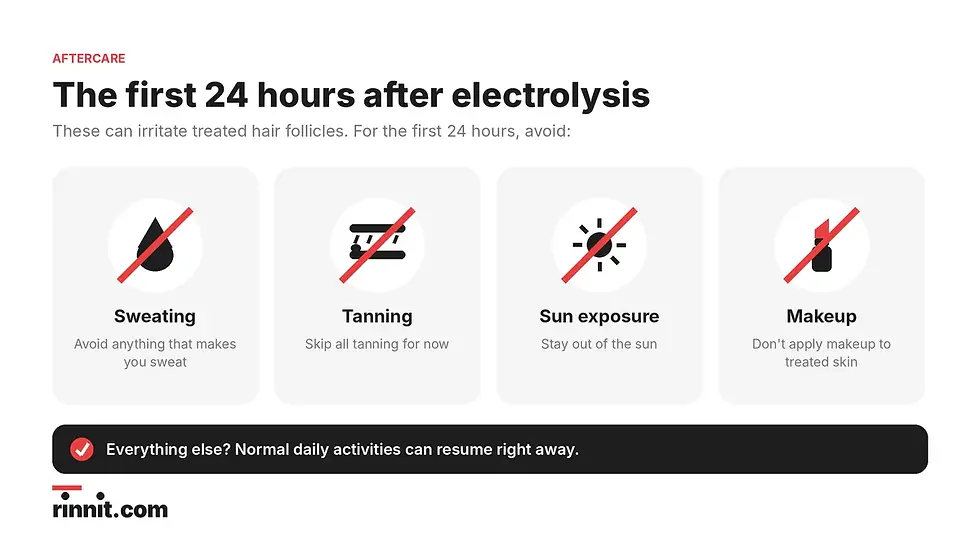
After electrolysis, you can return to normal activities right away, but for the first 24 hours you should avoid anything that may irritate the treated follicles. [1]
For the first 24 hours, avoid:
Activities that make you sweat
Tanning
Spending time in the sun
Applying makeup
If you notice temporary dark spots, let them fade on their own. Do not use bleaching cream on them. [1]
Is electrolysis painful?
Electrolysis usually causes only mild discomfort, such as a slight tingling, heat or a quick pinch as each hair is treated. [1]
Some people describe a stinging feeling with each hair. [2] If you are worried about pain, ask your electrologist whether a numbing cream (topical anesthetic) is suitable for you. [1] Learn more about how numbing medicines work in our anesthesia guide.
What are the risks and side effects of electrolysis?
Electrolysis is very safe when performed correctly, and its most common side effect is mild redness that fades quickly. [1]
Side effect or risk | How common | What to know |
Redness | Common | Short-lived; appears during or right after treatment [1] |
Temporary dark spots | Possible in darker skin | Fade over time; avoid bleaching creams [1] |
Infection | Rare | Linked to unsterile needles [1][2] |
Scarring and burns | Rare | Linked to incorrect technique [1][2] |
Raised (keloid) scars | Possible in darker skin tones | Reported with electrolysis; see our hypertrophic scars guide [2] |
These risks are very low when you choose a certified, professional practice. [1]
Is electrolysis permanent?
Yes, electrolysis is considered a permanent hair removal method because it destroys the growth cells inside the follicle, so treated hair does not grow back. [1][2]
Once the hair is gone, maintenance sessions are not usually needed. [2] Results depend on completing the full course, since hairs in different growth phases need separate treatments. [1]
A dermatology review also describes electrolysis as the only hair removal method that is not temporary. [6] Study results still vary: one small trial measured 35% hair clearance at six months after four electrolysis sessions, so short courses may not reach full clearance. [4]
How does electrolysis compare with laser and other hair removal methods?
Electrolysis is the method that suits the widest range of skin tones and hair colors, while laser is usually faster and requires fewer sessions. [1][2][3]

Feature | Electrolysis | Laser hair removal | Shaving, waxing, creams |
How it works | Electric current destroys each root [1] | Light energy targets hair pigment [2] | Removes hair at or just below the surface [1][2] |
Result | Permanent [1][2] | Long-lasting hair reduction after about 6 or more sessions; some hair may regrow [2] | Temporary [1][2] |
Light, gray or red hair | Works [2] | Does not work [2] | Works |
Sessions in one study | Mean 24.3 [3] | Mean 8.1 [3] | Ongoing |
Session length in one study | 152 minutes [3] | 26 minutes [3] | Minutes |
Common drawbacks | Long treatment course [1] | Burns, blisters or dark spots if done poorly [2] | Skin irritation, mess, pain or cost [1] |
Temporary methods have their own downsides. Chemical creams can irritate the skin and be messy, and waxing can be painful and costly. [1] Shaving can also lead to ingrown hairs; read our ingrown hair guide for prevention tips. [2]
Can you do electrolysis at home?
You can buy home electrolysis devices, but a trained electrologist is the safer choice. [1]
Professionals use high-quality, sterile equipment and tailor treatment to your skin and hair. [1] Home kits also work differently, because they do not insert probes into the hair follicles. [2]
How do you choose a qualified electrologist?
A qualified electrologist holds a current license or certification, follows strict sterilization practices and makes you feel comfortable asking questions. [1]
Check these four points before booking:
Qualifications. Many places require licensing or certification. Make sure the certificate is current and on display, or ask whether the provider trained at an accredited electrology school. [1]
Recommendations. Ask friends, family or your healthcare provider for referrals. [1]
Consultation. Use the first visit to ask every question you have. [1]
Cleanliness. Ask about cleaning and sterilization, and look for disposable equipment and a clean clinic. [1]
You can also ask a board-certified dermatologist or board-certified electrologist to perform the treatment. [2]
What should you ask an electrologist before starting?
Before starting electrolysis, ask questions that cover comfort, time, cost and experience. [1]
How will the procedure feel?
How long is each session?
How many visits do you think I'll need?
How much will the treatment cost?
Will insurance cover electrolysis?
How long have you practiced electrolysis?
How many people have you treated?
Conclusion
Electrolysis offers permanent removal of unwanted hair on almost any part of the body and for every skin tone and hair color. [1][2] The trade-off is time: expect regular sessions over many months, with brief redness as the usual side effect. [1] Choosing a licensed electrologist who uses sterile, disposable equipment keeps the rare risks of infection and scarring low. [1]
Ready to take the next step? If unwanted hair is new or increasing quickly, start by reading our guides to hirsutism and PCOS, then book a visit with a healthcare provider to find the cause before you begin hair removal.
FAQ
What is electrolysis hair removal?
Electrolysis hair removal is a treatment that destroys each hair root with a small electric current delivered through a fine probe placed in the follicle. Because the root is destroyed, the treated hair does not grow back. [1]
Is electrolysis permanent?
Yes, electrolysis is considered permanent because it destroys the growth cells inside the hair follicle. Most people need a full course of sessions to treat every hair at the right stage of its growth cycle. [1][2]
How many electrolysis sessions do you need?
Most people need sessions every week or every other week for up to about 18 months. Larger areas and coarse hair need more sessions. [1]
Does electrolysis hurt?
Electrolysis usually causes mild discomfort, such as tingling, heat or a quick pinch with each hair. Ask your electrologist about a numbing cream if you are concerned. [1]
What are the side effects of electrolysis?
The most common side effect of electrolysis is short-lived redness during or right after treatment. People with darker skin may get temporary dark spots, while infection and scarring are rare and linked to poor technique or unsterile needles. [1]
Is electrolysis better than laser hair removal?
Electrolysis works on all hair colors, including light, gray and red hair that lasers cannot target. Laser is usually faster and needs fewer sessions, so the better choice depends on your hair, skin and time. [2][3]
What should you avoid after electrolysis?
For the first 24 hours after electrolysis, avoid sweating, tanning, sun exposure and makeup. You can return to your other normal activities right away. [1]
Can electrolysis treat facial hair?
Yes, electrolysis can treat facial hair on the upper lip, chin and eyebrows. It is well suited to sensitive areas such as the face. [1]
Does electrolysis work on all skin and hair colors?
Yes. Electrolysis treats the hair root directly, so it works on all skin tones and hair colors, including blond, red, gray and white hair that lasers often cannot target.
Are at-home electrolysis devices safe?
At-home devices are not recommended. Using them without training can raise the risk of skin damage, infection and scarring, so it is safer to see a licensed or certified electrologist.
Related Reading
Laser Hair Removal: How It Works, Sessions and Results explains how laser hair removal works and what results to expect.
References
Cleveland Clinic. Electrolysis: Definition & Treatment. Cleveland Clinic. Last updated January 5, 2021. https://my.clevelandclinic.org/health/treatments/8306-electrolysis
American Academy of Dermatology. 6 ways to remove unwanted hair. American Academy of Dermatology Association. Last updated September 7, 2023. https://www.aad.org/public/everyday-care/skin-care-basics/hair/remove-unwanted-hair
Yuan N, Feldman AT, Chin P, et al. Comparison of permanent hair removal procedures before gender-affirming vaginoplasty: why we should consider laser hair removal as a first-line treatment for patients who meet criteria. Sex Med. 2022;10(5):100545. PMID: 35914381. https://doi.org/10.1016/j.esxm.2022.100545
Görgü M, Aslan G, Aköz T, et al. Comparison of alexandrite laser and electrolysis for hair removal. Dermatol Surg. 2000;26(1):37-41. PMID: 10632684. https://doi.org/10.1046/j.1524-4725.2000.99104.x
Martin KA, Anderson RR, Chang RJ, et al. Evaluation and treatment of hirsutism in premenopausal women: an Endocrine Society clinical practice guideline. J Clin Endocrinol Metab. 2018;103(4):1233-1257. PMID: 29522147. https://doi.org/10.1210/jc.2018-00241
Kang CN, Shah M, Lynde C, et al. Hair removal practices: a literature review. Skin Therapy Letter. 2021;26(5):6-11. PMID: 34524781. https://pubmed.ncbi.nlm.nih.gov/34524781/
Medical disclaimer
This article is for general educational purposes only and does not replace professional medical advice, diagnosis or treatment. Always speak with a qualified healthcare provider about your symptoms and before starting any hair removal treatment.



Comments