Transvaginal Ultrasound: Why It's Done, How to Prepare and What to Expect

Updated: 2 days ago
Written and medically reviewed by Dr. Baraa Alnahhal, MD · Last reviewed: November 2026 · How we review
Quick Answer: What is a transvaginal ultrasound?
A transvaginal ultrasound is a quick imaging test of the uterus, cervix, fallopian tubes and ovaries. A thin probe placed in the vagina uses sound waves to make pictures. It can help find causes of pelvic pain or unusual bleeding and check an early pregnancy. It takes 15 to 30 minutes and is safe during pregnancy. [1]
What the research says
It finds endometriomas about as well as MRI. A meta-analysis of 16 studies with 1,976 participants found transvaginal ultrasound picked up endometriomas (endometriosis cysts on the ovary) with 89% sensitivity and 95% specificity. MRI scored 94% and 94%, and the difference was not significant. (Kanti et al., Journal of Obstetrics and Gynaecology, 2024) [2]
It can also spot deep endometriosis near the bowel. Across 10 studies and 1,604 patients, transvaginal ultrasound detected deep endometriosis of the rectum and sigmoid colon with 85% sensitivity and 92% specificity, similar to MRI's 83% and 95%. (Xu et al., Frontiers in Medicine, 2025) [3]
It is a leading test in gynecological emergencies. A systematic review of 45 diagnostic studies found transvaginal ultrasound was the most studied noninvasive tool and performed best on its own for spotting serious emergencies such as a complicated ectopic pregnancy, adnexal torsion and internal bleeding, though the quality of the studies was generally low. (Polena et al., PLoS One, 2015) [4]
Key takeaways
A transvaginal ultrasound uses a thin probe placed in the vagina to make detailed images of the uterus, cervix, fallopian tubes and ovaries. [1]
It helps explain pelvic pain and unusual bleeding and can find cysts, fibroids, polyps and signs of ectopic pregnancy or miscarriage. [1]
In early pregnancy, it confirms where the pregnancy is, estimates how far along it is and measures the heartbeat. [1]
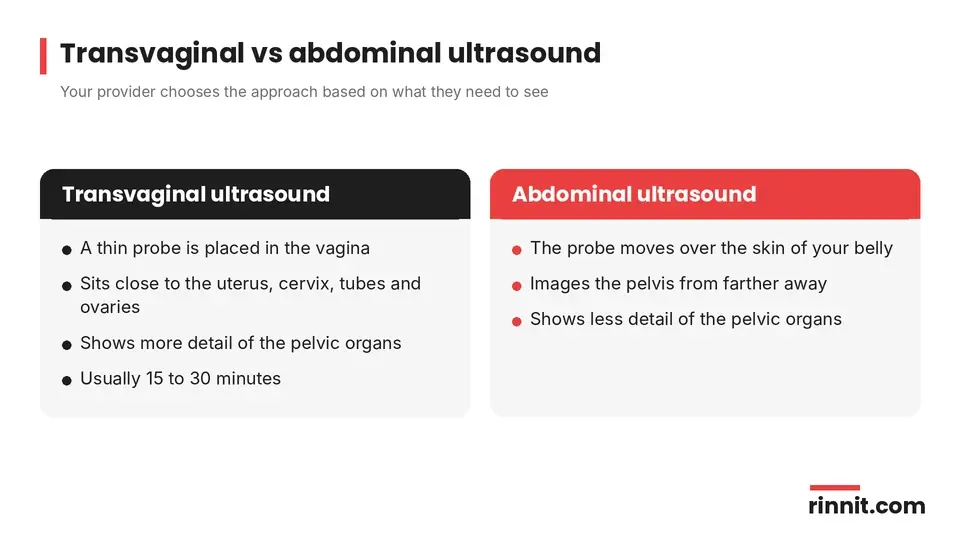
It usually takes 15 to 30 minutes and may cause pressure but shouldn't hurt. [1]
It is low risk and safe during pregnancy. [1]
What is a transvaginal ultrasound?
A transvaginal ultrasound is an imaging test that looks at your reproductive organs, including your uterus, cervix, fallopian tubes and ovaries. "Transvaginal" means "through the vagina." [1]
Your provider gently places a thin, wand-like device called a transducer into your vagina. The transducer sends out sound waves that bounce off your organs and create images on a screen. Because the probe sits close to these organs, the pictures show more detail than an abdominal (belly) ultrasound. [1]
Why is a transvaginal ultrasound done?
Your provider may recommend a transvaginal ultrasound if you have: [1]
Pelvic pain
Unusual or irregular vaginal bleeding
An abnormal finding during a pelvic exam
Upcoming pelvic surgery that needs planning
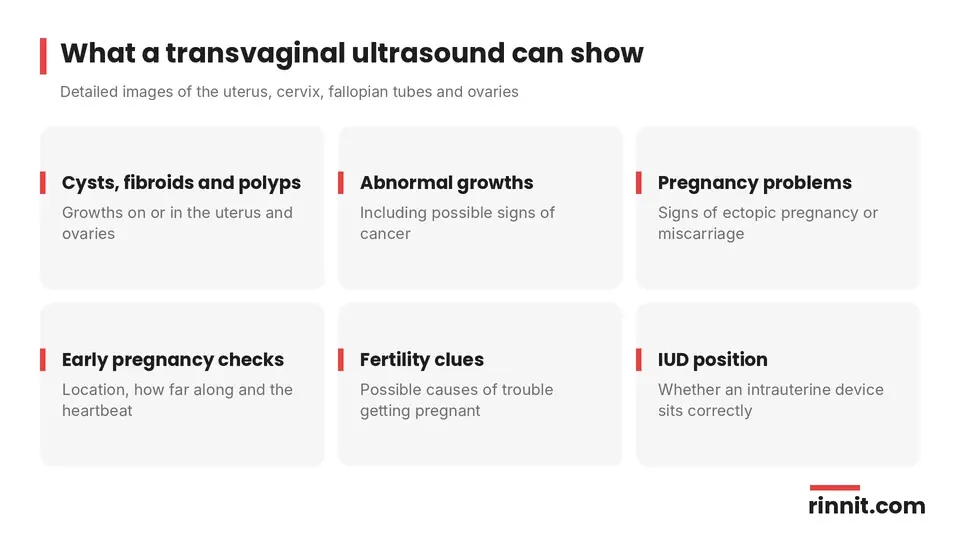
The test can help detect: [1]
Cysts, fibroids and polyps
Abnormal growths, including signs of cancer
Signs of an ectopic pregnancy or a miscarriage
Possible causes of fertility problems
Whether an intrauterine device (IUD) is in the right position
Transvaginal ultrasound in pregnancy
In early pregnancy, a transvaginal ultrasound can confirm that the pregnancy is growing in the right place, estimate how far along you are, measure the baby's heartbeat and find early complications. The test is safe during pregnancy. [1]
How do you prepare for a transvaginal ultrasound?
Little preparation is needed. Before your test: [1]
Follow your provider's instructions about drinking fluids and using the bathroom, because how full your bladder is can change how your organs look on the images
Remove your tampon if you're on your period
Wear clothes that are easy to take off, since you'll undress from the waist down and may wear a gown
What happens during a transvaginal ultrasound?

An ultrasound technician or another provider performs the test. Here's what usually happens: [1]
You lie on your back on an exam table, in a position similar to a pelvic exam.
The provider covers the transducer with a sterile cover and gel.
They gently place the transducer into your vagina.
The transducer records images, and the provider may move it slightly to get different angles.
The transducer is removed once enough images are taken.
Transvaginal ultrasound at a glance
Item | Typical detail |
What's imaged | Uterus, cervix, fallopian tubes and ovaries |
Who does it | An ultrasound technician or another provider |
How long it takes | Usually 15 to 30 minutes |
Does it hurt? | It may cause pressure or discomfort but shouldn't be painful |
Safe in pregnancy? | Yes |
Recovery | You can go about your day as normal |
Sources: [1]
How long does it take?
A transvaginal ultrasound usually takes 15 to 30 minutes. The exact time depends on what your provider is looking at and how easily the structures can be seen. [1]
Does a transvaginal ultrasound hurt?
It may feel uncomfortable or cause some pressure, but it shouldn't be painful. The transducer is shaped to fit comfortably in the vagina, and the gel helps it slide in easily. [1]
What are the risks of a transvaginal ultrasound?
A transvaginal ultrasound is considered low risk. You may notice: [1]
Mild pressure or discomfort during the test
Some discharge from the gel, which should clear within 24 hours
Light bleeding or cramping, which is uncommon and temporary
You can go back to your usual activities right after the test. [1]
When will you get results?
Your provider may talk with you about early findings on the same day. The full report usually takes a few hours to a few days, depending on how quickly the images are reviewed. Sometimes your provider may suggest more tests, such as an MRI, to get a clearer picture. [1]
When should you call your doctor?
Contact your provider if you have pain, heavy bleeding or any other symptoms that worry you after the test. [1]
Questions to ask your provider
Why do I need a transvaginal ultrasound?
Should my bladder be full or empty for the test?
What are you looking for on the images?
When will I get the full report?
Will I need any other tests, such as an MRI?
Conclusion
A transvaginal ultrasound gives your provider a close, detailed look at your uterus, cervix, fallopian tubes and ovaries. It helps find the cause of pelvic pain or unusual bleeding, spots growths such as cysts, fibroids and polyps, and checks on an early pregnancy.
The test is quick, low risk and safe during pregnancy. You may feel pressure, but it shouldn't hurt, and you can return to your day as soon as it's over.
Keep learning: Read our guides to ultrasound, the Pap smear, colposcopy and ovarian cysts. For more on pelvic imaging, see MedlinePlus: Transvaginal ultrasound.
FAQ
What is a transvaginal ultrasound used for?
It looks at the uterus, cervix, fallopian tubes and ovaries to explain pelvic pain or unusual bleeding and to find cysts, fibroids, polyps and early pregnancy problems. [1]
Does a transvaginal ultrasound hurt?
It may cause pressure or discomfort, but it shouldn't be painful. [1]
How long does a transvaginal ultrasound take?
It usually takes 15 to 30 minutes. [1]
Is a transvaginal ultrasound safe during pregnancy?
Yes. It is safe during pregnancy and is often used early on to check where the pregnancy is and measure the heartbeat. [1]
Can I have a transvaginal ultrasound on my period?
Yes. Just remove your tampon before the test. [1]
Do I need a full bladder for a transvaginal ultrasound?
Follow your provider's instructions, because how full your bladder is affects how your organs look on the images. [1]
What can a transvaginal ultrasound detect?
It can detect cysts, fibroids, polyps, abnormal growths, signs of ectopic pregnancy or miscarriage, possible causes of fertility problems and IUD position. [1]
Is there bleeding after a transvaginal ultrasound?
Light bleeding or cramping can happen but is uncommon and temporary, and gel discharge should clear within 24 hours. [1]
How soon will I get my results?
Early findings may be shared the same day, and the full report usually takes a few hours to a few days. [1]
When should I call my doctor after the test?
Call if you have pain, heavy bleeding or other worrying symptoms. [1]
Related Reading
Culdocentesis: Why It's Done, Procedure, Risks and Results explains the needle test that checks fluid behind the uterus.
Learn more in our guide to Ovarian Cysts: Symptoms, Causes, and Treatment Options Explained.
Learn more in our guide to Uterine Polyps: Complete Guide to Symptoms, Causes, and Treatment.
Learn more in our guide to Ectopic Pregnancy: Symptoms, Causes, and Treatment.
Learn more in our guide to What Is a Miscarriage? A Plain-Language Guide to Causes, Symptoms, and Recovery.
Learn more in our guide to Endometriosis: Symptoms, Causes, and Treatment.
Learn more in our guide to Threatened Miscarriage: Symptoms, Causes, Tests, and Care.
Endometriosis Ultrasound: What It Can Find, What It Misses, Preparation and Results explains the specialized transvaginal scan that maps endometriomas and deep nodules.
References
Cleveland Clinic. Transvaginal Ultrasound: Purpose, Procedure & Results. Cleveland Clinic. Last updated September 9, 2025. https://my.clevelandclinic.org/health/diagnostics/4993-transvaginal-ultrasound
Kanti FS, Gorak Savard R, Bergeron F, et al. Transvaginal ultrasound and magnetic resonance imaging in the diagnosis of endometrioma: a systematic review and meta-analysis of diagnostic test accuracy studies. J Obstet Gynaecol. 2024;44(1):2311664. PMID 38348799. https://doi.org/10.1080/01443615.2024.2311664
Xu Z, Li Y, Wang Y, et al. Transvaginal ultrasound and magnetic resonance imaging in detecting rectosigmoid deep infiltrating endometriosis: a comparative meta-analysis. Front Med (Lausanne). 2025;12:1552185. PMID 40166065. https://doi.org/10.3389/fmed.2025.1552185
Polena V, Huchon C, Varas Ramos C, et al. Non-invasive tools for the diagnosis of potentially life-threatening gynaecological emergencies: a systematic review. PLoS One. 2015;10(2):e0114189. PMID 25723401. https://doi.org/10.1371/journal.pone.0114189
Medical disclaimer
This article is for general education only and does not replace advice from a qualified healthcare professional. Talk to your doctor about your own diagnosis and treatment, and seek emergency care right away for severe or sudden symptoms.



Comments