Threatened Miscarriage: Symptoms, Causes, Tests, and Care

Updated: 3 days ago
Medically reviewed by Dr. Baraa Alnahhal, MD · Last reviewed: October 2026
A threatened miscarriage describes vaginal bleeding and pelvic pain during the first half of pregnancy, most commonly in the first trimester. The symptoms can be frightening, but they do not automatically mean that a miscarriage will happen. In many cases, the pregnancy continues. [1]
If you have vaginal bleeding, abdominal pain or cramping during pregnancy, contact your pregnancy care provider. A provider can assess the symptoms, check on the pregnancy and explain what follow-up may be needed. [1]
Quick Answer: What is a threatened miscarriage?
A threatened miscarriage is vaginal bleeding during the first half of pregnancy, up to 20 weeks, with or without mild cramping, most commonly in the first trimester. The bleeding is usually light and may last days or weeks. Many people with these symptoms go on to have a healthy pregnancy; the symptoms signal that monitoring may be needed. [1]
What the research says
Progesterone did not clearly improve live births in women with early-pregnancy bleeding. In a randomized, placebo-controlled trial of 4,153 women with vaginal bleeding in early pregnancy, live birth after at least 34 weeks occurred in 75% of those given vaginal progesterone versus 72% with placebo (relative rate 1.03, 95% CI 1.00–1.07; P = 0.08), a difference that was not statistically significant (Coomarasamy et al., N Engl J Med, 2019). [2]
There is not enough evidence that bed rest prevents miscarriage. A Cochrane review found only two small trials (84 women) of bed rest for women at high risk of miscarriage, with no statistically significant difference in miscarriage (RR 1.54, 95% CI 0.92–2.58), and concluded that evidence is insufficient to support a bed-rest policy (Aleman et al., Cochrane Database Syst Rev, 2005). [3]

What are the symptoms of a threatened miscarriage?
A threatened miscarriage typically includes vaginal bleeding, abdominal cramps, or both. The bleeding is usually mild and may be more than light spotting. Some people may pass small clots or tissue-like material.
The pain is often dull rather than sharp or intense. It may feel like cramping, but it can progress to constant or severe pain. Because several conditions can cause bleeding or pelvic pain during pregnancy, symptoms should be discussed with a healthcare professional. [1]
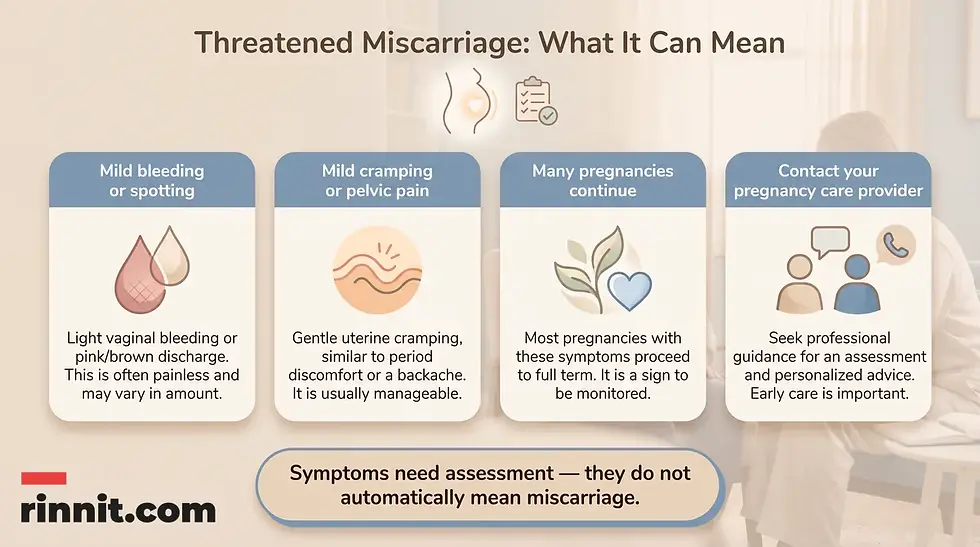
Is bleeding during early pregnancy always a miscarriage?
No. Vaginal bleeding or mild cramping during pregnancy does not necessarily mean there is a problem or that miscarriage will happen. In many cases, the pregnancy continues. [1]
The symptoms are a reason to contact a pregnancy care provider, not proof of a pregnancy loss. A provider can use an examination and testing to better understand what is happening.
What causes a threatened miscarriage?
A threatened miscarriage has no single cause, though factors such as chromosomal problems, a previous miscarriage, smoking, infections and age over 40 may play a role. Factors that may play a role include chromosomal problems with the fetus, a previous miscarriage, alcohol or drug use, exposure to chemicals early in pregnancy, obesity, being older than 40 during pregnancy, smoking cigarettes or vaping, placenta problems, trauma or injury, and vaginal or uterine infections.
Having one of these factors does not establish what caused an individual person’s symptoms. A provider can review medical history and symptoms in context.
Possible contributing factor | How it appears in the clinical discussion |
Chromosomal problems | Problems involving the fetus’s chromosomes may play a role. |
Previous miscarriage | A prior miscarriage is one factor associated with miscarriage risk. |
Early exposure | Alcohol, drugs, or chemicals early in pregnancy may contribute. |
Health factors | Obesity and being older than 40 during pregnancy are listed factors. |
Smoking or vaping | Nicotine exposure is listed among possible contributors. |
Placenta problems | Abnormalities involving the placenta may play a role. |
Trauma or infection | Injury and vaginal or uterine infections are also possible contributors. |
How is a threatened miscarriage diagnosed?
A pregnancy care provider begins by asking about the bleeding, pain, timing, and medical history. They may then use several tests to evaluate the pregnancy and look for other explanations. [1]
A vaginal or pelvic ultrasound may be used to check the fetus’s heartbeat. A pelvic exam may check whether the cervix is closed. Blood tests may measure the hormones human chorionic gonadotropin, often called hCG, and progesterone. Additional bloodwork may look for infection or other conditions. [1]
The provider may also check blood type and Rh factor. People with a negative blood type may need an immune globulin injection. [1]
With a threatened miscarriage, the cervix is closed, and a prenatal ultrasound may show a fetal heartbeat. The provider uses the full clinical picture rather than a single symptom or test alone. [1]
What tests may be used?
Evaluation | What it can help assess |
Symptom and medical-history review | The timing, amount, and pattern of bleeding or pain, along with relevant health history. |
Pelvic ultrasound | The pregnancy and whether a fetal heartbeat is visible. |
Pelvic exam | Whether the cervix is closed. |
Hormone blood tests | Levels of hCG and progesterone. |
Additional bloodwork | Infection or other conditions. |
Blood type and Rh factor testing | Whether Rh-related treatment may be needed. |
How is a threatened miscarriage treated?
In many cases, watchful waiting is the main approach. A provider may schedule follow-up tests, including hormone-level monitoring, to see how the pregnancy is progressing. [1]
There is no treatment that can stop a miscarriage from occurring. Some providers prescribe progesterone, a hormone that supports pregnancy. It may be given as an injection, suppository, or tablet. Studies of its effectiveness are mixed; a large trial found no clear overall benefit, though it may help people with bleeding who have had a miscarriage before. [1]
Bed rest was once recommended, but it has not been shown to stop miscarriage. A provider may still recommend taking it easy until the threat passes. [1]
What can you do while waiting?
Follow your pregnancy care provider’s instructions and attend every recommended follow-up appointment or test. Your provider may suggest pelvic rest, which means avoiding sex or placing anything inside the vagina until symptoms have been gone for at least one week.
Getting enough sleep and avoiding strenuous activity may be helpful. Distractions such as visiting friends, reading, or watching television or films may make the waiting period easier.
These measures do not guarantee a particular outcome. They are supportive steps to discuss with your provider while monitoring continues.

What is the outlook after a threatened miscarriage?
A threatened miscarriage does not mean that pregnancy loss is certain. Many pregnancies continue, and some people go on to have a healthy pregnancy. [1]
Continuing prenatal care is important. Attend follow-up appointments and tests, ask what you can do at home, and contact your pregnancy care provider if bleeding, abdominal pain, or cramping occurs or changes.
If a miscarriage does happen, it is not the fault of the person who experienced it. A pregnancy loss is still a loss, and allowing time to grieve and recover is important. [1]
When should you contact a pregnancy care provider?
Contact your pregnancy care provider if you have vaginal bleeding, abdominal pain, or cramping during pregnancy. If you think or know you are pregnant and have these symptoms, contact your provider right away so they can assess what is happening. Go to the emergency room or call 911 for heavy bleeding (soaking a pad in an hour), severe belly or shoulder pain, or fainting or dizziness, which can signal heavy blood loss or an ectopic pregnancy.
Other conditions can also cause bleeding and pelvic pain. Professional evaluation is the safest way to understand the symptoms and determine whether monitoring or additional testing is needed.
What questions should you ask your provider about a threatened miscarriage?
Question | Why it may help |
What might be causing the bleeding or cramping? | Helps you understand the possible explanations being considered. |
Do I need an ultrasound or pelvic exam? | Clarifies which evaluations are appropriate. |
Will you check hCG, progesterone, or Rh factor? | Explains the purpose of possible blood tests. |
What symptoms should I monitor? | Creates a clear plan for follow-up. |
Should I follow pelvic rest? | Helps you understand whether to avoid sex or placing anything inside the vagina. |
Should I avoid strenuous activity? | Clarifies what “taking it easy” means for you. |
When should I return for testing? | Helps you follow the recommended monitoring schedule. |
Conclusion: A threatened miscarriage does not always lead to miscarriage
A threatened miscarriage describes vaginal bleeding, sometimes with mild abdominal pain or cramping, during the first half of pregnancy. The symptoms can be alarming, but they do not automatically mean that the pregnancy will end. In many cases, the pregnancy continues. [1]
A pregnancy care provider may use an ultrasound, pelvic exam, blood tests, and follow-up monitoring to assess the pregnancy. Watchful waiting is common. Progesterone may be considered in some situations, while bed rest has not been shown to stop miscarriage. [1]
If you have vaginal bleeding, abdominal pain, or cramping during pregnancy, contact your pregnancy care provider. Continue recommended prenatal care and attend follow-up appointments or tests. [1]
Continue exploring plain-language health education: visit the health blog. For additional pregnancy health information, see the ACOG women’s health resource. [1]
Frequently Asked Questions
What does threatened miscarriage mean?
Threatened miscarriage means that vaginal bleeding, sometimes with abdominal pain or cramping, is occurring during the first half of pregnancy and may signal a risk of miscarriage. It does not confirm that a miscarriage will happen.
Can a threatened miscarriage resolve?
Many pregnancies with these symptoms continue. A provider may recommend monitoring, follow-up tests, and ongoing prenatal care.
What does threatened miscarriage bleeding look like?
The bleeding is usually mild and may be more than light spotting. It may include small clots or tissue-like material. Any bleeding during pregnancy should be discussed with a pregnancy care provider.
What does threatened miscarriage cramping feel like?
The cramps are typically dull and mild rather than sharp or intense. Pain can progress to constant or severe pain, so changes in pain should be reported to a provider.
Is bed rest recommended for threatened miscarriage?
Bed rest has not been shown to stop a miscarriage. A provider may still recommend taking it easy and avoiding strenuous activity while the threat passes.
What is pelvic rest?
Pelvic rest means avoiding sex or placing anything inside the vagina until symptoms have been gone for at least one week, if that is what your provider recommends.
Is progesterone used for threatened miscarriage?
Some providers prescribe progesterone, given as an injection, suppository, or tablet. Studies of its effectiveness are mixed, so a provider should decide whether it is appropriate.
What tests are used for threatened miscarriage?
Evaluation may include a symptom and history review, ultrasound, pelvic exam, hormone blood tests for hCG and progesterone, additional bloodwork, and blood type or Rh-factor testing.
When should I contact my provider?
Contact your pregnancy care provider if you have vaginal bleeding, abdominal pain, or cramping during pregnancy. Your provider can assess the symptoms and explain what follow-up is needed.
Can a threatened miscarriage be prevented?
There is rarely anything a person or provider can do to prevent a threatened miscarriage. Follow prenatal care recommendations and discuss any symptoms or risk factors with your pregnancy care provider.
Related Reading
Learn more in our guide to Transvaginal Ultrasound: Why It's Done, How to Prepare and What to Expect.
References
Cleveland Clinic. Threatened Miscarriage. Cleveland Clinic. Last updated June 6, 2023. https://my.clevelandclinic.org/health/diseases/25055-threatened-miscarriage
Coomarasamy A, Devall AJ, Cheed V, et al. A randomized trial of progesterone in women with bleeding in early pregnancy. N Engl J Med. 2019;380(19):1815-1824. PMID 31067371. https://doi.org/10.1056/NEJMoa1813730
Aleman A, Althabe F, Belizán J, et al. Bed rest during pregnancy for preventing miscarriage. Cochrane Database Syst Rev. 2005;(2):CD003576. PMID 15846669. https://doi.org/10.1002/14651858.CD003576.pub2
American College of Obstetricians and Gynecologists. Bleeding During Pregnancy. ACOG. Last updated May 2021. https://www.acog.org/womens-health/faqs/bleeding-during-pregnancy
Disclaimer
This article is for general educational purposes and is not a substitute for professional medical advice, diagnosis or treatment. Always seek the advice of a qualified health provider with any questions you may have regarding a medical condition.
This article is not a diagnosis, emergency protocol, prescription or individualized treatment plan. It does not imply that a person caused a threatened miscarriage, that symptoms guarantee pregnancy loss, or that one treatment works for everyone. A qualified pregnancy care professional should evaluate bleeding, abdominal pain, or cramping during pregnancy.



Comments