Culdocentesis: Why It's Done, Procedure, Risks and Results

Updated: 3 days ago
Written and medically reviewed by Dr. Baraa Alnahhal, MD · Last reviewed: November 2026 · How we review
Quick Answer
Culdocentesis is a procedure that uses a thin needle passed through the back wall of the vagina to remove fluid from the space behind the uterus. Checking this fluid can help find the cause of pelvic pain and detect bleeding from a ruptured ectopic pregnancy. It's used less often because transvaginal ultrasound can find pelvic fluid with less risk.
What the research says
Ultrasound outperforms culdocentesis for internal bleeding: in 40 people with an ectopic pregnancy confirmed at surgery, echogenic fluid on transvaginal ultrasound detected blood in the belly with 100% sensitivity and 100% specificity, compared with 66% and 80% for culdocentesis (Chen PC et al., American Journal of Roentgenology, 1998) [2]
Culdocentesis can also drain fluid: in 48 people with ovarian hyperstimulation syndrome and fluid in the belly after IVF, outpatient transvaginal culdocentesis with IV fluids and albumin caused no complications, and 91.6% avoided a hospital stay (Lincoln SR et al., Journal of Assisted Reproduction and Genetics, 2002) [3]
Key takeaways
Culdocentesis samples fluid from the space behind the uterus.
It can help find a ruptured ectopic pregnancy, infection or a ruptured cyst.
It takes under 10 minutes with local anesthetic.
Transvaginal ultrasound has largely replaced it.
Cramping usually settles within 24 to 48 hours.
What is culdocentesis?
The posterior cul-de-sac is the lowest point of the pelvis when you're upright, so blood, pus or extra fluid tends to collect there. In culdocentesis, a provider reaches this space with a needle through the vaginal wall and draws fluid into a syringe. The color and type of fluid give clues about what's happening inside the pelvis. Sources: [1]
Why it's done
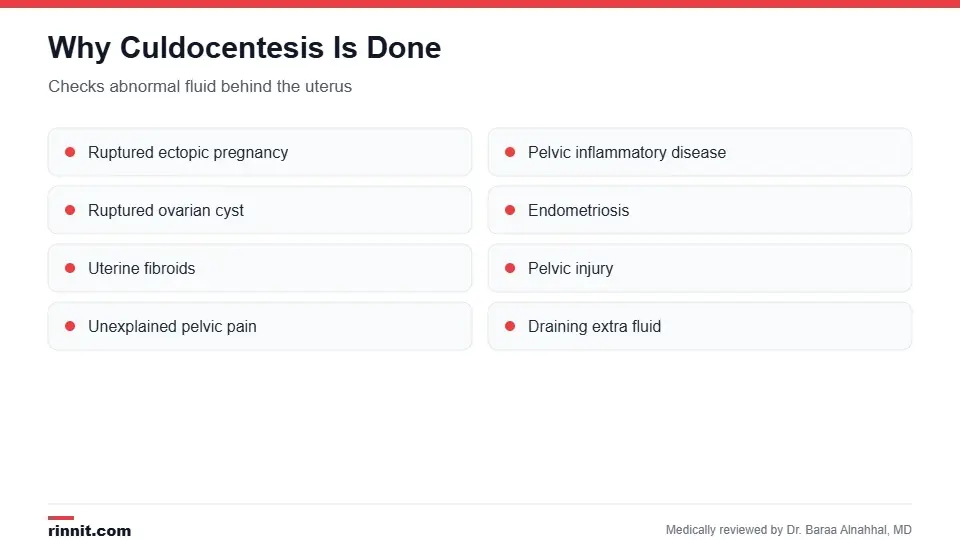
The test helps explain abnormal fluid in the pelvis.
Ectopic pregnancy that may have ruptured.
Endometriosis and uterine fibroids.
Pelvic injury or unexplained pelvic or lower belly pain. Sources: [1]
Culdocentesis vs. transvaginal ultrasound
Feature | Culdocentesis | Transvaginal ultrasound |
How it works | Needle draws fluid out | Sound waves show fluid and organs |
Invasive | Yes | No needle |
Main risks | Puncture of nearby organs, infection | Very low |
Today's role | Rare, when ultrasound isn't available or fluid needs testing | First choice for most cases |
Sources: [1, 2]
What happens during the procedure
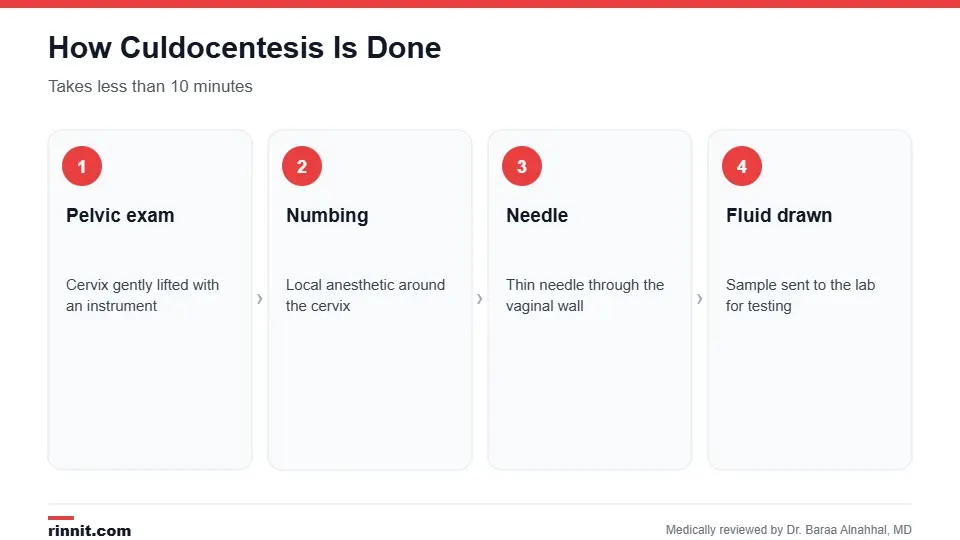
The procedure takes less than 10 minutes.
You lie on your back for a pelvic exam, and an instrument gently lifts the cervix.
The area around the cervix is numbed with local anesthetic.
A thin needle attached to a syringe is passed through the vaginal wall behind the cervix.
Fluid is drawn from the cul-de-sac and sent for testing. Sources: [1]
There's little preparation, but plan for someone to drive you home. Sources: [1]
Risks and recovery
Possible risks include accidental puncture of the uterus or rectum, infection, and puncture of blood vessels, cysts or tumors. Cramping or discomfort usually settles within 24 to 48 hours. Call your provider for heavy bleeding, worsening pain, fever or flu-like symptoms, and get emergency care for severe belly or pelvic pain. Sources: [1]
What the results mean
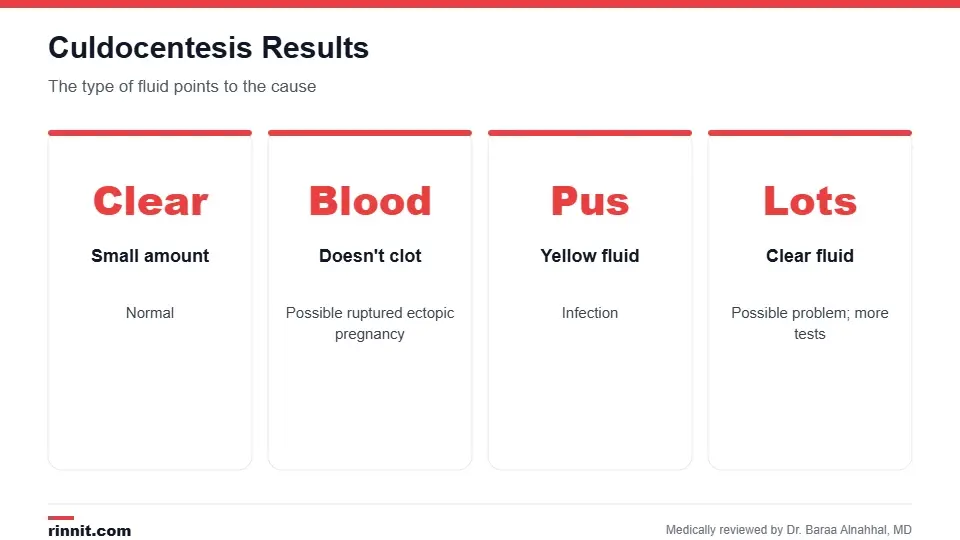
The type of fluid points to the cause.
Fluid found | What it may mean |
Small amount of clear fluid | Normal |
Blood that doesn't clot | Bleeding inside the belly, such as a ruptured ectopic pregnancy |
Yellow, pus-filled fluid | Infection |
Large amount of clear fluid | A possible problem that needs more testing |
Lab results usually come within a week. Depending on the cause, you may need antibiotics, drainage or surgery. Sources: [1]
Conclusion
Culdocentesis is a quick bedside test that checks fluid behind the uterus. It's rarely needed today because ultrasound is safer and more accurate, but it can still help in emergencies or when fluid needs to be tested or drained.
Keep learning: read about ectopic pregnancy and pelvic ultrasound.
Frequently asked questions
What is culdocentesis?
A procedure that removes fluid from the space behind the uterus with a needle through the vagina.
Why is culdocentesis done?
To find the cause of abnormal pelvic fluid, such as bleeding or infection.
Is culdocentesis painful?
Local anesthetic numbs the area, but you may feel pressure and cramping.
How long does it take?
Under 10 minutes.
What does blood in the fluid mean?
Blood that doesn't clot can suggest a ruptured ectopic pregnancy.
What does pus mean?
Yellow, pus-filled fluid suggests an infection.
Is culdocentesis still used?
Rarely. Transvaginal ultrasound has largely replaced it.
What are the risks?
Puncture of nearby organs, bleeding and infection.
How long does cramping last?
Usually 24 to 48 hours.
When will I get results?
Usually within a week.
Related Reading
Ectopic Pregnancy: Symptoms, Causes, and Treatment a main reason for checking pelvic fluid.
Pelvic Inflammatory Disease: Symptoms, Causes & Treatment — A Clear Guide an infection that can cause pus in the pelvis.
Ruptured Ovarian Cyst: Symptoms, Causes, and Emergency Care a cause of fluid or blood in the pelvis.
Transvaginal Ultrasound: Why It's Done, How to Prepare and What to Expect the safer test that has largely replaced culdocentesis.
Pelvic Ultrasound: Types, Preparation, What It Shows and Results imaging of the pelvic organs.
References
Cleveland Clinic. Culdocentesis: Purpose, Procedure, Risks & Results. Cleveland Clinic. Last updated July 19, 2026. https://my.clevelandclinic.org/health/diagnostics/24080-culdocentesis
Chen PC, Sickler GK, Dubinsky TJ, et al. Sonographic detection of echogenic fluid and correlation with culdocentesis in the evaluation of ectopic pregnancy. American Journal of Roentgenology. 1998;170(5):1299-1302. PMID 9574606. https://doi.org/10.2214/ajr.170.5.9574606
Lincoln SR, Opsahl MS, Blauer KL, et al. Aggressive outpatient treatment of ovarian hyperstimulation syndrome with ascites using transvaginal culdocentesis and intravenous albumin minimizes hospitalization. Journal of Assisted Reproduction and Genetics. 2002;19(4):159-163. PMID 12036082. https://doi.org/10.1023/a:1014828027282
Medical disclaimer
This article is for general education only and does not replace advice from a qualified healthcare professional. Talk to your doctor about your own diagnosis and treatment, and seek emergency care right away for severe or sudden symptoms.



Comments