Ruptured Ovarian Cyst: Symptoms, Causes, and Emergency Care

Updated: 3 days ago
Medically reviewed by Dr. Baraa Alnahhal, MD · Last reviewed: October 2026
Quick Answer: What is a ruptured ovarian cyst?
A ruptured ovarian cyst is a fluid-filled sac on the ovary that breaks open. It is often painless, but a symptomatic rupture causes sudden, sharp pelvic pain, nausea and bloating. Severe cases with heavy internal bleeding or infection are medical emergencies. A pelvic ultrasound confirms it, and management ranges from rest at home to surgery. [3]

What the research says
Most ruptures with internal bleeding can be managed without surgery. In a study of 78 healthy women with a ruptured cyst and blood in the pelvis (hemoperitoneum), 80.8% were managed conservatively. The surgery rate was 6.5%, 15.8%, and 77.8% in women with neither, one, or both of a low diastolic blood pressure (70 mmHg or lower) and a large pelvic fluid collection on CT (5.6 cm or more) (Kim et al., PLoS One, 2014). [4]
About 1 in 6 women with significant bleeding needs an intervention. Among 103 premenopausal women with hemoperitoneum from a ruptured cyst on CT, 16% required surgery or an interventional radiology procedure, and the amount and spread of blood on CT were linked to that need (Godbe et al., Emerg Radiol, 2022). [5]
Birth control pills do not make functional cysts go away faster. A Cochrane review of 8 randomized trials (686 women) found that combined oral contraceptives did not hasten cyst resolution. Most cysts resolved on their own within a few cycles, and watchful waiting for two or three cycles is appropriate (Grimes et al., Cochrane Database Syst Rev, 2014). [6]
What happens when an ovarian cyst ruptures?
An ovarian cyst is a small sac on the ovary filled with fluid or semisolid material. It is a normal physiological process for a functional cyst to break open during each ovulation cycle to release an egg. Many individuals do not even realize a rupture has occurred because it often happens without symptoms. [3]
However, certain types of cysts are more likely to cause significant symptoms when they burst. Larger cysts generally pose a higher risk of symptomatic rupture. Additionally, dermoid cysts, which contain different types of tissue, can cause intense irritation to the lining of nearby organs if their contents spill into the abdominal cavity. [1] [3]
What are the symptoms of a ruptured ovarian cyst?
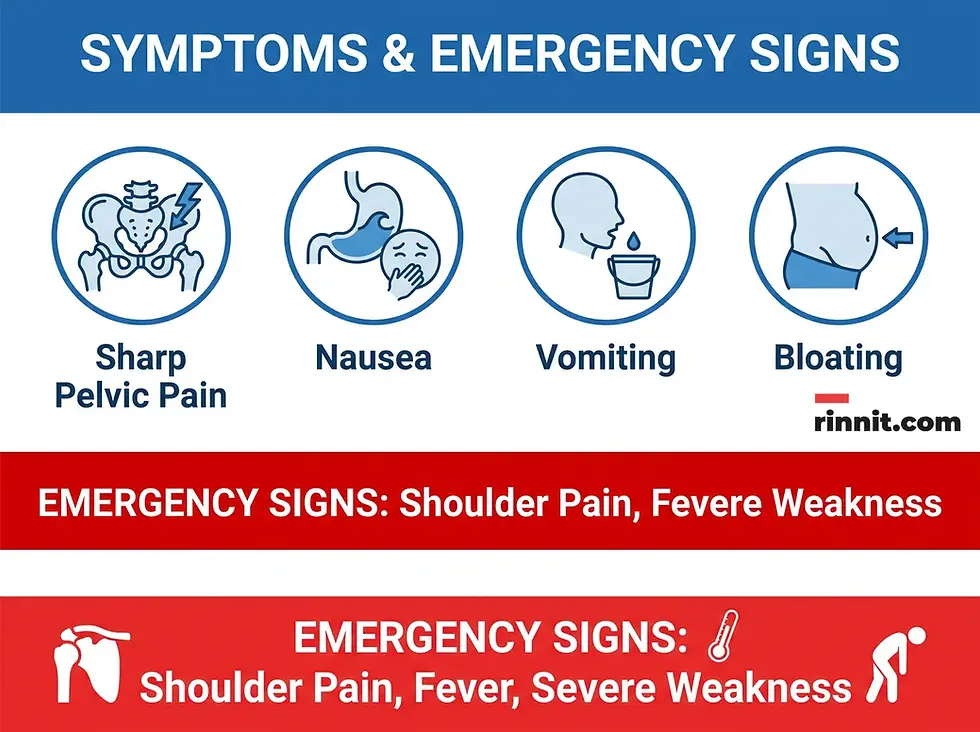
The hallmark of a symptomatic ovarian cyst rupture is the sudden onset of intense pain. This pain is often described as sharp and focused on one side of the lower abdomen. Because there are typically no warning signs, the pain can feel as though it appeared out of nowhere, often leaving the individual unable to move or function normally. [3]
Common Symptom Indicators
Symptom Type | Description |
|---|---|
Pain Pattern | Sudden, sharp, and intense pain in the lower abdomen, usually localized to one side. |
Physical Signs | Bloating or a feeling of fullness, which may indicate fluid or blood pooling in the abdomen. |
Systemic Signs | Nausea, vomiting, and fever (which may signal an underlying infection). |
Activity Triggers | Pain may increase significantly when sitting or following strenuous physical activity or sex. |
What causes a ruptured ovarian cyst, and who is at risk?
Many ovarian cysts burst for no apparent reason, but strenuous exercise or sexual intercourse can trigger a rupture, and the cyst's own development is the underlying cause. The physical stress of strenuous exercise or sexual intercourse is often a factor, similar to the pressure applied to an overfilled balloon. However, the underlying cause is typically the development of the cyst itself, which may be functional (related to the menstrual cycle) or atypical. [1] [3]
Potential Complications
A ruptured cyst is not always a simple event. In some instances, it can lead to serious medical complications that require immediate intervention:
Hemorrhage: Excessive internal bleeding into the abdominal cavity (hemoperitoneum). [3]
Infection: The release of cyst contents can trigger an inflammatory response or lead to a bacterial infection. [3]
Ovarian torsion: A large cyst can cause the ovary to twist on its blood supply, which is a surgical emergency. Learn more in our guide to ovarian torsion. [1] [3]
How is a ruptured ovarian cyst diagnosed?
Healthcare providers diagnose a ruptured ovarian cyst through a combination of medical history, physical examination, and diagnostic imaging. During the exam, a provider will assess the lower abdomen for tenderness and signs of fluid buildup. [3]
The primary tool for confirming a diagnosis is a pelvic ultrasound. This imaging test allows providers to visualize the ovaries and identify any pools of fluid or blood in the pelvis. Blood tests may also be ordered to check for signs of anemia (indicating blood loss), infection, or to rule out other conditions like appendicitis or ectopic pregnancy. [3]
How is a ruptured ovarian cyst treated and managed?
Most ruptured ovarian cysts are "physiologic" and will heal on their own as the body reabsorbs the released fluid. For these cases, management focuses on comfort and monitoring. [3]
Management Roadmap
Category | Action Plan |
|---|---|
Home Care | Rest and the use of over-the-counter pain relievers are typically sufficient for simple ruptures. |
Observation | Monitoring for new symptoms such as dizziness, weakness, or worsening pain. |
Medical Intervention | Antibiotics may be prescribed if there are signs of an infection following the rupture. |
Surgical Action | Minimally invasive laparoscopy is used to remove the cyst and clear internal bleeding or infected material. |

What is recovery like after a ruptured ovarian cyst?
The recovery time for a ruptured ovarian cyst depends on the type of cyst involved. For standard functional cysts, the body usually reabsorbs the fluid within 24 hours, though some discomfort may linger. Atypical cysts may take up to two weeks for full recovery. If an individual experiences frequent cyst ruptures, a gynecologist may investigate underlying hormonal or structural causes to prevent future occurrences. [3]
Conclusion
A ruptured ovarian cyst can be a frightening and painful experience, but most cases resolve without long-term complications. The key to a safe recovery is recognizing when symptoms move beyond simple discomfort into the realm of a medical emergency. By listening to your body and seeking prompt evaluation for intense pain, you can ensure that any complications are managed quickly and effectively.
What are the next steps if you think an ovarian cyst has ruptured?
If you have a history of ovarian cysts and experience a sudden change in pelvic pain, schedule an evaluation with your healthcare provider to discuss your management options. Go to the emergency room right away for sudden, severe pelvic pain, or pain with fever, vomiting, dizziness, fainting, fast breathing or cold, clammy skin. [1] [2]
Trusted resources: Office on Women's Health (WomensHealth.gov), Mayo Clinic.
Related reading on Rinnit: Ovarian Torsion, Ovarian Dermoid Cyst, Pelvic Inflammatory Disease, Chronic Pelvic Pain, Appendicolith.
Frequently Asked Questions
Is a ruptured ovarian cyst dangerous?
Most ruptures are not dangerous and heal on their own. However, they can be life-threatening if they cause heavy internal bleeding or a severe infection. [3]
How long does the pain last?
Pain from a simple rupture often improves within 24 hours, but for more complex cysts, soreness can last for several days or even two weeks. [3]
Can a ruptured cyst cause a fever?
Yes, a fever following a rupture may indicate that an infection has developed in the abdominal cavity. [3]
Can I treat a ruptured cyst at home?
If the pain is manageable with over-the-counter medication and you have no emergency signs, home rest is often the standard treatment. [3]
How is a rupture diagnosed?
A pelvic ultrasound is the most common and effective way to confirm that a cyst has broken open. [3]
Will I need surgery?
Surgery is only required if there is significant internal bleeding, a severe infection, or if the cyst caused the ovary to twist. [3]
Can a ruptured cyst affect fertility?
A simple functional cyst rupture does not typically affect future fertility. [2]
What does the pain feel like?
The pain is usually a sudden, sharp, and excruciating pain localized to one side of the lower abdomen. [3]
Why does a ruptured cyst cause shoulder pain?
Shoulder pain can occur if significant internal bleeding irritates the diaphragm, which shares nerve pathways with the shoulder. [3]
Can a ruptured cyst be mistaken for appendicitis?
Yes, because both conditions cause intense lower abdominal pain, doctors use imaging and blood tests to tell them apart. [3]
How does the body handle the fluid from a burst cyst?
The lining of the abdominal cavity naturally reabsorbs the fluid or blood over time. [3]
Can birth control prevent ruptures?
Hormonal birth control can prevent the formation of new functional cysts, thereby reducing the risk of future ruptures. [2]
Should I see a doctor even if the pain goes away?
If the pain was intense, it is a good idea to get a check-up to ensure there is no lingering fluid or risk of infection.
Related Reading
Culdocentesis: Why It's Done, Procedure, Risks and Results explains the needle test that checks fluid behind the uterus.
References
Mayo Clinic Staff. Ovarian cysts. Mayo Clinic. December 23, 2025. https://www.mayoclinic.org/diseases-conditions/ovarian-cysts/symptoms-causes/syc-20353405
Office on Women's Health. Ovarian cysts. WomensHealth.gov. February 22, 2021. https://www.womenshealth.gov/a-z-topics/ovarian-cysts
Cleveland Clinic. Ruptured Ovarian Cyst. Cleveland Clinic. May 4, 2026. https://my.clevelandclinic.org/health/diseases/ovarian-cyst-rupture
Kim JH, Lee SM, Lee JH, et al. Successful conservative management of ruptured ovarian cysts with hemoperitoneum in healthy women. PLoS One. 2014;9(3):e91171. PMID: 24608424. https://doi.org/10.1371/journal.pone.0091171
Godbe J, Horowitz JM, Nguyen E, et al. Association of CT findings in patients with hemoperitoneum due to ruptured ovarian cysts with subsequent intervention. Emerg Radiol. 2022;29(5):833-843. PMID: 35639185. https://doi.org/10.1007/s10140-022-02062-0
Grimes DA, Jones LB, Lopez LM, Schulz KF. Oral contraceptives for functional ovarian cysts. Cochrane Database Syst Rev. 2014;(4):CD006134. PMID: 24782304. https://doi.org/10.1002/14651858.CD006134.pub5
Medical Disclaimer
The information provided in this article is for educational purposes only and should not be used as a substitute for professional medical advice, diagnosis, or treatment. Always seek the advice of your physician or other qualified health provider with any questions you may have regarding a medical condition.



Comments