Ovarian Torsion: Symptoms, Causes, Diagnosis, and Emergency Treatment

Updated: 1 hour ago
Medically reviewed by Dr. Baraa Alnahhal, MD · Last reviewed: September 2026
TL;DR: Ovarian torsion is a critical medical emergency where an ovary twists on the ligaments that support it, cutting off its blood supply. Most common in women of reproductive age, it is often triggered by large ovarian cysts. Symptoms include sudden, severe pelvic pain, nausea, and vomiting. Without immediate surgical intervention to untwist the ovary, the tissue can die, leading to the loss of the ovary and potential complications like peritonitis.
Quick answer: Ovarian torsion occurs when an ovary (and sometimes the adjacent fallopian tube, called adnexal torsion) twists around the tissues and ligaments that hold it in place. This twisting restricts or completely blocks blood flow to the ovary. As an oval-shaped gland responsible for hormone production and egg release, the ovary requires a constant blood supply to remain viable.
The primary cause is typically a shift in weight, often due to a large ovarian cyst or a solid mass, which makes the ovary unstable and prone to twisting. It is the fifth most common gynecological surgical emergency, accounting for approximately 3% of emergency surgeries involving female reproductive anatomy. Diagnosis is usually suspected via transvaginal ultrasound and confirmed through laparoscopic surgery. The goal of treatment is to untwist the ovary (detorsion) as quickly as possible to restore blood flow and save the organ.
Medical emergency: Ovarian torsion is a time-sensitive emergency. If you experience sudden, severe, and persistent pain in your lower abdomen, especially if accompanied by nausea or vomiting, seek emergency medical care at the nearest hospital immediately.
Symptoms of Ovarian Torsion
The hallmark of ovarian torsion is intense, localized pain. Because these symptoms can overlap with other conditions like appendicitis or kidney stones, rapid evaluation is essential. If you are unsure whether your pelvic pain is a routine problem, see our guide to chronic pelvic pain.
Key Symptoms
Sudden, severe pain: Typically sharp and stabbing, located in the lower abdomen or pelvic region.
Nausea and vomiting: A common systemic response to the intense pain and twisting.
Localized or radiating pain: Pain may stay on one side (often the right) or spread to the back, flanks, and thighs.
Intermittent pain: In some cases, the ovary may twist and partially untwist, causing pain that comes and goes.
Signs of Tissue Death (Necrosis)
If blood flow is blocked for an extended period, the tissue may begin to die, leading to:
Fever and chills.
Abnormal vaginal bleeding or discharge.
Increased abdominal tenderness.
Causes and Risk Factors
Ovarian torsion is rarely a spontaneous event; it usually occurs when the physical balance of the ovary is disrupted.
Common Causes
Ovarian cysts: Cysts larger than 5 centimeters (about 2 inches) are the most common cause, as they add weight and instability to the ovary.
Ovarian tumors: Both benign and, less commonly, cancerous masses can trigger torsion.
Ligament length: Some individuals are born with longer-than-average ovarian ligaments, increasing the range of motion for twisting.
High-Risk Groups
Reproductive age: Most common between ages 29 and 34 due to active hormone cycles and cyst formation.
Pregnancy: Hormones relax ligaments, and corpus luteum cysts are common during the first trimester.
Fertility treatments: Medications that stimulate ovulation can lead to multiple or large follicles and cysts.

Diagnosis and Testing
Because torsion is a surgical emergency, doctors prioritize rapid imaging and physical assessment.
Transvaginal ultrasound: The primary imaging tool used to check for a mass and assess blood flow (Doppler ultrasound).
Physical examination: Checking for pelvic tenderness and palpable masses.
Laparoscopy: The "gold standard" for diagnosis. A surgeon inserts a small camera to view the ovary directly. If torsion is found, it is treated immediately.

Treatment and Recovery
The only way to treat ovarian torsion is through surgery. Modern techniques prioritize saving the ovary whenever possible.
Surgical Procedures
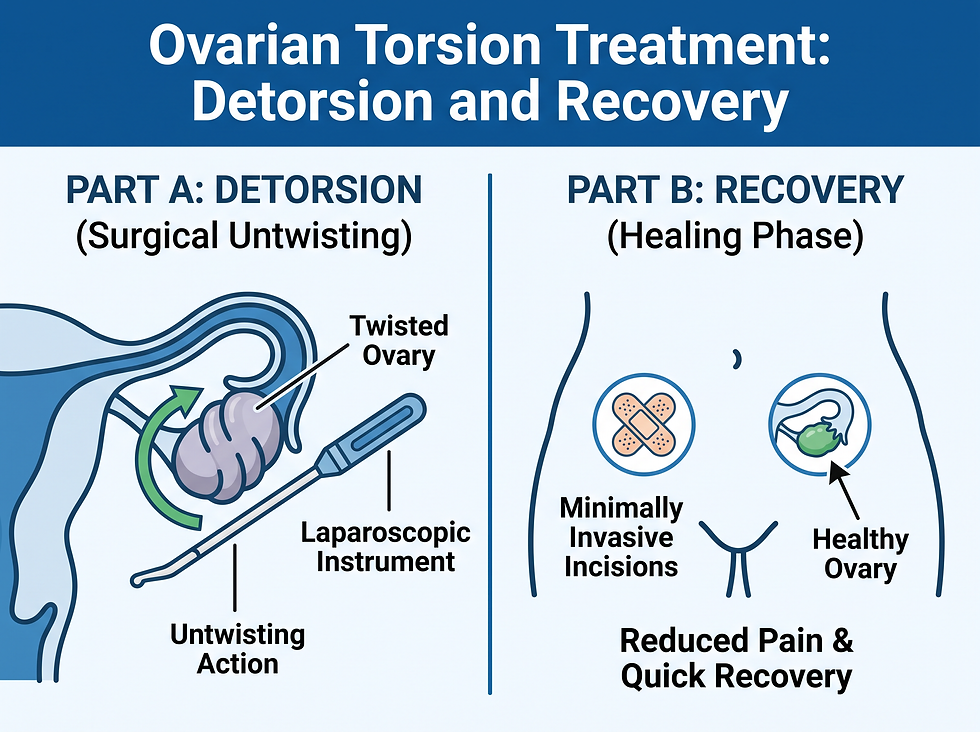
Laparoscopy (keyhole surgery): The most common approach. Small incisions are made, and the surgeon untwists the ovary (detorsion).
Ovarian cystectomy: If a cyst caused the torsion, it is removed during the same procedure to prevent recurrence.
Oophorectomy: Removal of the entire ovary. This is only done if the tissue has already died (necrosis) or if a cancerous growth is suspected.
Oophoropexy: A preventive procedure where the ovary is surgically fixed to the pelvic wall to prevent it from twisting again.
Recovery Outlook
Success rate: Surgery to save the ovary is successful in approximately 90% of cases if performed early.
Fertility: Even if one ovary must be removed, the remaining healthy ovary can typically support pregnancy and hormone production.
Conclusion
Ovarian torsion is a serious condition that demands immediate attention. While the pain is often unmistakable, the intermittent nature of some cases can be misleading. By seeking emergency care at the first sign of severe pelvic pain, most individuals can successfully have their ovary untwisted and preserved.
Call to Action
If you have a known ovarian cyst and experience a sudden onset of pelvic pain, do not wait for the pain to pass. Go to the nearest emergency room immediately for a professional evaluation.
Frequently Asked Questions
Is ovarian torsion always caused by a cyst?
No, but cysts or masses are present in up to 85% of cases. In rare instances, it can occur in healthy ovaries, particularly in children with long ligaments.
Can ovarian torsion untwist itself?
Yes, this is known as intermittent torsion. However, it is highly likely to twist again, so medical evaluation and surgical stabilization are still necessary.
Does ovarian torsion affect fertility?
If the ovary is saved, there is usually no impact. If one ovary is removed, the other can still release eggs, though some studies suggest a slight decrease in overall pregnancy chances.
Is the right ovary more likely to twist than the left?
Yes. Torsion is more common on the right side, possibly because the space on the left is more occupied by the sigmoid colon, limiting the ovary's movement.
Can children or babies get ovarian torsion?
Yes. While most common in reproductive-aged adults, it can occur in infants, children, and even fetuses.
How long can an ovary survive without blood flow?
There is no exact timeline, but the risk of permanent tissue death increases significantly after several hours. Immediate surgery is the best way to ensure survival.
Can exercise or sex trigger torsion?
Yes, sudden physical movements can sometimes trigger the final twist if an ovary is already unstable due to a cyst.
What is the difference between ovarian torsion and adnexal torsion?
Ovarian torsion refers only to the ovary, while adnexal torsion means both the ovary and the fallopian tube have twisted together.
Can I get ovarian torsion if I have had a hysterectomy?
Yes, as long as your ovaries were not removed during the hysterectomy, they can still twist on their supporting ligaments.
Does birth control prevent ovarian torsion?
Hormonal birth control can prevent the formation of new functional cysts, which indirectly reduces the risk of torsion.
What is peritonitis?
It is a serious infection of the abdominal lining that can occur if a twisted ovary dies and the infection spreads.
Will I need a hospital stay after surgery?
For laparoscopic surgery, many patients go home the same day. Open surgery (laparotomy) usually requires an overnight stay.
Can a cancerous tumor cause torsion?
Yes, though it is less common than benign cysts. If cancer is suspected, the surgeon will likely remove the entire ovary.
What does "detorsion" mean?
It is the surgical act of untwisting the ovary to restore its normal position and blood flow.
Can ovarian torsion be diagnosed with a blood test?
No. While blood tests can check for signs of infection or pregnancy, they cannot confirm if an ovary is twisted. Imaging and surgery are required.
Helpful Resources
Medical Disclaimer
This content is for informational purposes only and does not constitute medical advice. Always seek the advice of your physician or other qualified health provider with any questions you may have regarding a medical condition. Never disregard professional medical advice or delay seeking it because of something you have read here. If you think you may have a medical emergency, call your doctor or 911 immediately.
Source date: July 23, 2024.
Comments