Appendicolith: The Small Appendix Stone That Can Trigger Appendicitis — Symptoms, Causes, and When It Needs Treatment

Updated: 2 days ago
Medically reviewed by Dr. Baraa Alnahhal, MD · Last reviewed: September 2026
TL;DR: An appendicolith is a hard lump formed from stool (feces) and minerals clumping together inside the appendix. It occurs in about 3% of the general population, is usually less than 1 centimeter wide, and most often causes no symptoms at all — it is typically discovered by accident on a CT scan or ultrasound. While not dangerous on its own, an appendicolith can block the opening of the appendix and trigger appendicitis. If appendicitis develops, surgery (appendectomy) plus antibiotics is the standard treatment, and full recovery is the expected outcome.
Quick Answer
An appendicolith is a hard lump of feces and minerals that forms inside the appendix and is present in about 3% of the general population.
Most appendicoliths are under 1 centimeter in size — from grain-of-sand tiny to pea- or marble-sized — and cause no symptoms.
The main danger is blockage: an appendicolith larger than 10 millimeters carries a higher chance of blocking the appendix and causing appendicitis.
Without appendicitis, treatment is usually watchful waiting — most stones pass through the colon on their own. With appendicitis, an appendectomy (often laparoscopic) plus antibiotics is the standard, with recovery in 1–3 weeks (up to 6 weeks after open surgery).
What Is an Appendicolith?
An appendicolith is a hard lump made when stool (feces) and minerals clump together inside the appendix — the small tube-shaped pouch attached to the large intestine. Think of it as a pebble that forms inside a narrow side pocket of your digestive tract.
These stones are usually less than 1 centimeter in diameter and typically cause no symptoms. Most people never know they have one. Providers often discover appendicoliths by accident during a CT scan or ultrasound performed for another reason, such as checking for injuries after an accident.

Is an appendicolith an emergency?
Not usually. An appendicolith by itself is not an emergency. However, if it blocks the opening of the appendix, it can cause appendicitis — severe inflammation that makes the appendix swell and can lead to intense stomach pain.
If appendicitis is left untreated, the swollen appendix can burst. A ruptured appendix can cause peritonitis (infection of the abdominal lining), abscesses, and septic shock, which can be fatal. That is why sudden severe abdominal pain always deserves immediate medical attention.
What Are the Symptoms of an Appendicolith?
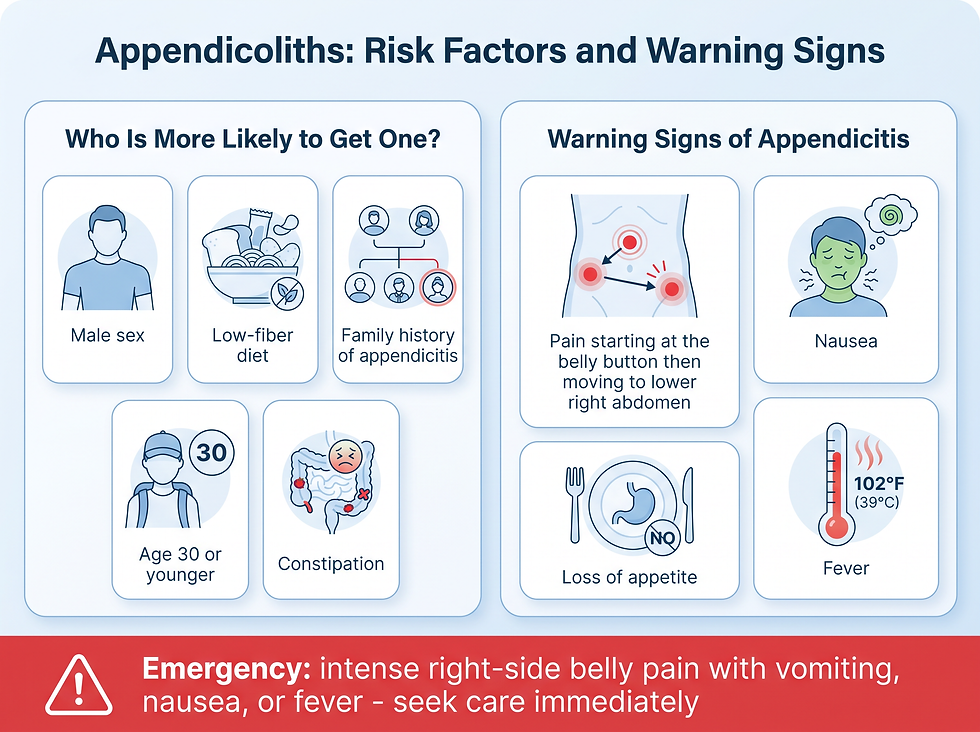
Most people with an appendicolith have no symptoms at all. When problems do occur, the symptoms are actually the symptoms of the appendicitis the stone triggers. These include:
Symptom | What it looks like | Why it matters |
Stomach pain | Often starts around the belly button and moves to the lower right side | The classic pattern that signals appendicitis |
Nausea | Feeling sick to the stomach, sometimes with vomiting | A common appendicitis warning sign |
Loss of appetite | No desire to eat | Frequently accompanies appendicitis |
Fever | Elevated body temperature | Suggests inflammation or infection |
Appendicoliths themselves are silent. It is the blockage — and the inflammation that follows — that produces pain, nausea, lost appetite, and fever.
What Causes Appendicoliths?
Healthcare providers are not certain why appendicoliths develop. One leading theory is that they form when you swallow hard particles that pass through the intestines without being digested, eventually lodging and hardening inside the appendix.
While the exact cause is unknown, several factors are associated with a higher chance of developing an appendicolith:
Risk factor | How it relates |
Being male | Appendicoliths are more common in males |
Low-fiber diet | Eating low-fiber meals is a recognized risk factor |
Family history | A family history of appendicitis increases risk |
Age 30 or younger | Appendicoliths are more common in younger people |
Constipation | Constipation issues raise the likelihood |
How common are appendicoliths?
Appendicoliths are very common, occurring in about 3% of the general population. Because they usually cause no symptoms (asymptomatic), most people who have one never find out.
How Are Appendicoliths Diagnosed?
Providers usually find appendicoliths during imaging scans done for other reasons. For example, a provider might order a CT scan or abdominal ultrasound after an accident to check for internal injuries — and discover an appendicolith along the way.
Sometimes the stone is found during imaging specifically done to diagnose appendicitis. If a provider finds an appendicolith but you show no signs of appendicitis, they will discuss whether you need treatment.
Diagnostic tool | What it shows |
CT scan | The gold-standard imaging for spotting an appendicolith and checking for appendicitis |
Abdominal ultrasound | A radiation-free option that can reveal the stone |
Complete blood count (CBC) | Shows white blood cell count; an increase signals infection |
C-reactive protein (CRP) | A blood marker of inflammation; usually elevated in appendicitis |
Lab work itself does not diagnose an appendicolith — imaging does. But blood tests help the provider understand your overall health and build a treatment plan by confirming whether inflammation or infection is present.
How do I know if my appendicolith will lead to appendicitis?
The answer depends on three factors:
Factor | What it means |
Symptoms | Pain starting at the navel and moving to the lower right side, plus nausea and vomiting, suggests appendicitis is already happening — see a provider right away |
Stone size on imaging | An appendicolith larger than 10 millimeters has a bigger chance of causing blockage and appendicitis |
Medical history | A personal or family history of stomach problems or appendicitis increases the risk |
If you know you have an appendicolith, your provider may want to see you regularly to monitor it and help decide next steps based on your overall health, the stone's size, and its location.
How Is an Appendicolith Treated?
Treatment depends on the size of the appendicolith, how much pain it causes, and whether it has led to appendicitis. Some providers recommend removing all appendicoliths regardless of size because they raise the odds of appendicitis — and even though appendicitis has several causes, an appendicolith can make it worse.
What happens if I don't have appendicitis?
If you have an appendicolith but no appendicitis, treatment is generally watchful waiting. Many people simply pass the appendicolith through their colon without any medical intervention.
What happens if appendicitis develops?
When appendicitis develops, the standard treatment is removal of the appendix (appendectomy) through either open surgery or laparoscopic (minimally invasive) surgery. The faster the surgery is performed, the better — prompt removal helps avoid serious infections that can lead to septic shock.
If the appendix is removed, antibiotics are also given to prevent further infection.
Scenario | Treatment | Notes |
Appendicolith without appendicitis | Watchful waiting | Most stones pass on their own through the colon |
Appendicolith causing pain or high risk | Possible removal | Some providers remove all appendicoliths because of appendicitis risk |
Appendicitis developed | Appendectomy + antibiotics | Laparoscopic or open surgery; faster is better |

What Are the Complications of Treatment?
Every treatment carries some risk. Your provider will discuss the specific risks that apply to your health condition and treatment type.
Treatment | Possible complications |
High-dose antibiotics | Rash, dizziness, nausea, diarrhea, yeast infections — common but usually not severe |
Open surgery | Pain, anesthesia side effects (sore throat, nausea, vomiting, allergic reaction), bleeding, infection, wound re-opening, scarring, fever |
Laparoscopic surgery | Injuries from surgical instruments, trapped gas in the stomach, anesthesia side effects, bleeding, infection |
Laparoscopic surgery generally has fewer complications than open surgery and a quicker recovery time, but all surgery carries some risk. During a laparoscopic procedure, the surgeon pumps gas into the belly to create room for the instruments — that gas can become trapped and cause discomfort.
How long does recovery take?
Recovery length depends on your overall health, how severe your illness was, and the type of treatment. After laparoscopic removal, recovery takes about one to three weeks. After open surgery, it may take up to six weeks.
What Is the Outlook?
Having an appendicolith is not necessarily dangerous, but it does put you at a higher risk of developing appendicitis. Removing the appendicolith greatly reduces that risk.
If you develop appendicitis, you will likely need surgery to remove your appendix. The good news: you can expect to make a full recovery.
Situation | Expected outcome |
Appendicolith with no appendicitis | Often no treatment needed; monitor and let it pass |
Appendicolith removed | Greatly reduced appendicitis risk |
Appendicitis treated with surgery | Full recovery expected |
Appendicitis left untreated | Risk of rupture, peritonitis, abscesses, and septic shock |
Can you prevent an appendicolith?
You cannot really prevent appendicoliths or appendicitis. But you can support bowel health, which may lower your risk of developing these conditions:
Bowel-health step | How it helps |
Eat more high-fiber foods | Keeps digestion and stool movement healthy |
Drink enough water | Prevents constipation and keeps things moving |
When should I go to the ER?
Call your healthcare provider immediately if you have intense stomach pain that starts around your belly button and spreads down the right side of your stomach. Other appendicitis signs that call for emergency care include vomiting, nausea, and fever.
Conclusion: Stay Informed, Act Fast
An appendicolith is a small, usually silent stone in the appendix — common (about 3% of people have one), mostly harmless on its own, and usually found only by accident on a scan. The real concern is what it can trigger: appendicitis. Pain that begins near your belly button and moves to the lower right side, combined with nausea, lost appetite, or fever, is your body's alarm.
Call to action: If you have been told you have an appendicolith, ask your provider about your personal appendicitis risk and whether monitoring is right for you. And if sudden right-sided abdominal pain strikes, do not wait — seek emergency care immediately. Quick treatment is the difference between a simple recovery and a life-threatening complication.
Frequently Asked Questions (FAQ)
Can you have an appendicolith without appendicitis?
Yes. Many people have an appendicolith and never know it because they feel completely well. The stone only becomes a problem if it blocks the appendix opening.
How big is an appendicolith?
They range from as tiny as a grain of sand to as large as a pea or marble, and are usually under 1 centimeter in diameter. Stones larger than 10 millimeters carry a higher chance of causing blockage and appendicitis.
Are appendicoliths dangerous?
Not by themselves. The danger comes if the stone blocks the appendix and causes appendicitis — which, left untreated, can lead to a ruptured appendix, peritonitis, and septic shock.
Do appendicoliths cause pain?
No — appendicoliths are typically painless. Pain occurs when the stone triggers appendicitis, starting around the belly button and moving to the lower right abdomen.
Do all appendicoliths need to be removed?
No. Without appendicitis, treatment is usually watchful waiting, and most people pass the stone through their colon without intervention. Some providers suggest removing all appendicoliths because of the elevated appendicitis risk — discuss your options with your provider.
How is appendicitis from an appendicolith treated?
With an appendectomy — removal of the appendix — by open or laparoscopic surgery, plus antibiotics. The faster the surgery, the better the outcome.
How long is recovery after appendectomy?
About one to three weeks after laparoscopic surgery, and up to six weeks after open surgery. Most people make a full recovery.
Can you prevent appendicoliths?
Not really — there is no proven way to prevent appendicoliths or appendicitis. Eating high-fiber foods and drinking enough water supports bowel health, which may help lower your risk.
Learn More
References
Medical disclaimer: This article is for general educational purposes only and does not constitute medical advice. Always consult a qualified healthcare provider for diagnosis and treatment decisions related to your individual health.
Comments