Appendicitis Test: How Doctors Diagnose Appendicitis With Exams, Labs and Imaging

Updated: 2 days ago
Written and medically reviewed by Dr. Baraa Alnahhal, MD · Last reviewed: November 2026 · How we review
Quick Answer: Is there a test for appendicitis?
An appendicitis test isn't a single test: providers combine a physical exam, blood and urine tests, and imaging to confirm appendicitis. A CT scan is the most accurate, while ultrasound avoids radiation and is used for children and pregnant people. Appendicitis is an emergency, so seek care right away for constant belly pain. [1]
What the research says
A simple clinical score is good at ruling appendicitis out. In a review of 42 studies, an Alvarado score below 5 ruled out appendicitis well (sensitivity 99%), but a score of 7 or more was less reliable for ruling it in (specificity 81%). (Ohle et al., BMC Medicine, 2011) [2]
Bedside ultrasound performs well in children. Across 8 studies and 993 children, point-of-care ultrasound detected appendicitis with a pooled sensitivity of 85.6% and specificity of 90.2%. (Miller et al., Archives of Disease in Childhood, 2026) [3]
Key takeaways
No single test diagnoses appendicitis; providers use several together. [1]
A CT scan is the most accurate way to diagnose appendicitis. [1]
Ultrasound is used instead of CT for infants, children, young adults and during pregnancy. [1]
About a third of people with appendicitis have a normal white blood cell count. [1]
Appendicitis is a medical emergency because the appendix can burst. [1]
What is an appendicitis test?
Healthcare providers use a combination of tests to confirm whether you have appendicitis, an infection or inflammation of the appendix. The goal is a prompt diagnosis so you get the care you need. [1]
The appendix is a 2- to 4-inch, tube-shaped organ attached to the large intestine (colon) in the lower part of your abdomen. If you have appendicitis, you'll most likely have an appendectomy, surgery to remove it. You can live a long, healthy life without your appendix. [1]
What tests are used to diagnose appendicitis?
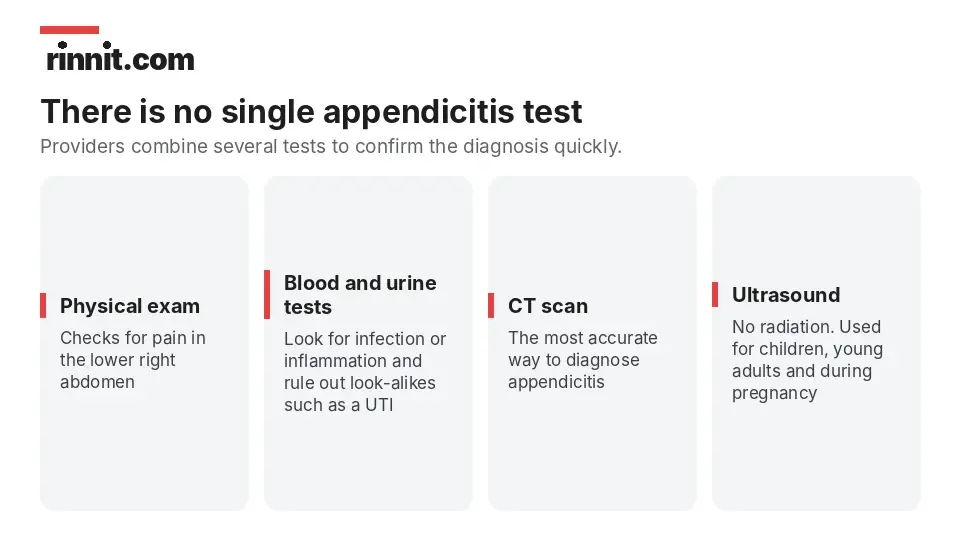
There's no single appendicitis test. Providers combine several.
Test | What it does |
Physical exam | Checks for pain in the lower right side of your abdomen, where the appendix usually sits |
Blood and urine tests | Look for infection or inflammation and rule out look-alike conditions such as a urinary tract infection |
CT scan | Takes images of your abdomen; the most accurate way to diagnose appendicitis |
Ultrasound | Uses sound waves instead of radiation; less accurate than CT but preferred for infants, children, young adults and during pregnancy |
Sources: [1]
If you could be pregnant, you'll have a pregnancy test before a CT scan to avoid unnecessary radiation. A pregnancy test and ultrasound can also rule out an ectopic pregnancy, which can cause pain similar to appendicitis. [1]
What are the early warning signs of appendicitis?
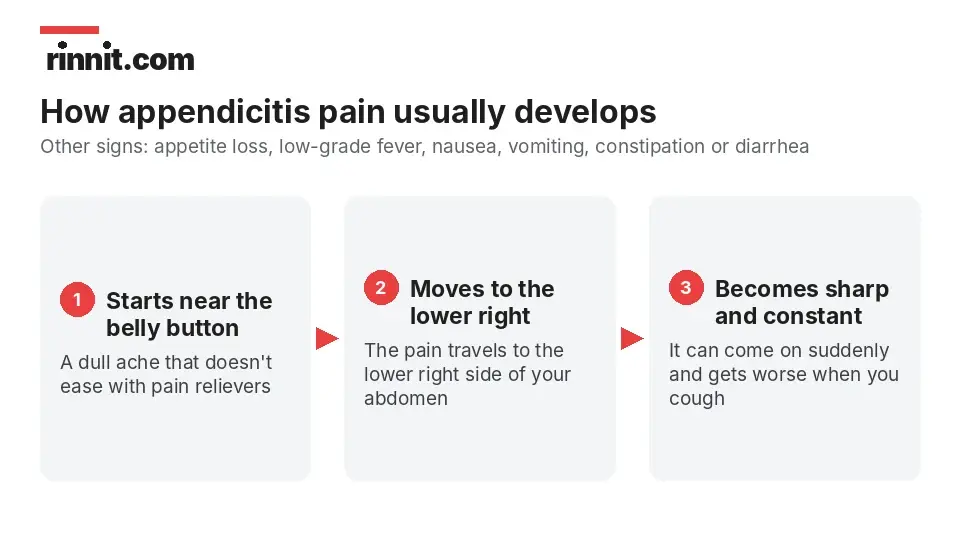
Constant belly pain needs emergency care.
The first sign is usually a dull pain around your belly button. The pain then travels to the lower right side of your abdomen and becomes more intense and sharp. [1]
The pain might also: [1]
Be constant
Come on suddenly
Get worse when you cough
Start as a dull ache that doesn't improve with a pain reliever
Other early warning signs include: [1]
Loss of appetite
Constipation or diarrhea
Not being able to pass gas
Low-grade fever
Nausea and vomiting
An inflamed appendix can burst and spread bacteria through your body, causing a serious, potentially life-threatening infection called peritonitis. Knowing the early signs helps you get diagnosed and treated in time. [1]
Who performs appendicitis tests?
Different providers handle different steps. A doctor may take your history and do a physical exam, a nurse or phlebotomist draws blood, and a radiology technician may perform your ultrasound or CT scan. [1]
Can you check for appendicitis at home?
Pay attention to your symptoms. You can also notice whether you feel sharp belly pain when you lie on your left side and extend your right hip, or when you bend your right hip and knee and rotate the hip. [1]
If the pain persists or gets worse, or you're not sure, contact your provider. Untreated appendicitis can cause severe complications. [1]
How do you prepare for the tests?
You don't need to prepare for a physical exam, blood test or urine test. For an imaging scan, you might need to stop eating or drinking a few hours beforehand. Your provider will give you the details. [1]
What happens during the tests?
Physical exam
Your provider may check whether you feel pain when: [1]
You lie on your left side while they extend your right thigh and press on your right hip
They press on parts of your abdomen and then release the pressure
They press on your right knee as you lift your leg
Blood test
A provider inserts a thin needle into a vein and collects a small amount of blood. [1]
CT scan
You may drink a contrast dye or receive it through a vein, then lie on a table while the scanner takes pictures of your abdomen. [1]
Ultrasound
A provider puts a special gel on your belly and moves a handheld device called a transducer over it to see images. [1]
Exams, blood tests and ultrasound carry little risk, but a CT scan uses a small amount of radiation, and contrast dye can rarely cause an allergic reaction. [1]
What do appendicitis test results mean?

Imaging results are often ready in about one to two hours.
A high white blood cell count means you have an infection, but about a third of people with appendicitis have a normal white blood cell count. High levels of C-reactive protein may mean there's inflammation in your body and possibly appendicitis. [1]
A urine sample with white blood cells and bacteria usually means a urinary tract infection. Certain minerals or blood in the urine can suggest kidney stones instead. [1]
If you have appendicitis, a CT scan or ultrasound may show: [1]
Finding | What it means |
Enlarged appendix | More than 6 millimeters wide |
Thickened appendix wall | More than 2 millimeters thick |
Appendicolith | Calcified deposits inside the appendix |
Peri-appendiceal fat stranding | Inflammation of the fat around the appendix |
Sources: [1]
Timing varies by test. Ultrasound or CT results usually take about an hour or two. [1]
When should you get care?
Appendicitis is an emergency. Get immediate medical attention if you have symptoms, especially constant pain in your abdomen. [1]
Conclusion
Diagnosing appendicitis takes a few tests working together: an exam, blood and urine tests, and usually a CT scan or ultrasound. Because an inflamed appendix can burst, fast testing matters. [1]
If you have belly pain that starts near your navel and moves to the lower right side, don't wait. Seek emergency care.
Keep learning: Read our appendicitis guide or our guide to the CT scan. For more background, see the NIDDK page on diagnosing appendicitis.
FAQ
Is there a single test for appendicitis?
No. Providers use a physical exam, blood and urine tests and imaging together.
What is the most accurate test for appendicitis?
A CT scan of the abdomen.
Why is ultrasound used instead of CT?
It uses no radiation, so it's preferred for infants, children, young adults and pregnant people.
Can blood tests show appendicitis?
They can show infection or inflammation, but about a third of people with appendicitis have a normal white blood cell count.
Why do I need a urine test?
It helps rule out look-alike problems such as a urinary tract infection or kidney stones.
What does appendicitis look like on a CT scan?
An appendix wider than 6 mm, a wall thicker than 2 mm, an appendicolith or inflamed surrounding fat.
How long do appendicitis test results take?
Ultrasound or CT results usually take about one to two hours.
What are the first signs of appendicitis?
Dull pain near the belly button that moves to the lower right abdomen and becomes sharp.
Do I need to prepare for an appendicitis test?
Not for an exam or lab tests, but you may need to stop eating or drinking before imaging.
Is appendicitis an emergency?
Yes. Get immediate care for symptoms, because the appendix can burst.
Related Reading
Appendicitis: Symptoms, Causes, Diagnosis, Treatment & Complete Guide explains the condition these tests are used to find.
Appendicolith: The Small Appendix Stone That Can Trigger Appendicitis covers the calcified deposit that imaging can show.
Peritonitis: Symptoms, Causes & Treatment explains the serious infection that can follow a burst appendix.
CT Scan and Ultrasound explain the two imaging tests used most often.
References
Cleveland Clinic. Appendicitis Test: Types, Purpose, Procedure & Results. Cleveland Clinic. Last updated April 13, 2022. https://my.clevelandclinic.org/health/diagnostics/22801-appendicitis-test
Ohle R, O'Reilly F, O'Brien KK, et al. The Alvarado score for predicting acute appendicitis: a systematic review. BMC Med. 2011;9:139. PMID 22204638. https://doi.org/10.1186/1741-7015-9-139
Miller B, McCreary D, Rees J. How accurate is point-of-care ultrasound for detecting paediatric appendicitis? A systematic review and meta-analysis. Arch Dis Child. 2026;111(5):401-408. PMID 41106830. https://doi.org/10.1136/archdischild-2025-328953
Medical disclaimer
This article is for general education only and does not replace advice from a qualified healthcare professional. Talk to your doctor about your own diagnosis and treatment, and seek emergency care right away for severe or sudden symptoms.



Comments