FISH Test: How Fluorescence In Situ Hybridization Finds Gene Changes

Updated: 2 days ago
Written and medically reviewed by Dr. Baraa Alnahhal, MD · Last reviewed: November 2026 · How we review
Quick Answer
A FISH test (fluorescence in situ hybridization) is a lab technique that uses glowing DNA probes to find gene and chromosome changes in cells. It's widely used in cancer care, for example to check HER2 in breast cancer and to diagnose leukemias and lymphomas, and to find chromosome conditions before birth. Results usually take one to four weeks.
What the research says
FISH helps resolve unclear HER2 results: among 273 breast cancers with an equivocal (2+) HER2 staining result, FISH found HER2 amplification in about 12%, which can identify people likely to benefit from HER2-targeted treatment (Taylor VJ et al., Virchows Arch, 2021) [2]
Urine FISH can detect bladder cancer: a meta-analysis of 14 studies with 2,477 tests found the urine FISH test detected bladder and urinary tract cancers with 72% sensitivity, compared with 42% for urine cytology, though cytology was more specific (Hajdinjak T, Urol Oncol, 2008) [3]
Key takeaways
Uses glowing DNA probes to find gene and chromosome changes.
Detects extra copies, rearrangements and deletions.
Key in cancer care, such as HER2 and lung cancer gene changes.
Also used for prenatal, IVF embryo and blood-cancer testing.
Results usually take one to four weeks.
How does FISH work?

FISH lights up specific genes.
A sample is taken, such as blood, a tumor or bone marrow biopsy, amniotic fluid or urine.
Probes, short DNA sequences carrying a fluorescent label, are designed to match a specific gene.
The DNA in the probe and the sample is separated, and the probe binds (hybridizes) to its match.
A pathologist counts and maps the glowing spots under a fluorescence microscope and writes a pathology report. Sources: [1]
What changes can FISH find?

Each glowing pattern means something different.
Change | What it means | Example |
Amplification | Too many copies of a gene | HER2 in breast cancer |
Rearrangement (translocation) | Part of a gene or chromosome has moved | ALK, ROS1 or RET in lung cancer |
Deletion | Genetic material is missing | Some chromosome conditions |
FISH can also confirm findings from a karyotype test. Sources: [1]
What is it used for?
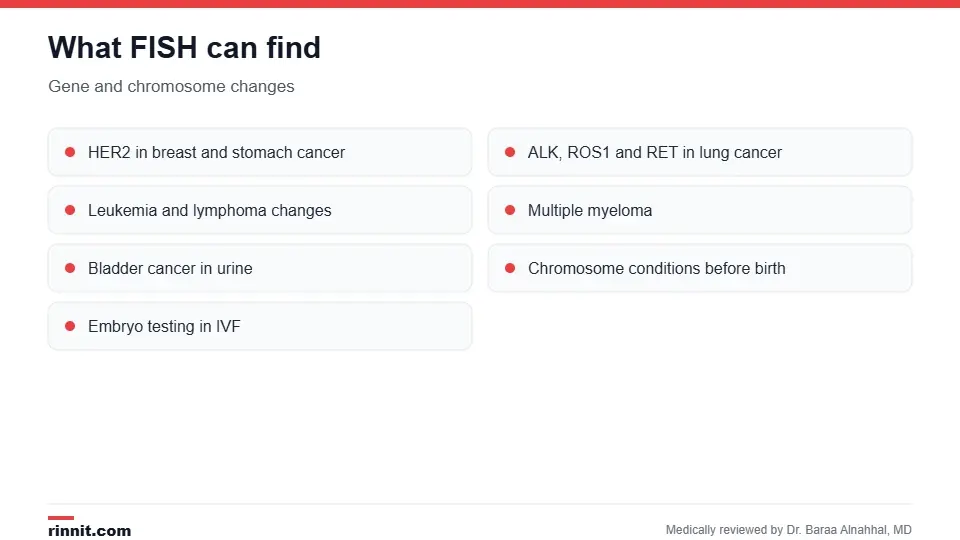
FISH guides diagnosis and targeted treatment.
Cancer gene changes: HER2 in breast and stomach cancer; MET in lung and stomach cancer; MYCN in neuroblastoma; ALK, ROS1 and RET in non-small cell lung cancer.
Blood and other cancers: lymphoma, acute myeloid leukemia, chronic myeloid leukemia, multiple myeloma, glioma, mesothelioma and bladder cancer.
Before birth: chromosome conditions found through amniocentesis.
IVF: embryo testing during preimplantation genetic testing. Sources: [1, 2, 3]
For bladder cancer, urine FISH is sometimes used alongside urine cytology. Sources: [1, 3]
How do I prepare?
Preparation depends on how the sample is collected. Blood and urine samples need little preparation. Biopsies are often done with numbing medicine or anesthesia, so follow your provider's instructions. Sources: [1]
Understanding your results
Results usually take one to four weeks. A positive result means a chromosome or gene change was found. In cancer, it may point to targeted treatment options, such as HER2-targeted drugs. Your provider will explain what the results mean for you. Sources: [1, 2]
Conclusion
FISH is a powerful way to see specific genes and chromosomes under the microscope. It helps diagnose many cancers and genetic conditions and often guides personalized treatment.
Keep learning: read about the karyotype test and genetic testing for cancer.
Frequently asked questions
What is a FISH test?
A lab test that uses glowing probes to find gene and chromosome changes.
What does FISH stand for?
Fluorescence in situ hybridization.
What samples are used?
Blood, tumor or bone marrow tissue, amniotic fluid, embryo cells or urine.
What is FISH used for in breast cancer?
To check for extra copies of the HER2 gene.
Can FISH find leukemia?
Yes. It helps diagnose several leukemias and lymphomas.
Is FISH used in pregnancy?
Yes, on amniocentesis samples to check chromosomes.
How long do results take?
Usually one to four weeks.
What does a positive result mean?
A gene or chromosome change was found.
How is FISH different from a karyotype?
FISH targets specific genes; a karyotype looks at all chromosomes.
Do I need to prepare?
Only if a biopsy is needed to collect the sample.
Related Reading
Karyotype Test: What It Shows, Sample Types, Results and Limits a test that looks at all chromosomes.
Genetic Testing for Cancer Risk: Who Needs It, How It Works and What Results Mean genetic testing in cancer care.
Pathology Report: How to Read Margins, Grade, Stage and More where FISH results are reported.
Preimplantation Genetic Testing (PGT): Types, Process, Results and Accuracy embryo testing that may use FISH.
Amniocentesis: Why It's Done, What Happens, Risks and What Your Results Mean a prenatal sample used for FISH.
References
Cleveland Clinic. FISH Test: What It Is, How It Works & Results. Cleveland Clinic. Last updated April 22, 2024. https://my.clevelandclinic.org/health/diagnostics/fluorescence-in-situ-hybridization-fish-test
Taylor VJ, Barnes PJ, Godwin SC, et al. Assessment of HER2 using the 2018 ASCO/CAP guideline update for invasive breast cancer: a critical look at cases classified as HER2 2+ by immunohistochemistry. Virchows Arch. 2021;479(1):23-31. PMID 33527151. https://doi.org/10.1007/s00428-021-03034-4
Hajdinjak T. UroVysion FISH test for detecting urothelial cancers: meta-analysis of diagnostic accuracy and comparison with urinary cytology testing. Urol Oncol. 2008;26(6):646-651. PMID 18367109. https://doi.org/10.1016/j.urolonc.2007.06.002
Medical disclaimer
This article is for general education only and does not replace advice from a qualified healthcare professional. Talk to your doctor about your own diagnosis and treatment, and seek emergency care right away for severe or sudden symptoms.



Comments