Acute Myeloid Leukemia (AML): What It Is, Who Gets It, and How It Is Treated

Updated: 2 days ago
Medically reviewed by Dr. Baraa Alnahhal, MD · Last reviewed: September 2026
Editor's note: This article is for educational purposes only and is not a substitute for professional medical advice, diagnosis, or treatment. Always consult a qualified healthcare provider for decisions about your health. Last verified: August 2026.
TL;DR
Acute myeloid leukemia (AML) is an aggressive cancer of the bone marrow and blood in which abnormal "blast" cells multiply out of control and crowd out healthy blood cells. It typically strikes adults 65 and older, develops symptoms over days to weeks, and is treated with chemotherapy and sometimes stem cell transplant. Many patients achieve complete remission, but relapse is common and survival improves with early, expert care.
Quick Answer: What Is Acute Myeloid Leukemia?
Acute myeloid leukemia (AML) is a fast-growing blood cancer that starts in the bone marrow, the soft tissue inside bones where blood cells are made. Faulty genes cause immature white blood cells (blasts) to multiply without stopping, squeezing out the healthy red cells, platelets, and infection-fighting white cells your body needs. Symptoms appear quickly — often like a cold or flu that does not go away — and include fatigue, bleeding, bruising, fevers, and frequent infections. AML mostly affects adults around age 70. Treatment begins immediately with chemotherapy, and stem cell transplant is currently the only established cure.
What Exactly Is Acute Myeloid Leukemia?
Your bone marrow works like a production line. It creates stem cells that mature into red blood cells (which carry oxygen), white blood cells (which fight infection), and platelets (which stop bleeding).
In AML, that production line goes wrong. Genes or chromosomes mutate and create abnormal myeloid cells called myeloblasts (or myeloid blasts). Unlike normal cells, blasts do not follow the genetic instructions that tell cells when to grow, multiply, and die.
Blasts multiply uncontrollably and never die. They crowd the bone marrow, which then cannot make enough healthy blood cells. As blasts build up, they also spill out of the bone marrow into the bloodstream, where they can travel to other parts of the body, including the brain and spinal cord.
Because blast cells multiply so fast, AML progresses quickly — often over days or weeks. That is why it is called an acute leukemia. It can be life-threatening without prompt treatment, which is why diagnosis is treated as urgent.
How Common Is Acute Myeloid Leukemia, and Who Gets It?
AML is a rare but serious cancer. It accounts for about 1 in 3 adult leukemias and roughly 1% of all cancers.
New U.S. cases (2026 estimate): ~22,720 (12,160 men; 10,560 women) — American Cancer Society
AML deaths per year (2026 estimate): ~11,500 — American Cancer Society
Rate of new cases: 4.4 per 100,000 people per year — NCI SEER
Deaths per year: 2.7 per 100,000 people per year — NCI SEER
Median age at diagnosis: 68–70 years — SEER / StatPearls
Lifetime risk (both sexes): ~0.5% (about 1 in 200) — SEER
People living with AML in U.S. (2023): ~83,311 — NCI SEER
Children diagnosed each year: ~1,160
Age is the single biggest factor. The median age at diagnosis is about 68–70, and AML is most often diagnosed between ages 65 and 74.
Under 20: 4.0% of new AML cases
20–34: 5.2% of new AML cases
35–44: 5.1% of new AML cases
45–54: 7.8% of new AML cases
55–64: 15.8% of new AML cases
65–74: 26.6% of new AML cases
75–84: 24.9% of new AML cases
Over 84: 10.5% of new AML cases
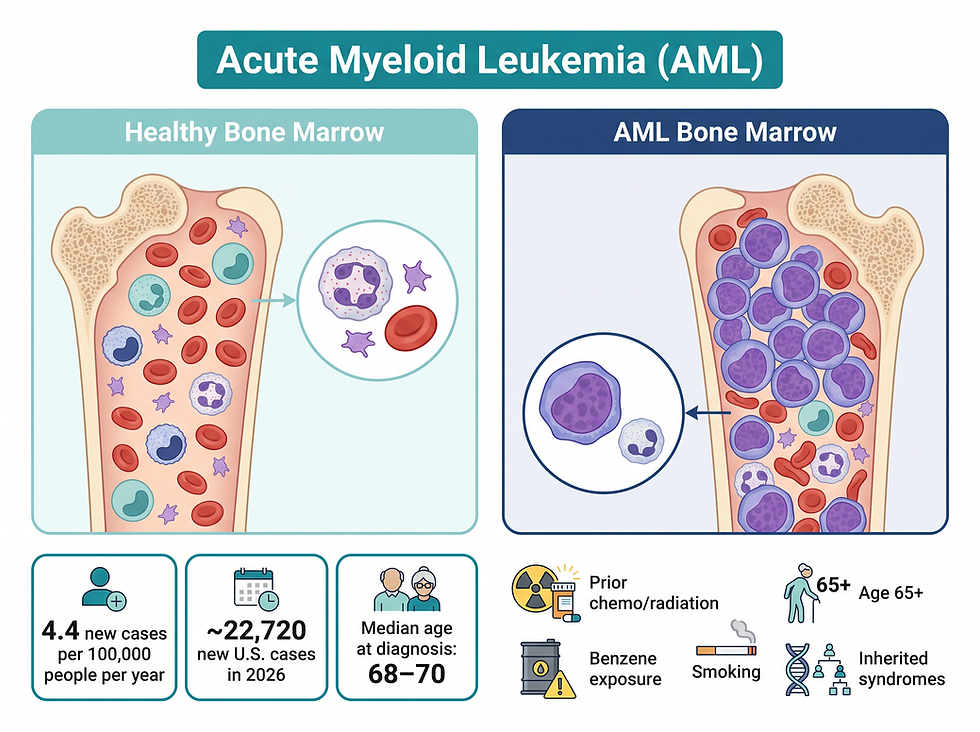
About half of all people with AML are 65 or older at diagnosis. Men develop AML more often than women (roughly 5 cases for every 3 in women), and incidence is highest among non-Hispanic White adults. Only about 4% of cases occur before age 20.
What Are the Symptoms of Acute Myeloid Leukemia?
Early symptoms often feel like a cold or flu that simply will not go away. Because AML is aggressive, new and more noticeable symptoms appear quickly — typically within days or weeks.
Low red blood cells (anemia): Fatigue, weakness, pale skin, shortness of breath, feeling cold, dizziness
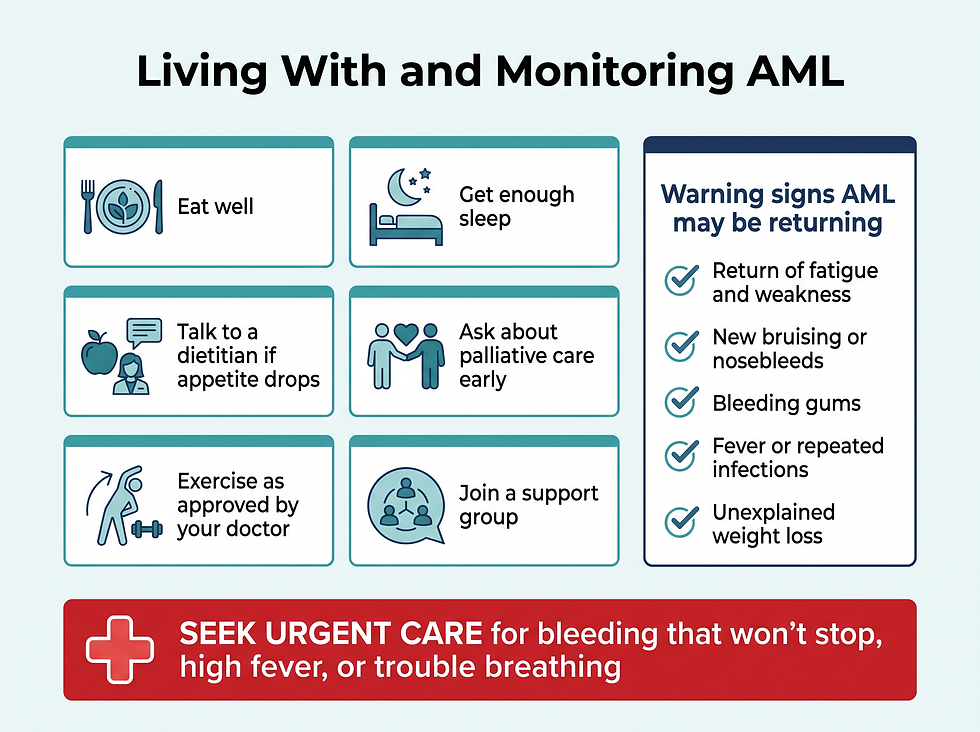
Low platelets (bleeding): Easy bruising, frequent nosebleeds, bleeding gums, tiny red skin spots (petechiae), wounds that do not heal
Low healthy white cells (infection): Fever, frequent infections, infections that will not clear
Other symptoms: Night sweats, unexplained weight loss, loss of appetite, headaches, bone/back/abdominal pain, swollen lymph nodes
What Causes Acute Myeloid Leukemia?
No one knows the exact trigger. What experts do know is that AML begins when certain genes or chromosomes mutate, creating abnormal blood cells. These changes can happen three ways: during your lifetime when something alters your DNA, through an inherited genetic disorder, or from a change present in a biological parent's sperm or egg.
Most cases still arise de novo — with no identifiable cause — despite the known risk factors below.
Risk Factors You Can Modify
Smoking: Including secondhand smoke exposure
Chemical exposure: Long-term contact with benzene and formaldehyde
Prior cancer treatment: Earlier chemotherapy (especially alkylating agents, topoisomerase inhibitors) or radiation therapy
High-dose radiation: From a nuclear accident or atomic bomb exposure
Chemotherapy- or radiation-linked AML (called therapy-related AML) often appears 5 to 7 years after exposure.
Risk Factors You Cannot Modify
Age: About half of patients are 65+ at diagnosis
Inherited syndromes: Down syndrome, Fanconi anemia, Li-Fraumeni syndrome, Bloom syndrome, ataxia telangiectasia, Klinefelter syndrome, Wiskott-Aldrich syndrome, Familial Platelet Disorder
Prior bone marrow disorders: Myelodysplastic syndrome (MDS), myeloproliferative neoplasms (polycythemia vera, myelofibrosis, thrombocytosis), aplastic anemia
People with high-risk MDS — shown by transfusion-dependent low blood counts and blast cells in the blood — carry an elevated risk of AML developing and need close monitoring.
What Are the Different Types of AML?
Medical pathologists classify AML subtypes by examining cancerous cells under a microscope and testing for chromosome changes and gene mutations. Different subtypes cause different symptoms and respond to treatment differently.
Myeloid leukemia: Cancer in neutrophil-producing cells — the most common form
Acute monocytic leukemia (AML-M5): Cancer in monocyte-producing cells — second most recognized lineage form
Acute megakaryocytic leukemia: Cancer in red blood cell/platelet-producing cells
Acute promyelocytic leukemia (APL): Cancer in immature white cells (promyelocytes) that cannot develop — carries the best prognosis, 5-year survival over 80% in children
Modern classification (such as the European LeukemiaNet 2022 system) also groups patients by genetic risk: favorable, intermediate, or high-risk. Key markers include NPM1 mutations (up to 35% of patients), FLT3 mutations (25–30%), IDH mutations (15–20%), and t(8;21) translocation (~12%). The risk group directly guides which treatment approach fits best.
How Is Acute Myeloid Leukemia Diagnosed?
Because symptoms come on fast, diagnosis usually moves quickly. Providers start with a physical exam, checking for bruises, bleeding, infection, and enlarged organs — specifically the liver, spleen, and lymph nodes.
Complete blood count (CBC): Low red cells, platelets, and/or healthy white cells; sometimes visible blasts
Peripheral blood smear: Blasts are large, immature white cells with distinctive nuclei — visible on a microscope slide
Bone marrow biopsy: Confirms blasts in the marrow and their proportion — the definitive diagnostic test
Spinal tap (lumbar puncture): Checks whether leukemia cells have reached the central nervous system
Genetic testing then pins down the exact subtype, which drives treatment decisions:
Immunohistochemistry: Cell-staining patterns under a microscope
Flow cytometry: Protein markers on the surface of blast cells
Karyotype test: Whole-chromosome changes
FISH (fluorescence in situ hybridization): Specific chromosome rearrangements
How Is Acute Myeloid Leukemia Treated?
Treatment options — chemotherapy, targeted therapy (including monoclonal antibody therapy), and allogeneic stem cell transplantation — are the same for adults and children. The immediate goal is complete remission: blood counts return to normal and no cancerous cells appear in the bone marrow under the microscope.
Treatment begins urgently. AML is a medical emergency in practice — induction therapy typically starts within days of diagnosis.
The Three Phases of Chemotherapy
Remission induction: First push toward complete remission; given over several days (some patients need two rounds). Typical drugs: cytarabine, daunorubicin, idarubicin, azacitidine, decitabine, glasdegib, venetoclax
Consolidation: Kills remaining cancer cells and lowers recurrence risk; high-dose cytarabine (HiDAC) five days a month for 3–4 months
Maintenance: Ongoing low-dose chemotherapy when needed, lasting months or years. Typical drugs: azacitidine, decitabine, midostaurin
How Well Does Induction Therapy Work?
Children and teens: More than 60% achieve complete remission after induction
Adults age 60 and younger: About 75% achieve complete remission after induction
Adults over age 60: About 50% achieve complete remission after induction
Targeted Therapy and Stem Cell Transplant
Targeted therapy attacks specific gene mutations in the cancer cells, often when AML relapses or fails chemotherapy.
FLT3 mutation (25–30% of AML cases): Treated with midostaurin or gilteritinib
IDH mutation (15–20% of AML cases): Treated with enasidenib or ivosidenib
Allogeneic stem cell transplantation replaces the patient's diseased marrow with stem cells from a related or unrelated donor (sourced from bone marrow, peripheral blood, or cord blood). It is currently the only established curative therapy for AML. Not everyone is a candidate, and transplant carries the most serious side effects of any AML treatment. Chemotherapy can also cause myelosuppression — dangerously low blood cell and platelet counts.

What Are the Complications of AML?
Early on, AML depletes healthy blood cells and platelets. Without treatment, this produces three linked complications:
Anemia: Too few red blood cells — fatigue, pallor, breathlessness
Thrombocytopenia: Too few platelets — bleeding and bruising
Pancytopenia: All three cell lines low at once
A less common but dangerous emergency is tumor lysis syndrome, when massive blast-cell death releases potassium, phosphorus, uric acid, and LDH into the blood — sometimes before chemotherapy even begins. It can cause sudden kidney failure and is treated as an oncologic emergency.
What Is the Prognosis and Survival Rate for AML?
Overall, an estimated 50% to 80% of people achieve complete remission after treatment — more often in children and people under 60. Remission may last months or years.
However, about half of patients who reach complete remission experience relapse (recurrent AML). When that happens, providers may recommend additional chemotherapy, stem cell transplantation, or a clinical trial.
5-year relative survival (all ages): 33.4% (SEER 2016–2022; earlier datasets cited 30–31%)
Children under 15: 67% (over 80% for the APL subtype)
Adults overall: ~30% alive at 5 years (reflects 2012–2018 data; newer treatments exist)
The good news: outcomes are improving. Death rates have been falling about 0.9% per year since 2015, and five-year survival has risen steadily from under 10% in the 1970s to roughly 37% in recent SEER trend data. Survival figures describe large groups — your own prognosis depends on age, genetic subtype, overall health, and treatment response, and your care team is the best source for your individual outlook.
Can Acute Myeloid Leukemia Be Prevented?
There is no proven way to prevent AML, because the mutation triggers are unknown. But you can reduce modifiable risks:
Quit smoking; avoid secondhand smoke: Smoking raises AML risk
Limit benzene and formaldehyde exposure: Use protective clothing and follow workplace safety rules
Discuss cancer-treatment risks with your team: Prior chemo/radiation is a known risk factor; balance benefits and risks with your provider
How Do You Take Care of Yourself During and After Treatment?
Living with a cancer that may return is challenging. Practical self-care includes eating well (ask for a nutritionist if treatment affects appetite), discussing palliative care early to manage side effects, getting enough sleep, and managing stress through approved exercise.
Because AML is rare, patients often feel isolated. Support groups and cancer survivorship programs can make a real difference. After treatment, your provider will outline which symptoms could signal recurrence so you know exactly when to call.
The Bottom Line
Acute myeloid leukemia moves fast — but modern treatment moves with it. With induction chemotherapy achieving remission in 50–75% of patients depending on age, and stem cell transplant offering a real cure, more people are living longer with AML than ever before. If you notice flu-like symptoms that persist, unexplained bruising or bleeding, or repeated infections, do not wait — see a healthcare provider promptly and ask for a complete blood count. Early evaluation saves lives with AML.
If you or a loved one is facing AML, ask your care team about your genetic subtype, clinical trials, and stem cell transplant eligibility — and talk to a leukemia specialist center about second opinions.
Frequently Asked Questions (FAQ)
1. What is the difference between acute myeloid leukemia and other leukemias?
AML starts in myeloid precursor cells in the bone marrow and progresses over days to weeks, while chronic leukemias (like CLL and CML) involve more mature cells and develop over months or years. AML accounts for about 1 in 3 adult leukemias.
2. Is acute myeloid leukemia curable?
It can be. Allogeneic stem cell transplantation is currently the only established curative therapy. Many patients reach complete remission with chemotherapy alone, and remission can last months or years.
3. How fast does AML progress?
Very quickly. Symptoms typically build over days to weeks, and untreated AML can be life-threatening. Diagnosis and treatment begin urgently — induction chemotherapy usually starts within days.
4. What are the first signs of AML?
Early symptoms resemble a persistent cold or flu: fatigue, fever, weakness. Bleeding signs (bruising, nosebleeds, bleeding gums, petechiae) and frequent infections follow as blood counts drop.
5. What causes acute myeloid leukemia?
Genetic mutations in genes or chromosomes create abnormal blast cells that multiply uncontrollably. Triggers include aging, prior chemotherapy/radiation, benzene exposure, smoking, and inherited syndromes — but most cases arise with no identifiable cause.
6. What is the survival rate for AML?
The overall 5-year relative survival rate is about 31–33%, and death rates have been falling steadily since 2015. Children do much better (67% five-year survival; over 80% for the APL subtype), while older adults face lower odds.
7. Does AML come back after remission?
About half of patients who achieve complete remission experience relapse. Options include additional chemotherapy, stem cell transplantation, targeted therapy, and clinical trials.
8. Can acute myeloid leukemia be prevented?
Not fully, since mutation triggers are unknown. You can lower modifiable risks by not smoking, avoiding secondhand smoke, and limiting long-term benzene/formaldehyde exposure with proper workplace protection.
References
Cleveland Clinic — Acute Myeloid Leukemia (AML) (medically reviewed, last updated 03/21/2023)
American Cancer Society — Key Statistics for Acute Myeloid Leukemia (AML), Cancer Facts & Figures 2026 (last revised Jan 13, 2026)
National Cancer Institute — SEER Cancer Stat Facts: Acute Myeloid Leukemia (AML), 2024
Vakiti A, Reynolds SB, Mewawalla PM — Acute Myeloid Leukemia, StatPearls (last updated Apr 27, 2024)
Medscape eMedicine — Acute Myeloid Leukemia (AML) (updated June 11, 2026)
Leukemia Research Foundation — Leukemia Statistics (SEER-derived)
Cancer Research UK — Survival for acute myeloid leukaemia (AML)
American Society of Hematology — Blood Cancers: Acute Myeloid Leukemia
MedlinePlus, National Library of Medicine — Acute Myeloid Leukemia
National Cancer Institute — Acute Myeloid Leukemia Treatment (PDQ®), Patient Version
Comments