Urine Cytology: Testing Urine for Bladder Cancer Cells

Updated: 2 days ago
Written and medically reviewed by Dr. Baraa Alnahhal, MD · Last reviewed: November 2026 · How we review
Quick Answer
Urine cytology is a lab test that looks at cells in the urine to find cancer or precancer cells. It helps detect bladder cancer and other urinary tract cancers and is often ordered for blood in the urine. It's good at finding high-grade cancers but often misses low-grade cancers, so it's used with cystoscopy and imaging.
What the research says
Cytology misses many low-grade cancers: in a prospective study of 109 people with bladder cancer, urine cytology had an overall sensitivity of 48%, only 16% for low-grade tumors but 84% for high-grade tumors, with a specificity of 86% (Yafi FA et al., Urol Oncol, 2015) [2]
The report category predicts risk: a meta-analysis of the Paris System for reporting urine cytology found the risk of high-grade cancer was about 13% with a negative result, 39% with atypical cells, 77% when suspicious and 92% when positive (Nikas IP et al., J Pers Med, 2022) [3]
Key takeaways
Checks urine for cancer or precancer cells.
Helps find bladder and other urinary tract cancers and monitor recurrence.
Usually a clean-catch sample; avoid first morning urine.
Very accurate for high-grade cancer, less reliable for low-grade cancer.
Abnormal results lead to cystoscopy or CT imaging.
What is urine cytology?
Cytology is the study of individual cells. In urine cytology, a cytopathologist examines cells shed from the lining of the urinary tract. It's different from a routine urinalysis, which checks the urine's appearance, concentration and contents such as protein and glucose. Sources: [1]
Why is it done?
To help diagnose bladder, ureter, urethra or kidney cancer.
To check blood in the urine (hematuria) or frequent pain or burning when urinating.
To watch for recurrence after treatment for bladder cancer, such as BCG therapy.
To monitor recurrent urinary tract infections or check for viral infections such as cytomegalovirus. Sources: [1]
How do I prepare?
Don't use your first morning urine, because cells that sat in the bladder overnight can break down. You may need to give the sample at a hospital or lab. Sources: [1]
How is the sample collected?

Avoid first morning urine for cytology.
Clean catch: you clean the genital area, start urinating into the toilet, then collect the rest of the stream in a sterile cup.
Catheter: a thin tube is passed through the urethra into the bladder; this carries a small, treatable risk of UTI.
Cystoscopy: a sample is collected during a cystoscopy, which uses a thin scope to view the bladder.
In the lab, cells are spun down, placed on a slide, stained and examined. Sources: [1]
Understanding your results
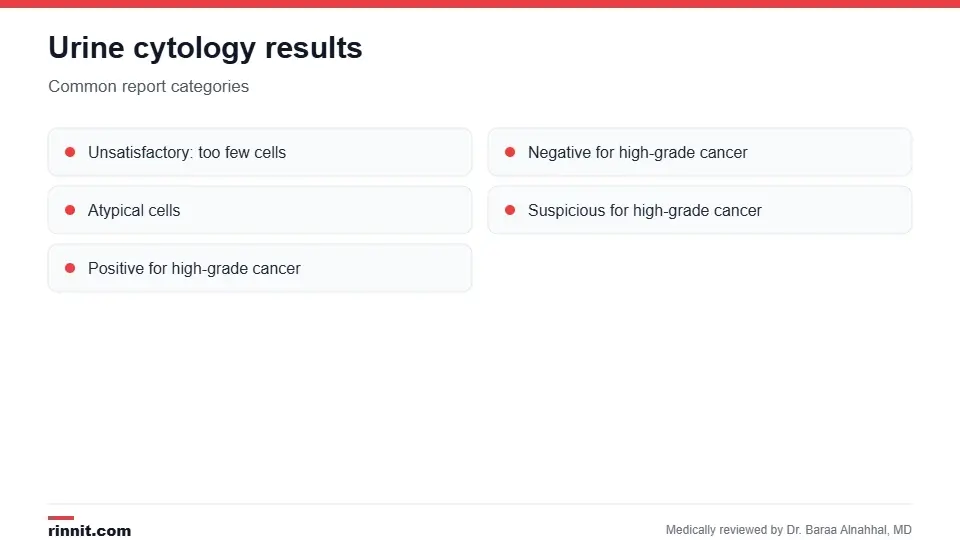
Results are reported in standard categories.
Result | What it means |
Unsatisfactory | Too few cells; a new sample may be needed |
Negative for high-grade urothelial carcinoma | No cancer or abnormal cells found |
Atypical urothelial cells | Some changes, not severe enough to call cancer |
Suspicious for high-grade urothelial carcinoma | Abnormal cells that may be cancer |
Positive for high-grade urothelial carcinoma | Cancer cells found |
Abnormal cells can also come from inflammation or past radiation near the bladder. Sources: [1, 3]
How accurate is it?
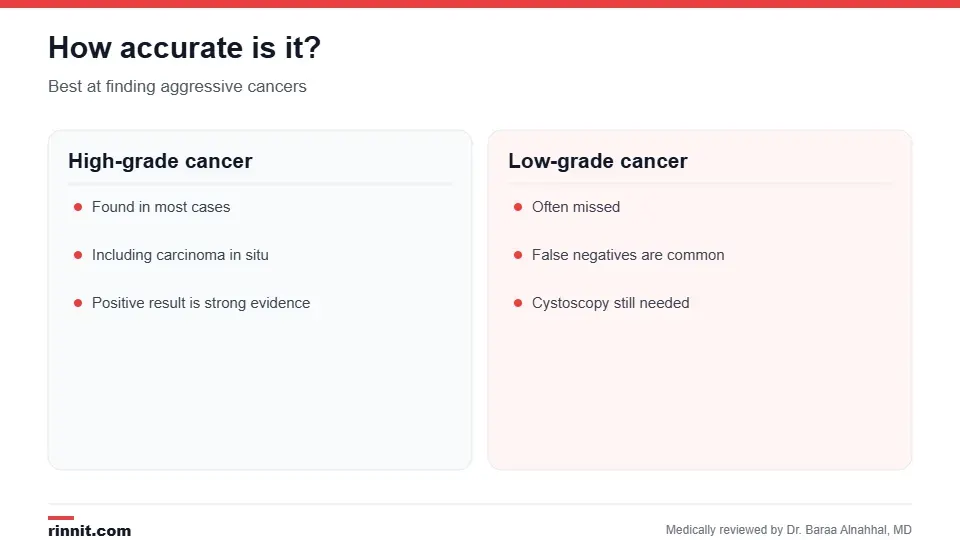
Cytology works best for aggressive cancers.
Urine cytology is about 95% accurate for invasive high-grade tumors and carcinoma in situ, but only about 10–50% accurate for low-grade cancers, with many false negatives. A negative result doesn't rule out cancer, so it may be repeated and combined with other tests. Sources: [1, 2]
What happens next?
Atypical, suspicious or positive results usually lead to cystoscopy or a CT urogram of the urinary tract. Cytology alone isn't used to diagnose cancer. Learn more about urothelial carcinoma. Sources: [1]
Conclusion
Urine cytology is a simple, noninvasive test that's especially good at spotting aggressive bladder cancers and checking for recurrence. Because it can miss low-grade cancers, it's always paired with cystoscopy and imaging.
Keep learning: read about blood in the urine and cystoscopy.
Frequently asked questions
What is urine cytology?
A test that looks for cancer cells in your urine.
Why is it done?
To help find urinary tract cancers and monitor bladder cancer.
Should I use my first morning urine?
No. Cells from overnight urine can break down.
How is the sample collected?
Usually clean catch; sometimes by catheter or during cystoscopy.
How accurate is it?
Very accurate for high-grade cancer, less so for low-grade cancer.
Does a negative result rule out cancer?
No. Other tests may still be needed.
What does atypical mean?
Cells look abnormal but not clearly cancerous.
Is it the same as a urinalysis?
No. Urinalysis is a routine check; cytology looks for cancer cells.
What happens if results are abnormal?
Usually cystoscopy or a CT scan of the urinary tract.
Are there risks?
Clean-catch samples have no risk; a catheter carries a small UTI risk.
Related Reading
Cytology (Cytopathology): Types, Why It's Done, What Happens and What Results Mean how cells are studied under the microscope.
Urinalysis: What It Tests, How to Prepare, Normal Values and What Results Mean the routine urine test.
Cystoscopy: Purpose, Procedure, Recovery and Risks the scope test often done with cytology.
Blood in Urine (Hematuria): Symptoms, Causes, and Treatment a common reason for testing.
Transitional Cell Cancer: A Comprehensive Guide to Urothelial Carcinoma the cancer urine cytology looks for.
References
Cleveland Clinic. Urine Cytology: What Is It, Purpose, Procedure & Results. Cleveland Clinic. Last updated May 5, 2022. https://my.clevelandclinic.org/health/diagnostics/22942-urine-cytology
Yafi FA, Brimo F, Steinberg J, et al. Prospective analysis of sensitivity and specificity of urinary cytology and other urinary biomarkers for bladder cancer. Urol Oncol. 2015;33(2):66.e25-31. PMID 25037483. https://doi.org/10.1016/j.urolonc.2014.06.008
Nikas IP, Seide S, Proctor T, et al. The Paris System for reporting urinary cytology: a meta-analysis. J Pers Med. 2022;12(2):170. PMID 35207658. https://doi.org/10.3390/jpm12020170
Medical disclaimer
This article is for general education only and does not replace advice from a qualified healthcare professional. Talk to your doctor about your own diagnosis and treatment, and seek emergency care right away for severe or sudden symptoms.



Comments