CT Urogram: What It Is, Why It's Done, How to Prepare and What to Expect

Updated: 2 days ago
Written and medically reviewed by Dr. Baraa Alnahhal, MD · Last reviewed: November 2026 · How we review
Quick Answer: What is a CT urogram?
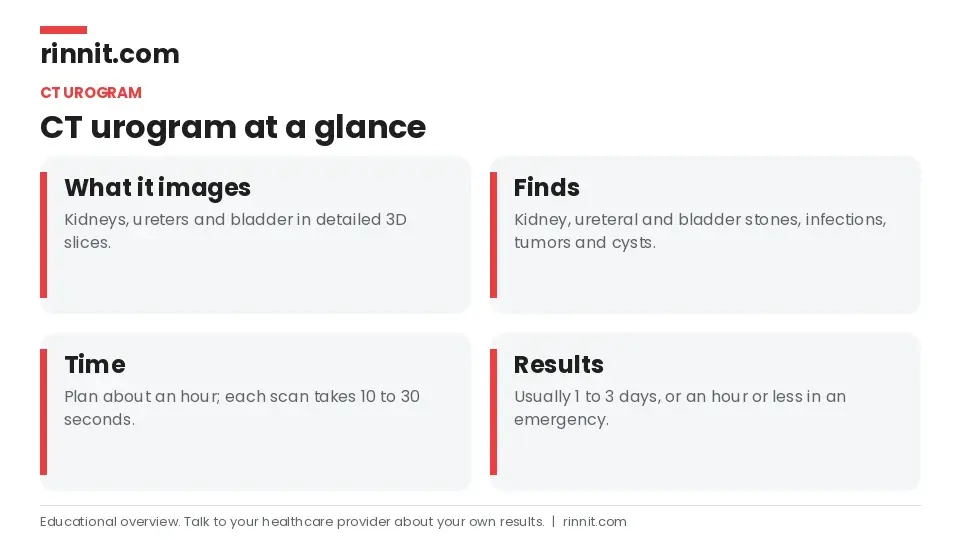
A CT urogram is a type of CT scan that uses contrast dye, X-rays and a computer to make detailed 3D images of the urinary system: the kidneys, ureters and bladder. It helps diagnose stones, infections, cysts and tumors. The scan is painless, the visit takes about an hour, and most people get results within a few days. [1]
What the research says
CT urography is highly accurate for upper urinary tract tumors. In a review of studies of people with blood in the urine, CT urography had a pooled sensitivity of 96% and specificity of 99% for tumors of the upper urinary tract lining, and it performed better than older intravenous urography. (Chlapoutakis et al., European Journal of Radiology, 2010) [2]
Cancer is uncommon when blood in the urine is only microscopic. In 30 studies of 24,366 people checked for microscopic blood in the urine, bladder cancer was found in 2.0% and upper tract tumors in 0.02%, rising to 4.61% and 0.45% in high-risk groups. This is why providers use your risk level to decide who needs a CT urogram. (Waisbrod et al., JAMA Network Open, 2021) [3]
Key takeaways
A CT urogram images your kidneys, ureters and bladder using contrast dye and a rotating X-ray. [1]
It helps diagnose kidney, ureteral and bladder stones, infections, tumors and cysts. [1]
Tell your provider about allergies to contrast or iodine, pregnancy, and medicines such as metformin. [1]
Plan for about an hour; each scan takes only 10 to 30 seconds. [1]
The test is painless apart from the IV needle, and the risks are small. [1]
Results usually take 1 to 3 days, or an hour or less in an emergency. [1]
What is a CT urogram?
A CT urogram examines your urinary system, including your kidneys, bladder and ureters, the two thin tubes that carry urine from your kidneys to your bladder. It produces images of your abdomen, pelvis and lower back that show thin "slices" of bones, muscles, organs and blood vessels. [1]
A regular X-ray uses a fixed tube to take flat (2D) pictures. A CT scanner uses a doughnut-shaped ring that rotates the X-ray 360 degrees around you, and a computer builds the images into a 3D view. [1]
Why would a urologist order a CT urogram?
Your urologist may order one if you have symptoms of a urinary system problem, such as blood in the urine. A CT urogram can help diagnose: [1]
Kidney stones
Ureteral stones
Bladder stones
Infections
Tumors
Cysts
A radiologic technologist, who specializes in imaging procedures, performs the scan. [1]
How do you prepare?
Your provider will check your vital signs and ask whether you: [1]
Have any medical conditions
Are allergic to contrast dye or iodine
Are or might be pregnant
Take medicines such as metformin for diabetes, NSAIDs, antibiotics or blood thinners like warfarin
You may need a blood test first to make sure the right contrast dye is used. If you are allergic to contrast, you may take a steroid the night before and the morning of the scan, and likely an antihistamine beforehand. [1]
Before the scan
What happens during a CT urogram?
You lie on your back on a table; you may also be asked to lie on your side or stomach, with cushions to keep you in position. [1]
A provider places a small needle and tube in a vein in your arm or hand to give the contrast dye. You feel a slight pinch. [1]
As the dye flows through, you may feel warm or flushed, briefly nauseous or have a headache, notice a salty or metallic taste, or suddenly feel like you need to pee. These feelings pass after a few moments. [1]
The table slowly moves into the scanner. Stay as still as you can, since movement blurs the images. Tell the team if you need to move. [1]
The scanner takes pictures of the areas your provider needs. It is fairly quiet, though the table can make some noise as it moves. [1]
Part of the visit | Typical time |
Whole appointment | About 1 hour |
Scanning session | 10 to 30 minutes, to let your body process the contrast |
Each individual scan | 10 to 30 seconds |
Sources: [1]

After the scan
Once the technologist confirms the images are clear, they remove the IV and bandage the spot. You can change back into your clothes. [1]
What are the risks?
CT urograms are generally safe, but like other imaging tests they use a small amount of ionizing radiation. [1]
Risk | What to know |
Cancer risk | All imaging that uses radiation slightly increases cancer risk, but the increase is too small to measure well. |
Allergic reaction | Some people have a minor or, occasionally, more serious reaction to the contrast dye. |
Bruising or swelling | May occur where the needle went in. |
Sources: [1]
When will you get results?
Results usually take 1 to 3 days. A radiologist reviews the images and writes a report, then your provider discusses it with you by phone or at a visit. In an emergency setting, results may be ready in an hour or less. If you have not heard back after a few days, contact your provider. [1]
CT urogram vs. other tests
Test | How it differs |
Standard CT scan | A CT urogram is a CT scan focused on the urinary system; other CT scans may not use contrast. |
More invasive: a thin lighted camera is passed through the urethra to look inside the bladder. | |
An older X-ray method; CT urography gives more detailed 3D images. |

Conclusion
A CT urogram is a safe, noninvasive and low-risk way for your provider to look closely at your kidneys, ureters and bladder. It helps them make an accurate diagnosis and choose the right treatment. [1]
It is normal to feel nervous before a scan. Ask your provider any questions you have about the contrast dye, the radiation or what they are looking for.
Keep learning: Read our guide to the CT scan or our guide to blood in the urine. For more trusted, doctor-reviewed health guides, visit Rinnit.com.
FAQ
What is a CT urogram?
It is a CT scan with contrast dye that makes detailed 3D images of your kidneys, ureters and bladder. [1]
Why would a urologist order a CT urogram?
To look for stones, infections, tumors or cysts when you have urinary symptoms. [1]
How do I prepare for a CT urogram?
Report allergies, pregnancy and medicines, and you may need to drink water and hold your pee before the scan. [1]
How long does a CT urogram take?
Plan for about an hour; each scan itself takes 10 to 30 seconds. [1]
Is a CT urogram painful?
No. You only feel a slight pinch when the IV goes in. [1]
What does the contrast dye feel like?
You may feel warm or flushed, notice a metallic taste or feel the urge to pee for a few moments. [1]
What are the risks of a CT urogram?
Small radiation exposure, a possible reaction to the dye, and bruising or swelling at the needle site. [1]
What if I'm allergic to contrast dye?
Your provider may give you a steroid the night before and the morning of the scan, plus an antihistamine. [1]
How long do CT urogram results take?
Usually 1 to 3 days, or an hour or less in an emergency. [1]
What is the difference between a CT urogram and a cystoscopy?
A cystoscopy passes a camera into your bladder, so it is more invasive than a CT urogram. [1]
Related Reading
Kidney Stones: Symptoms, Causes, and Treatment Guide explains kidney stones, one of the main conditions a CT urogram finds.
Ureteral Obstruction: Symptoms, Causes, and Treatment covers blockages of the ureters, which this test can show.
Blood in Urine (Hematuria): Symptoms, Causes, and Treatment explains blood in the urine, a common reason a urologist orders a CT urogram.
Microhematuria Explained: Causes, Symptoms, and Diagnostic Steps covers microscopic blood in the urine and where CT urography fits in the workup.
Kidney Cancer: Symptoms, Causes & Treatment Guide explains kidney tumors that CT urography can help detect.
Transitional Cell Cancer: A Comprehensive Guide to Urothelial Carcinoma covers cancer of the urinary lining, which CT urography is sensitive for.
Urinary Tract Infection (UTI): Symptoms, Causes, Treatment, and Prevention explains urinary infections, which a CT urogram can help diagnose.
Kidney Cysts: Symptoms, Causes, Diagnosis, and Treatment Options covers kidney cysts, another finding on this scan.
References
Cleveland Clinic. CT Urogram: Purpose, Procedure, Risks & Results. Cleveland Clinic. Last updated September 21, 2022. https://my.clevelandclinic.org/health/diagnostics/24186-ct-urogram
Chlapoutakis K, Theocharopoulos N, Yarmenitis S, et al. Performance of computed tomographic urography in diagnosis of upper urinary tract urothelial carcinoma, in patients presenting with hematuria: Systematic review and meta-analysis. Eur J Radiol. 2010;73(2):334-338. PMID 19058939. https://doi.org/10.1016/j.ejrad.2008.10.026
Waisbrod S, Natsos A, Wettstein MS, et al. Assessment of Diagnostic Yield of Cystoscopy and Computed Tomographic Urography for Urinary Tract Cancers in Patients Evaluated for Microhematuria: A Systematic Review and Meta-analysis. JAMA Netw Open. 2021;4(5):e218409. PMID 33970257. https://doi.org/10.1001/jamanetworkopen.2021.8409
Medical disclaimer
This article is for general education only and does not replace advice from a qualified healthcare professional. Talk to your doctor about your own diagnosis and treatment, and seek emergency care right away for severe or sudden symptoms.



Comments