Cytology (Cytopathology): Types, Why It's Done, What Happens and What Results Mean

Updated: 2 days ago
Written and medically reviewed by Dr. Baraa Alnahhal, MD · Last reviewed: November 2026 · How we review
Quick Answer: What is cytology?
Cytology, also called cytopathology, is a test in which a pathologist looks at cells from a sample of tissue or body fluid under a microscope. It checks for changes in the size, shape or other features of cells. It's used most often to screen for or diagnose cancer and precancerous changes, but it can find infections and inflammatory conditions. [1]
What the research says
Pleural fluid cytology finds cancer in about 6 of 10 cases. In a review of 36 studies covering 6,057 people with cancer-related fluid around the lungs, cytology of that fluid detected the cancer 58.2% of the time. Detection was highest for lung adenocarcinoma (83.6%) and ovarian cancer (85.2%) and lowest for lung squamous cell carcinoma (24.2%) and mesothelioma (28.9%). (Kassirian et al., Thorax, 2023) [2]
Urine cytology is specific but can miss bladder cancer. Across 68 studies with 12,696 participants, urine cytology identified bladder cancer with 55% sensitivity and 92% specificity. Several DNA-based urine markers showed higher sensitivity, but they still need validation before routine use. (Silva-Ferreira et al., European Urology Focus, 2024) [3]
Key takeaways
Cytology examines individual cells or small clusters of cells under a microscope to screen for or diagnose disease. [1]
It can find cancer, precancerous changes and infections caused by bacteria, viruses, fungi or parasites. [1]
Samples come from fluids the body sheds, from brushing or scraping tissue, or from a thin needle placed into a lump. [1]
Most cytology tests need no special preparation, and serious complications are very rare. [1]
An abnormal result does not necessarily mean cancer, and your provider may suggest more testing, such as a biopsy. [1]
What is cytology?
Cytology, or cytopathology, is a way to screen for or diagnose disease by studying cells. A pathologist examines cells from a small tissue or fluid sample under a microscope and looks for changes in their size, shape or other features. [1]
It is one of the three main sections of anatomic pathology, the field that studies disease in tissues and organs and what causes it. [1]
Why would you need a cytology test?
Your provider may order cytology to: [1]
Screen for or diagnose cancer, including precancerous changes
Diagnose infectious diseases caused by bacteria, parasites, fungi or viruses
Diagnose inflammatory conditions, such as sarcoidosis
What are the types of cytology?
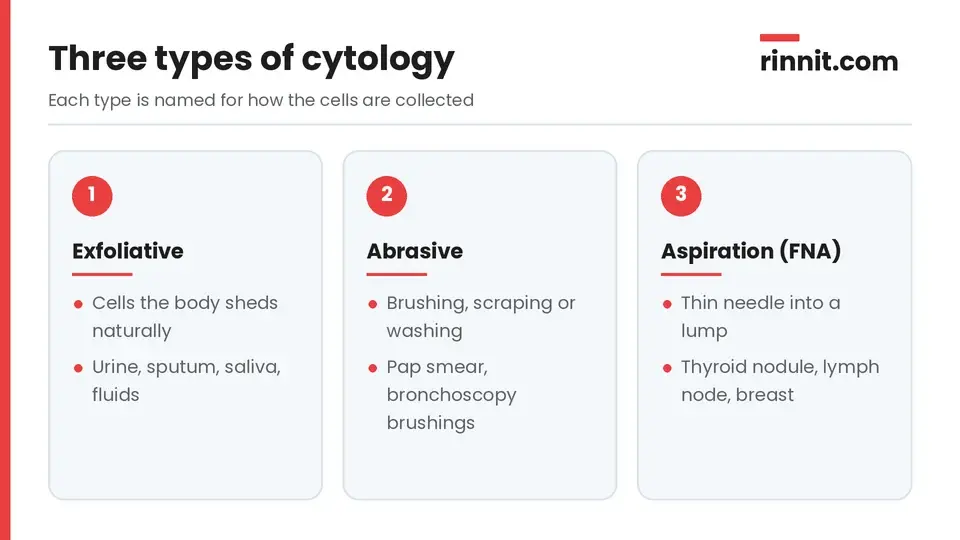
Cytology types are named for how the cells are collected.
Cytology types are grouped by how the sample is collected. [1]
Type | How cells are collected | Examples |
Exfoliative cytology | Cells the body sheds naturally into fluids or secretions | Saliva, sputum, urine, cerebrospinal fluid, discharge from the eye, vagina or nipple |
Abrasive cytology | Cells are loosened by brushing, scraping or washing (lavage) | Pap smear, brushings during bronchoscopy or endoscopy, skin scrapings |
Aspiration cytology | A thin needle collects fluid from a lump you can feel | Fine-needle aspiration (FNA) of a lymph node, thyroid nodule or breast lump |
Sources: [1]
Exfoliative cytology
This type looks at cells your body sheds on its own. Besides saliva, sputum (mucus coughed up from the lungs) and urine, samples can include fluid that collects around the heart, lungs or abdominal organs (pericardial, pleural or peritoneal effusions). [1]
Abrasive cytology
Here, a provider loosens cells from a surface. Examples include a Pap smear from the cervix, washings or brushings from the airways during bronchoscopy, samples from the esophagus, stomach or small intestine during endoscopy, skin scrapings from a rash or sore, and swabs of the nose, throat or inside of the cheek. [1]
Aspiration cytology (fine-needle aspiration)
A small needle passes through the skin to collect fluid from a lump or mass that can be felt from the outside. It is used for enlarged lymph nodes, thyroid nodules, salivary gland masses, head and neck masses and breast lumps. [1]
How do you prepare for cytology?
Most cytology tests need no specific preparation. Ask your provider whether there is anything you need to do for your particular test. [1]
What happens during a cytology test?
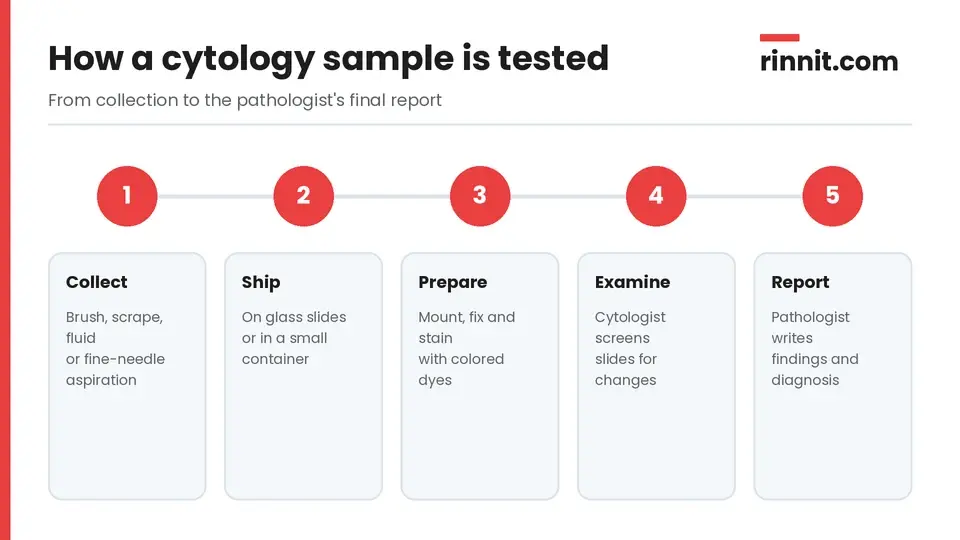
A cytology sample passes through several hands before you get a result.
The way your sample is collected depends on the test, such as a Pap smear, an endoscopy or fine-needle aspiration. After that, the steps are similar: [1]
Collection: Your provider brushes or scrapes tissue, collects discharge or body fluid such as urine, or performs a fine-needle aspiration.
Shipping: The sample travels to the lab on glass slides (smears) or in a small container.
Preparation: A cytopreparatory technologist separates cells from the fluid, mounts them on slides, fixes the sample and stains it with colored dyes so the cells are easy to see.
Examination: A cytologist screens the slides for abnormal cells, and sometimes for germs such as bacteria or parasites, then passes them to the pathologist.
Report: The pathologist reviews the slides and writes a final report with the findings and diagnosis.
The pathologist sends the report to your provider, who will go over the results and next steps with you. [1]
What are the risks of cytology?
Complications are very rare. Possible risks include infection and a false-negative or false-positive result. [1]
How is cytology different from a biopsy?
Both tests aim to diagnose or rule out disease, but they use different amounts of tissue. [1]
Feature | Cytology | Biopsy |
What is examined | Individual cells or small clusters of cells | Larger pieces of tissue, which may include several cell types |
Sample size | Very small amount of tissue or fluid | Larger tissue sample |
How invasive | Less invasive, with less pain and discomfort | Generally more invasive |
Complications | Less likely | More likely than with cytology |
Sources: [1]
What do cytology results mean?

An abnormal cytology result is not the same as a cancer diagnosis.
What your result means depends on whether the test was for screening or diagnosis and which part of the body was sampled. [1]
Result | What it means |
Normal or negative | No abnormal or cancerous cells, or no infection, were found |
Undetermined, unsatisfactory or inadequate | There were too few cells, or the cells could not be assessed well enough |
Abnormal or positive | Cells look different from normal, or an infection was found; this does not necessarily mean cancer |
Sources: [1]
An abnormal report may use terms such as dysplasia, hyperplasia, metaplasia, hypertrophy or atrophy. It can also include a grade, which rates how much abnormal cells differ from normal cells, and recommendations such as further testing with a biopsy. [1]
How long do results take?
Some routine screenings return results in a day or two. Others can take one to two weeks. [1]
What happens next?
Next steps depend on what was tested and what the result shows. Your provider will explain whether you need more testing or treatment. Contact your provider if you have questions about how your sample was collected or about your results. [1]
Conclusion
Cytology is a simple, low-risk way to look at your cells under a microscope. It helps your provider screen for cancer, find precancerous changes and diagnose infections or inflammatory conditions using only a small sample.
Waiting for results can be stressful. If your result is abnormal or unclear, ask your provider what it means and whether you need another test, such as a biopsy.
Keep learning: Read our guide to the Pap smear or our guide to biopsy. For more trusted, doctor-reviewed health guides, visit Rinnit.com.
FAQ
What is cytology?
It is a test in which a pathologist examines cells from a small tissue or fluid sample under a microscope.
What is cytology used for?
To screen for or diagnose cancer, precancerous changes, infections and inflammatory conditions such as sarcoidosis.
What are the types of cytology?
Exfoliative, abrasive and aspiration cytology, named for how the cells are collected.
Is a Pap smear a type of cytology?
Yes. A Pap smear is abrasive cytology, using a swab of cells from the cervix.
What is fine-needle aspiration?
A thin needle collects fluid from a lump, such as a thyroid nodule or enlarged lymph node.
Do I need to prepare for a cytology test?
Usually not, but ask your provider whether your test needs any preparation.
Is cytology painful or risky?
It is less invasive than a biopsy, and complications such as infection are very rare.
How long do cytology results take?
Some routine screenings take a day or two; others take one to two weeks.
Does abnormal cytology mean cancer?
Not necessarily. Abnormal cells or an infection can cause an abnormal result.
What is the difference between cytology and a biopsy?
Cytology looks at single cells or small clusters, while a biopsy removes larger pieces of tissue.
Related Reading
Cervical Cancer: Symptoms, Screening, Diagnosis, Treatment and Support explains how cervical cancer is screened for and diagnosed, including with cell samples.
What Is Cervical Dysplasia (Cervical Intraepithelial Neoplasia)? covers the precancerous cervical cell changes that cytology can find.
Thyroid Nodules: Symptoms, Causes, Diagnosis and Treatment — What You Need to Know describes thyroid lumps, one of the masses that fine-needle aspiration can sample.
Lung Cancer: Symptoms, Causes, Diagnosis, and Treatment Explained explains the symptoms, causes, diagnosis and treatment of lung cancer.
Transitional Cell Cancer: A Comprehensive Guide to Urothelial Carcinoma covers a cancer of the bladder and urinary tract lining.
Swollen Lymph Nodes: Symptoms, Causes, and When to Seek Care explains enlarged lymph nodes, which may be sampled with a thin needle.
Sarcoidosis: Complete Guide to the Condition That Forms Granulomas Throughout the Body describes an inflammatory condition that cytology can help diagnose.
Urine Cytology: Testing Urine for Bladder Cancer Cells explains the urine test that looks for bladder and urinary tract cancer cells.
Pathology Report: How to Read Margins, Grade, Stage and More explains how to read the sections and key terms of a pathology report.
References
Cleveland Clinic. Cytology (Cytopathology): What It Is, Types & Procedure. Cleveland Clinic. Last updated July 22, 2025. https://my.clevelandclinic.org/health/diagnostics/21714-cytology
Kassirian S, Hinton SN, Cuninghame S, et al. Diagnostic sensitivity of pleural fluid cytology in malignant pleural effusions: systematic review and meta-analysis. Thorax. 2023;78(1):32-40. PMID 35110369. https://doi.org/10.1136/thoraxjnl-2021-217959
Silva-Ferreira M, Carvalho JA, Salta S, et al. Diagnostic Test Accuracy of Urinary DNA Methylation-based Biomarkers for the Detection of Primary and Recurrent Bladder Cancer: A Systematic Review and Meta-analysis. Eur Urol Focus. 2024;10(6):922-934. PMID 38897871. https://doi.org/10.1016/j.euf.2024.05.024
Medical disclaimer
This article is for general education only and does not replace advice from a qualified healthcare professional. Talk to your doctor about your own diagnosis and treatment, and seek emergency care right away for severe or sudden symptoms.



Comments