Lung Cancer: Symptoms, Causes, Diagnosis, and Treatment Explained

Updated: 3 days ago
Medically reviewed by Dr. Baraa Alnahhal, MD · Last reviewed: October 2026
Lung cancer is the leading cause of cancer deaths worldwide and usually shows no symptoms until it is advanced. Smoking is the biggest risk factor, but the disease also affects people who have never smoked. Diagnosis relies on imaging tests, sputum cytology, and biopsy, and treatment ranges from surgery to radiation, chemotherapy, targeted therapy, immunotherapy, and palliative care [1][2].
Quick Answer: What is lung cancer?
Lung cancer is a growth of abnormal cells in the lungs. It typically causes no early symptoms, so signs such as a persistent cough, chest pain, coughing up blood and shortness of breath usually appear when it is advanced. Smoking is the main risk factor, and quitting at any age lowers risk. Treatments include surgery, radiation, chemotherapy and immunotherapy. [1] [2]
What the research says
Low-dose CT screening lowers lung cancer deaths in high-risk people. A Cochrane review of 8 randomized trials (91,122 participants) found that screening with low-dose CT reduced lung cancer mortality by 21% (risk ratio 0.79, 95% CI 0.72–0.87) compared with no screening or chest X-ray, and reduced all-cause mortality by 5% (risk ratio 0.95, 95% CI 0.91–0.99); the evidence was graded moderate certainty (Bonney et al., Cochrane Database Syst Rev, 2022 [3]).
Screening also has trade-offs, including false-positive results. A systematic review for the US Preventive Services Task Force (7 randomized trials, 86,486 participants) found that in the National Lung Screening Trial, three annual rounds of low-dose CT reduced lung cancer mortality compared with chest radiography (incidence rate ratio 0.85, 95% CI 0.75–0.96; 323 people screened to prevent 1 lung cancer death over 6.5 years), but false-positive results led to 17 invasive procedures per 1,000 people screened, and overdiagnosis estimates varied widely (0%–67%) (Jonas et al., JAMA, 2021 [4]).
Quitting smoking around the time of diagnosis is associated with longer survival. A meta-analysis of 21 studies including more than 10,000 people with lung cancer found that quitting smoking at or around diagnosis was associated with improved overall survival (summary relative risk 0.71, 95% CI 0.64–0.80), with similar results for non-small cell lung cancer (0.77) and small cell lung cancer (0.75); the studies varied widely in design (Caini et al., J Thorac Oncol, 2022 [5]).
What Is Lung Cancer?
Lung cancer is a kind of cancer that starts as a growth of cells in the lungs. The lungs are two spongy organs in the chest that control breathing. Lung cancer is the leading cause of cancer deaths worldwide [1].
People who smoke have the greatest risk of lung cancer. The risk increases with the length of time and the number of cigarettes smoked. Quitting smoking, even after smoking for many years, significantly lowers the chances of developing lung cancer. Importantly, lung cancer also can happen in people who have never smoked [1].

What are the symptoms of lung cancer?
Lung cancer typically doesn't cause symptoms early on. Symptoms of lung cancer usually happen when the disease is advanced [1].
Signs and symptoms that happen in and around the lungs may include a new cough that doesn't go away, chest pain, coughing up blood (even a small amount), hoarseness, shortness of breath, and wheezing. Signs and symptoms that happen when lung cancer spreads to other parts of the body may include bone pain, headache, losing weight without trying, loss of appetite, and swelling in the face or neck.
Symptom category | Possible signs and symptoms |
In and around the lungs | New cough that doesn't go away, chest pain, coughing up blood (even a small amount), hoarseness, shortness of breath, wheezing |
When cancer spreads to other parts of the body | Bone pain, headache, losing weight without trying, loss of appetite, swelling in the face or neck |
The fact that early symptoms are rare is why lung cancer is often caught at a later stage. Anyone who smokes and cannot quit should talk to a healthcare professional even before symptoms appear.
When to See a Doctor
Make an appointment with your doctor or other healthcare professional if you have any symptoms that worry you. If you smoke and haven't been able to quit, make an appointment. Your healthcare professional can recommend strategies for quitting smoking. These may include counseling, medicines, and nicotine replacement products [1].
What Causes Lung Cancer?
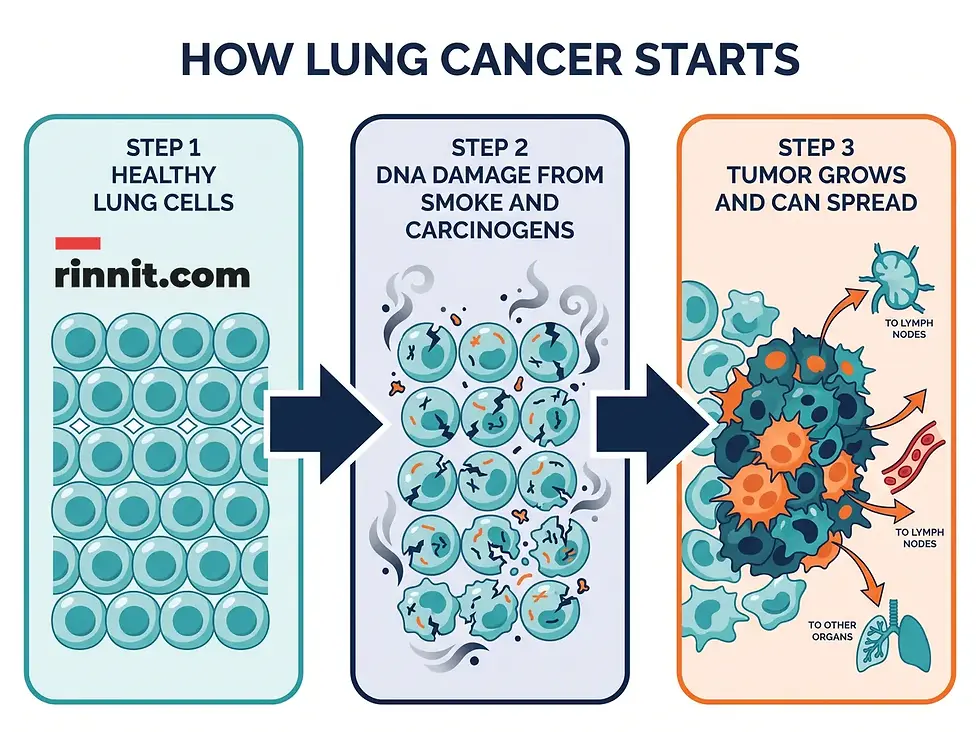
Lung cancer happens when cells in the lungs develop changes in their DNA. A cell's DNA holds the instructions that tell a cell what to do. In healthy cells, the DNA gives instructions to grow and multiply at a set rate, and the instructions tell the cells to die at a set time. In cancer cells, the DNA changes give different instructions. The changes tell the cancer cells to make many more cells quickly, and cancer cells can keep living when healthy cells would die. This causes too many cells [1].
The cancer cells might form a mass called a tumor. The tumor can grow to invade and destroy healthy body tissue. In time, cancer cells can break away and spread to other parts of the body. When cancer spreads, it's called metastatic cancer.
How Smoking Causes Lung Cancer
Researchers believe smoking causes lung cancer by damaging the cells that line the lungs. Cigarette smoke is full of cancer-causing substances, called carcinogens. When you inhale cigarette smoke, the carcinogens cause changes in the lung tissue almost immediately [1].
At first, your body may be able to repair this damage. But with each repeated exposure, the healthy cells that line your lungs become more damaged. Over time, the damage causes cells to change and eventually cancer may develop.
Smoking causes most lung cancers. It can cause lung cancer in both people who smoke and in people exposed to secondhand smoke. But lung cancer also happens in people who never smoked or have never been exposed to secondhand smoke. In these people, there may be no clear cause of lung cancer.
Types of Lung Cancer
Lung cancer is divided into two major types based on the appearance of the cells under a microscope. Your healthcare professional makes treatment decisions based on which major type of lung cancer you have [1].
Type | What it means |
Small cell lung cancer | Usually only happens in people who have smoked heavily for years; less common than non-small cell lung cancer |
Non-small cell lung cancer | A category that includes several types of lung cancers: squamous cell carcinoma, adenocarcinoma, and large cell carcinoma |
What are the risk factors for lung cancer?
A number of factors may increase the risk of lung cancer. Some risk factors can be controlled, for instance, by quitting smoking. Other factors can't be controlled, such as your family history [1].
Risk factor | Details |
Smoking | Risk increases with the number of cigarettes smoked each day and the number of years smoked; quitting at any age can significantly lower risk |
Exposure to secondhand smoke | Risk increases if you're around people who are smoking, even if you don't smoke |
Previous radiation therapy | Radiation therapy to the chest for another type of cancer may increase risk |
Exposure to radon gas | Radon is produced by the natural breakdown of uranium in soil, rock, and water; unsafe levels can build up in any building, including homes |
Exposure to cancer-causing substances | Workplace exposure to carcinogens such as asbestos, arsenic, chromium, and nickel can increase risk; the risk may be higher if you smoke |
Family history | People with a parent, sibling, or child with lung cancer have an increased risk |
What complications can lung cancer cause?
Lung cancer can cause a number of complications as it grows and spreads [1].
Shortness of breath can happen if cancer grows to block the major airways. Lung cancer also can cause fluid to collect around the lungs and heart. The fluid makes it harder for the affected lung to expand fully when you inhale.
Coughing up blood can result from bleeding in the airway. Sometimes bleeding can become severe. Treatments are available to control bleeding.
Pain can occur when advanced lung cancer that spreads affects the lining of a lung or another area of the body, such as a bone. Tell your healthcare professional if you experience pain. Many treatments are available to control pain.
Fluid in the chest, called pleural effusion, develops when fluid accumulates in the space that surrounds the affected lung in the chest cavity, called the pleural space. Pleural effusion can cause shortness of breath. Treatments are available to drain the fluid from your chest and to reduce the risk that it will happen again.
Cancer that spreads to other parts of the body is a serious complication. Lung cancer often spreads, and it may spread to the brain and the bones. Cancer that spreads can cause pain, nausea, headaches, or other symptoms depending on what organ is affected. Once lung cancer has spread beyond the lungs, it's generally not curable. Treatments are available to decrease symptoms and to help you live longer.
Complication | What happens | Available help |
Shortness of breath | Cancer blocks the major airways; fluid collects around the lungs and heart | Treatments to control airway blockage and drain fluid |
Coughing up blood | Bleeding in the airway | Treatments available to control bleeding |
Pain | Cancer spreads to the lining of a lung or another area such as a bone | Many treatments available to control pain |
Fluid in the chest (pleural effusion) | Fluid accumulates in the pleural space around the affected lung | Treatments to drain the fluid and reduce recurrence |
Cancer that spreads (metastasis) | Often spreads to the brain and bones; symptoms depend on the affected organ | Treatments to decrease symptoms and help you live longer |
How is lung cancer diagnosed?
Lung cancer diagnosis often starts with an imaging test to look at the lungs. If you have symptoms that worry you, a healthcare professional might start with an X-ray. If you smoke or used to smoke, you might have an imaging test to look for signs of lung cancer before you develop symptoms [2].
Testing Healthy People for Lung Cancer
People with an increased risk of lung cancer may consider yearly lung cancer screening using low-dose CT scans. Lung cancer screening is generally offered to people 50 and older who smoked heavily for many years. Screening also is offered to people who have quit smoking in the past 15 years. Discuss your lung cancer risk with your healthcare professional. Together you can decide whether lung cancer screening is right for you [2].
Tests to Diagnose Lung Cancer
If your healthcare professional thinks you may have lung cancer, a number of tests can be used to look for cancerous cells and to rule out other conditions [2].
Test | What it involves |
Imaging tests | Pictures of the body that show the location and size of the lung cancer; may include X-ray, MRI, CT, and PET scan |
Sputum cytology | The mucus coughed up from the lungs is looked at under a microscope; can sometimes show lung cancer cells |
Bronchoscopy | A healthcare professional passes a lighted tube with a camera down your throat into your lungs; special tools collect a tissue sample |
Mediastinoscopy | An incision is made at the base of the neck; surgical tools are inserted behind the breastbone to take tissue samples from lymph nodes |
Needle biopsy | X-ray or CT images guide a needle through the skin on your chest into the lung tissue to collect cells that could be cancerous |
A biopsy sample also may be taken from lymph nodes or other areas where cancer has spread. Your cancer cells will be carefully tested in a lab to find out what type of lung cancer you have. The results can help determine the likely outcome of your cancer, called the prognosis, and guide your treatment.
Tests to Determine the Extent of the Cancer
If you're diagnosed with lung cancer, you may have other tests to see if the cancer has spread. These tests help your healthcare team find out the extent of your cancer, also called the stage. Cancer staging tests often involve imaging tests and might look for signs of cancer in your lymph nodes or in other parts of your body. Your healthcare team uses the cancer staging test results to help create your treatment plan. Imaging tests may include MRI, CT, bone scans, and PET scan. Not every test is right for every person. Talk with your healthcare professional about which procedures will work for you [2].
Staging information | What it means |
Stages 1 to 4 | The lowest number means the cancer is small and only in the lung; as the cancer grows larger or spreads outside of the lungs, the numbers get higher; stage 4 means the cancer has spread to other areas of the body |
Small cell lung cancer staging | Stages may be called limited (cancer affects one lung and the area around it) or extensive (cancer has spread to the other lung or to other parts of the body) |

What are the treatment options for lung cancer?
Treatment for lung cancer usually begins with surgery to remove the cancer. If the cancer is very large or has spread to other parts of the body, surgery may not be possible. Treatment might start with medicine and radiation instead [2].
Your healthcare team considers many factors when creating a treatment plan. These factors may include your overall health, the type and stage of your cancer, and your preferences. Some people with lung cancer choose not to have treatment. For instance, you may feel that the side effects of treatment will outweigh the potential benefits. When that's the case, your healthcare professional may suggest comfort care to treat only the symptoms the cancer is causing.
Treatment option | What it does |
Surgery | Removes the cancer and some healthy tissue around it; options include wedge resection, segmental resection, lobectomy, and pneumonectomy |
Radiation therapy | Uses powerful energy beams (X-rays, protons, or other sources) aimed at the cancer from a moving machine |
Chemotherapy | Uses strong medicines, most given through a vein, in a series of treatments over weeks or months with breaks to recover |
Stereotactic body radiotherapy | Intense radiation treatment that aims beams from many angles; typically completed in one or a few treatments |
Targeted therapy | Uses medicines that attack specific chemicals in the cancer cells, causing the cancer cells to die |
Immunotherapy | Uses medicine that helps the body's immune system find and kill the cancer cells |
Palliative care | A special type of healthcare that relieves pain and other symptoms and improves quality of life |
Surgery
Lung cancer surgery can involve removing a portion of the lung or the entire lung. During surgery, your surgeon works to remove the lung cancer and some healthy tissue around it [2].
Procedure | What is removed |
Wedge resection | A small section of lung that contains the cancer along with a margin of healthy tissue |
Segmental resection | A larger portion of lung, but not an entire lobe |
Lobectomy | The entire lobe of one lung |
Pneumonectomy | An entire lung |
If you have surgery, your surgeon also may remove lymph nodes from your chest to test them for cancer. Surgery may be an option if your cancer is only in the lungs. If you have a larger lung cancer, chemotherapy or radiation therapy may be used before surgery to shrink the cancer. Chemotherapy or radiation therapy also may be used after surgery if there's a risk that cancer cells were left behind or that your cancer may come back.
Radiation Therapy
Radiation therapy treats cancer with powerful energy beams. The energy can come from X-rays, protons, or other sources. During radiation therapy, you lie on a table while a machine moves around you. The machine directs radiation to precise points on your body. For lung cancer that has spread within the chest, radiation may be used before surgery or after surgery. It's often combined with chemotherapy treatments. If surgery isn't an option, combined chemotherapy and radiation therapy may be your first treatment. For lung cancers that have spread to other areas of the body, radiation therapy may help relieve symptoms [2].
Chemotherapy
Chemotherapy treats cancer with strong medicines. Many chemotherapy medicines exist. Most are given through a vein. Some come in pill form. A combination of medicines usually is given in a series of treatments over a period of weeks or months. Breaks in between are used to help you recover. Chemotherapy is often used after surgery to kill any cancer cells that may remain. It can be used alone or combined with radiation therapy. Chemotherapy also may be used before surgery to shrink cancers and make them easier to remove. In people with lung cancer that has spread, chemotherapy can be used to relieve pain and other symptoms [2].
Stereotactic Body Radiotherapy
Stereotactic body radiotherapy is an intense radiation treatment. This treatment aims beams of radiation from many angles at the cancer. It is typically completed in one or a few treatments. Sometimes this treatment is called stereotactic radiosurgery. Stereotactic body radiotherapy may be an option for people with small lung cancers who can't have surgery. It also may be used to treat lung cancer that spreads to other parts of the body, including the brain [2].
Targeted Therapy
Targeted therapy for cancer is a treatment that uses medicines that attack specific chemicals in the cancer cells. By blocking these chemicals, targeted treatments can cause cancer cells to die. For lung cancer, targeted therapy may be used for people with cancer that spreads or comes back after treatment. Some targeted therapies only work in people whose cancer cells have certain DNA changes. Your cancer cells may be tested in a lab to see if these medicines might help you [2].
Immunotherapy
Immunotherapy for cancer is a treatment with medicine that helps the body's immune system to kill cancer cells. The immune system fights off diseases by attacking germs and other cells that shouldn't be in the body. Cancer cells survive by hiding from the immune system. Immunotherapy helps the immune system cells find and kill the cancer cells. For lung cancer, immunotherapy might be used after surgery to kill any cancer cells that remain. When surgery isn't an option, immunotherapy might help control the cancer [2].
Palliative Care
Palliative care is a special type of healthcare that helps you feel better when you have a serious illness. If you have cancer, palliative care can help relieve pain and other symptoms. A healthcare team that may include doctors, nurses, and other specially trained health professionals provides palliative care. The care team's goal is to improve quality of life for you and your family [2].
Palliative care specialists work with you, your family, and your care team. They provide an extra layer of support while you have cancer treatment. You can have palliative care at the same time you're getting strong cancer treatments, such as surgery, chemotherapy, or radiation therapy. The use of palliative care with other proper treatments can help people with cancer feel better and live longer.
How can you care for yourself while living with lung cancer?
Many people with lung cancer experience shortness of breath. Treatments such as supplemental oxygen and medicines are available to help you feel more comfortable. However, they aren't always enough [2].
To cope with shortness of breath, it may help to try to relax, since feeling short of breath can be scary and fear and anxiety only make it harder to breathe. When you begin to feel short of breath, choose an activity that helps you relax. Listen to music, imagine your favorite vacation spot, meditate, or say a prayer. It may help to lean forward when you feel short of breath. When you feel short of breath, focus your mind on your breathing. Instead of trying to fill your lungs with air, concentrate on breathing out slowly. It can also help to save your energy for what's important. Reduce activities that take a lot of effort and pace yourself through the day.
Alternative Medicine
Some people use alternative approaches such as acupuncture, hypnosis, massage, meditation, and yoga to cope with the discomfort of lung cancer and its treatment. These approaches should not replace your medical treatment, and you should tell your healthcare team before trying them. They may help some people feel more comfortable [2].
Coping and Support
Learning enough about lung cancer to make decisions about your care can give you a sense of control. Keeping friends and family close provides everyday support, and finding someone to talk with, whether a friend, family member, or support group, helps you process difficult feelings [2].
How can you lower your risk of lung cancer?
There's no sure way to prevent lung cancer, but you can reduce your risk with a number of practical steps [1].
Prevention step | What to do |
Don't smoke | If you've never smoked, don't start. Talk to your children about not smoking, and begin conversations about the dangers of smoking early so they can handle peer pressure |
Stop smoking | Quitting reduces your risk even if you've smoked for years. Options include nicotine replacement products, medicines, and support groups |
Avoid secondhand smoke | Urge people you live or work with to quit, ask them to smoke outside, and avoid areas where people smoke, such as bars |
Test your home for radon | High radon levels can be fixed to make your home safer; test kits are sold at hardware stores and online |
Avoid carcinogens at work | Follow your employer's precautions, always wear a protective face mask when given one, and ask your healthcare professional what more you can do |
Eat a diet full of fruits and vegetables | Food sources of vitamins and nutrients are best; avoid large doses of vitamins in pill form, which may be harmful |
Exercise most days of the week | If you don't exercise regularly, start out slowly and try to exercise most days |
One important caution about supplements: researchers hoping to reduce the risk of lung cancer in people who smoked heavily gave them beta carotene supplements. Results showed the supplements increased the risk of cancer in people who smoke [1].
How should you prepare for a lung cancer appointment?
If you think you may have lung cancer, preparing for your appointment helps you make the most of your visit [2].
Write down any symptoms you're experiencing, including any that may seem unrelated. Note key personal information, including any major stresses or recent life changes. Make a list of all medicines, vitamins, and supplements you take. Consider taking a family member or friend along to help you remember the information you receive, and write down questions to ask your healthcare professional.
Questions to Ask Your Healthcare Professional
What type of lung cancer do I have?
What is the stage of my cancer?
Has the cancer spread beyond my lungs?
What tests will I need?
What treatments are available for my type of lung cancer?
What is my likely prognosis?
How will treatment affect my daily life?
Are there clinical trials I might be eligible for?
How do you recommend I manage my other health conditions at the same time?
Should I see a specialist? What will that cost?
Are there brochures, websites, or other printed materials I can take with me?
Your doctor will likely ask about your smoking history, any exposure to secondhand smoke or carcinogens, your symptoms, and your overall health.
What is the bottom line on lung cancer?
Lung cancer is the leading cause of cancer deaths worldwide, and it typically produces no symptoms until the disease is advanced. The single most important step anyone can take is to avoid smoking, and quitting at any age meaningfully lowers your risk, even after years of smoking. If you notice a new cough that doesn't go away, chest pain, coughing up blood, hoarseness, shortness of breath, or wheezing, don't wait. See a healthcare professional promptly. Today's treatment options (surgery, radiation, chemotherapy, targeted therapy, immunotherapy, and palliative care) offer real paths to better outcomes and better quality of life [1][2].
Your next step: Talk to a healthcare professional about your risk, get screened if you qualify, and learn which prevention steps apply to your life.
Frequently Asked Questions
What is lung cancer?
Lung cancer is a kind of cancer that starts as a growth of cells in the lungs, the two spongy organs in the chest that control breathing. It is the leading cause of cancer deaths worldwide.
What are the first signs of lung cancer?
Lung cancer typically doesn't cause symptoms early on. When symptoms appear, they may include a new cough that doesn't go away, chest pain, coughing up blood, hoarseness, shortness of breath, and wheezing. Symptoms usually happen when the disease is advanced.
What causes lung cancer?
Lung cancer happens when cells in the lungs develop changes in their DNA that tell the cells to multiply quickly and live longer than healthy cells. The resulting cells may form a tumor that invades healthy tissue and can spread to other parts of the body, which is called metastatic cancer.
Does lung cancer only happen in smokers?
No. Smoking causes most lung cancers, including in people exposed to secondhand smoke, but lung cancer also happens in people who have never smoked or been exposed to secondhand smoke. In some of these people, there may be no clear cause.
What is the difference between small cell and non-small cell lung cancer?
Small cell lung cancer usually only happens in people who have smoked heavily for years and is less common. Non-small cell lung cancer is a category that includes squamous cell carcinoma, adenocarcinoma, and large cell carcinoma. Treatment decisions are based on which major type you have.
What are the main risk factors for lung cancer?
Risk factors include smoking, exposure to secondhand smoke, previous radiation therapy to the chest, exposure to radon gas, workplace exposure to carcinogens such as asbestos, arsenic, chromium, and nickel, and a family history of lung cancer in a parent, sibling, or child.
When should lung cancer screening start?
Lung cancer screening with yearly low-dose CT scans is generally offered to people 50 and older who smoked heavily for many years, and to people who have quit smoking in the past 15 years. Discuss your risk with your healthcare professional to decide whether screening is right for you.
How is lung cancer diagnosed?
Diagnosis often starts with an imaging test such as an X-ray. Tests may include imaging tests (X-ray, MRI, CT, PET scan), sputum cytology (examining coughed-up mucus under a microscope), and biopsy by bronchoscopy, mediastinoscopy, or needle biopsy. Lab testing of the cells determines the cancer type.
What are the stages of lung cancer?
Stages range from 1 to 4. The lowest number means the cancer is small and only in the lung; higher numbers mean the cancer is larger or has spread outside the lungs. Stage 4 means the cancer has spread to other areas of the body. Small cell lung cancer is staged as limited or extensive.
What treatments are available for lung cancer?
Treatment options include surgery (wedge resection, segmental resection, lobectomy, pneumonectomy), radiation therapy, chemotherapy, stereotactic body radiotherapy, targeted therapy, immunotherapy, and palliative care. Some people choose not to have treatment and may opt for comfort care instead.
Can lung cancer be prevented?
There's no sure way to prevent lung cancer, but you can lower your risk by not smoking, quitting smoking at any age, avoiding secondhand smoke, testing your home for radon, avoiding workplace carcinogens, eating a diet full of fruits and vegetables, and exercising most days of the week.
Related Reading
Trusted sources to learn more:
National Cancer Institute: Lung cancer
American Cancer Society: Lung cancer
American Lung Association: Lung.org
Centers for Disease Control and Prevention: Lung cancer
Learn more in our guide to PET Scan: Uses, Preparation, What to Expect and Results.
Learn more in our guide to Bronchoscopy: Why It's Done, What to Expect, Recovery and Risks.
Chest X-Ray (CXR): What It Shows, How It's Done and What Results Mean explains what a chest X-ray can show, including masses, and what tests may follow.
Cytology (Cytopathology): Types, Why It's Done, What Happens and What Results Mean explains how cytology examines cells from sputum, airway brushings or fluid around the lungs.
Biomarker Testing for Cancer: What It Is, How It Works and What Results Mean explains how testing a tumor for gene changes and proteins helps match people with cancer to the treatments most likely to work.
Lung Cancer Screening: Who Should Get It, How Low-Dose CT Works and What Results Mean explains who qualifies for yearly low-dose CT screening, how the scan works and what the results mean.
Thoracoscopy: Types, How It's Done, Risks and Recovery explains the camera procedure used to see inside the chest and sample the pleura.
Lung Biopsy: Types, What to Expect, Recovery, Risks and Results explains the biopsy types used to sample lung tissue.
Mediastinoscopy: Why It's Done, Procedure, Recovery and Risks explains the procedure that samples lymph nodes between the lungs to stage cancer.
Endobronchial Ultrasound (EBUS): Lung Biopsy and Cancer Staging explains the ultrasound bronchoscopy used to biopsy chest lymph nodes.
References
Mayo Clinic. Lung cancer - Symptoms and causes. Mayo Clinic. April 30, 2024. https://www.mayoclinic.org/diseases-conditions/lung-cancer/symptoms-causes/syc-20374620
Mayo Clinic. Lung cancer - Diagnosis and treatment. Mayo Clinic. April 30, 2024. https://www.mayoclinic.org/diseases-conditions/lung-cancer/diagnosis-treatment/drc-20374627
Bonney A, Malouf R, Marchal C, et al. Impact of low-dose computed tomography (LDCT) screening on lung cancer-related mortality. Cochrane Database Syst Rev. 2022;8(8):CD013829. PMID 35921047. https://doi.org/10.1002/14651858.CD013829.pub2
Jonas DE, Reuland DS, Reddy SM, et al. Screening for lung cancer with low-dose computed tomography: updated evidence report and systematic review for the US Preventive Services Task Force. JAMA. 2021;325(10):971-987. PMID 33687468. https://doi.org/10.1001/jama.2021.0377
Caini S, Del Riccio M, Vettori V, et al. Quitting smoking at or around diagnosis improves the overall survival of lung cancer patients: a systematic review and meta-analysis. J Thorac Oncol. 2022;17(5):623-636. PMID 34995798. https://doi.org/10.1016/j.jtho.2021.12.005
Medical disclaimer
This article is for informational purposes only and is not a substitute for professional medical advice, diagnosis, or treatment. The clinical information in this guide reflects source material last reviewed in April 2024.



Comments