Low Sperm Count: Symptoms, Causes, Diagnosis, and Treatment Explained

Updated: 2 days ago
Medically reviewed by Dr. Baraa Alnahhal, MD · Last reviewed: October 2026
Low sperm count, also called oligospermia, means fewer than 15 million sperm per milliliter of semen. The main symptom is usually the inability to get a partner pregnant after a year of regular, unprotected sex. Causes range from varicoceles and infections to medications, toxins, and lifestyle factors like smoking and stress. Diagnosis centers on a semen analysis, usually repeated over time. Treatments include surgery, medication, and assisted reproductive technology such as IVF and intracytoplasmic sperm injection, and many men with a low sperm count can still father a child [1][2].
Quick Answer: What is a low sperm count?
A low sperm count is a count below 15 million sperm per milliliter of semen, and a complete absence of sperm is called azoospermia. The main symptom is difficulty conceiving after 12 months of trying. It is diagnosed with repeated semen analysis. Treatments include surgery, antibiotics, hormone therapy and assisted reproduction, and lifestyle changes also help. [1] [2]
What the research says
Varicocele repair is linked to higher pregnancy and live birth rates. A meta-analysis of 31 articles found a higher pregnancy rate (odds ratio 1.82, 95% CI 1.37–2.41) and a higher live birth rate (odds ratio 2.80, 95% CI 1.67–4.72) in men treated for varicocele than in untreated men, and a higher sperm retrieval rate in men with azoospermia (odds ratio 1.69, 95% CI 1.16–2.45) (Birowo et al., Heliyon, 2020 [3]).
Repairing a subclinical varicocele shows little clinical benefit. A meta-analysis of 13 studies including 1,357 men found that correcting a subclinical varicocele was associated with only a minor increase in sperm density and total motile sperm count that was not clinically significant, and no increase in pregnancy rates; the authors note a high risk of bias across the studies (Kohn et al., Curr Urol Rep, 2018 [4]).
Antioxidant therapy may improve semen parameters and pregnancy rates, but live birth data are limited. A meta-analysis of 45 randomized controlled trials in 4,332 infertile men found a significantly higher pregnancy rate with antioxidants than with placebo or no treatment, along with higher sperm concentration, motility, and normal morphology, but no effect on live birth or miscarriage rates in the four studies that reported them (Agarwal et al., World J Mens Health, 2023 [5]).
What Is Low Sperm Count?
Low sperm count means there is less sperm than typical in semen, the fluid the penis releases during orgasm. The medical name for this condition is oligospermia (pronounced ol-ih-go-SPUR-me-uh). When there is a complete lack of sperm, the condition is called azoospermia (pronounced ay-zoh-uh-SPUR-me-uh) [1].
A sperm count is considered lower than typical when it falls below a specific threshold. The table below shows how counts are classified.
Term | Definition |
Typical sperm count | 15 million or more sperm per milliliter of semen |
Low sperm count (oligospermia) | Fewer than 15 million sperm per milliliter |
Azoospermia | No sperm present in the semen at all |
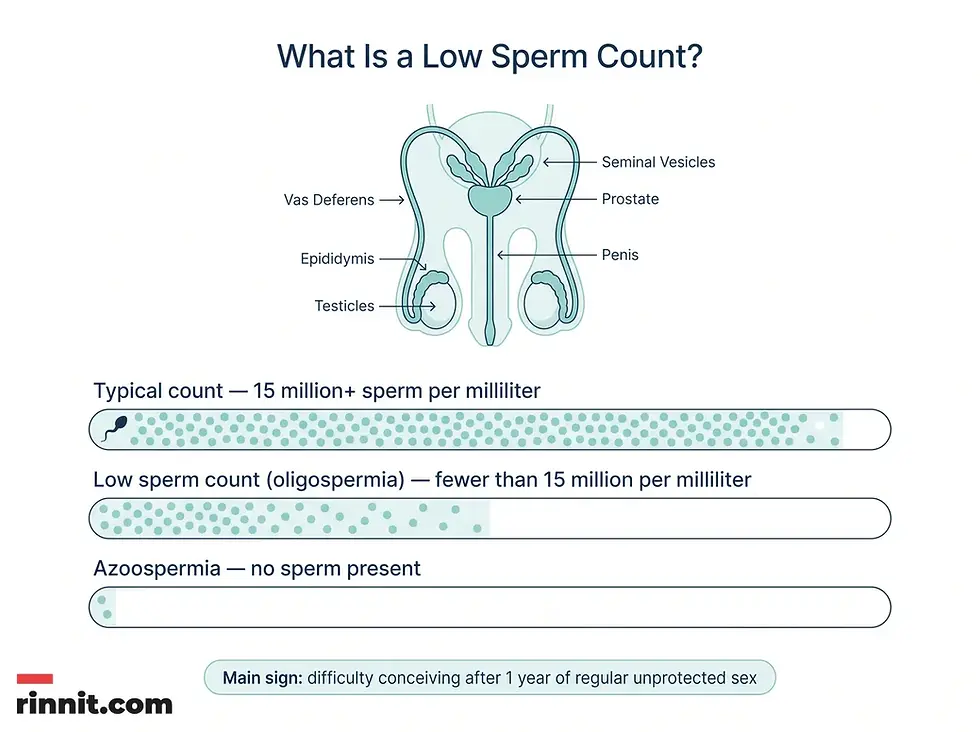
Having a low sperm count makes it less likely that a sperm will join with a partner's egg to start a pregnancy. However, it does not make pregnancy impossible. If needed, treatments can help couples boost their chances of becoming pregnant [1].
What are the symptoms of low sperm count?
The main symptom of a low sperm count is not being able to start a pregnancy. There might be no other clear symptoms at all. In some cases, an underlying health condition causes the low sperm count along with additional symptoms. These extra symptoms depend on the underlying condition and can include the issues shown in the table below [1].
Possible accompanying symptom | What it may suggest |
Low sex drive or erectile dysfunction | A hormonal condition affecting sexual function |
Pain, swelling, or a lump in the testicle area | An infection, tumor, or varicocele |
Less facial or body hair | A chromosome or hormone condition |
When to See a Doctor
See a healthcare professional if you and your partner have not been able to become pregnant after one year of regular sex without birth control. This is how infertility is defined [1].
Get a checkup sooner than that if any of the following apply to you:
Erection or ejaculation concerns, low sex drive, or other trouble having sex
Pain, discomfort, a lump, or swelling in the testicle area
A history of testicle, prostate, or sexual problems
Prior groin, testicle, penis, or scrotum surgery
How does sperm production work?
For the body to make sperm, the testicles and certain hormone-producing organs in the brain must work properly. Once sperm are made in the testicles, they travel through delicate tubes until they mix with semen. The semen is then released from the penis, usually during orgasm [1].

Issues with any of these systems can lower the number of sperm in semen. Irregular sperm movement or shape can also lessen fertility, even when the count is adequate. Still, the cause of a low sperm count often cannot be found at all [1].
What causes low sperm count?
Low sperm count can be caused by medical conditions, certain medical treatments, environmental exposures, and lifestyle and other factors.
Medical Causes
Several health conditions can cause a low sperm count. The table below summarizes the most common ones [1].
Medical cause | How it affects sperm |
Varicocele | Swelling of the veins draining the testicle; a common cause of male infertility; may affect testicle temperature; surgery can improve sperm count, movement, and shape. |
Infection | Reduces sperm health or production; scarring from repeated infections can block sperm passage; sexually transmitted infections such as gonorrhea or HIV also affect fertility. |
Trouble with ejaculation | Retrograde ejaculation sends semen into the bladder instead of out of the penis; caused by diabetes, spinal injuries, prostate or bladder surgery, or alpha blocker blood pressure medicines. |
Tumors | Cancers and non-cancerous tumors affect reproductive organs directly or through hormone glands like the pituitary; surgery, radiation, and chemotherapy can reduce sperm production. |
Undescended testicles | Testicles that do not drop into the scrotum before birth are linked to lower fertility in adulthood. |
Hormone imbalance | Changes in hormones from the hypothalamus, pituitary, testicles, thyroid, or adrenal glands disrupt sperm production. |
Blocked sperm tubes | Injury from surgery, past infections, or trauma can block the tubes that carry sperm; cystic fibrosis can cause tubes to never develop properly. |
Genetic conditions | Klinefelter syndrome, cystic fibrosis, Kallmann syndrome, and Kartagener's syndrome cause irregular development of the male reproductive organs. |
Medical Treatments That Reduce Sperm
Certain treatments can also cause a low sperm count [1].
Treatment category | Examples |
Certain medicines | Treatments for arthritis, depression, anxiety, low testosterone, digestive trouble, infections, high blood pressure, and cancer |
Prior surgeries | Vasectomy, inguinal hernia repairs, scrotum or testicle surgeries, prostate surgeries, and large abdominal surgeries for testicular or rectal cancers |
Often, surgery can reverse the blockages caused by past operations. Surgery can also retrieve sperm directly from the testicles and the epididymis, the coiled tube attached to each testicle.
Environmental Causes
Sperm count and function can be affected by exposure to certain substances in a person's surroundings [1].
Environmental factor | Effect on sperm |
Industrial chemicals | Long-term exposure to insecticides, pesticides, and organic solvents may lower sperm counts. |
Heavy metals | Exposure to lead or other heavy metals can cause infertility. |
Radiation or X-rays | Reduces sperm production; typical levels may take years to recover; high doses may cause permanent reduction. |
Excess heat on the scrotum | Overheating affects sperm count and function. |
Lifestyle and Other Causes
Several health, lifestyle, and testing factors can also lower sperm count [1].
Factor | How it lowers fertility |
Drug use | Anabolic steroids reduce sperm production; cocaine or marijuana may lower sperm number and quality. |
Alcohol use | Heavy or ongoing use lowers testosterone and sperm production. |
Tobacco smoking | Smokers tend to have lower sperm counts than non-smokers. |
Emotional stress | Long-term stress, including fertility stress, may affect semen quality. |
Obesity | May directly impact sperm or trigger hormone changes that lessen fertility. |
Sperm testing issues | A sample taken too soon after ejaculation, too soon after illness or stress, or a spilled sample can make the count appear falsely low. |
Because a single sample can be misleading, results are usually based on a few samples taken over time.
What are the risk factors for low sperm count?
Many risk factors are linked with a low sperm count and related fertility problems [1].
Category | Specific risk factors |
Lifestyle | Smoking tobacco; drinking alcohol; using illicit drugs |
Health conditions | Being overweight; being very stressed; past or present infections; testicle trauma; a personal or family history of fertility disorders; tumors and long-term illnesses; undescended testicles |
Medical treatments | Cancer treatments such as radiation; certain medicines; vasectomy or major abdominal or pelvic surgery |
Environment | Exposure to toxins |
What complications can low sperm count cause?
Infertility caused by a low sperm count can be stressful for both partners. The possible complications extend beyond emotional strain [1].
Complication | Description |
Surgery or treatments | Needed to address an underlying cause of the low count |
Expensive fertility treatments | Procedures such as in vitro fertilization are involved and costly |
Emotional stress | Arises from not being able to start a pregnancy |
How can low sperm count be prevented?
To protect fertility, stay away from known factors that can affect sperm count and quality. The table below lists the protective steps you can take [1].
Prevention step | Action |
Avoid tobacco | Don't smoke |
Moderate alcohol | Limit alcohol or don't drink it |
Avoid drugs | Don't use illicit drugs |
Review medicines | Ask your healthcare professional whether your medicines affect sperm count |
Healthy weight | Stay at a healthy weight |
Manage heat | Try not to become overheated |
Manage stress | Practice stress management techniques |
Avoid toxins | Limit exposure to pesticides, heavy metals, and other toxins |
How is low sperm count diagnosed?
You may learn you have a low sperm count when you get a checkup because you are having trouble getting your partner pregnant. At your appointment, the healthcare professional works to find the cause of the fertility trouble. Even with a suspected low sperm count, your partner's fertility may also need to be checked to guide treatment options [2].
General Physical Exam and Health History
The exam includes an examination of the genitals. The healthcare professional also asks questions about inherited conditions, long-term health problems, illnesses, injuries, and surgeries that could affect fertility. You may also be asked about your sexual habits and your sexual development [2].
Semen Analysis
A sample of your semen is collected for testing. This test is called a semen analysis. Your semen is checked under a microscope to count the sperm present, sometimes with computer assistance. There are two ways to collect a sample: you can masturbate and ejaculate into a special container at the office, or you can use a special condom that collects semen during sex [2].
Two facts are important to understand about semen analysis. First, new sperm are made regularly in the testicles and take about 42 to 76 days to mature. A semen analysis therefore reflects your environment over the past three months, and lifestyle changes will not show up for several months. Second, incomplete or improper collection is one of the most common causes of a falsely low result. Because counts also change on their own, most healthcare professionals check two or more semen samples over time [2].
Semen sample collection rule | Why it matters |
All semen must go into the collection cup or condom | A partial sample makes the count appear falsely low |
No sex or masturbation for 2 to 7 days before collection | Timing affects the sample |
Second sample collected at least two weeks after the first | Counts change on their own, so repeated testing is needed |
No lubricants during collection | Lubricant products can affect sperm movement |
Semen Analysis Results
If you have a low sperm count, your semen contains fewer than 15 million sperm per milliliter, or fewer than 39 million sperm in the entire sample. Some men have no sperm in their semen at all, which is azoospermia [2].
The chance of getting a partner pregnant drops with lower sperm counts. However, many factors go into pregnancy, and sperm count is only one of them. Many men with low sperm counts do get their partners pregnant, while some men with typical counts are not able to start pregnancies. Healthy sperm movement, called motility, is also required to start a pregnancy even when enough sperm are present [2].
Other Tests
Depending on the semen analysis results, additional tests can look for the underlying cause [2].
Test | What it checks |
Scrotal ultrasound | Uses high-frequency sound waves to examine the testicles and supporting structures |
Hormone testing | Blood test for hormones made by the pituitary gland and testicles that drive sexual development and sperm production |
Post-ejaculation urinalysis | Urine test after ejaculation; sperm in the urine indicates retrograde ejaculation |
Genetic tests | Blood test for genetic conditions when sperm levels are extremely low; results matter because gene changes can pass to children |
Testicle biopsy | Small tissue samples removed with a needle; not commonly used to find the cause of infertility |
Transrectal ultrasound | A lubricated wand checks the prostate and looks for blockages in the semen-carrying tubes |

What are the treatment options for low sperm count?
Treatment depends on the underlying cause. The table below summarizes the main treatment categories [2].
Treatment | What it involves |
Surgery | Repair a varicocele; repair an obstructed vas deferens; reverse a past vasectomy; collect sperm directly from the testicles or epididymis if none appears in semen. |
Treatments for infections | Antibiotics can cure a reproductive tract infection, though this does not always restore fertility. |
Treatments for sexual conditions | Medicine or counseling can improve fertility in erectile dysfunction or premature ejaculation. |
Hormone treatments and medications | Help when infertility is caused by abnormal hormone levels or problems with hormone use. |
Assisted reproductive technology (ART) | Helps couples become pregnant without sex, using sperm collected through ejaculation, surgery, or donors. |
Assisted Reproductive Technology Explained
ART covers several procedures, each suited to different situations. The table below compares the three main types [2].
ART procedure | How it works |
Intrauterine insemination | Sperm are placed directly into the uterus through a tube |
In vitro fertilization (IVF) | Sperm and eggs are mixed together in a lab and placed in the uterus |
Intracytoplasmic sperm injection (ICSI) | A single healthy sperm is injected into each mature egg before placement in the uterus |
When Treatment Doesn't Work
Rarely, male fertility problems cannot be treated and the affected person's sperm cannot be used to start a pregnancy. Even then, having a child is still possible. Couples can consider using sperm from a donor or adopting a child [2].
Which lifestyle and home remedies help with low sperm count?
You can take steps at home to raise your chances of getting your partner pregnant [2].
Home strategy | Details |
Have sex more often | Every day or every other day; start 5 to 7 days before ovulation and continue until 2 days after ovulation |
Avoid certain lubricants | Astroglide, K-Y Jelly, lotions, and saliva might affect sperm movement; ask your healthcare professional about sperm-safe lubricants |
Exercise and diet | Get regular exercise and eat a balanced diet |
Sleep | Aim for at least seven hours of sleep a night |
Manage stress | Take charge of stress |
Quit smoking and drugs | Stop tobacco and illicit drug use as soon as possible |
Avoid overheating | Try not to become overheated |
Can alternative medicine help with low sperm count?
If you have a low sperm count, taking a multivitamin is reasonable. However, talk with your healthcare professional before trying any other supplement or type of alternative medicine. It is unclear whether supplements can help treat male infertility, and some supplements may interfere with medicines you take or health conditions you have [2].
How should you prepare for a low sperm count appointment?
For a low sperm count, you can start by seeing your family healthcare professional, who might refer you to an infertility specialist [2].
What You Can Do
Before your appointment, prepare with the checklist below.
Preparation step | Details |
Note any restrictions | Ask if you need to abstain from sex or masturbation for a certain time before testing |
Write down symptoms | Include anything that might not seem related to the appointment |
Note key personal info | Major stresses or recent life changes |
Check family fertility history | A brother or father with fertility trouble or reproductive conditions offers clues |
Ask your parents | Whether you had undescended testes or other conditions at birth or in early childhood |
List all medicines | Include vitamins and supplements with the amounts you take |
Bring your partner | They may also need tests, and a second listener helps track instructions |
Write down questions | Prepare a list of questions for your healthcare professional |
Questions to Ask Your Healthcare Professional
What do you think may be causing my low sperm count?
Other than the most likely cause, what are other possible reasons we haven't been able to become pregnant?
What kinds of tests do I need?
Will my partner also need tests?
What treatments are available to raise my sperm count, and which do you recommend?
Are there any restrictions I need to follow?
At what point should we think about options such as a sperm donor or adoption?
Are there brochures or websites you recommend?
What to Expect From Your Doctor
The healthcare professional may also ask you questions. Be ready to answer about the age you started puberty, any vasectomy or vasectomy reversal, use of marijuana, cocaine, or anabolic steroids, regular exposure to chemicals, pesticides, radiation, or lead, all medicines and dietary supplements you take, and any history of undescended testicles [2].
What is the bottom line on low sperm count?
Low sperm count is defined as fewer than 15 million sperm per milliliter of semen, and its most common sign is difficulty conceiving after a year of regular unprotected sex. The causes are wide-ranging, from varicoceles and infections to medications, environmental toxins, and lifestyle habits, and often require a semen analysis plus additional tests to identify. The good news is that many men with low sperm counts can still father children, and a full range of treatments exists, from simple lifestyle changes and medication to surgery and assisted reproductive technology [1][2].
Your next step: If you and your partner have been trying to conceive for a year without success, or if you have any of the warning signs described in this article, schedule an appointment with your healthcare professional. Early evaluation identifies treatable causes and opens the door to effective fertility options. Talk to your healthcare provider about your fertility options today.
Frequently Asked Questions
What is considered a low sperm count?
A sperm count below 15 million sperm per milliliter of semen is considered low. A total of fewer than 39 million sperm in the entire sample also qualifies as low. A complete absence of sperm is called azoospermia.
What is the main symptom of a low sperm count?
The main symptom is not being able to start a pregnancy. There are often no other clear symptoms unless an underlying condition such as a hormone problem or infection is also present.
What is the most common medical cause of low sperm count?
A varicocele, which is a swelling of the veins that drain the testicle, is a common cause of male infertility. It lowers both sperm count and quality, and surgery to fix it can improve sperm count, movement, and shape.
Can a low sperm count be caused by lifestyle?
Yes. Smoking tobacco, heavy alcohol use, illicit drug use including anabolic steroids, obesity, and long-term emotional stress can all lower sperm count or quality.
How is low sperm count diagnosed?
The main test is a semen analysis, where semen is collected and examined under a microscope. Because counts vary on their own and collection errors are common, most healthcare professionals check two or more samples over time.
How long does a semen sample reflect your health?
Sperm take about 42 to 76 days to mature, so a semen analysis reflects your environment and habits over the past three months. Lifestyle changes typically take several months to show up in results.
Can low sperm count be treated?
Treatment depends on the cause and may include surgery to repair a varicocele or blockage, antibiotics for infections, hormone therapy, and assisted reproductive technology such as IVF or intracytoplasmic sperm injection.
What is intracytoplasmic sperm injection (ICSI)?
ICSI is an assisted reproductive technology in which a single healthy sperm is injected directly into each mature egg before the eggs are placed in the uterus.
Can you get pregnant with a low sperm count?
Yes. The chance of pregnancy drops with lower counts, but many men with low sperm counts still get their partners pregnant, since sperm count is only one of several factors in conception.
What lifestyle changes can improve sperm count?
Quit smoking, limit or avoid alcohol, stop illicit drug use, stay at a healthy weight, manage stress, get at least seven hours of sleep, exercise regularly, and avoid overheating the scrotum and exposure to toxins like pesticides and heavy metals.
How long should we try before seeing a doctor about fertility?
See a healthcare professional after one year of regular sex without birth control without a pregnancy. Seek earlier care if you have erection or ejaculation concerns, testicle pain or lumps, or a history of testicle or prostate problems.
Related Reading
Hydrocele: causes, symptoms, and treatment
For authoritative external guidance, visit these resources:
National Institute of Child Health and Human Development: Male infertility
American Urological Association: Male infertility guidelines
American Society for Reproductive Medicine: ASRM
Learn more in our guide to Semen Analysis: Purpose, How to Prepare and What Results Mean.
References
Mayo Clinic. Low sperm count - Symptoms and causes. Mayo Clinic. October 23, 2024. https://www.mayoclinic.org/diseases-conditions/low-sperm-count/symptoms-causes/syc-20374585
Mayo Clinic. Low sperm count - Diagnosis and treatment. Mayo Clinic. October 23, 2024. https://www.mayoclinic.org/diseases-conditions/low-sperm-count/diagnosis-treatment/drc-20374591
Birowo P, Tendi W, Widyahening IS, et al. The benefits of varicocele repair for achieving pregnancy in male infertility: a systematic review and meta-analysis. Heliyon. 2020;6(11):e05439. PMID 33204888. https://doi.org/10.1016/j.heliyon.2020.e05439
Kohn TP, Ohlander SJ, Jacob JS, et al. The effect of subclinical varicocele on pregnancy rates and semen parameters: a systematic review and meta-analysis. Curr Urol Rep. 2018;19(7):53. PMID 29774482. https://doi.org/10.1007/s11934-018-0798-8
Agarwal A, Cannarella R, Saleh R, et al. Impact of antioxidant therapy on natural pregnancy outcomes and semen parameters in infertile men: a systematic review and meta-analysis of randomized controlled trials. World J Mens Health. 2023;41(1):14-48. PMID 36102104. https://doi.org/10.5534/wjmh.220067
Medical disclaimer
This article is for informational purposes only and is not a substitute for professional medical advice, diagnosis, or treatment. The clinical information in this guide reflects source material last reviewed in October 2024.



Comments