Semen Analysis: Purpose, How to Prepare and What Results Mean

Updated: 2 days ago
Written and medically reviewed by Dr. Baraa Alnahhal, MD · Last reviewed: November 2026 · How we review
Quick Answer: What is a semen analysis?
A semen analysis is a lab test that looks at a semen sample under a microscope to check how many sperm there are, how well they move and what shape they are. It's one of the first tests used when a couple has trouble getting pregnant, and it also confirms whether a vasectomy has worked. [1]
What the research says
Updated reference values describe the lowest 5% of fertile men. Pooling data from more than 3,500 men in 12 countries, researchers found the 5th-centile values were 16 million sperm per mL, 42% total motility (30% progressive) and 4% normal forms. They stress these are not sharp cut-offs between fertile and subfertile men. (Campbell et al., Andrology, 2021) [2]
Average sperm concentration has fallen worldwide since the 1970s. A meta-analysis of 223 studies with samples collected from 1973 to 2018 found mean sperm concentration among men not selected by fertility fell by 51.6%, and the yearly decline was steeper after 2000 (2.64% per year). (Levine et al., Human Reproduction Update, 2023) [3]
How long you abstain before the test changes the numbers. Across 85 studies, shorter abstinence in healthy men was linked with lower semen volume (about 0.95 mL less) and lower total sperm count. The authors caution that confounding makes firm cause-and-effect conclusions difficult. (Du et al., Andrology, 2024) [4]
Key takeaways
A semen analysis measures sperm count, movement (motility) and shape (morphology), plus semen volume, pH and other features. [1]
It is used to look for male-factor infertility and to confirm a vasectomy was successful. [1]
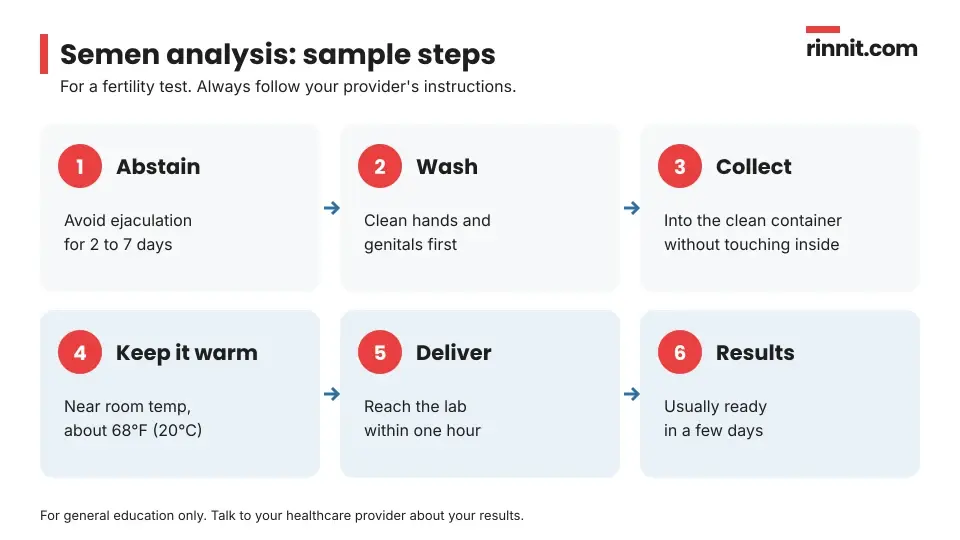
For fertility testing, you usually avoid ejaculation for 2 to 7 days before giving the sample. [1]
A sample collected at home should reach the lab within one hour and be kept near room temperature. [1]
Sperm counts vary from day to day, so you may need more than one test a few weeks apart. [1]
An abnormal result lowers the odds of pregnancy but does not tell the whole story; more tests may follow. [1]
What is a semen analysis?
Semen (ejaculate) is the fluid released from the penis at orgasm. It carries sperm, the cells that fertilize an egg. [1]
A semen analysis examines a fresh semen sample in a lab. A specialist looks at it under a microscope and measures several features that together give a picture of sperm health. [1]
You may also hear it called a sperm analysis or sperm count test. When it is done after a vasectomy, it is often called a post-vasectomy semen analysis. [1]
Why is a semen analysis done?
There are two main reasons your provider may order this test. [1]
Fertility testing: If you and your partner have had trouble getting pregnant, a problem with semen or sperm may be part of the cause. The test is one of the first steps in checking male fertility. [1]
After a vasectomy: The test confirms that sperm no longer appear in your semen, so you know the procedure has worked. [1]
Before the test, your provider may ask about your medical history and do a physical exam, which can include a genital exam. [1]
What does a semen analysis measure?
The lab checks the sperm themselves and the fluid that carries them. Key measurements include: [1]
Sperm concentration (count): how many sperm are in each milliliter of semen.
Motility: the share of sperm that are moving.
Morphology: the share of sperm with a normal shape, meaning one round head and a tail.
Vitality: the share of sperm that are alive.
Volume: how much semen is in the sample.
pH: how acidic or alkaline the semen is.
Liquefaction time: how long semen takes to turn from a thick gel into a liquid.
White blood cells: small numbers are normal; high numbers can point to infection or inflammation.
Together, these features help your provider judge how likely sperm are to reach and fertilize an egg. [1]
How do you prepare for a semen analysis?
Preparation depends on why you are having the test. Your provider will give you instructions, so follow those first. [1]
For fertility testing
The abstinence window matters because time since your last ejaculation affects semen volume and total sperm count. [4]
After a vasectomy
How is the semen sample collected?
The preferred way to collect a sample is by masturbation, either at home or in a private room at the clinic or lab. Feeling nervous or embarrassed is common, and staff handle every sample in a routine, professional way. [1]
Wash your hands and genitals before you start. [1]
Collect the semen directly into the clean, wide-mouthed container you were given, without touching the inside. [1]
If some of the sample misses the container, do not try to scoop it up, because that can contaminate it. Tell the lab instead. [1]
Close the container and label it as instructed.
Saliva, vaginal fluid and most personal lubricants can harm sperm, so avoid them. If masturbation is not an option for you, including for religious reasons, ask your provider for a special nonlubricated collection condom; the semen is then moved into the container. [1]
Getting a home sample to the lab
If you collect at home, deliver the sample within one hour. Keep it close to room temperature, about 68°F (20°C), because heat or cold can affect sperm. [1]
What are normal semen analysis results?
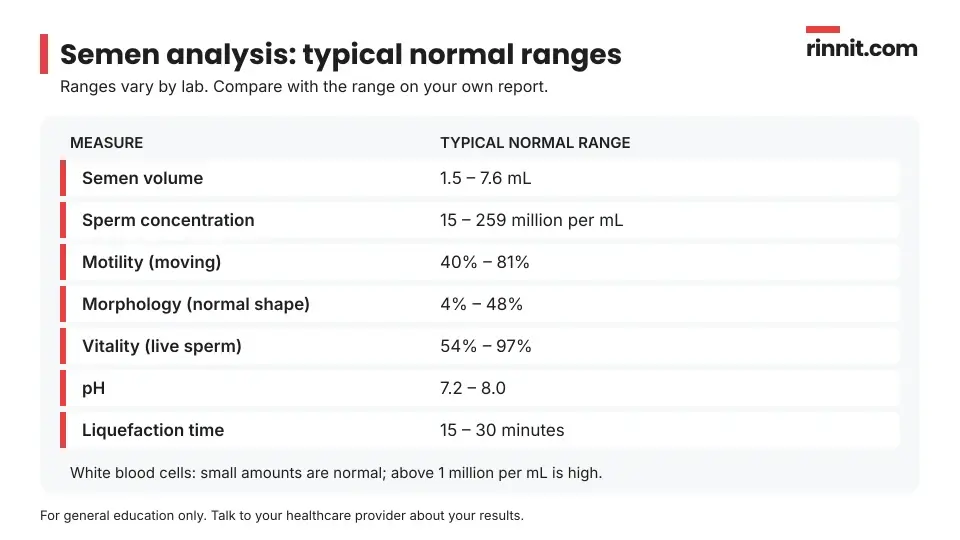
Normal values describe a sample that is likely to support fertility. The table below shows commonly used ranges. Ranges vary by lab, so always compare your report with the range your lab provides. [1]
Measure | Typical normal range |
Semen volume | 1.5 to 7.6 mL |
Sperm concentration | 15 to 259 million per mL |
Motility (moving sperm) | 40% to 81% |
Morphology (normal shape) | 4% to 48% |
Vitality (live sperm) | 54% to 97% |
pH | 7.2 to 8.0 |
Liquefaction time | 15 to 30 minutes after collection |
White blood cells | Small amounts are normal; above 1 million per mL is high |
Sources: [1]
In general, a healthy fertility result shows active sperm with a normal shape, enough sperm, a pH that is not too acidic and semen that liquefies promptly. [1]
Reference values come from large studies of fertile men. One update found the lowest 5% of fertile men had about 16 million sperm per mL and 4% normal forms, and its authors note these values do not sharply separate fertile from subfertile men. [2]
What do abnormal results mean?
An abnormal fertility result means the chance of pregnancy is lower than average, not that pregnancy is impossible. A semen analysis is only one part of a male fertility workup. [1]
A high white blood cell count (pyospermia) can be a sign of infection or inflammation. [1]
Depending on your results, your provider may suggest more tests: [1]
Sperm counts naturally vary over time. Large studies also show that average sperm concentration has dropped in many parts of the world since the 1970s, which is one reason labs rely on updated reference values. [1] [3]
What results are expected after a vasectomy?
After a vasectomy, the goal is a sample with no sperm (azoospermia) or only a very small number of sperm that are not moving. Finding moving sperm, or many nonmoving sperm, is an abnormal result. [1]
It can take several weeks for semen to become sperm-free, so you may need repeat tests. Use backup birth control until your provider tells you the result is confirmed. [1]

Fertility testing | After a vasectomy | |
Main goal | Check sperm count, movement and shape | Confirm sperm are gone |
Timing | After 2 to 7 days without ejaculating | About 8 to 12 weeks after the procedure |
Expected result | Values within the lab's normal ranges | No sperm or very few nonmoving sperm |
Possible next steps | Repeat test, hormone or genetic blood tests, ultrasound | Repeat test; use backup birth control until confirmed |
Sources: [1]
How long do semen analysis results take?
Results are usually ready a few days after you give the sample. [1]
Because sperm counts change from day to day, a single test may not give a complete picture. Your provider may ask for more than one sample, often a few weeks apart. [1]
Are at-home sperm tests as good as a lab test?
At-home sperm tests are less thorough than a full lab semen analysis, and the evidence behind them is limited. Relying on one may delay a proper diagnosis and treatment. [1]
If you are worried about fertility, a lab test ordered by your provider gives a more complete result.
When should you talk to your provider?
Talk to your provider if you have concerns about fertility or if you and your partner are having trouble getting pregnant. [1]
Ask questions any time something about the test is unclear, such as how to collect the sample, what your numbers mean or whether you need a repeat test. [1]
Questions to ask your provider
How many days should I avoid ejaculating before my test?
Should I collect the sample at home or at the clinic?
How will I get a home sample to the lab in time?
Which results on my report are outside the normal range, and what do they mean?
Will I need a repeat semen analysis, and when?
Do I need blood tests or an ultrasound next?
After my vasectomy, when can I stop using backup birth control?
Conclusion
A semen analysis is a simple, noninvasive lab test that shows how many sperm you have, how well they move and how they are shaped. It is a key early step in checking male fertility and the standard way to confirm a vasectomy has worked. [1]
Good preparation helps you get an accurate result: follow the abstinence window, collect the sample carefully and get it to the lab quickly. If a result is abnormal, it is a starting point for further testing, not a final answer. [1]
Keep learning: Read our guides to male infertility, low sperm count and varicocelectomy. For more, see MedlinePlus: Semen Analysis.
FAQ
What is a semen analysis?
It is a lab test that checks a semen sample for sperm count, movement and shape, along with volume and other features. [1]
Why is a semen analysis done?
It is used to check male fertility when a couple has trouble conceiving and to confirm that a vasectomy worked. [1]
How do I prepare for a semen analysis?
For fertility testing, avoid ejaculation for 2 to 7 days beforehand and bring photo ID if you go to a lab. Follow your provider's instructions. [1]
How is the sample collected?
Usually by masturbation into a clean container, at home or in a private clinic room. A special nonlubricated condom is an option if needed. [1]
Does a semen analysis hurt?
No. Collecting the sample is painless and needs no needles. Feeling nervous or embarrassed is common, and staff handle samples professionally. [1]
How fast must a home sample reach the lab?
Within one hour, kept near room temperature, about 68°F (20°C). [1]
What is a normal sperm count?
A typical normal range is 15 to 259 million sperm per mL. Ranges vary by lab. [1]
How long do results take?
Results usually come back within a few days. [1]
Will I need more than one test?
Often, yes. Sperm counts vary day to day, so a repeat test a few weeks later is common. [1]
When is the test done after a vasectomy?
Usually about 8 to 12 weeks after the procedure. Use backup birth control until your result is confirmed. [1]
Related Reading
Learn more in our guide to Male Infertility: Causes, Symptoms, Tests, and Treatments Explained.
Learn more in our guide to Low Sperm Count: Symptoms, Causes, Diagnosis, and Treatment Explained.
Learn more in our guide to Oligospermia Comprehensive Guide: Causes, Diagnosis, and Treatment for Low Sperm Count.
Learn more in our guide to Varicocelectomy: Improving Fertility and Reducing Testicular Pain.
Learn more in our guide to Semen: Understanding the Composition and Role of Seminal Fluid.
References
Cleveland Clinic. Semen Analysis: Purpose, Procedure & Results. Cleveland Clinic. Last updated January 30, 2024. https://my.clevelandclinic.org/health/diagnostics/21520-semen-analysis
Campbell MJ, Lotti F, Baldi E, et al. Distribution of semen examination results 2020 - A follow up of data collated for the WHO semen analysis manual 2010. Andrology. 2021;9(3):817-822. PMID 33528873. https://doi.org/10.1111/andr.12983
Levine H, Jørgensen N, Martino-Andrade A, et al. Temporal trends in sperm count: a systematic review and meta-regression analysis of samples collected globally in the 20th and 21st centuries. Hum Reprod Update. 2023;29(2):157-176. PMID 36377604. https://doi.org/10.1093/humupd/dmac035
Du C, Li Y, Yin C, et al. Association of abstinence time with semen quality and fertility outcomes: a systematic review and dose-response meta-analysis. Andrology. 2024;12(6):1224-1235. PMID 38197853. https://doi.org/10.1111/andr.13583
Medical disclaimer
This article is for general education only and does not replace advice from a qualified healthcare professional. Talk to your doctor about your own diagnosis and treatment, and seek emergency care right away for severe or sudden symptoms.



Comments