Lipoma: Symptoms, Causes, Diagnosis, and Treatment

Updated: 2 days ago
Medically reviewed by Dr. Baraa Alnahhal, MD · Last reviewed: October 2026
A lipoma is a slow-growing, soft fatty lump under the skin that is not cancer and usually needs no treatment. It feels doughy, moves easily with finger pressure, and most often appears on the neck, shoulders, back, abdomen, arms, or thighs, commonly between ages 40 and 60. Any new lump should still be checked by a healthcare professional, and removal by surgery or liposuction is an option if it bothers you, hurts, or grows [1].
Quick Answer: What is a lipoma?
A lipoma is a harmless, slow-growing fatty lump just below the skin, most often on the neck, shoulders, back, abdomen, arms or thighs. It feels soft, moves easily and is usually less than 1 to 2 inches across. It is not cancer and typically needs no treatment, but it can be removed if painful, growing or bothersome. [1] [2]
What the research says
Most deep fatty lumps are benign, but size and location matter. In a review of 248 patients with deep lipomatous tumours, 81 (32.7%) turned out to be atypical lipomatous tumours (a low-grade fatty cancer), the rest were lipomas; these tumours were larger than lipomas (median 19 vs 10 cm), none was smaller than 5 cm, and they were more likely in the lower limb (48.4% vs 13.5%) (Cairncross et al., Br J Surg, 2019 [3]).
A lump's feel and symptoms alone can't reliably tell it is harmless. In a nine-year cohort study comparing 15 clinical, ultrasound, and MRI signs against the final pathology, none of the clinical signs (including size, depth, growth noticed by the patient, and pain) was a statistically significant predictor of a non-benign tumour, and only ultrasound depth was (p = 0.044), which is why a new lump should be examined rather than judged by its features (Khan et al., Sci Rep, 2020 [4]).
A simple MRI decision tree separated lipomas from well-differentiated liposarcoma with about 92% accuracy. In 231 patients (186 lipoma and variants, 45 liposarcoma) the model reached an accuracy of 91.77% (sensitivity 80%, specificity 94.62%), and in an external group of 157 patients it reached 91.72% (sensitivity 66.67%, specificity 95.59%) (Shim et al., Eur J Radiol, 2020 [5]).
What Is a Lipoma?
A lipoma is a slow-growing, fatty lump that most often lies between the skin and the muscle layer, just below the skin. It feels soft and rubbery and often isn't tender. It also moves with slight finger pressure, as if it is not connected to the skin above [1].
Lipomas are often detected in middle age, and some people have more than one. A lipoma is not cancer, and it typically is harmless [1].
Key Fact | What It Means for You |
Not cancer | A lipoma is a benign fatty growth with no malignant behavior. |
Location | Between the skin and the muscle layer, below the skin. |
Feel | Soft, rubbery, and doughy; often not tender. |
Movement | Moves with slight finger pressure. |
Growth | Slow-growing; often found in middle age. |
Number | Some people have more than one. |

A lipoma sits in the fatty layer under the skin and most often appears on the neck, shoulders, back, abdomen, arms, and thighs.
How does a lipoma feel, and where does it appear?
Lipomas can occur anywhere in the body. They share a small set of features that help distinguish them from other lumps [1].
Feature | Typical Presentation |
Location | Just under the skin, most often on the neck, shoulders, back, abdomen, arms, and thighs. |
Texture | Soft and doughy to the touch. |
Mobility | Moves easily with slight finger pressure. |
Size | Generally small, typically less than 1 to 2 inches (3 to 5 centimeters) in diameter, but can grow. |
Pain | Sometimes painful if the lipoma grows and presses on nearby nerves or contains many blood vessels. |
Most lipomas cause no symptoms beyond the visible or palpable lump itself. Pain is uncommon and usually occurs only when a lipoma grows enough to press on nearby nerves or when it contains many blood vessels [1].
When should you see a doctor about a lipoma?
A lipoma is rarely a serious medical condition. But if you notice a lump or swelling anywhere on your body, have your healthcare professional check it [1]. A proper evaluation is the only way to confirm that a lump really is a harmless lipoma and not something else that needs attention.
What Causes a Lipoma?
The cause of lipomas isn't fully understood. They tend to run in families, so genetic factors likely play a role in their development [1].
What are the risk factors for a lipoma?
Several factors may raise your risk of getting a lipoma [1]:
Risk Factor | Details |
Age | Being between 40 and 60 years old; lipomas can occur at any age, but they are most common in this age group. |
Genetics | Lipomas tend to run in families. |

Age, family history, and having more than one lipoma are the main patterns.
What complications can a lipoma cause?
The main concern is not the lipoma itself but mistaking something else for a lipoma. There is a very small chance that a lump that looks like a lipoma may be a cancer called liposarcoma, a cancerous tumor in fatty tissue [2].
Lipoma (Benign) | Liposarcoma (Cancerous) |
Grows slowly | Grows rapidly |
Moves under the skin | Doesn't move under the skin |
Often painless | Often painless, so pain is not a reliable sign |
If your healthcare professional suspects liposarcoma, a biopsy, or an MRI or CT scan, is typically done to rule it out [2].
How is a lipoma diagnosed?
To diagnose a lipoma, your healthcare professional may take the following steps, moving to the next only when the lump has unusual features [2]:
Diagnostic Step | When It's Used |
Physical examination | The first step for most lumps: checking how it feels and moves. |
Biopsy | Removing a tissue sample for lab examination. |
Imaging (X-ray, ultrasound, MRI, or CT scan) | Ordered if the lump is large, has unusual features, or appears to be deeper than the fatty tissue. |
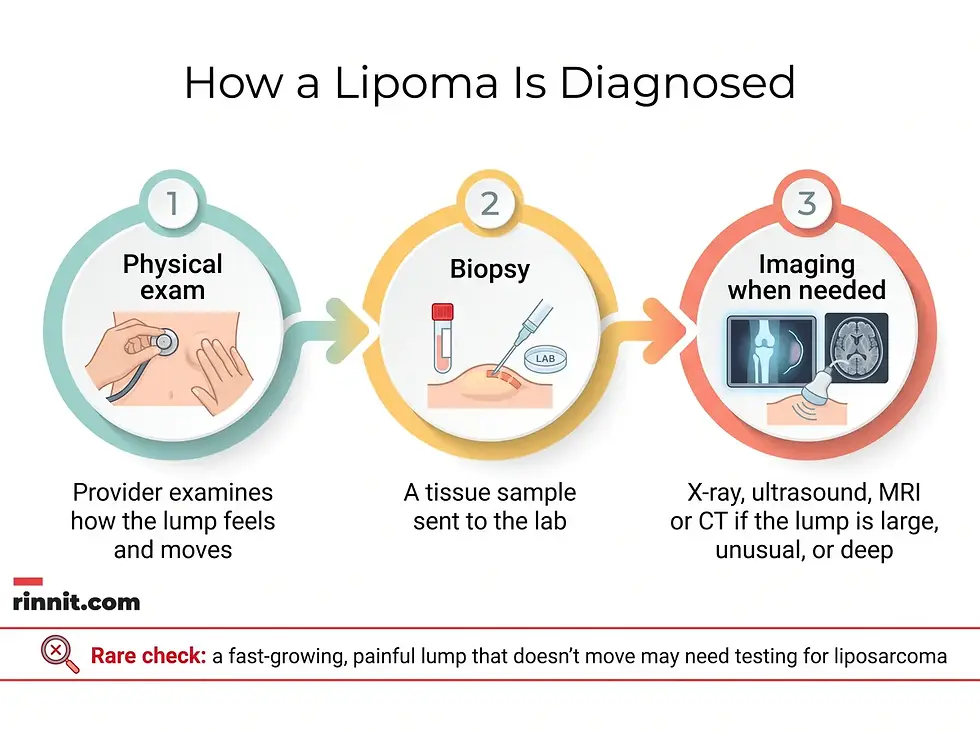
Diagnosis starts with an exam and adds a biopsy or imaging only when needed.
What are the treatment options for a lipoma?
A lipoma typically doesn't need to be treated. But if the lipoma bothers you, or if it's painful or growing, your healthcare professional might recommend removing it [2].
Treatment | How It Works | Things to Know |
No treatment (watchful waiting) | Leave the lipoma alone if it's harmless. | The usual approach for painless, non-growing lumps. |
Surgical removal | Most lipomas are removed surgically by cutting them out. | Lipomas typically don't return once removed; possible side effects are scarring and bruising. |
Minimal excision extraction | A technique for surgical removal. | May result in less scarring. |
Liposuction | Uses a needle and a large syringe to remove the fatty lump. | An alternative to cutting out the lump. |
How should you prepare for a lipoma appointment?
You're likely to start by seeing your primary healthcare professional, and you may then see a healthcare professional who specializes in skin disorders, known as a dermatologist [2].
Prepare | What to Bring or Note |
Symptom list | Details about the lump and any other symptoms, including those that seem unrelated. |
Medicine list | All medicines, vitamins, and supplements you take. |
Questions | See the lists below. |
Questions to ask your provider include: What caused this growth? Is it cancer? Do I need tests? Will this lump always be there? Can I have it removed? What's involved in removing it? Are there risks? Is it likely to return, or am I likely to get another? Do you have any brochures or other resources I can have? What websites do you recommend?
Your provider will likely ask: When did you notice the lump? Has it grown? Have you had similar growths in the past? Is the lump painful? Have others in your family had similar lumps?
Conclusion
A lipoma is one of the most common and most benign lumps you can find under your skin. It grows slowly, feels soft and doughy, moves freely under your fingers, and is almost never dangerous. Most never need treatment at all [1].
Your next step: If you've noticed a new lump or swelling anywhere on your body, book an appointment with your healthcare professional. A quick exam can confirm what it is, rule out the rare serious causes, and set up removal if the lump bothers you.
Frequently Asked Questions
What is a lipoma?
A lipoma is a slow-growing, fatty lump located between the skin and muscle layer, just below the skin. It feels soft and rubbery, often isn't tender, and is not cancer.
What does a lipoma feel like?
A lipoma feels soft, doughy, and rubbery to the touch. It moves easily with slight finger pressure, as if it isn't connected to the skin above.
Where do lipomas most often appear?
Lipomas most often appear on the neck, shoulders, back, abdomen, arms, and thighs. They sit just under the skin and can occur anywhere in the body.
How big do lipomas get?
Lipomas are generally small, typically less than 1 to 2 inches (3 to 5 centimeters) in diameter. However, they can grow over time.
Is a lipoma cancer?
No. A lipoma is not cancer and typically is harmless. Very rarely, a lump that looks like a lipoma may instead be a cancer called liposarcoma, which is why new lumps should be checked.
What causes lipomas?
The cause isn't fully understood, but lipomas tend to run in families, so genetic factors likely play a role in their development.
Who is most likely to get a lipoma?
People between 40 and 60 years old are most likely to develop a lipoma, though it can occur at any age. Family history also raises risk.
Do lipomas need to be removed?
Usually no. Treatment generally isn't needed. Removal is considered if the lipoma bothers you, is painful, or is growing.
Can a lipoma be painful?
Sometimes. Lipomas can be painful if they grow and press on nearby nerves or if they contain many blood vessels.
Will a lipoma come back after removal?
Lipomas typically don't return once they're removed surgically.
How is a lipoma removed?
Most lipomas are removed surgically by cutting them out, sometimes with a minimal excision extraction technique that leaves less scarring. Liposuction, using a needle and large syringe, is another option.
Related Reading
Fine-Needle Aspiration (FNA): What It Is, Why It's Done, What to Expect and Results explains how a thin needle samples cells or fluid from a lump, what to expect and what results can show.
References
Mayo Clinic Staff. Lipoma: symptoms & causes. Mayo Clinic. May 16, 2025. https://www.mayoclinic.org/diseases-conditions/lipoma/symptoms-causes/syc-20374470
Mayo Clinic Staff. Lipoma: diagnosis & treatment. Mayo Clinic. May 16, 2025. https://www.mayoclinic.org/diseases-conditions/lipoma/diagnosis-treatment/drc-20374474
Cairncross L, Snow HA, Strauss DC, et al. Diagnostic performance of MRI and histology in assessment of deep lipomatous tumours. British Journal of Surgery. 2019;106(13):1794-1799. PMID 31502664. https://doi.org/10.1002/bjs.11309
Khan K, Azzopardi E, Camilleri L, et al. Value of clinical, ultrasonographic and MRI signs as diagnostic differentiators of non-benign lipomatous tumours. Scientific Reports. 2020;10(1):20756. PMID 33247209. https://doi.org/10.1038/s41598-020-77244-2
Shim EJ, Yoon MA, Yoo HJ, et al. An MRI-based decision tree to distinguish lipomas and lipoma variants from well-differentiated liposarcoma of the extremity and superficial trunk: classification and regression tree (CART) analysis. European Journal of Radiology. 2020;127:109012. PMID 32339981. https://doi.org/10.1016/j.ejrad.2020.109012
Medical disclaimer
This article is for informational purposes only and is not a substitute for professional medical advice, diagnosis, or treatment. The clinical information in this guide reflects source material last reviewed in May 2025.



Comments