Mediastinoscopy: Why It's Done, Procedure, Recovery and Risks

Updated: 2 days ago
Written and medically reviewed by Dr. Baraa Alnahhal, MD · Last reviewed: November 2026 · How we review
Quick Answer
A mediastinoscopy is a minor surgical procedure that uses a thin scope with a light and camera to look at the mediastinum, the space between the lungs. Through a small cut above the breastbone, the surgeon removes samples of lymph nodes or masses. It's mainly used to stage lung cancer. Most people go home the same day.
What the research says
Needle-based staging is often done first: in a randomized trial of 241 people with suspected lung cancer, starting with endosonography (EBUS/EUS) and adding mediastinoscopy only when needed found lymph node spread more often (94% vs 79% sensitivity) and cut unnecessary chest surgeries from 18% to 7% compared with mediastinoscopy alone (Annema JT et al., JAMA, 2010) [2]
Confirmatory mediastinoscopy has trade-offs: a meta-analysis found similar rates of missed lymph node spread after a negative endosonography whether or not mediastinoscopy was added (9.6% vs 9.9%), while mediastinoscopy itself had a 6.0% complication rate, mostly hoarseness from nerve irritation (Bousema JE et al., Journal of Thoracic Oncology, 2019) [3]
Key takeaways
A scope through a small cut above the breastbone to sample lymph nodes between the lungs.
Mainly for staging lung cancer; also for lymphoma, sarcoidosis, thymus and esophageal tumors.
General anesthesia; about an hour; usually same-day discharge.
Expect a sore throat, cough or hoarseness for a day or two.
Bleeding is the most common complication; serious problems are rare.
What is the mediastinum?
The mediastinum is the central part of your chest between the lungs. It contains the heart and major blood vessels, the trachea, the esophagus, the thymus and chains of lymph nodes that drain the lungs. Cancer that spreads from the lungs often reaches these nodes first. Sources: [1]
Why is it done?
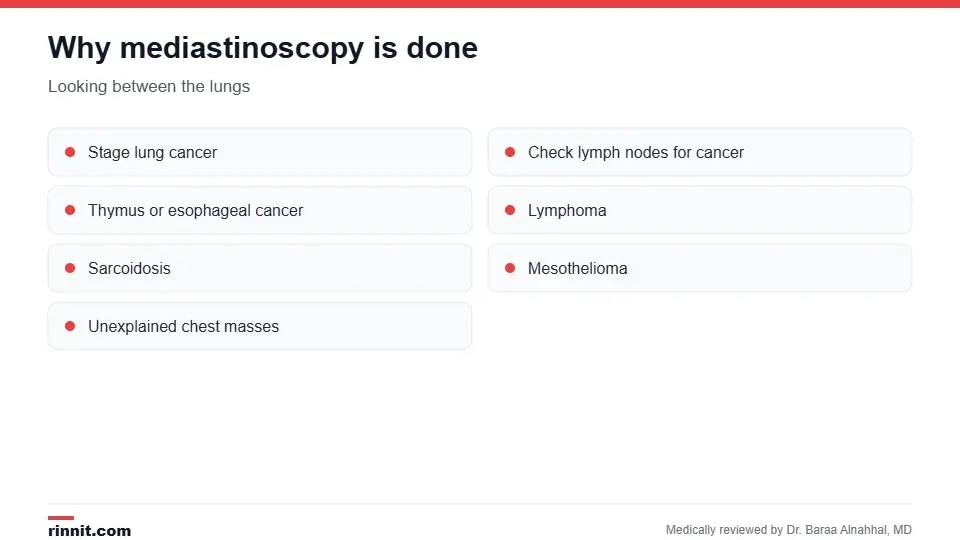
Mediastinoscopy samples lymph nodes between the lungs.
To stage lung cancer, especially non-small cell lung cancer, by checking lymph nodes for cancer before surgery.
To stage thymus or esophageal cancer, such as thymoma.
To diagnose mediastinal tumors, lymphoma such as Hodgkin lymphoma, sarcoidosis or mesothelioma.
Less often, to diagnose a lung infection. Sources: [1]
Results feed into cancer staging, which guides whether surgery, chemotherapy or radiation is best. Often, a less invasive needle biopsy through a scope, such as bronchoscopy with endobronchial ultrasound, is tried first. Sources: [1, 2]
Who shouldn't have it?
Mediastinoscopy may not be suitable if you've had one before, had radiation to the chest or have a tumor that can't be operated on. Sources: [1]
How do I prepare?
Have the tests your team orders, such as a chest X-ray, CT scan, PET scan and pulmonary function tests.
Stop blood thinners a few days before, as instructed.
Don't eat or drink for several hours before surgery.
Arrange for someone to drive you home. Sources: [1]
What happens during the procedure?
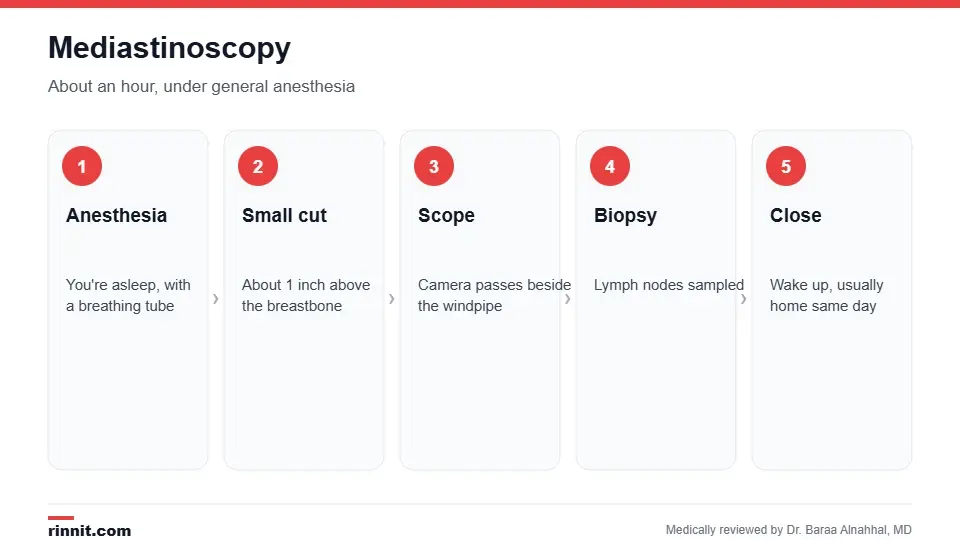
Mediastinoscopy usually takes about an hour.
You receive general anesthesia through an IV, and a breathing tube is placed.
The surgeon makes a small cut, about 1 inch, just above the breastbone.
The mediastinoscope is passed down beside the windpipe.
Lymph nodes or abnormal tissue are removed or sampled.
The scope is removed, the cut is closed, and you wake up as the breathing tube is removed. Sources: [1]
It's done in an operating room by a thoracic or general surgeon, usually in about an hour. Sources: [1]
Recovery

Most people go home the same day.
Most people go home the same day once they can walk, drink, pee and control pain.
You'll be sleepy for a few hours; you can't drive yourself home.
Your mouth and throat may be numb for a few hours, so wait before eating or drinking.
Expect a sore throat, cough or hoarseness the next day, and some pain at the cut for a few days. Sources: [1]
Risks
Bleeding, the most common complication.
Infection of the wound.
Pneumonia.
Collapsed lung (pneumothorax).
Hoarseness from irritation of the nerve to the vocal cords, usually temporary. Sources: [1, 3]
Serious complications are rare; the reported death rate is about 0.09%. Contact your provider for chest pain, fever or trouble breathing. Sources: [1]
Understanding your results
A pathologist examines the samples; results usually take a few days. If cancer is found in the lymph nodes, it changes the stage and usually the treatment plan. If no cancer is found, surgery to remove a lung tumor may be the next step. Sources: [1, 2]
Conclusion
A mediastinoscopy gives a definite answer about whether cancer has reached the lymph nodes in the center of your chest. Today it's often used after a needle biopsy through an airway scope, and it remains an important, generally safe tool for planning lung cancer treatment.
Keep learning: read about lung cancer and lymph node biopsy.
Frequently asked questions
What is a mediastinoscopy?
A procedure that uses a small scope to look at and sample lymph nodes between the lungs.
Why is a mediastinoscopy done?
Mainly to stage lung cancer; also to diagnose lymphoma, sarcoidosis and chest masses.
Will I be asleep?
Yes. It's done under general anesthesia.
How long does it take?
About an hour.
Can I go home the same day?
Usually, once you're fully awake.
Will it leave a scar?
A small scar about 1 inch long above the breastbone.
Why is my voice hoarse afterward?
The breathing tube or nerve irritation can cause temporary hoarseness.
What are the risks?
Bleeding, infection, pneumonia, collapsed lung and, rarely, serious complications.
How long until results?
Usually a few days.
Is there a less invasive option?
Often, a needle biopsy through an airway scope (EBUS) is tried first.
Related Reading
Lung Cancer: Symptoms, Causes, Diagnosis, and Treatment Explained the cancer most often staged with mediastinoscopy.
Understanding Mediastinal Tumors: Types, Symptoms, and Treatments masses found in the center of the chest.
Understanding the Mediastinum: The Vital Core of Your Thoracic Cavity the chest space this procedure explores.
Thymoma and Thymic Carcinoma: Symptoms, Treatment and Outlook thymus tumors in the mediastinum.
Sarcoidosis: Complete Guide to the Condition That Forms Granulomas Throughout the Body an inflammatory disease that can affect chest lymph nodes.
Endobronchial Ultrasound (EBUS): Lung Biopsy and Cancer Staging explains the ultrasound bronchoscopy used to biopsy chest lymph nodes.
References
Cleveland Clinic. Mediastinoscopy: Procedure Details & Recovery. Cleveland Clinic. Last updated August 2, 2022. https://my.clevelandclinic.org/health/diagnostics/23952-mediastinoscopy
Annema JT, van Meerbeeck JP, Rintoul RC, et al. Mediastinoscopy vs endosonography for mediastinal nodal staging of lung cancer: a randomized trial. JAMA. 2010;304(20):2245-2252. PMID 21098770. https://doi.org/10.1001/jama.2010.1705
Bousema JE, van Dorp M, Noyez VJJM, et al. Unforeseen N2 disease after negative endosonography findings with or without confirmatory mediastinoscopy in resectable non-small cell lung cancer: a systematic review and meta-analysis. J Thorac Oncol. 2019;14(6):979-992. PMID 30905829. https://doi.org/10.1016/j.jtho.2019.02.032
Medical disclaimer
This article is for general education only and does not replace advice from a qualified healthcare professional. Talk to your doctor about your own diagnosis and treatment, and seek emergency care right away for severe or sudden symptoms.



Comments