Understanding the Mediastinum: The Vital Core of Your Thoracic Cavity

Updated: 3 days ago
Medically reviewed by Dr. Baraa Alnahhal, MD · Last reviewed: October 2026
Quick Answer
The mediastinum is the middle compartment of the thoracic cavity, situated between the two lungs [1]. It serves as a secure “housing” for the heart, thymus gland, esophagus, trachea, and major blood vessels [1]. By providing structural support and cushioning, the mediastinum protects these vital organs while facilitating the passage of air, food, and blood between the neck, chest, and abdomen [1].
What the research says
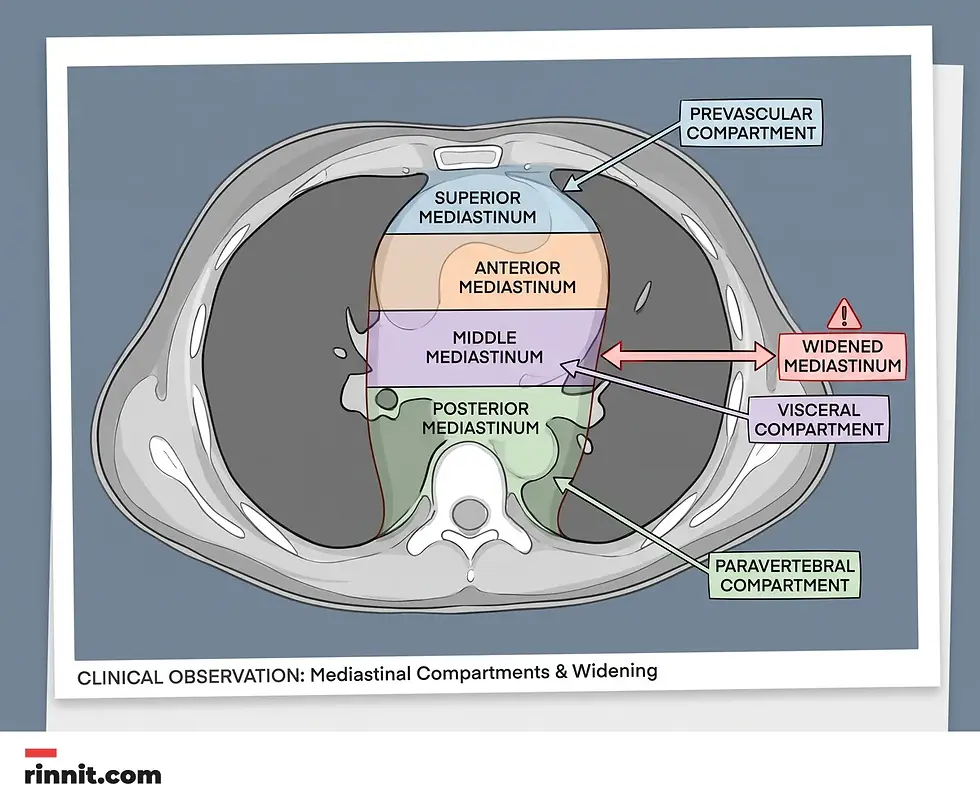
The three-compartment ITMIG model is now the international standard. A 2026 clinical practice review notes that the ITMIG model (prevascular, visceral, paravertebral) has replaced the traditional four-compartment system, yet the superior mediastinum is still worth considering separately because disease there is dominated by thyroid goiters and neurogenic tumors, and surgery in the narrow space is challenging. (Nakanishi, Mediastinum, 2026) [2]
CT and MRI each add something different. A review from MD Anderson explains that CT is widely available, fast and detects calcium, while MRI avoids radiation, shows tissue invasion better, and is superior to CT at separating cystic from solid lesions and thymic hyperplasia from thymic malignancy. (Archer et al., Mediastinum, 2023) [3]
Mediastinal width on X-ray helps flag aortic dissection, but the cut-off depends on the film. In a study of 100 patients with acute aortic dissection and 120 controls, a maximal mediastinal width of 7.45 cm on a standard back-to-front (PA) film gave 90% sensitivity and 88.3% specificity, while on a portable bedside (AP) film a width of 8.65 cm gave 72% sensitivity and 80% specificity. (Lai et al., Emerg Radiol, 2012) [4]
The mediastinum is a three-dimensional space located in the center of the chest, serving as the anatomical hub of the thoracic cavity. It is bounded by the breastbone (sternum) in the front, the spine in the back, and the lungs on either side [1]. This central region is essential for maintaining the careful balance and protection of the body’s most critical life-support systems.
Primary Structures and Organization
The mediastinum contains a dense concentration of organs, vessels, and tissues. These structures are organized into specific compartments, which are often classified using either a traditional four-part model or a modern three-part imaging model [1]. This organization allows for the efficient transport of materials throughout the body and provides a clear map for clinical evaluation. For a closer look at one of its passing structures, see our guide to the esophagus.
The Functional Role of the Mediastinum
Beyond simply holding organs in place, the mediastinum acts as a critical “railroad station” for the body. It provides a secure passageway for structures traveling between the neck and the belly [1]. For instance, the esophagus carries food through this space, while the trachea transports air to the lungs. The fatty and connective tissues within the mediastinum also provide essential cushioning [1], protecting the heart from external impact.

Clinical Significance and Conditions
The health of the mediastinum is vital, as it can be affected by primary tumors, cysts, and infections such as mediastinitis (see also pneumomediastinum and primary mediastinal large B-cell lymphoma). Other conditions that may affect it include aortic dissection, cardiac tamponade, esophageal cancer, goiter, lymphoma, myasthenia gravis and thoracic aortic aneurysm [1]. One common clinical sign is a “widened mediastinum,” identified via X-ray, which may indicate serious issues such as aortic dissection, cardiac tamponade, a mediastinal tumor, mediastinitis, a thoracic aortic aneurysm, or broken ribs or vertebrae [1]. Understanding the specific compartment where a condition originates helps healthcare teams determine the most effective treatment path.
Providers may check the mediastinum with a chest X-ray, CT scan, MRI scan, mediastinoscopy or ultrasound [1], depending on the symptoms or the issue being monitored.
Maintaining Thoracic Health
Protecting the mediastinum often involves managing the health of the organs it contains. A healthy lifestyle can help lower the risk of many conditions that affect it: avoid smoking and all tobacco products, eat a heart-healthy diet, exercise regularly, limit alcohol, take medications as prescribed, and visit your provider for yearly checkups [1]. Because the mediastinum is so central to bodily function, any symptoms involving the chest should be evaluated by a professional. Call 911 for sudden, severe chest or upper back pain, chest pressure, or trouble breathing, which can signal a heart attack or aortic dissection.

Conclusion
The mediastinum is much more than an empty space; it is a highly organized and protective environment for the body’s most vital organs. By serving as both a shield and a thoroughfare, it ensures that the heart, lungs, and digestive system can function in harmony. Recognizing the importance of this central compartment is the first step toward better understanding overall thoracic health.
Take Action Today
Monitor symptoms: if you experience persistent chest pain or difficulty breathing, seek a medical evaluation.
Support heart health: maintain a heart-healthy diet and exercise regularly, and avoid tobacco.
Keep up checkups: visit your provider for yearly checkups and take medications as prescribed.
Frequently Asked Questions
1. What exactly is the mediastinum?
The mediastinum is the middle section of the chest cavity located between the two lungs.
2. Where is the mediastinum located?
The mediastinum is found in the center of the chest, bounded by the sternum, spine, and diaphragm.
3. What is the most important organ in the mediastinum?
The heart is the most prominent organ housed within the mediastinum.
4. What are the "great vessels"?
The great vessels are the major blood vessels, such as the aorta and vena cava, that connect directly to the heart.
5. How is the mediastinum divided?
Traditionally it is divided into superior, anterior, middle, and posterior compartments; the modern ITMIG model uses three compartments (prevascular, visceral, and paravertebral).
6. What is the function of the thymus?
The thymus supports the immune system and is most active before a person reaches puberty.
7. Does the mediastinum help with breathing?
Yes, it contains the trachea, which is the primary windpipe for air transport.
8. What does a "widened mediastinum" mean?
A "widened mediastinum" means the space is at least 8 cm wide on an X-ray, which may require further medical investigation.
9. Can infections occur in the mediastinum?
Yes, a condition called mediastinitis is an infection or swelling of this central space.
10. What is the role of fatty tissue in the mediastinum?
Fatty tissue provides essential cushioning and protection for the heart and other structures.
11. Is the esophagus located in the mediastinum?
Yes, the esophagus passes through the visceral compartment as it travels to the stomach.
12. What is the ITMIG model?
The ITMIG model is a modern three-compartment classification system based on 3D imaging like CT scans.
13. Are there lymph nodes in the mediastinum?
Yes, the mediastinum contains numerous lymph nodes that support the body's immune response.
14. What separates the mediastinum from the belly?
The diaphragm is the muscular border that separates the thoracic and abdominal cavities.
15. Can cancer spread to the mediastinum?
Yes, cancers from other parts of the body can spread to the mediastinum, and infections that affect the whole body can also impact mediastinal tissues.
Related Reading
Mediastinoscopy: Why It's Done, Procedure, Recovery and Risks explains the procedure that samples lymph nodes between the lungs to stage cancer.
References
Cleveland Clinic. Mediastinum. Cleveland Clinic. Last updated August 29, 2022. https://my.clevelandclinic.org/health/body/24113-mediastinum
Nakanishi T. Classification of mediastinal compartments: is separation of the superior mediastinum crucial?-a clinical practice review. Mediastinum. 2026;10:7. PMID 41982606. https://doi.org/10.21037/med-2025-1-56
Archer JM, et al. Multimodality imaging of mediastinal masses and mimics. Mediastinum. 2023;7:27. PMID 37701642. https://doi.org/10.21037/med-22-53
Lai V, et al. Diagnostic accuracy of mediastinal width measurement on posteroanterior and anteroposterior chest radiographs in the depiction of acute nontraumatic thoracic aortic dissection. Emergency Radiology. 2012;19(4):309-315. PMID 22415593. https://doi.org/10.1007/s10140-012-1034-3
Medical disclaimer
The information provided in this article is for educational purposes only and is not intended as medical advice. Always consult with a qualified healthcare professional for the diagnosis and treatment of medical conditions.



Comments